
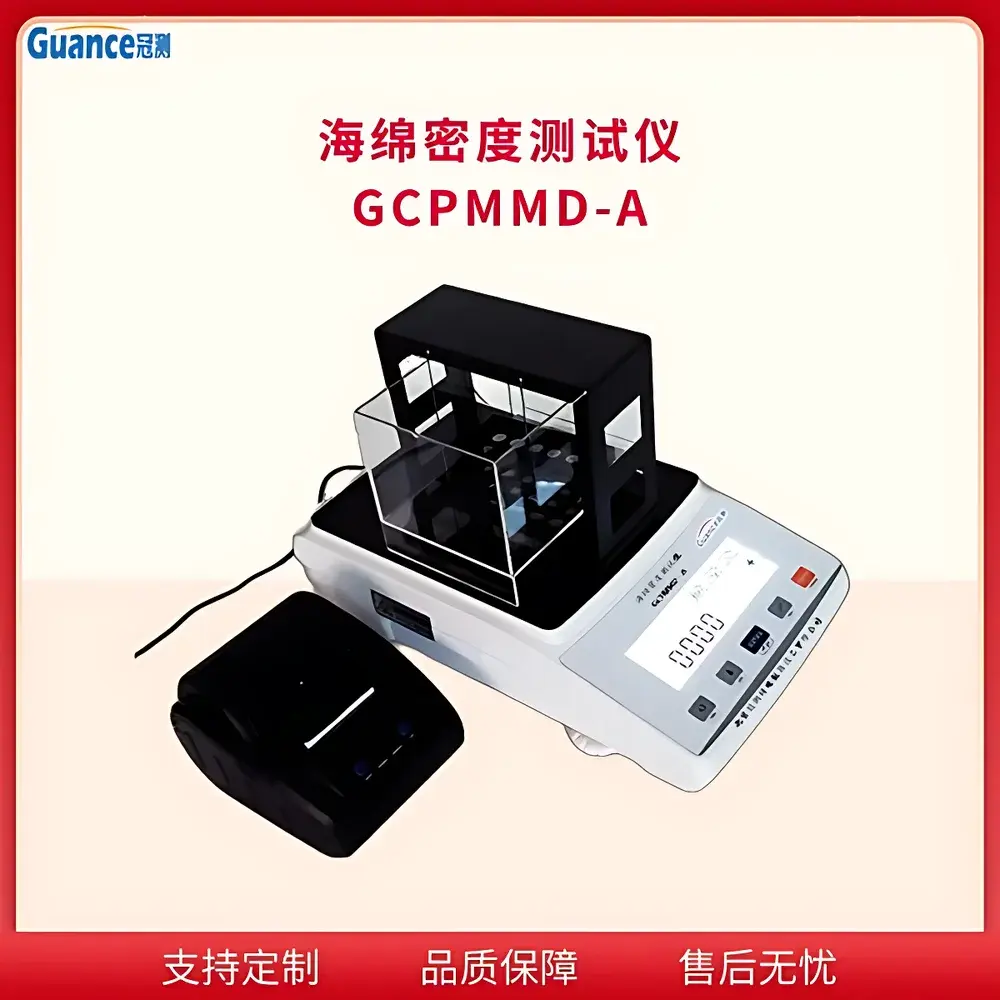
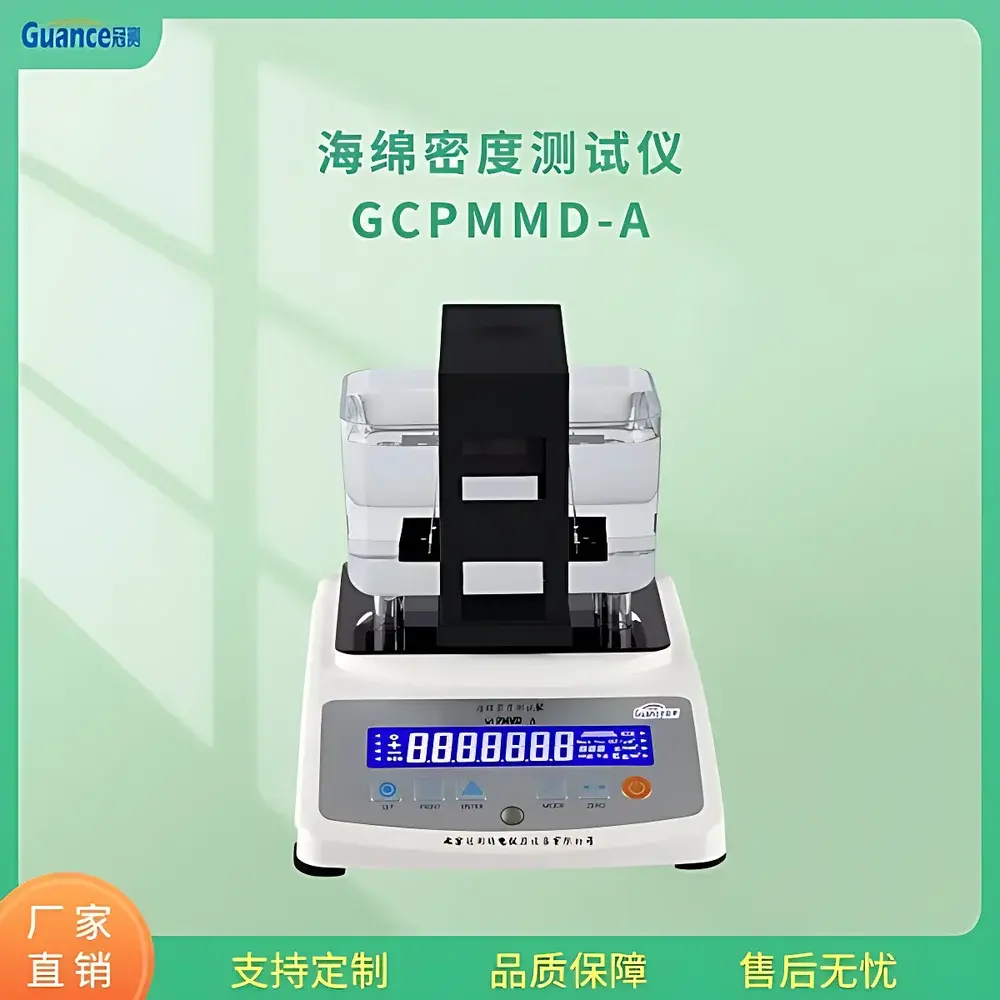
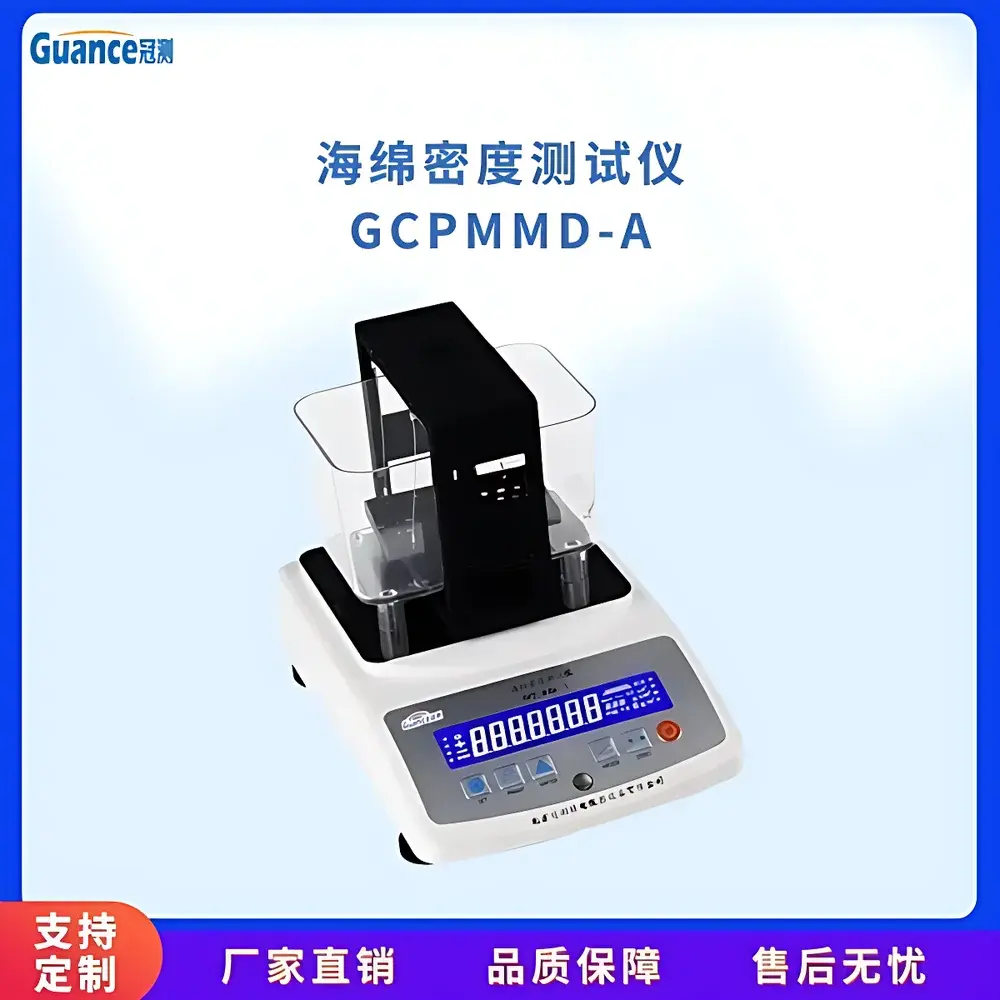
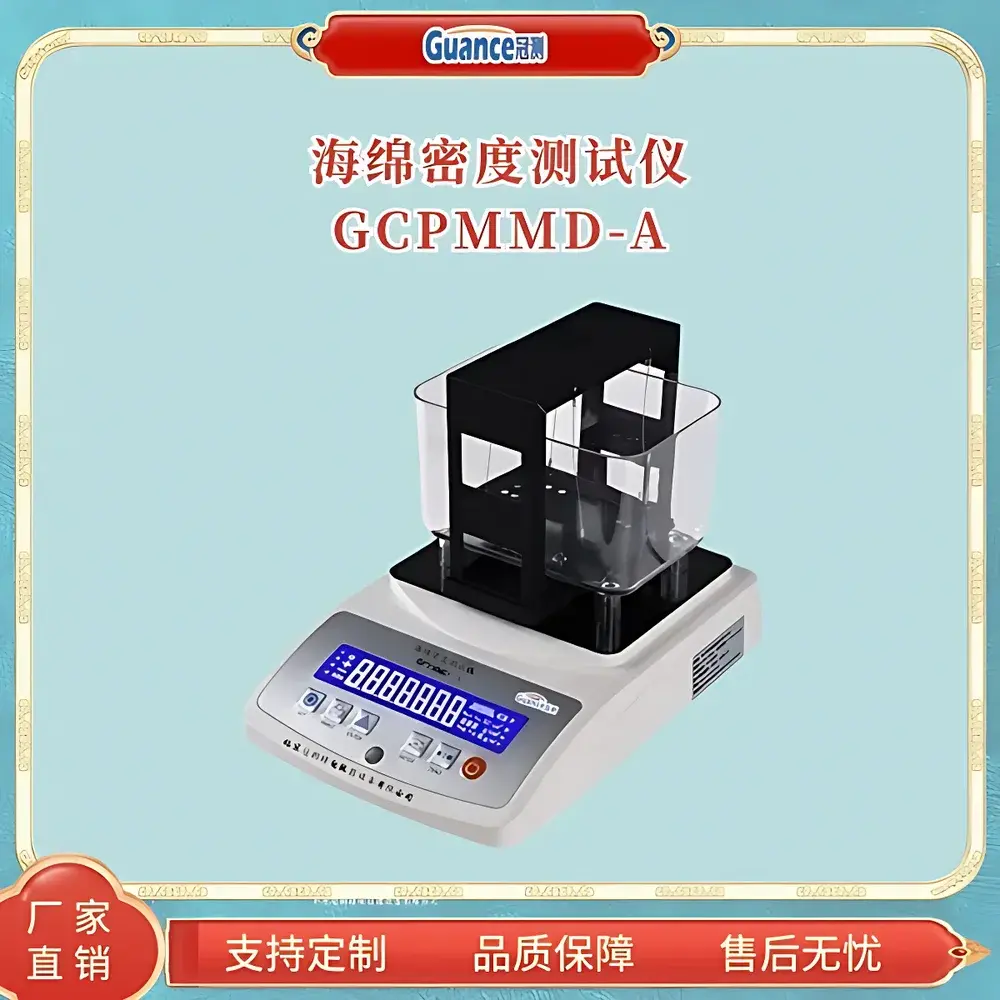
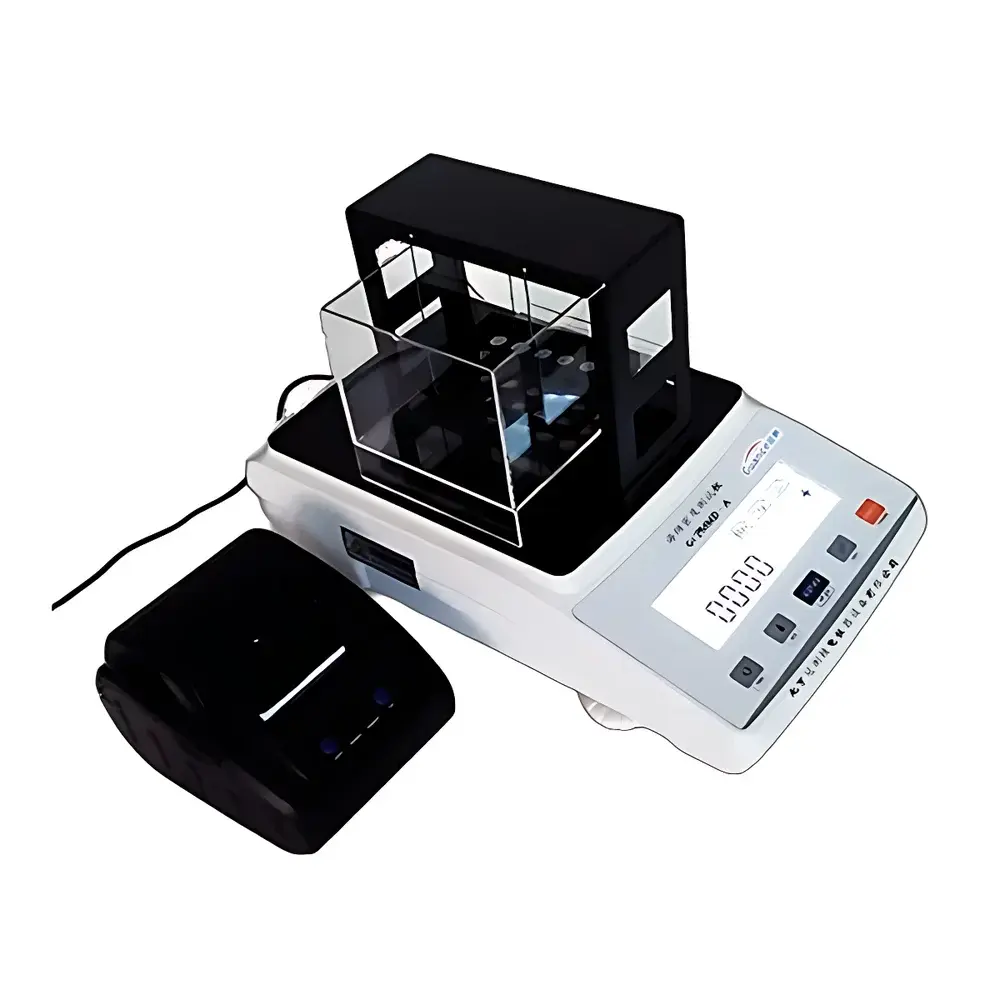
GuanCe GCPMMD-A Digital Direct-Reading Sponge Density Tester
| Brand | GuanCe Instruments |
|---|---|
| Origin | Beijing, China |
| Manufacturer Type | Authorized Distributor |
| Country of Origin | China |
| Model | GCPMMD-A |
| Price | USD 3,500 (FOB Beijing) |
| Application Field | General-purpose density measurement for porous polymeric materials |
| Instrument Type | Bulk Density Tester |
| Form Factor | Portable Benchtop Unit |
| Measurement Principle | Archimedean Buoyancy Method (Liquid Displacement) |
| Density Range | 0.001–2.000 g/cm³ |
| Density Resolution | 0.001 g/cm³ |
| Density Accuracy | ±0.01 g/cm³ |
| Maximum Sample Weight | 200 g |
| Minimum Sample Weight | 0.001 g |
| Repeatability | ±0.001 g/cm³ |
| Display | High-contrast LCD, direct numeric readout |
| Operating Temperature Range | 0–40 °C |
| Temperature Compensation | Adjustable (0–40 °C) |
| Data Interface | RS-232C compliant (PC & printer compatible) |
| Construction | Anodized aluminum chassis with corrosion-resistant water trough and stainless-steel measuring platform |
| Compliance Standards | ASTM D792, ASTM D297, ISO 2781, ISO 1183, GB/T 533, GB/T 1033, JIS K6530, DIN 53479 |
Overview
The GuanCe GCPMMD-A Digital Direct-Reading Sponge Density Tester is a precision benchtop instrument engineered for rapid, non-destructive density determination of open-cell and closed-cell polymeric foams—including polyurethane, polyester, latex, and memory foam—according to the Archimedean buoyancy principle. Unlike conventional pycnometers or gas pycnometers, this system employs liquid displacement in a calibrated aqueous medium to compute true volume and apparent mass, enabling direct calculation of bulk density (g/cm³) without iterative calibration curves or operator interpolation. Its design adheres to the physical metrology framework defined in ISO 1183-1 (Plastics — Methods for determining the density of non-cellular plastics) and ISO 2781 (Rubber — Determination of density), while maintaining full compatibility with ASTM D792 (Standard Test Methods for Density and Specific Gravity of Plastics by Displacement) and GB/T 1033.1–2008 (Plastics — Methods for determining the density of plastics — Part 1: Immersion method, liquid pyknometer method and titration method). The instrument operates under ambient laboratory conditions (0–40 °C), with built-in temperature compensation to correct for thermal expansion of the immersion fluid, ensuring traceable measurements across variable environmental conditions.
Key Features
- Direct digital readout of density (g/cm³) and sample volume (cm³) on high-contrast LCD display—no manual calculation required.
- High-resolution weighing module with 0.001 g minimum readability and 200 g maximum capacity, certified per OIML R76 Class II specifications.
- Dual-mode operation: supports both sink-and-weigh (for ρ > 1 g/cm³) and sink-and-suspend (using anti-buoyancy fixture for ρ < 1 g/cm³) configurations.
- Integrated large-capacity transparent acrylic water trough (220 × 150 × 120 mm) accommodating irregular or oversized sponge blocks up to 180 mm in length.
- Modular accessory set includes stainless-steel sample platform, anti-floating frame, granular sample basket, precision 100 g calibration weight, tweezers, and universal power adapter.
- RS-232C serial interface enables automated data logging into LIMS or Excel via terminal emulation software; supports GLP-compliant timestamped output with unit identification.
- Anodized aluminum housing provides mechanical rigidity, ESD protection, and resistance to moisture ingress—eliminating sensor contamination risks common in plastic-bodied alternatives.
Sample Compatibility & Compliance
The GCPMMD-A is validated for use with all standard commercial and industrial sponge types, including reticulated foams, viscoelastic memory foams, flame-retardant polyether/polyester blends, and recycled foam composites. It accommodates solid geometries ranging from irregular cut pieces (≥0.001 g) to monolithic slabs (≤200 g), provided surface porosity permits complete wetting and air evacuation during immersion. The system meets essential requirements for quality control laboratories operating under ISO/IEC 17025:2017 accreditation, supporting documented traceability to NIST-traceable mass standards. All measurement protocols align with FDA-recommended practices for material characterization in medical device manufacturing (21 CFR Part 820), and support audit-ready documentation for GMP environments where density serves as a critical process parameter (e.g., cushioning performance validation in orthopedic padding or packaging inserts).
Software & Data Management
While the GCPMMD-A operates autonomously via front-panel controls, its RS-232C port delivers ASCII-formatted output at 9600 baud, comprising: instrument ID, date/time stamp, sample mass (g), immersed mass (g), calculated density (g/cm³), temperature (°C), and operator code. Third-party software—including LabVIEW drivers, custom Python scripts (pySerial), and industry-standard QC platforms such as NetSuite Quality Management or SPC XL—can ingest this stream for real-time SPC charting, batch trending, and CAPA linkage. The instrument firmware stores no internal history; all records reside externally, satisfying 21 CFR Part 11 requirements for electronic record integrity when paired with appropriate access controls and audit trail configuration.
Applications
- Raw material acceptance testing of polyol/isocyanate pre-blends prior to foam casting.
- In-process verification of density uniformity across foam buns (±0.005 g/cm³ tolerance).
- Final product inspection of automotive seat cushions, mattress cores, and acoustic insulation panels.
- R&D evaluation of density gradients in gradient-density memory foams.
- Regulatory submission support for ISO 13485-certified medical foam components (e.g., wound contact layers, prosthetic liners).
- Supplier qualification audits requiring repeatable, inter-laboratory comparable results per ISO 5725.
FAQ
Does the GCPMMD-A require calibration with certified reference standards?
Yes—initial calibration must be performed using NIST-traceable stainless-steel weights (100 g and 200 g) and a certified density standard (e.g., fused quartz sphere, ρ = 2.203 g/cm³). Daily zero-point verification is recommended.
Can it measure density of water-absorbing foams without surface sealing?
Yes—the instrument includes a timed immersion protocol (default 60 s) aligned with ASTM D792 Annex A1 for hygroscopic materials; optional vacuum-assisted saturation fixtures are available upon request.
Is temperature compensation applied automatically or manually?
Temperature compensation is user-configurable: either input measured bath temperature manually or connect an optional Pt100 probe (sold separately) for real-time auto-compensation.
What maintenance intervals are recommended for long-term accuracy?
We recommend quarterly verification of weighing cell linearity and annual recalibration of the density algorithm against primary standards by an ISO/IEC 17025-accredited service provider.
Is the water trough resistant to organic solvents used in specialty foam cleaning?
The standard acrylic trough is rated for aqueous solutions only; for solvent-based immersion (e.g., ethanol, acetone), optional borosilicate glass troughs are available (Order Code: GCPMMD-A-GT).



