
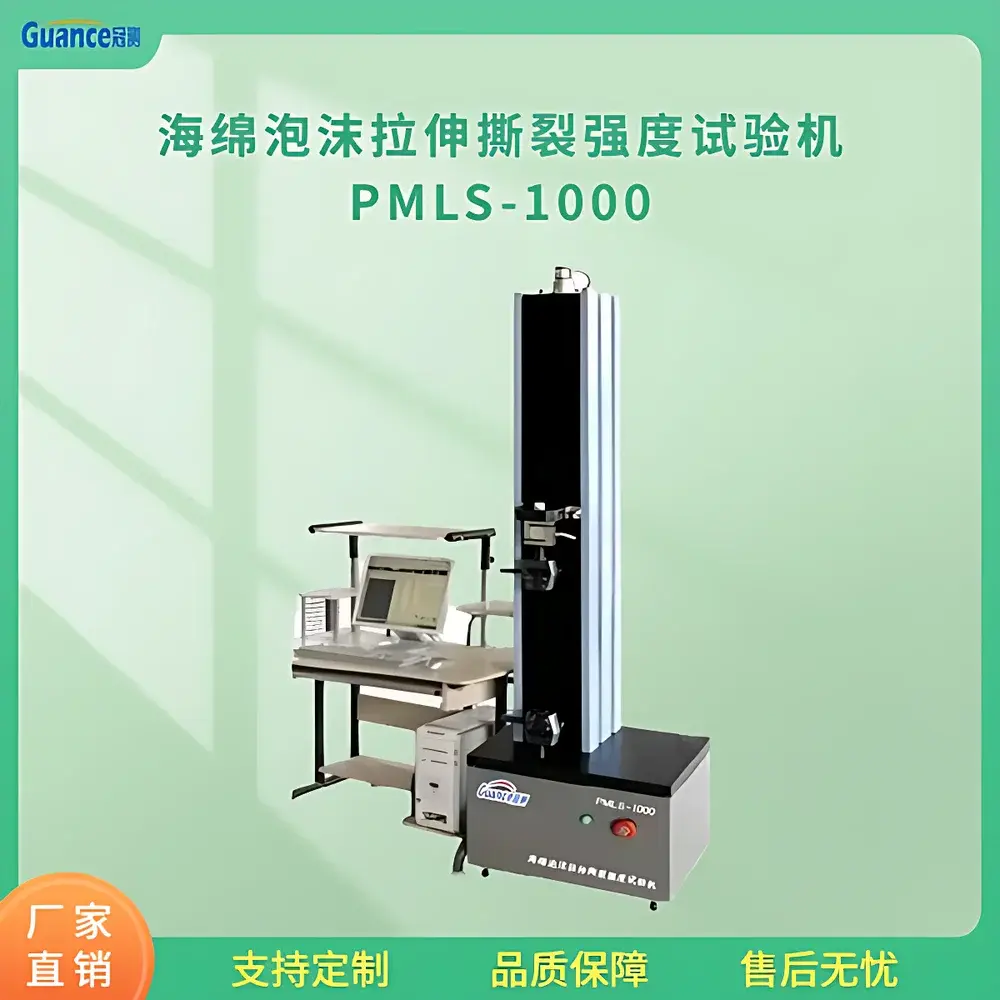
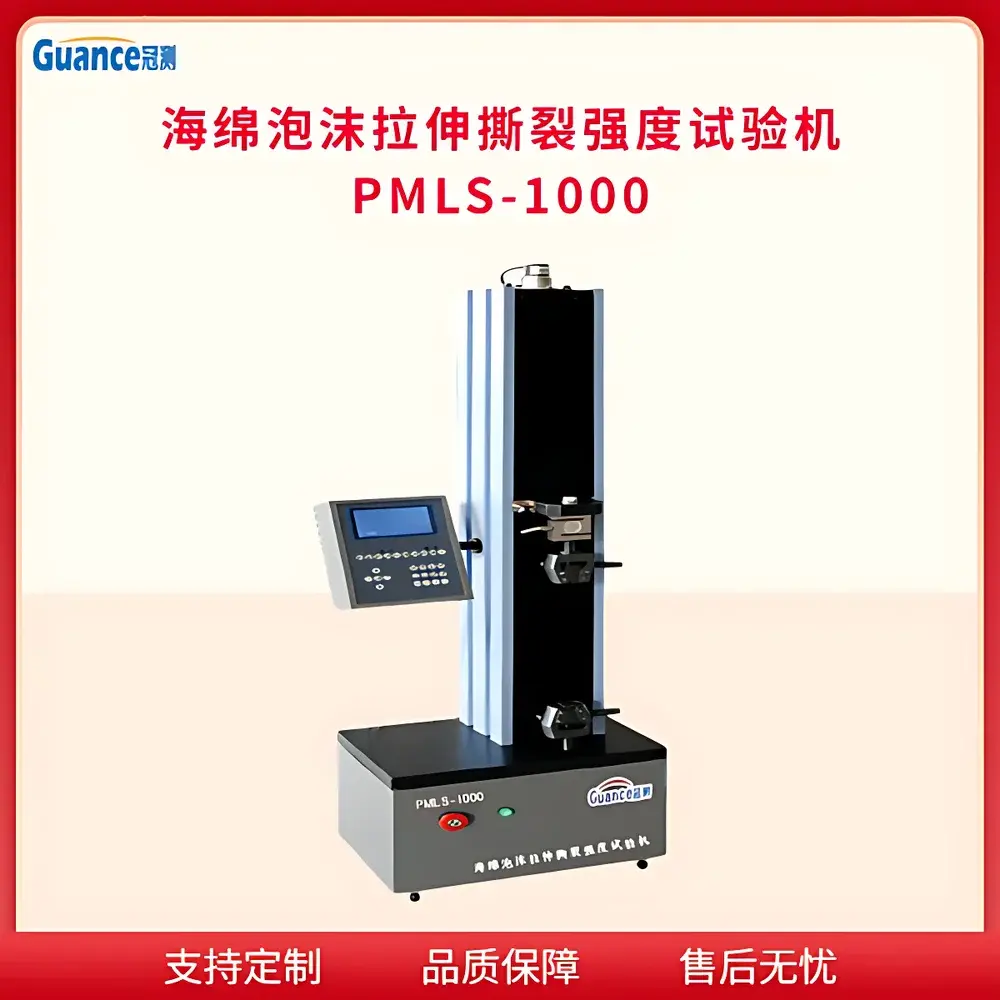
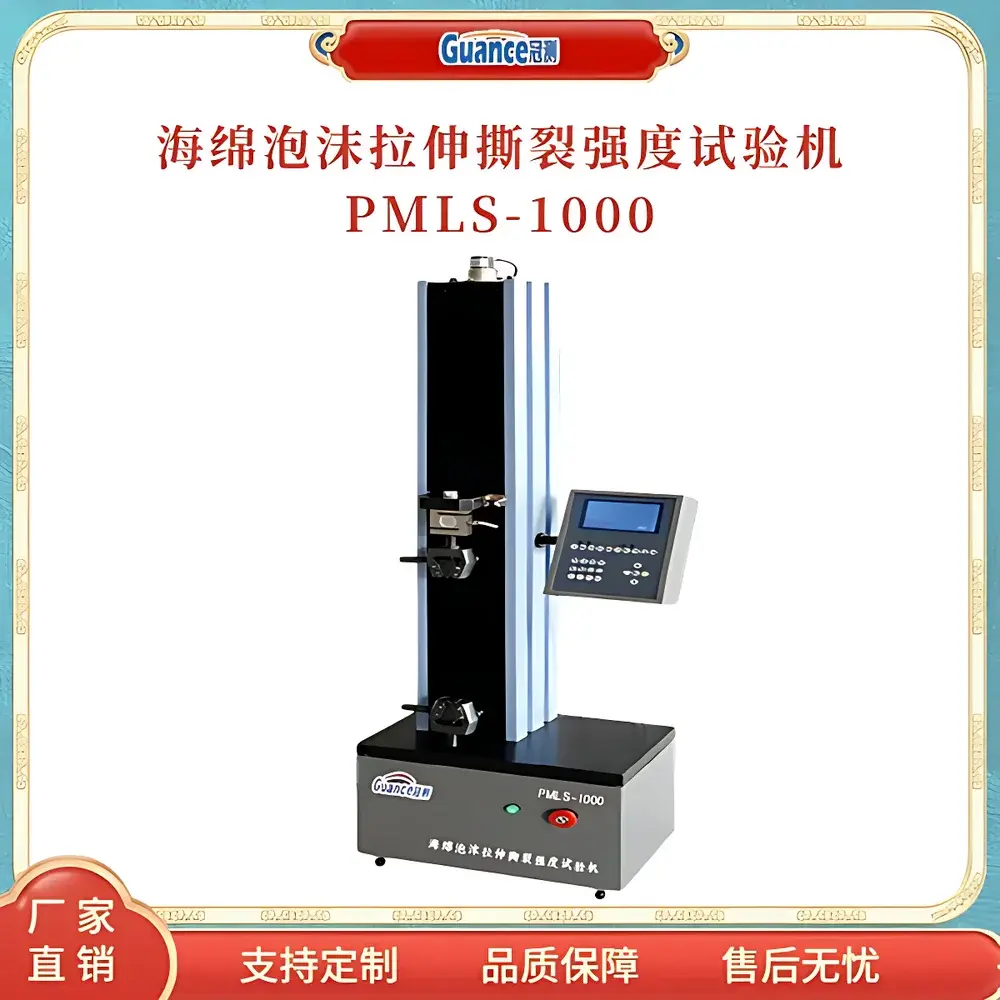
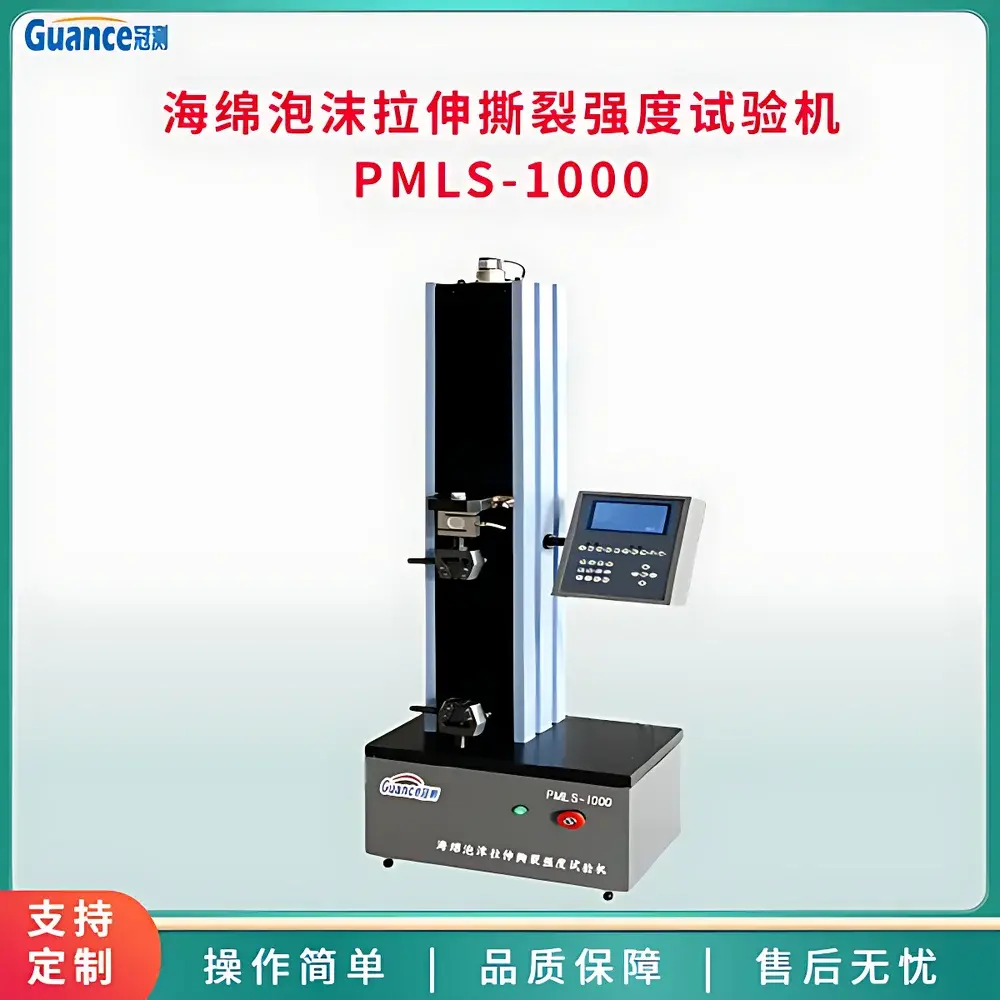
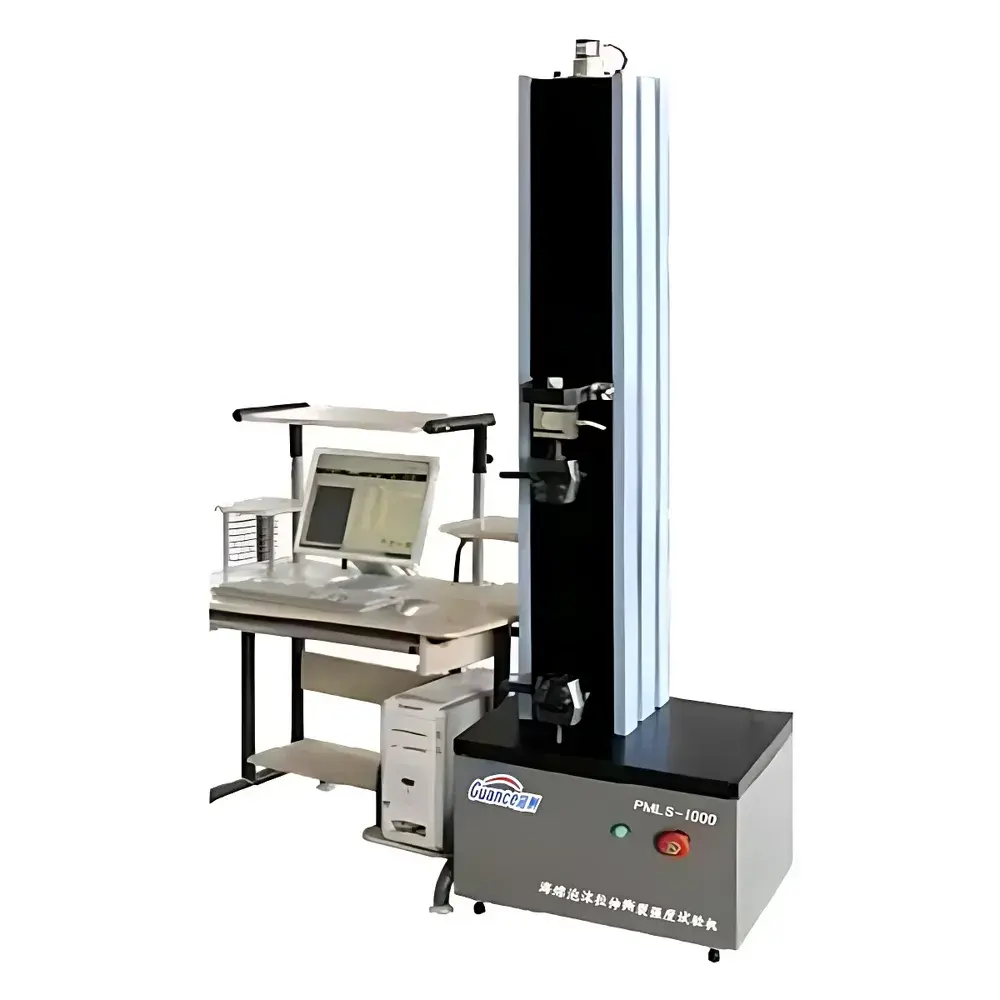
GuanCe Instruments PMLS1000.3 Sponge Tensile & Tear Strength Tester
| Brand | GuanCe Instruments |
|---|---|
| Origin | Beijing, China |
| Manufacturer Type | Authorized Distributor |
| Regional Classification | Domestic (PRC) |
| Model | PMLS1000.3 |
| Price | USD 2,200 (approx.) |
Overview
The GuanCe Instruments PMLS1000.3 Sponge Tensile & Tear Strength Tester is a single-column universal testing system engineered for precise mechanical characterization of flexible polymeric foam materials—specifically soft sponge, elastomeric foams, and porous elastic polymers. It operates on the principle of uniaxial tensile loading and controlled tear propagation, conforming to internationally harmonized test methodologies including ISO 1798:1997 (Flexible cellular polymeric materials — Determination of tensile strength and elongation at break), GB/T 6344–2008 (Determination of tensile strength and elongation at break for flexible cellular polymeric materials), and GB/T 10808–2006 (Determination of tear strength for polymer porous elastic materials). The instrument employs a fully digital AC servo motor coupled with a high-precision timing belt reduction system and a ground precision ball screw assembly to ensure smooth, low-noise force application and sub-millimeter positional repeatability. Its modular architecture supports both tensile and tear mode configurations using standardized fixtures, enabling direct correlation with ASTM D3574 (Standard Test Methods for Flexible Cellular Materials — Slab, Bonded, and Molded Urethane Foams) Annexes B (Tensile Strength) and C (Tear Strength).
Key Features
- Single-column rigid frame design with integrated load cell and optical encoder for high-fidelity force and displacement feedback
- Digital servo drive system offering continuous speed control from 0.05 mm/min to 300 mm/min, with speed switching capability at three pre-programmed points during active testing
- High-resolution LCD interface with Chinese/English bilingual menu navigation and real-time graphical display of load vs. displacement curves
- Auto-stop function triggered upon specimen rupture, coupled with automatic return-to-initial-position functionality post-test
- Dual-limit protection: programmable software-based stroke limits and mechanical hard-stop safeguards prevent overtravel and system damage
- Overload protection set at 103–105% of full-scale capacity (1000 N), initiating immediate shutdown to preserve sensor integrity
- Integrated thermal-printer module for on-demand hardcopy output of test parameters, peak load, elongation at break, and tear resistance values
Sample Compatibility & Compliance
The PMLS1000.3 is validated for use with low-density open-cell and closed-cell flexible foams, including polyurethane (PU), polyethylene (PE), and ethylene-vinyl acetate (EVA) sponges. Specimen geometries follow ISO 1798 standard dumbbell-shaped tensile strips (Type 1 or Type 2) and ASTM D3574 tear specimens (Trouser or Rectangular). The system supports compliance documentation workflows required under GLP (Good Laboratory Practice) environments, including timestamped test logs, operator ID tagging, and non-editable result archives. While not certified to FDA 21 CFR Part 11 out-of-the-box, its data export functions (CSV/Excel-compatible) support traceability integration into validated LIMS or QMS platforms used in packaging R&D and quality assurance labs.
Software & Data Management
The embedded firmware provides local data acquisition without external PC dependency. All test records—including raw load-displacement time series, calculated metrics (tensile strength in kPa, elongation at break in %, tear strength in N/mm), and pass/fail flags—are stored internally with date/time stamps and user-defined batch IDs. Export is supported via USB port to removable flash drives. For enterprise deployment, optional RS-232 or Ethernet connectivity modules (sold separately) enable remote monitoring and centralized database synchronization. Calibration coefficients are digitally secured and require password-protected access, supporting audit-ready calibration history tracking per ISO/IEC 17025 requirements.
Applications
- Quality control of automotive interior foam components (seat cushions, headrests, door panels)
- R&D evaluation of biodegradable sponge alternatives for sustainable packaging applications
- Batch release testing of medical-grade foam dressings and wound-contact layers
- Validation of compression-set resistance and recovery behavior in cushioning materials
- Comparative tear propagation analysis across foam densities, crosslinking agents, and blowing agent formulations
- Supplier qualification per OEM specifications requiring conformance to GB/T 10808 or ISO 1798 tear thresholds
FAQ
What standards does the PMLS1000.3 directly support?
It complies with ISO 1798:1997, GB/T 6344–2008, GB/T 10808–2006, and aligns with relevant sections of ASTM D3574.
Is the system compatible with third-party data analysis software?
Yes—raw CSV exports contain time-stamped force and displacement columns, enabling import into MATLAB, OriginLab, or Minitab for advanced statistical modeling.
Can the instrument be upgraded for compression or cyclic fatigue testing?
No—the PMLS1000.3 is purpose-built for static tensile and tear testing; dynamic or compression modules require separate instrumentation.
What maintenance is required for long-term accuracy?
Annual recalibration of the load cell and encoder is recommended; routine cleaning of the screw thread and lubrication of the guide rails every 6 months ensures mechanical fidelity.
Does the system meet CE or UL safety certification requirements?
As a domestically certified PRC-manufactured device, it carries CCC marking; CE/UL compliance requires additional regional conformity assessment and is not included in base configuration.




