
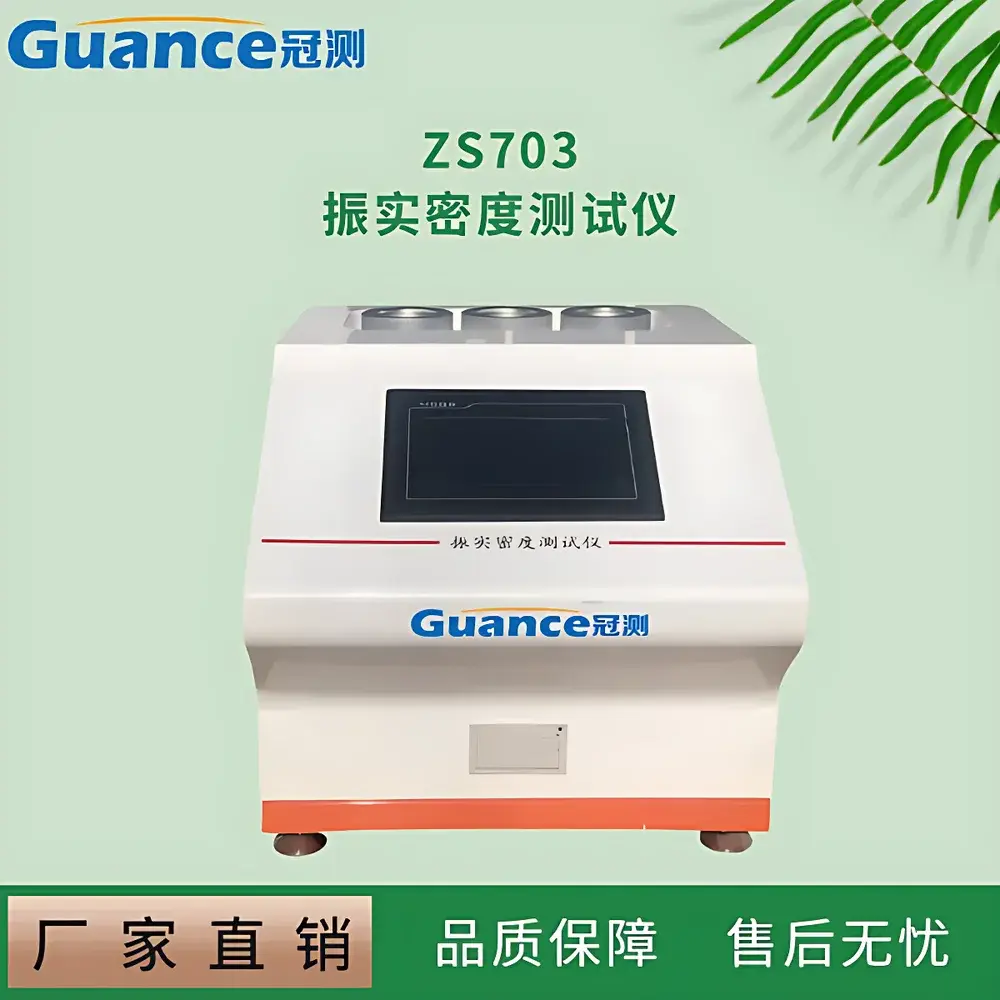
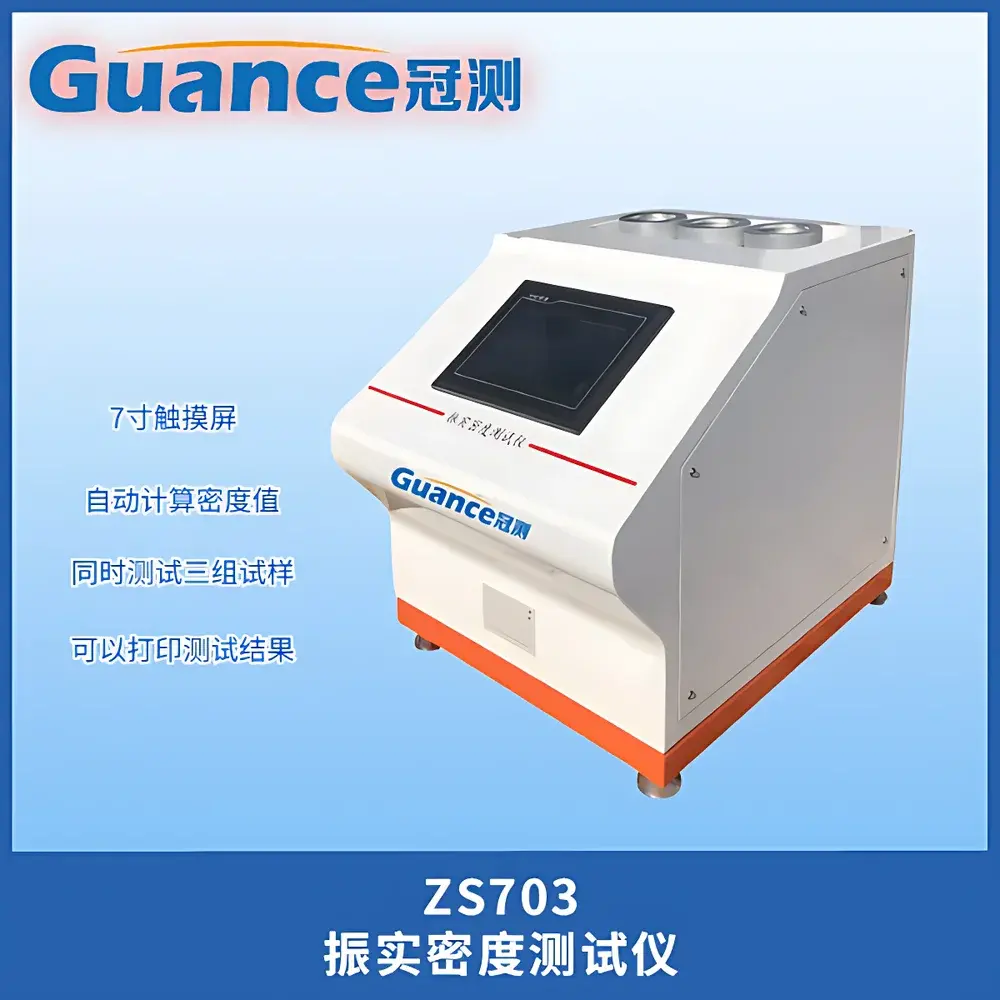
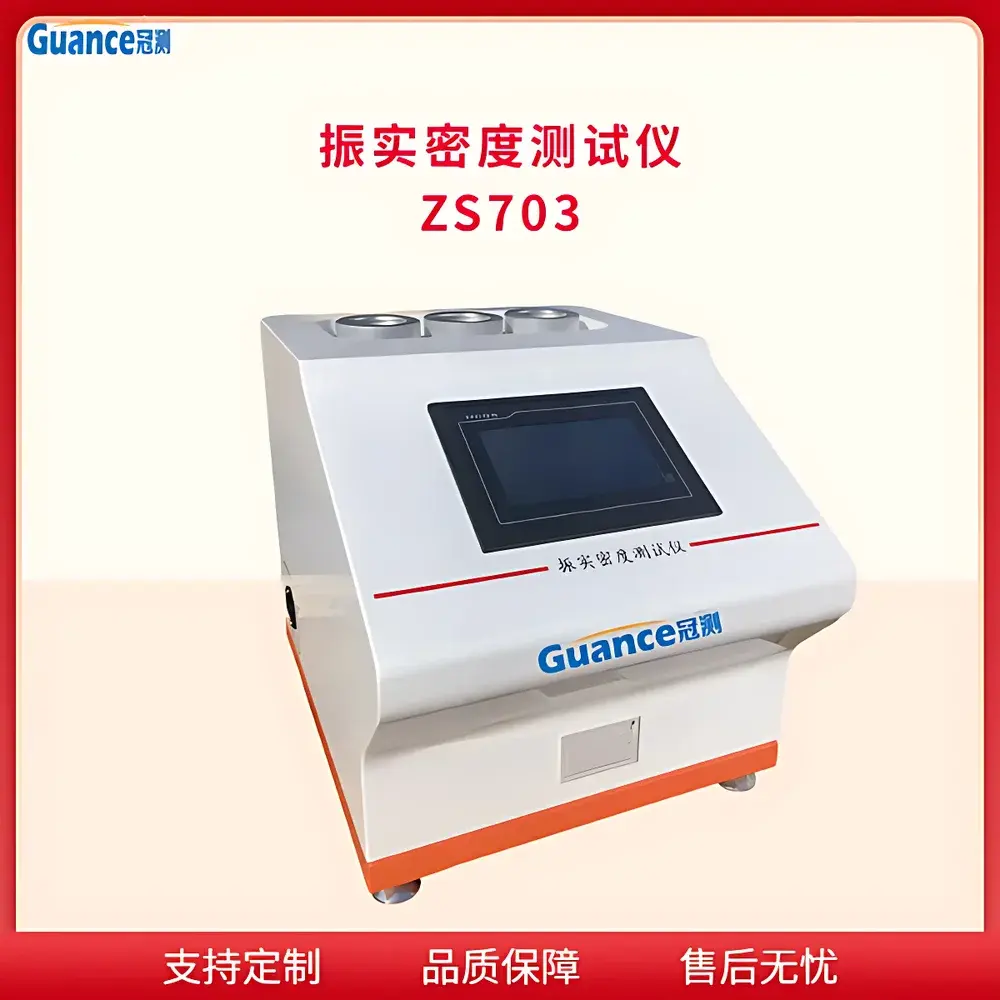
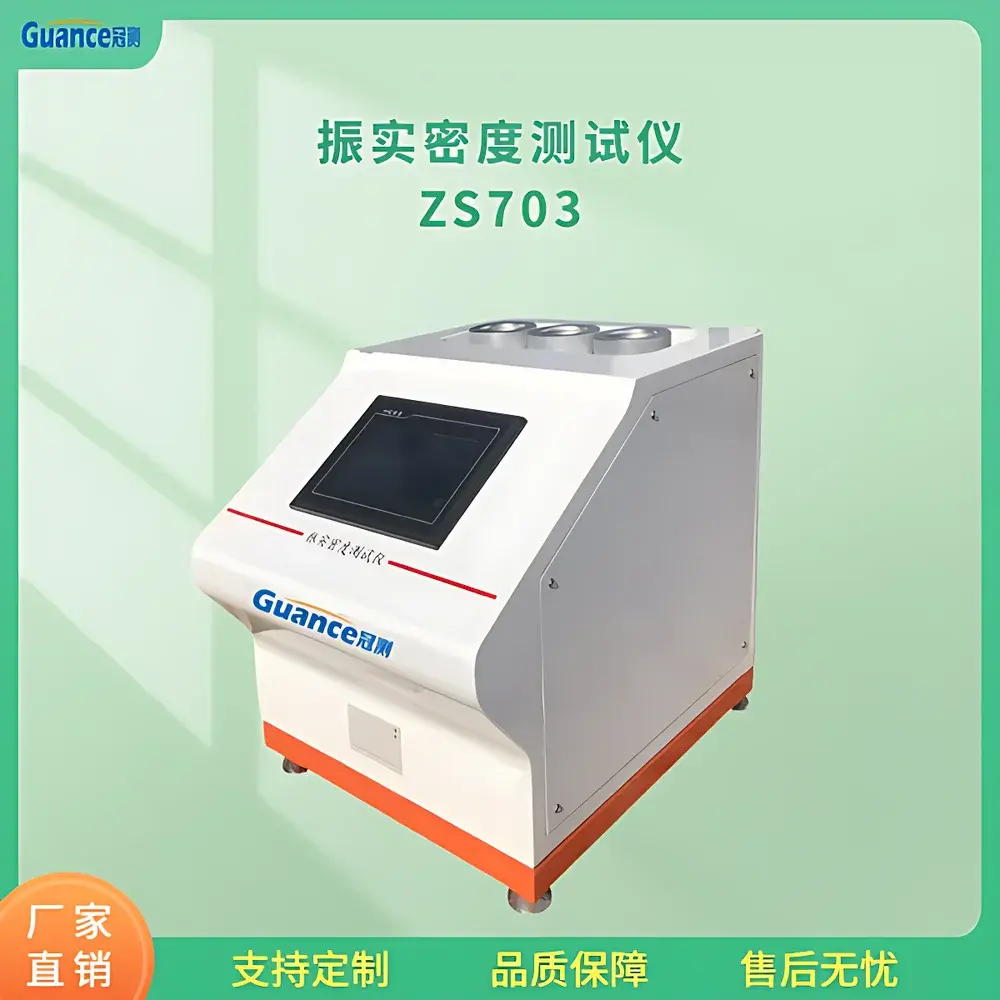
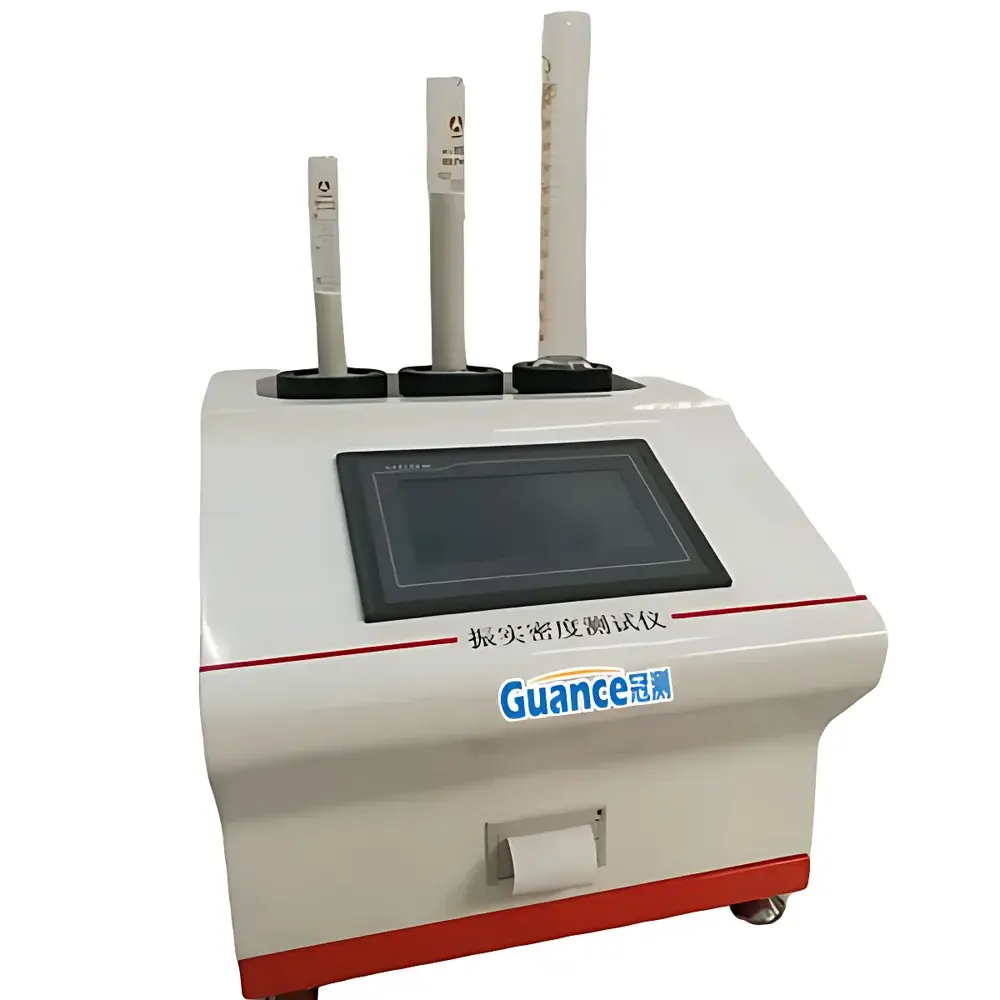
GuanCe Instruments ZS703a Tap Density Tester
| Brand | GuanCe Instruments |
|---|---|
| Origin | Beijing, China |
| Model | ZS703a |
| Instrument Type | Tap Density Tester |
| Application | Powder Bulk Density Measurement |
| Compliance | GB/T 5162–2006 / ISO 3953:1993 |
| Maximum Sample Weight | 500.00 g |
| Maximum Sample Volume | 250.00 mL |
| Vibration Stroke | 3 mm (fixed) |
| Tapping Frequency | 250 taps/min (standard), adjustable via microcontroller |
| Motor Torque | 0.86 N·m |
| Power Supply | AC 220 V, 50 Hz |
| Rated Power | 100 W |
| Display | LED digital display (4-digit weight + 3-digit tap count) |
| Repeatability | ≤±0.5% RSD (n=10, standard reference powder) |
| Construction | Stainless steel sample cup holder, aluminum alloy frame, ESD-safe enclosure |
Overview
The GuanCe Instruments ZS703a Tap Density Tester is a precision-engineered instrument designed for the standardized determination of tap density (also known as tapped density or settled density) of free-flowing powders and granular solids. It operates on the principle of controlled mechanical tapping—repeated vertical displacement of a calibrated sample container under defined stroke length (3 mm) and frequency (250 taps per minute)—to progressively reduce interparticulate void volume until density stabilization. This method directly implements the gravimetric volumetric protocol specified in ISO 3953:1993 and its national adoption GB/T 5162–2006, which are internationally recognized standards for metal powders and extendable to pharmaceutical excipients, battery cathode/anode materials, catalysts, food powders, and ceramic precursors. Unlike true density analyzers (e.g., gas pycnometers), the ZS703a measures *bulk density after mechanical consolidation*, providing critical data for powder flowability assessment, die-filling uniformity prediction, and bulk handling system design.
Key Features
- Microprocessor-controlled tapping mechanism with precise frequency regulation (250 ± 2 taps/min) and fixed 3 mm stroke—ensuring strict adherence to ISO 3953:1993 timing and motion parameters.
- Dual-range digital weighing interface integrated into the base unit: high-resolution readout (0.01 g) up to 500.00 g maximum capacity, synchronized with real-time tap counting (0–14,750 cycles).
- Stainless steel sample cup retention system with quick-lock alignment, minimizing operator-induced variability during cup insertion and removal.
- ESD-safe housing and grounded chassis—essential for handling electrostatic-sensitive powders such as lithium cobalt oxide (LiCoO₂) or micronized APIs.
- No external balance required: built-in load cell and calibration routine compliant with OIML R76-1 Class III accuracy requirements for laboratory mass measurement.
- Low thermal drift design: aluminum alloy frame with passive heat dissipation ensures stable operation during extended test sequences (e.g., multi-step tap protocols per USP <616>).
Sample Compatibility & Compliance
The ZS703a accommodates cylindrical sample cups conforming to ISO 3953 dimensions (internal diameter 25.0 ± 0.1 mm, height ≥ 100 mm), supporting volumes up to 250.00 mL. It is validated for use with powders exhibiting particle sizes from 1 µm to 2 mm, including cohesive, slightly adhesive, and free-flowing materials. The instrument satisfies regulatory documentation requirements for GLP and GMP environments: all tap counts, final mass, and calculated density values are manually recorded per test, and the device’s mechanical consistency enables full traceability under FDA 21 CFR Part 11 when paired with lab notebook SOPs. While not an automated data-logging system, its deterministic tapping profile meets the reproducibility thresholds mandated by ASTM D4781 (for carbon black) and ISO 787-11 (for pigments).
Software & Data Management
The ZS703a operates as a standalone electromechanical tester with no embedded firmware or network connectivity. Density calculation follows the fundamental equation: ρtap = m / V, where m is the measured mass (g) and V is the calibrated cup volume (mL). Users perform manual entry of V (pre-determined via cup calibration with mercury or certified glass spheres) and compute results using internal calculators or external spreadsheets. For quality systems requiring audit trails, laboratories integrate the ZS703a into validated paper-based or electronic lab notebook (ELN) workflows—documenting operator ID, ambient temperature/humidity, cup serial number, initial/final mass, total tap count, and observed settling behavior (e.g., “no further volume change after 500 taps”). Calibration certificates for the internal load cell and cup volume are retained per ISO/IEC 17025 requirements.
Applications
- Pharmaceutical development: Quantifying tap density of active pharmaceutical ingredients (APIs) and excipients to predict compressibility and tablet weight variation (per ICH Q5C and USP <1174>).
- Battery materials characterization: Evaluating cathode powder (e.g., NMC, LFP) packing density for electrode slurry formulation and calendering process optimization.
- Metal additive manufacturing: Verifying feedstock powder consistency per ASTM F3049 specifications prior to laser powder bed fusion (LPBF) processing.
- Food & nutraceuticals: Assessing flow and dispersion behavior of powdered vitamins, milk replacers, and instant beverage mixes.
- Quality control labs: Routine batch release testing against internal specifications derived from ISO 3953-compliant baselines.
FAQ
Does the ZS703a comply with USP <616> for tap density testing?
Yes—the mechanical tapping parameters (stroke, frequency, and cup geometry) align with the operational definitions in USP <616>, though USP does not mandate specific instrumentation. Validation must be performed per site-specific IQ/OQ protocols.
Can the instrument be used for cohesive or nanoscale powders?
It is suitable for moderately cohesive powders; however, highly agglomerated or <100 nm nanoparticles may require surface treatment or humidity control prior to testing to achieve reproducible tap curves.
Is cup volume calibration included with the instrument?
No—users must perform initial and periodic cup volume verification using traceable reference standards (e.g., certified glass beads or mercury pycnometry), documented per ISO 17025.
What maintenance is required for long-term accuracy?
Annual load cell recalibration by an accredited metrology lab and biannual inspection of cam follower wear and motor torque stability (0.86 N·m nominal) are recommended.
How is repeatability verified during daily use?
By running three replicate measurements on a certified reference powder (e.g., NIST SRM 1950) and calculating relative standard deviation (RSD); acceptance criterion is ≤0.5% RSD per GB/T 5162–2006 Annex B.



