
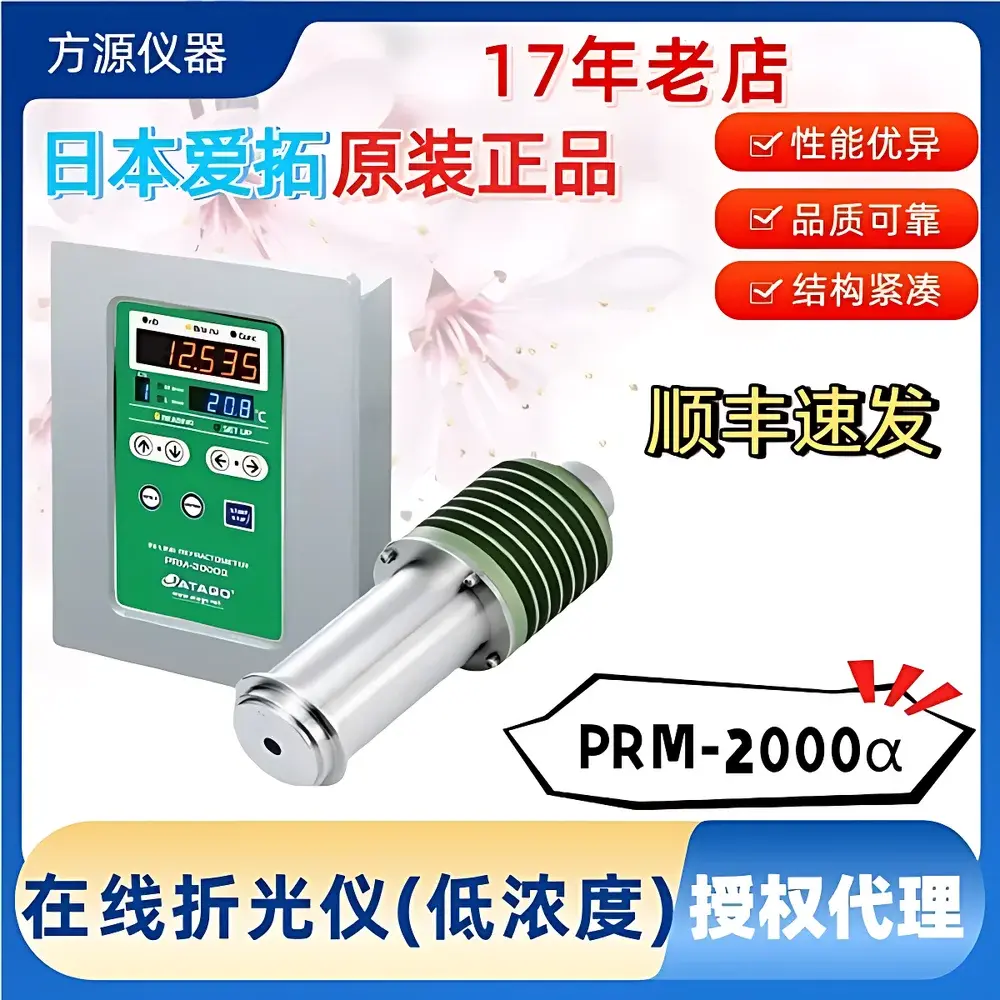
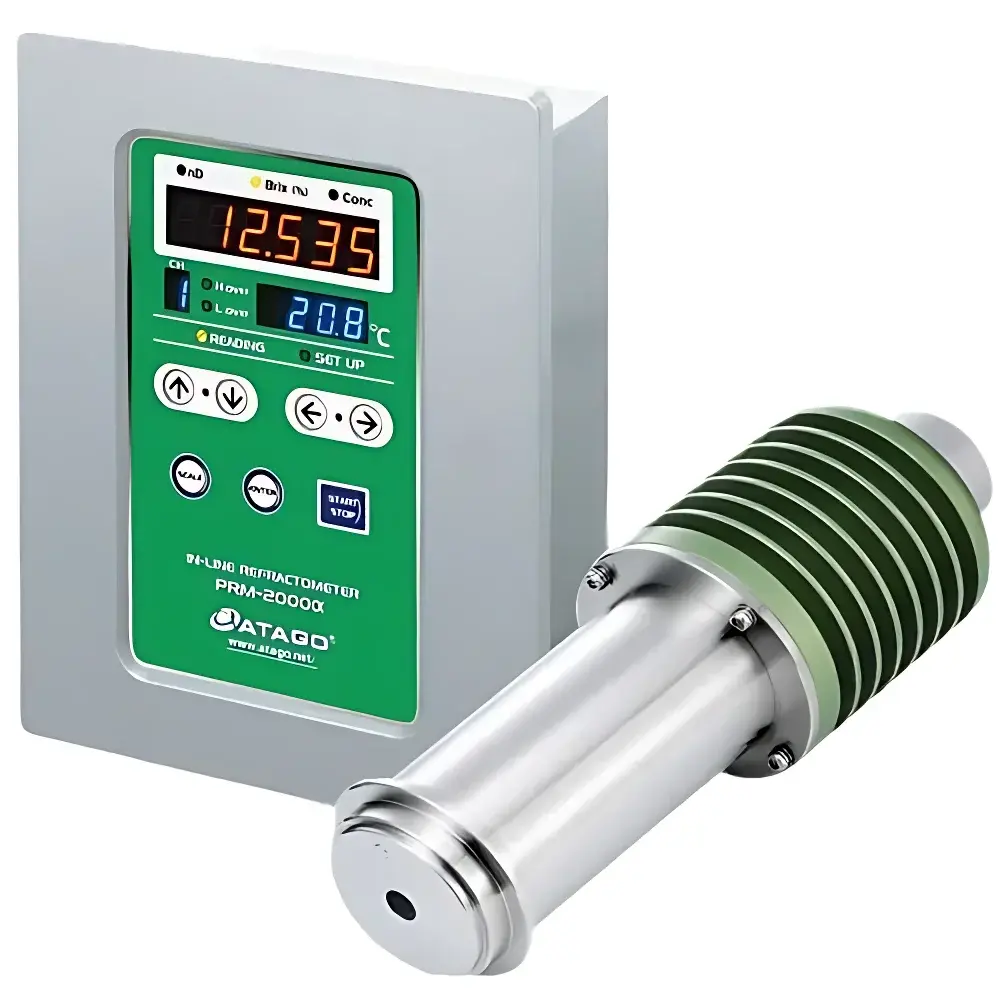
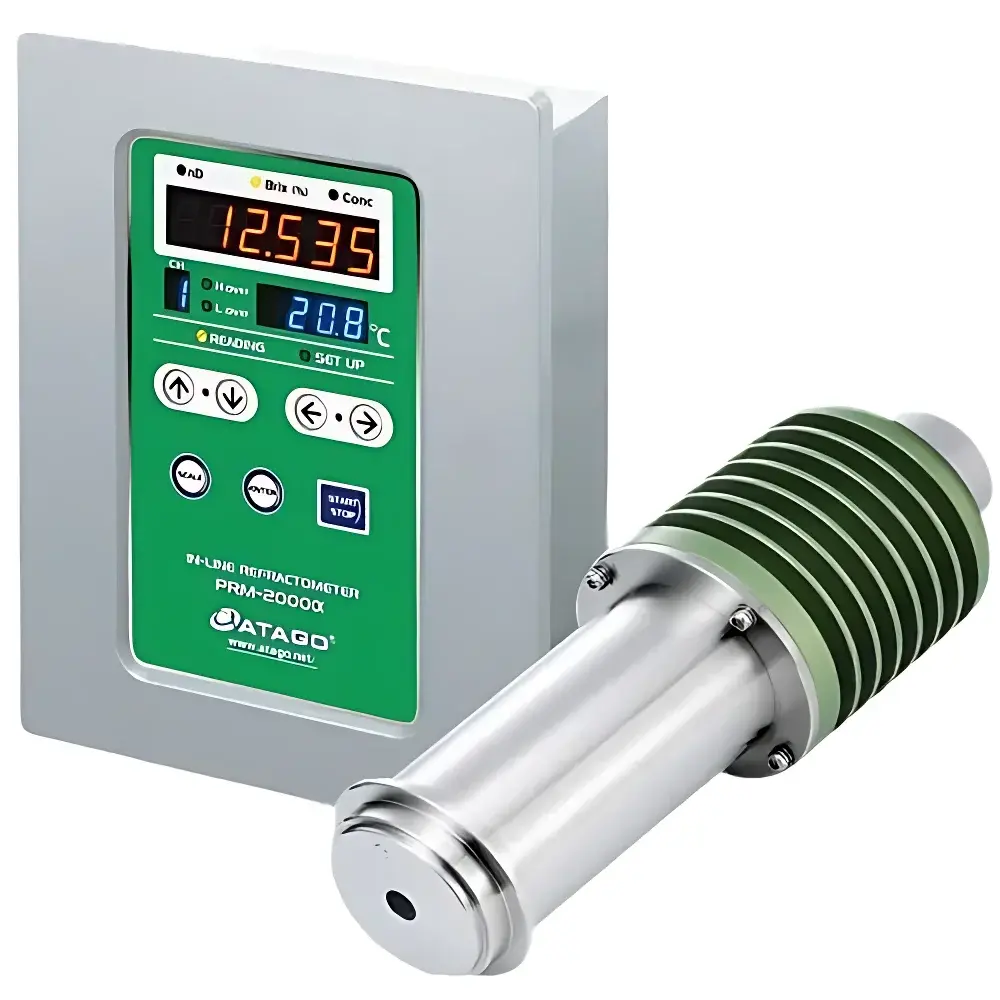
ATAGO PRM-2000α In-line Refractometer for Low-Brix Applications
| Brand | ATAGO |
|---|---|
| Origin | Japan |
| Model | PRM-2000α |
| Refractive Index (nD) Range | 1.32069–1.36500 |
| Resolution | nD: 0.00001 |
| Accuracy | ±0.00001 (1.32069–1.33681), ±0.00010 (1.33682–1.36500) |
| Temperature Display Range | −35.0 to 165.0 °C |
| Brix Range | 0.000–20.000 % |
| Brix Accuracy | ±0.007 % (0.000–2.000 %), ±0.050 % (2.001–20.000 %) |
| Output | 4–20 mA, RS-232C |
| IP Rating | IP67 |
| Pressure Rating | 1.0 MPa |
| Prism Material | Sapphire |
| Wetted Parts | SUS316L |
| Light Source | LED (≈589 nm, D-line equivalent) |
Overview
The ATAGO PRM-2000α is a high-precision, industrial-grade in-line refractometer engineered for continuous, real-time monitoring of low-concentration aqueous solutions—particularly low-Brix beverages such as lightly sweetened juices, flavored waters, isotonic drinks, and sugar-free or low-sugar formulations (≤2% Brix). Unlike conventional benchtop or handheld refractometers, the PRM-2000α integrates directly into process pipelines using a flow-through measurement cell, enabling non-invasive, maintenance-free optical detection based on the principle of critical-angle refraction. Its sapphire prism and 316L stainless steel wetted components ensure long-term stability under harsh sanitary and pressure-controlled environments. The instrument operates on near-monochromatic LED illumination (centered at ~589 nm, closely approximating the sodium D-line), delivering traceable, temperature-compensated refractive index (nD) measurements with metrological rigor aligned with ISO 21748 and ASTM D1218 standards for refractometric analysis.
Key Features
- High-resolution optical sensing: 0.00001 nD resolution with dual-tier accuracy specification—±0.00001 for nD values between 1.32069 and 1.33681, and ±0.00010 across the extended range up to 1.36500—optimized for low-Brix differentiation.
- Triple-channel Brix calibration capability: Independent calibration curves for sucrose, high-fructose corn syrup (HFCS), and low-sugar/non-sugar matrices (e.g., stevia-, monk fruit-, or erythritol-based systems ≤2% w/w), supporting formulation flexibility without manual correction factors.
- Integrated automatic temperature compensation (ATC): Active compensation across 5.0–90.0 °C; temperature display extends from −35.0 to 165.0 °C (with visual alerting outside ATC range).
- Ruggedized process interface: IP67-rated electronics housing and 1.0 MPa pressure-rated sensor head compatible with CIP/SIP cycles; sapphire prism resists abrasion, chemical attack, and thermal shock.
- Configurable output architecture: Simultaneous analog (4–20 mA) and digital (RS-232C) outputs for refractive index, Brix (CH1–CH3), user-defined concentration scale, and temperature—enabling seamless integration into DCS, SCADA, or MES platforms.
- Real-time process alarm management: Programmable upper/lower limits per measured parameter; discrete alarm signal triggered upon deviation, supporting automated batch release logic and HACCP-critical control point monitoring.
Sample Compatibility & Compliance
The PRM-2000α is validated for continuous inline measurement of transparent to mildly turbid aqueous liquids with minimal suspended solids (<5 µm particle size, <0.1% v/v). It is routinely deployed in juice blending lines, carbonated beverage dilution stations, dairy-based drink fillers, and functional beverage production where precise sugar or sweetener dosing is required. The device complies with international food safety and instrumentation standards including FDA 21 CFR Part 11 (when paired with compliant data acquisition software), EC 1935/2004 for food-contact materials, and ISO 22000-aligned process validation requirements. Its 316L wetted path meets 3-A Sanitary Standards #74-01 and EHEDG Doc. 8 for hygienic design. Calibration traceability is supported via NIST-traceable sucrose reference solutions (e.g., USP ).
Software & Data Management
While the PRM-2000α operates autonomously as a standalone transmitter, its RS-232C interface supports bidirectional communication with ATAGO’s optional PC-based configuration and logging software (PRM-PC Utility v3.x). This utility enables remote setup of measurement intervals (1–10 s selectable), Brix channel assignment, alarm thresholds, and linearization coefficients. All configuration changes are logged with timestamp and operator ID, satisfying GLP/GMP audit trail requirements. Raw output data can be exported in CSV format for statistical process control (SPC) analysis, including X-bar/R charting and capability indices (Cp, Cpk). When integrated into enterprise systems, the 4–20 mA signal may be mapped to PLC-based recipe control loops—e.g., dynamically adjusting syrup feed rate in response to real-time Brix drift.
Applications
- Continuous Brix verification during cold-fill juice blending (e.g., apple-carrot or lemon-ginger formulations with 1–8% total soluble solids)
- In-line concentration control of low-sugar sports drinks containing electrolytes and non-nutritive sweeteners
- Final product verification prior to aseptic filling of vitamin-fortified waters
- Monitoring osmotic pressure proxies in plant-based beverage ultrafiltration retentate streams
- QC gate check for incoming syrup lots in co-packing facilities handling multi-brand beverage portfolios
- Validation support for process analytical technology (PAT) initiatives under ICH Q8/Q9 frameworks
FAQ
Is the PRM-2000α suitable for measuring highly viscous or particulate-laden samples?
No. It is designed exclusively for low-viscosity, optically clear to slightly hazy liquids. Suspended particles >5 µm or viscosity >50 mPa·s will scatter light and compromise measurement integrity.
Can the instrument be calibrated in situ without disassembly?
Yes—zero-point calibration is performed using deionized water at process temperature; span calibration requires a certified reference solution introduced via a dedicated sample port or bypass loop.
What is the maximum allowable cable length between sensor and display unit?
Standard cable length is 15 m; extension up to 200 m is supported using shielded twisted-pair RS-485 cabling with proper grounding and termination.
Does the device meet explosion-proof requirements for Zone 1 hazardous areas?
No. It carries IP67 ingress protection but lacks ATEX/IECEx certification; installation in classified zones requires external barrier systems or purged enclosures.
How frequently should routine verification be performed?
Daily verification with a traceable standard is recommended for GMP-regulated environments; weekly full calibration is typical for non-GMP food manufacturing where process variability is well-characterized.



