
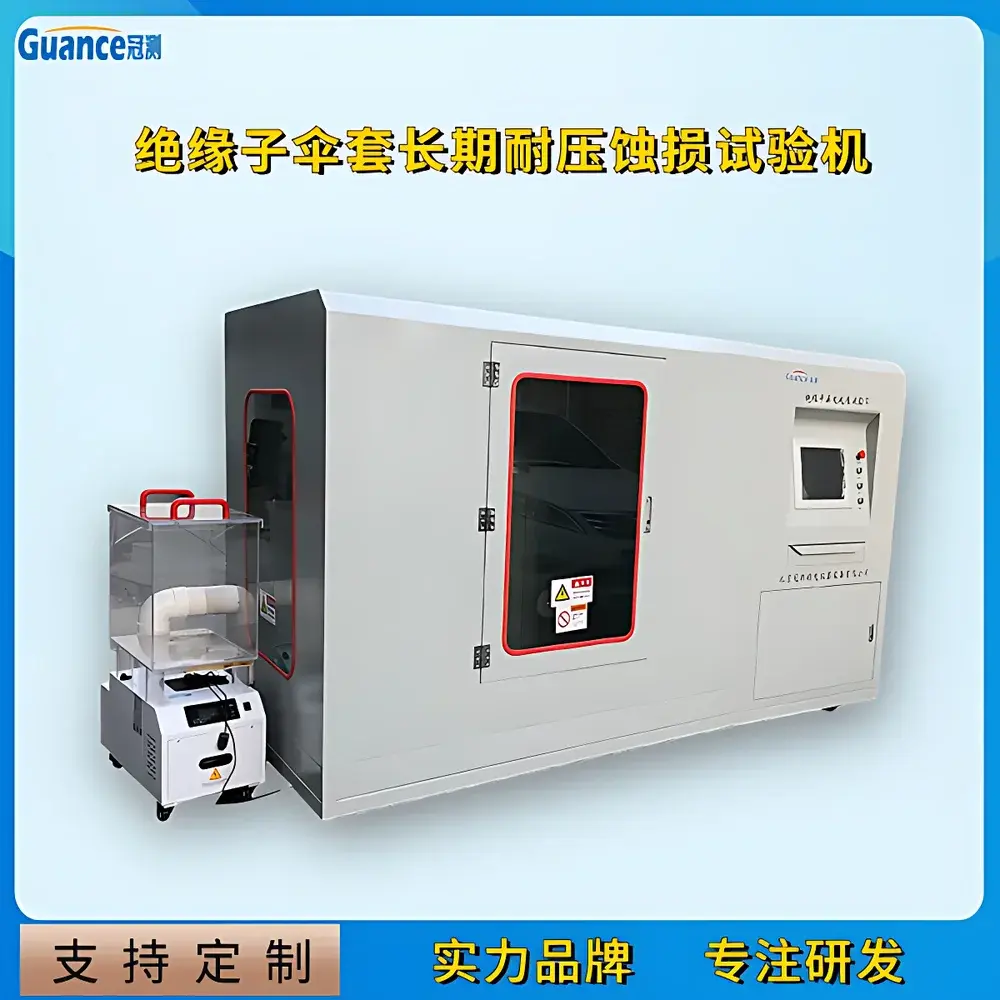
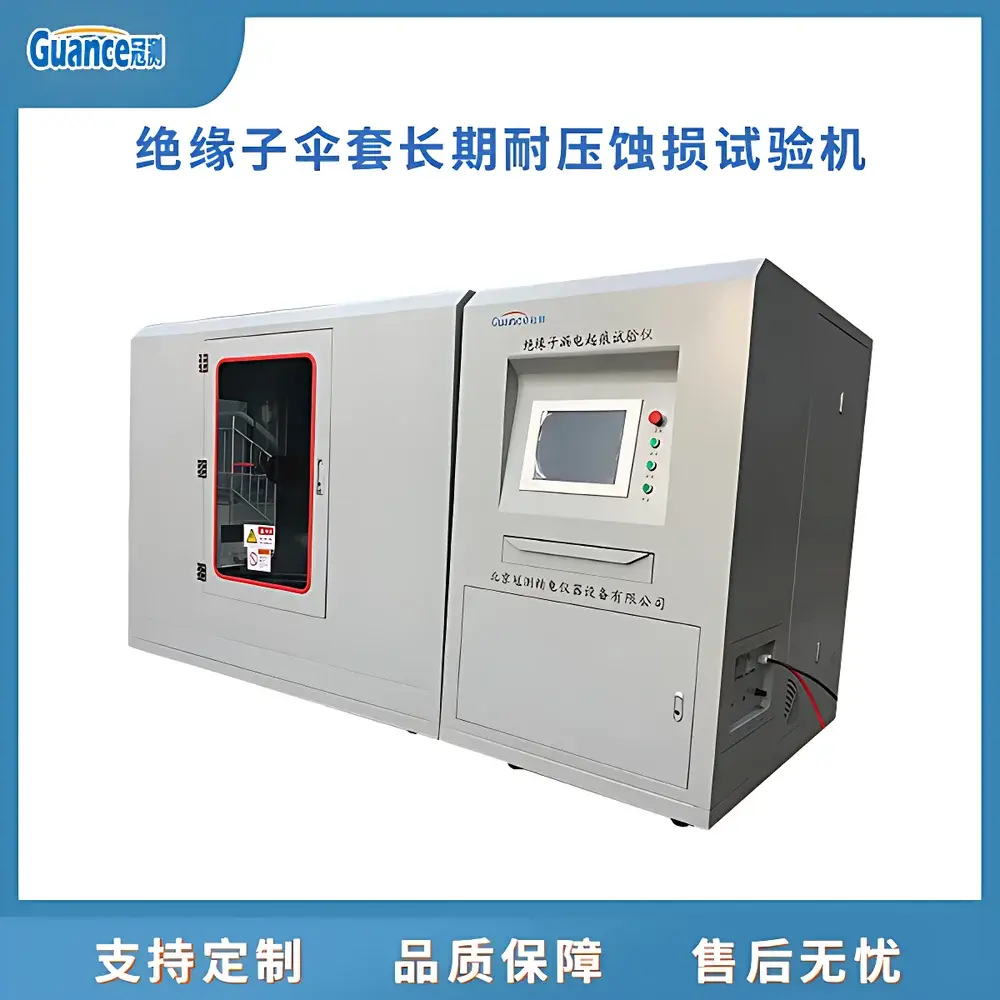
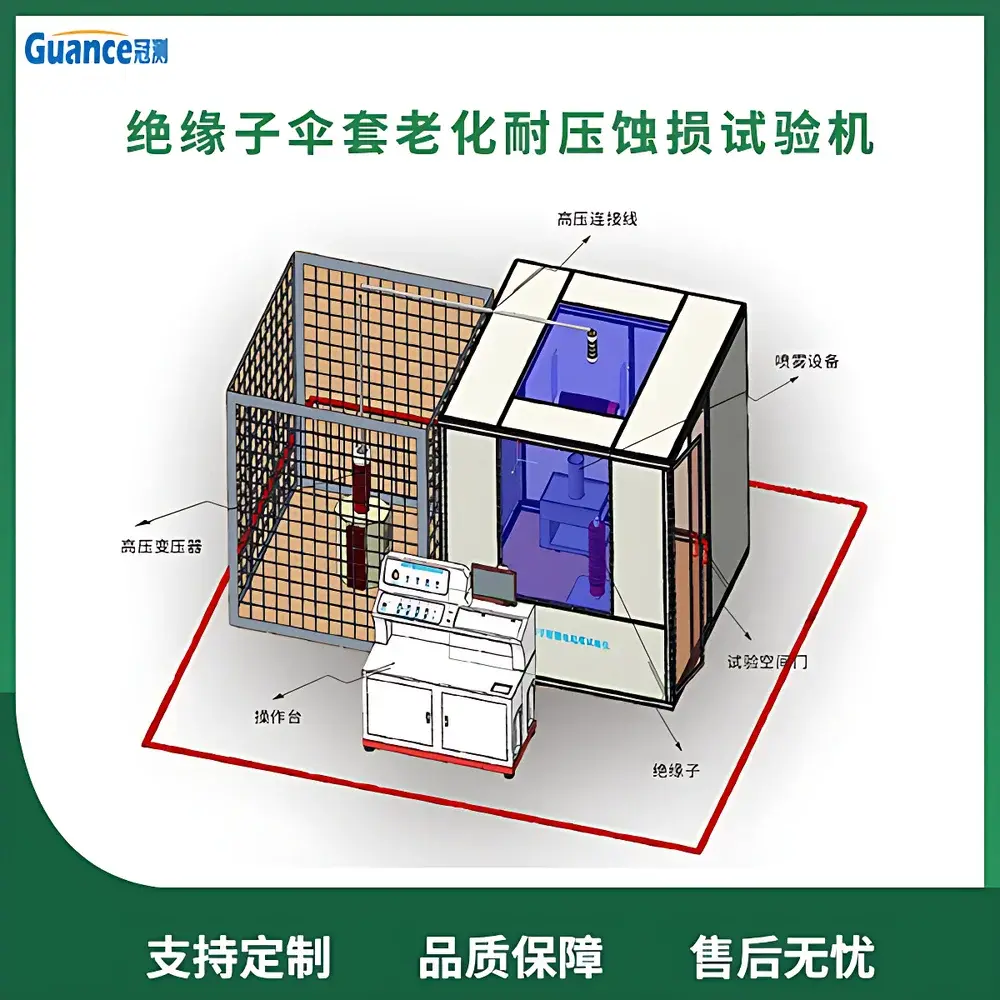
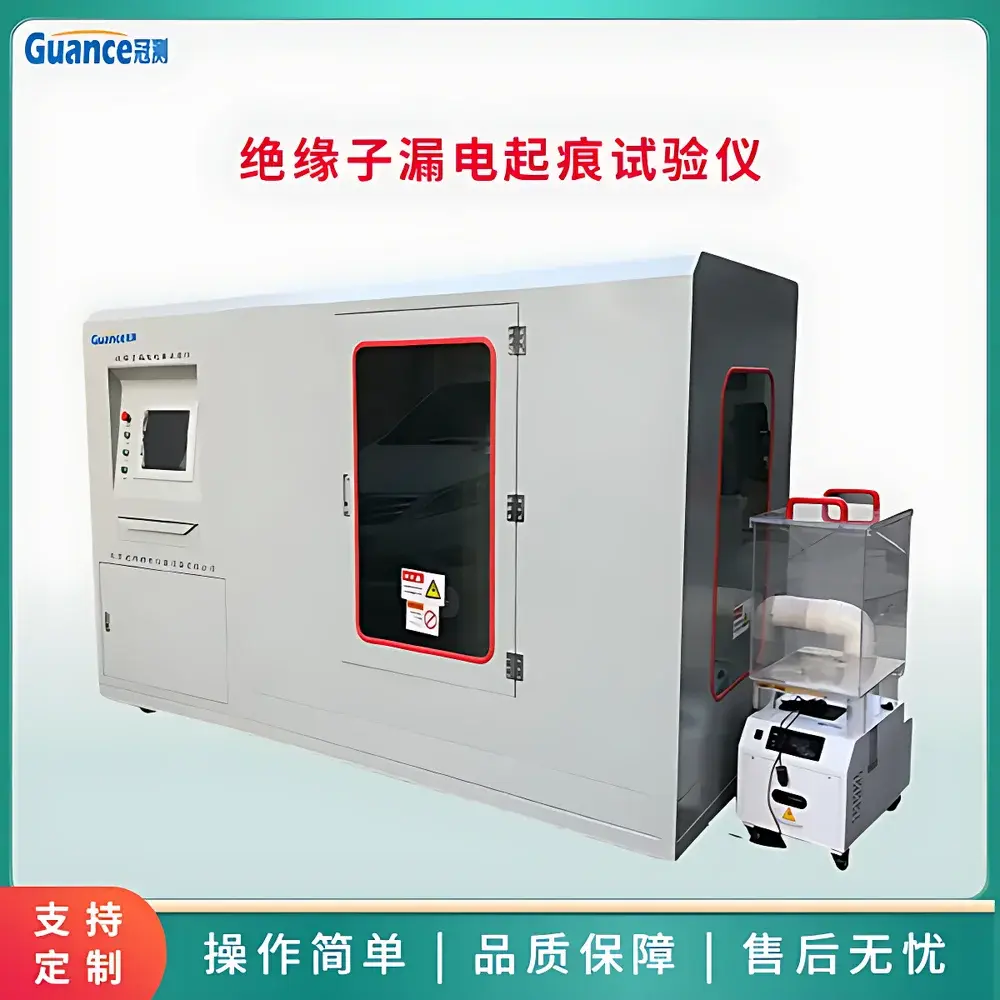
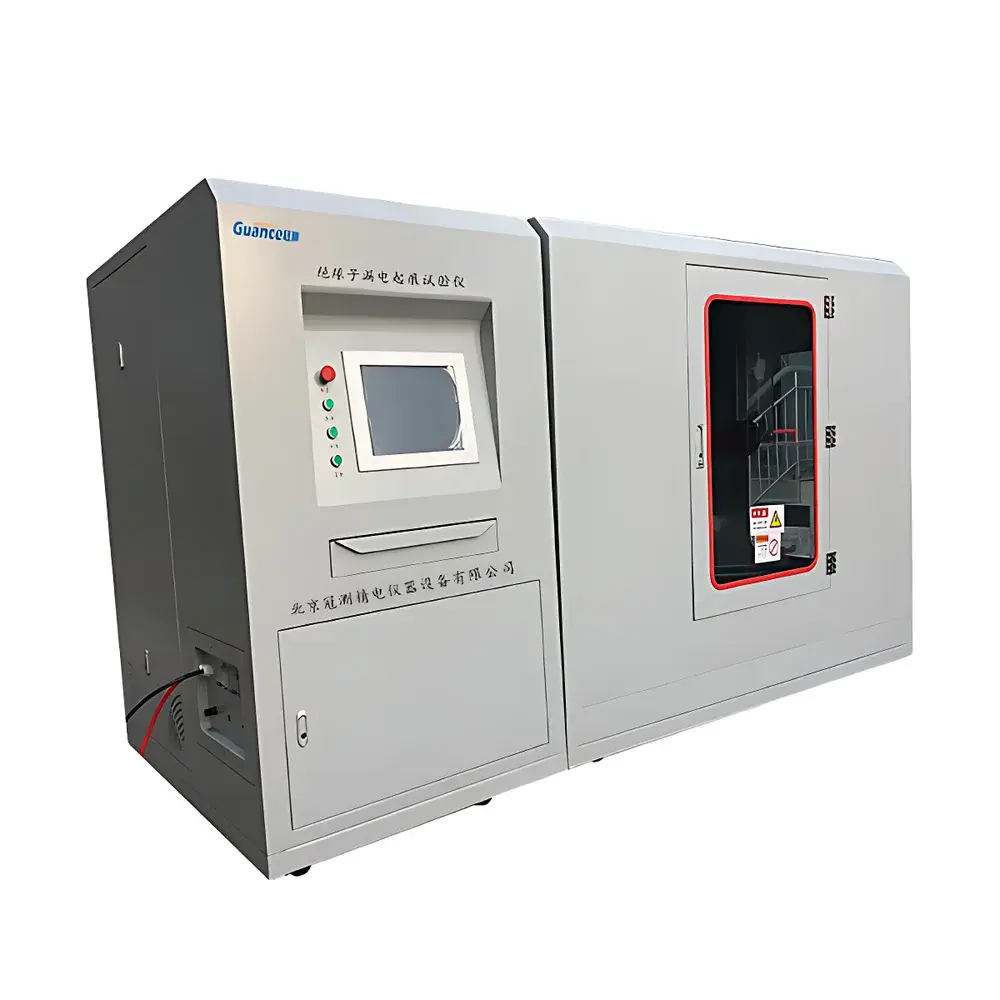
GuanCe Instruments NLD-AII.2 Universal Test System for Tracking Resistance of Insulators
| Brand | GuanCe Instruments |
|---|---|
| Origin | Beijing, China |
| Manufacturer Type | Authorized Distributor |
| Product Category | Domestic |
| Model | NLD-AII.2 |
| Instrument Type | Electromechanical Universal Testing System |
| Input Voltage | AC 220 V |
| Output Voltage Range | AC 0–50 kV / DC −50–0 kV (adjustable) |
| Electrical Capacity | 50 kVA |
| Voltage Accuracy | < ±2% |
| High-Voltage Output Current | ≥1 A |
| Current Measurement Accuracy | < ±1% |
| Spray Velocity at Specimen | 3 m/s |
| Salt Fog Generation Rate | (0.4 ± 0.1) L/m³·h |
| 雾室 Volume | 4 m³ (L×W×H = 2000 × 1200 × 1700 mm) |
| 雾化 Particle Size | 5–10 µm |
| Specimen Mounting | 1 horizontal + 1 vertical |
| Minimum Clearance | ≥400 mm from ceiling and walls |
| Test Duration | 1000 h (continuous) |
| 雾化 Method | Ultrasonic Atomization |
| Salt Solution | NaCl + deionized water |
| Safety Interlock | Door-activated high-voltage cutoff & auto-zero reset |
| Control System | Embedded industrial computer |
| Dimensions (L×W×H) | 3400 × 1300 × 1800 mm |
| Weight | 300 kg |
Overview
The GuanCe Instruments NLD-AII.2 Universal Test System for Tracking Resistance of Insulators is a purpose-built electromechanical testing platform engineered to evaluate the electrical tracking and erosion resistance of polymeric insulators under accelerated saline environmental stress. It operates on the principle of combined high-voltage dielectric stress and controlled salt-fog exposure — replicating long-term service conditions encountered by overhead line and substation insulators in coastal, industrial, or high-humidity regions. The system conforms rigorously to GB/T 20142–2006 (for AC overhead line post-type composite insulators above 1000 V) and GB/T 22079–2008 (for indoor/outdoor polymer insulators), ensuring alignment with national standards governing definition, test methodology, and acceptance criteria. Unlike generic universal testers, the NLD-AII.2 integrates high-voltage generation, precision fog dynamics, real-time electrical monitoring, and fail-safe interlocks into a single unified architecture — enabling standardized, repeatable, and auditable evaluation of surface degradation mechanisms such as dry-band arcing, carbonization path formation, and leakage current escalation.
Key Features
- Integrated high-voltage source: Dual-mode AC/DC output (0–50 kV AC / −50–0 kV DC), adjustable via precision autotransformer and isolation transformer; rated capacity 50 kVA.
- Ultrasonic salt-fog generation system: Produces stable, monodisperse aerosol (5–10 µm median particle diameter) at calibrated delivery rate of (0.4 ± 0.1) L/m³·h, with uniform spray velocity of 3 m/s at specimen location.
- Thermally insulated 4 m³ fog chamber: Internal dimensions 2000 × 1200 × 1700 mm; designed to maintain spatial homogeneity of fog concentration and minimize thermal stratification during 1000-hour continuous operation.
- Dual-axis specimen mounting: Accommodates one insulator horizontally and one vertically, each positioned ≥400 mm from chamber walls and ceiling to ensure unimpeded fog circulation and avoid edge-effect artifacts.
- Embedded industrial control unit: Real-time acquisition and display of voltage, leakage current, elapsed time, and system status; supports programmable pause/resume with cumulative runtime logging.
- Comprehensive safety architecture: Interlocked door switch triggers immediate HV shutdown and automatic voltage discharge to zero; configurable overcurrent protection; mechanical upper/lower limit switches with visual status indicators.
Sample Compatibility & Compliance
The NLD-AII.2 accepts standard polymeric insulators conforming to IEC 62217 and GB/T 22079 geometries, including pin-type, post-type, and station post configurations with creepage distances up to 2.5 m. Specimens must be mounted using non-conductive fixtures compatible with ASTM D2303–18 (Standard Test Methods for Determining the Comparative and Proof Tracking Indices of Solid Electrical Insulating Materials). All test protocols are traceable to GB/T 20142–2006 Annex B (salt-fog tracking test) and GB/T 22079–2008 Clause 8.4. The system’s measurement uncertainty budget satisfies ISO/IEC 17025 requirements for accredited laboratories, and its data integrity controls—including timestamped event logs, parameter calibration records, and electronic signature-capable reporting—support GLP and GMP-aligned quality systems.
Software & Data Management
The embedded control software provides full-cycle test management without external PC dependency. Core functions include real-time oscillographic display of voltage and leakage current waveforms, configurable alarm thresholds for current surges, and automatic detection of tracking initiation (defined as sustained >10 mA leakage current for ≥2 s). All raw data are stored internally with millisecond timestamp resolution. Historical test records are searchable by date, operator ID, or specimen batch number. Electronic reports comply with PDF/A-1b archival standards and embed digital signatures per FDA 21 CFR Part 11 requirements when deployed in regulated environments. Data export is supported via USB 2.0 interface in CSV and XML formats for integration with LIMS or statistical process control platforms.
Applications
- Evaluation of silicone rubber, EPDM, and ethylene propylene diene monomer (EPDM) housing materials for outdoor insulation performance.
- Qualification testing of new insulator designs prior to type approval under GB/T 20142 or IEC 61109.
- Comparative aging studies assessing the impact of filler composition, hydrophobicity recovery rate, and surface contamination on tracking resistance.
- Root-cause analysis of field failures involving flashover or progressive surface erosion in transmission networks.
- Supporting R&D validation for insulators intended for use in severe pollution zones (IEC 60815 classification Zone d).
FAQ
What standards does the NLD-AII.2 explicitly support?
GB/T 20142–2006 and GB/T 22079–2008 are fully implemented; test sequences, fog parameters, voltage application profiles, and pass/fail criteria align directly with these specifications.
Can the system perform both AC and DC tracking tests?
Yes — the high-voltage section delivers continuously adjustable AC (0–50 kV) and negative-polarity DC (−50–0 kV), enabling comparative evaluation of polarity-dependent tracking behavior per IEC TR 60815-3.
Is remote monitoring or network connectivity available?
The base configuration uses standalone embedded control; optional Ethernet module enables Modbus TCP or OPC UA integration for centralized lab monitoring systems.
How is calibration traceability maintained?
Voltage and current sensors are calibrated annually against NIM-traceable references; calibration certificates and adjustment logs are stored within the system database and exportable with test reports.
What maintenance intervals are recommended for the ultrasonic fogger?
Ultrasonic transducers require quarterly cleaning with deionized water and annual replacement; fog chamber interior must be rinsed after each test cycle to prevent salt crystallization buildup.



