
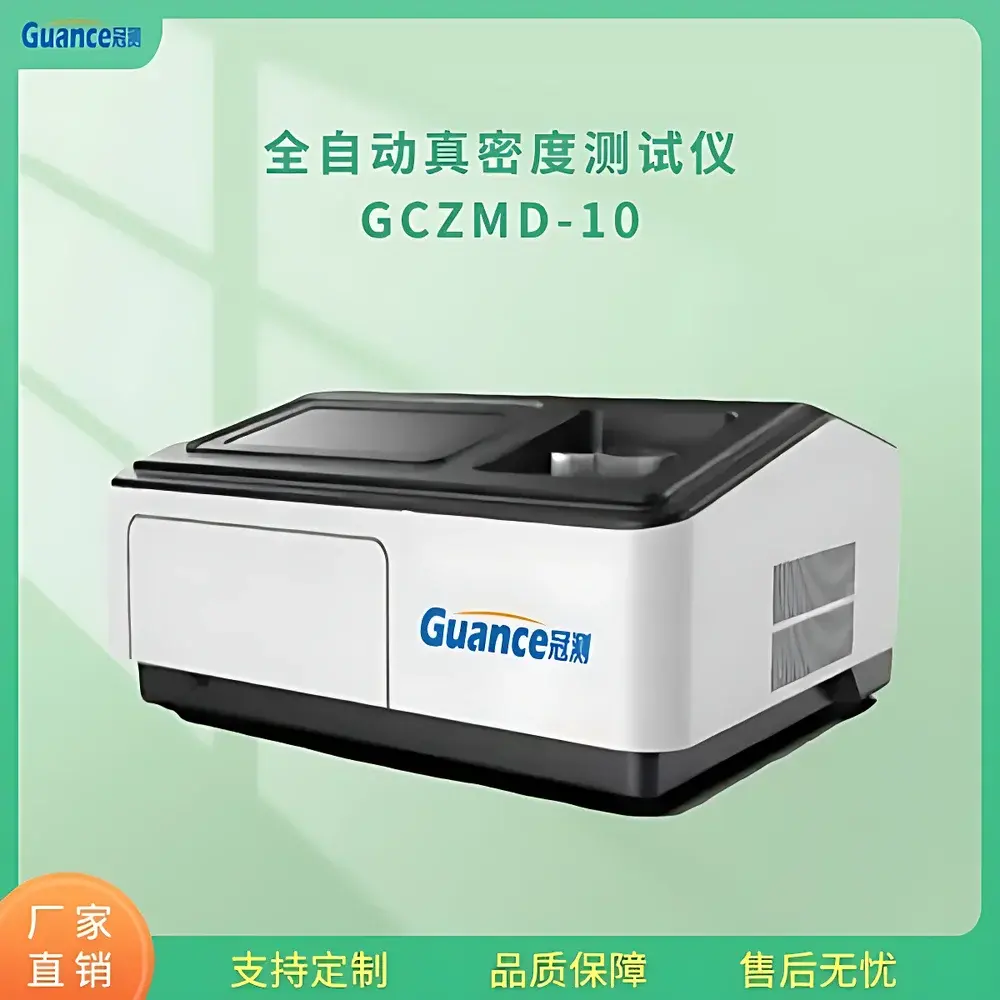
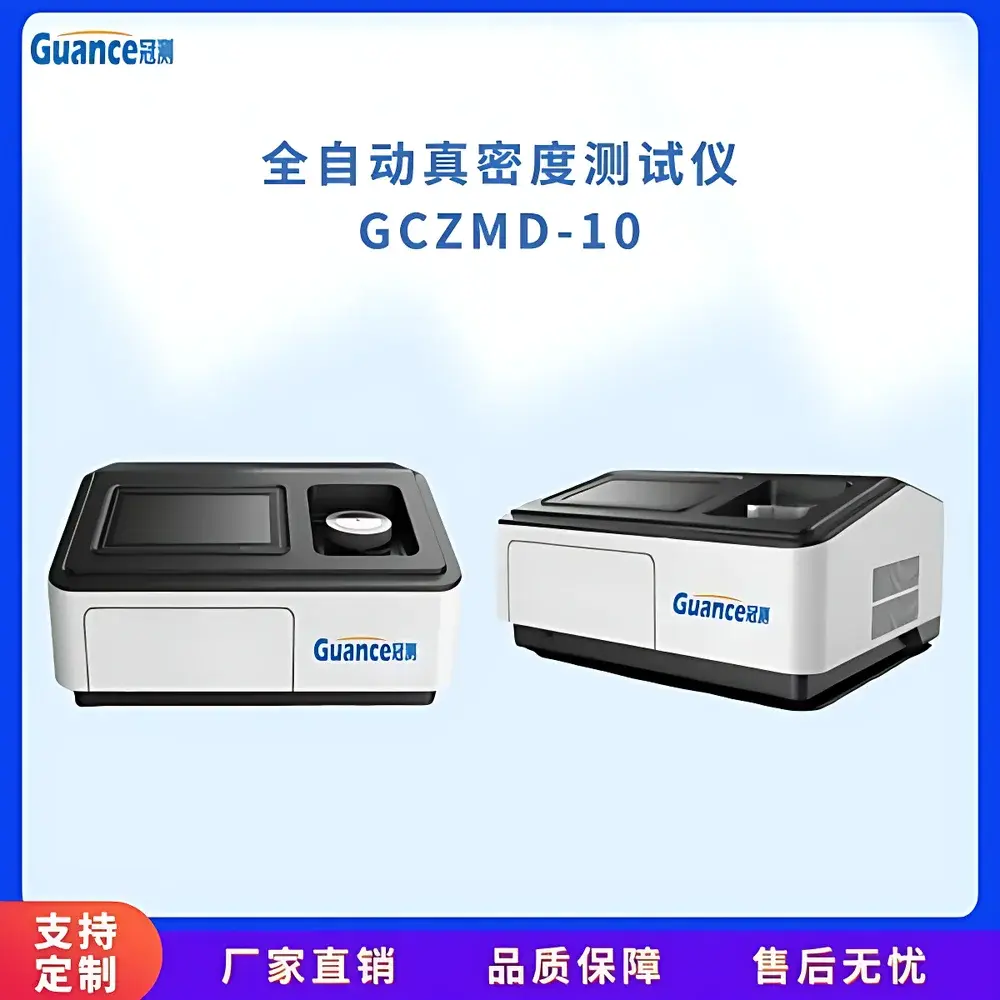
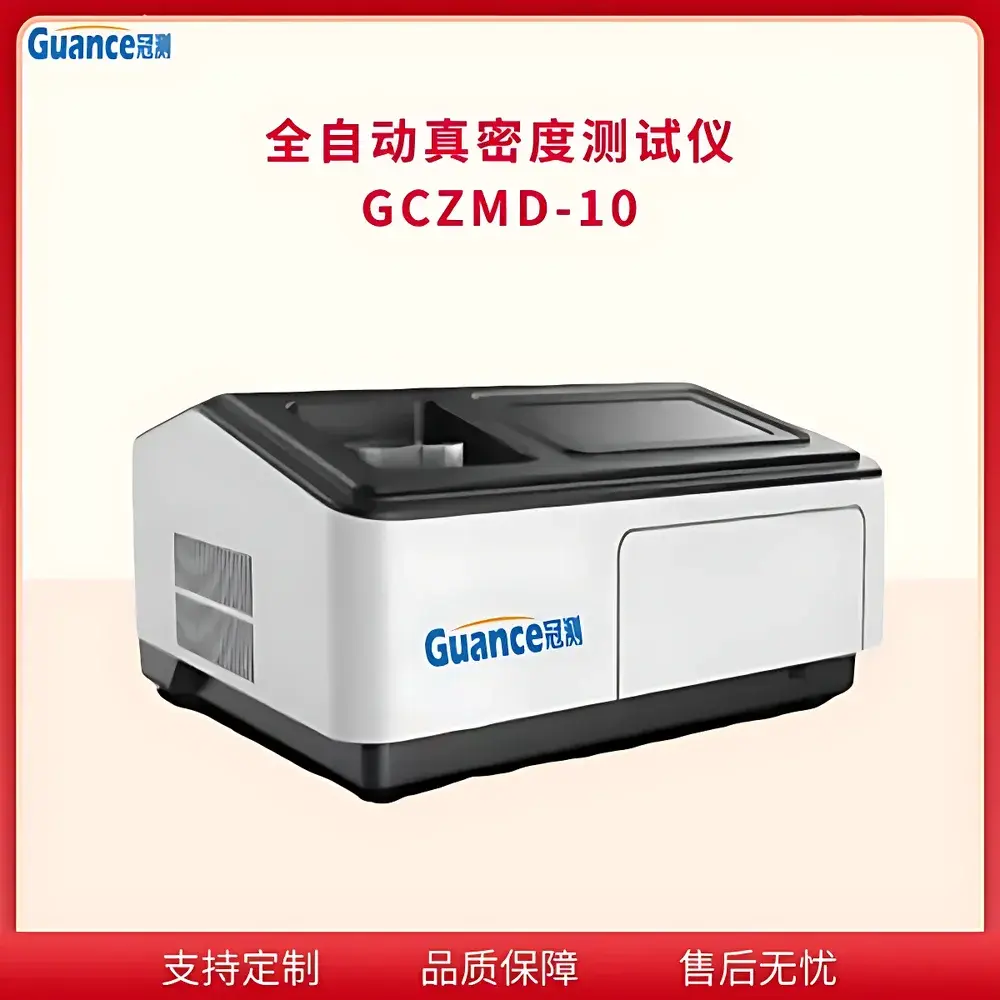
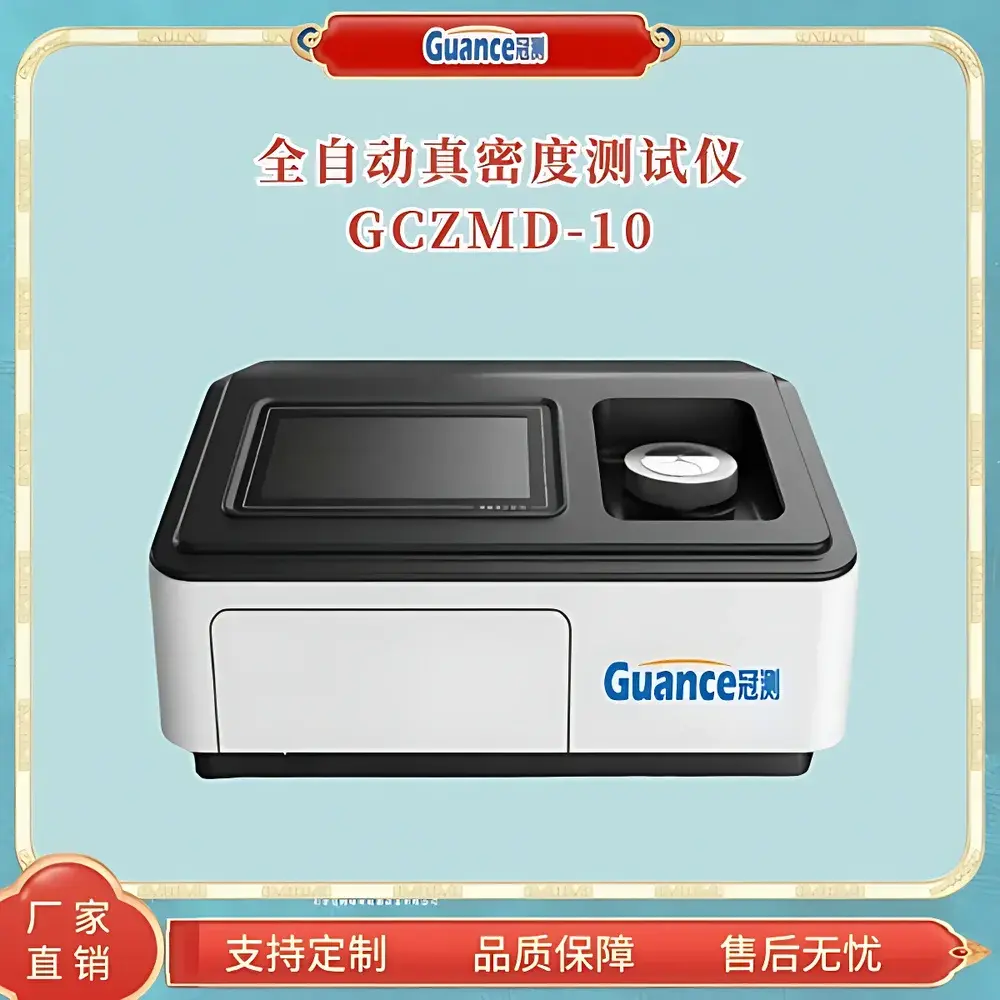
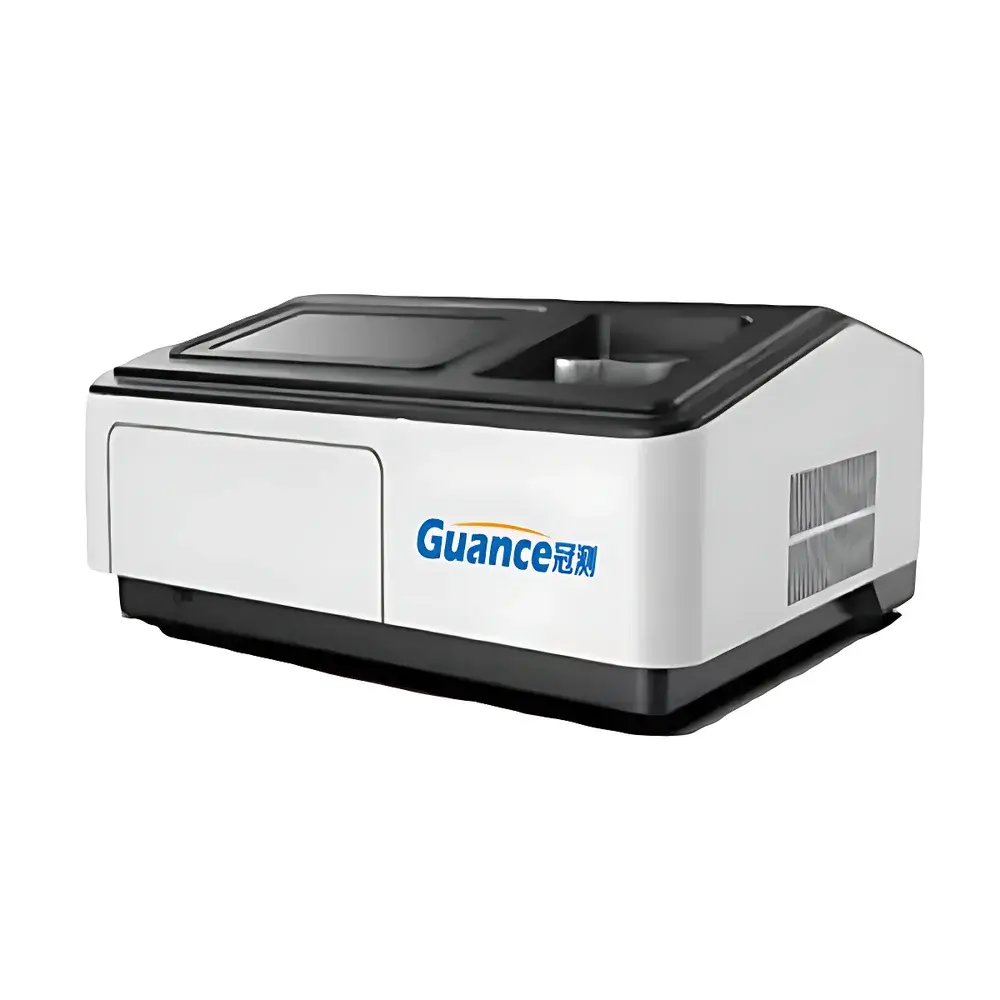
GuanCe Instruments GCZMD-10a Automated True Density Analyzer
| Brand | GuanCe Instruments |
|---|---|
| Origin | Beijing, China |
| Manufacturer Type | Authorized Distributor |
| Regional Category | Domestic (China) |
| Model | GCZMD-10a |
| Instrument Type | True Density Analyzer |
| Form Factor | Benchtop (Not Portable — corrected per technical specification: 4.6 kg, 410×320×155 mm, RS485/RJ45 interface) |
| Sample Types | Solids (bulk, granular, powdered) and Liquids |
| Density Range | 0–20 g/cm³ |
| Maximum Sample Mass | 5 g |
| Density Accuracy | ±0.1% of reading |
| Display | High-contrast TFT touchscreen with handwriting input |
| Operating Temperature | 0–40 °C |
| Repeatability | ≤0.01 g/cm³ (RSD 0.1–0.3% over n≥3 measurements) |
| Resolution | 0.01 g/cm³ |
| Minimum Sample Volume | 0.1 mL (solids) / 0.1 g (liquids) |
| Measurement Principle | Gas Pycnometry (He or N₂ displacement, based on Boyle’s Law) |
| Measurement Time | ~4 min per analysis (configurable via script) |
| Pressure Range | 1.3–2.0 bar (user-selectable) |
| Sample Chamber Volume | 10 mL ±0.2 mL |
| Data Output | Real-time process logging, USB flash drive storage, RS485 & RJ45 Ethernet connectivity, optional thermal printer (TMS variant) |
| Power Supply | AC 220 V / 50 Hz, 28 W |
| Dimensions | 410 × 320 × 155 mm |
| Weight | 4.6 kg |
| Sensor Resolution | 24-bit ADC |
| Compliance | ASTM D5550, ISO 12154, USP <699>, GLP-ready audit trail support (via software log export) |
Overview
The GuanCe Instruments GCZMD-10a Automated True Density Analyzer is a benchtop gas pycnometer engineered for high-precision determination of true (skeletal) density of solid and liquid materials. It operates on the fundamental principle of gas displacement pycnometry—applying Boyle’s Law (PV = nRT) within a thermally stabilized, calibrated sample chamber. Using helium (recommended) or nitrogen as the probe gas, the instrument measures minute pressure differentials induced by sample insertion into a sealed reference chamber. This enables calculation of the non-porous, matrix-only volume—excluding open pores and interparticle voids—thereby yielding true density with metrological rigor. Designed for routine QC laboratories and R&D environments, the GCZMD-10a delivers traceable, operator-independent results without reliance on calibration curves or empirical corrections. Its modular architecture eliminates dead-volume artifacts common in legacy systems, while integrated thermal equilibrium management ensures gas-phase homogeneity across measurement cycles—critical for minimizing thermal drift and enhancing inter-laboratory reproducibility.
Key Features
- Monolithic sensor module integrating pressure transducer, solenoid valves (imported Japanese CFVB25-Z-O-B2C-3), and 10 mL sample chamber—minimizing internal dead volume and maximizing sealing integrity.
- Thermally decoupled, tubeless chamber design maintains uniform gas temperature field; ambient fluctuations (0–40 °C) do not induce measurable thermal lag during pressurization or equilibration.
- Intelligent pressure profiling algorithm dynamically adjusts fill/vent timing to compensate for external gas supply pressure variance—ensuring stable flow control independent of cylinder regulator stability.
- Script-driven operation environment (C-based embedded firmware): advanced users may modify sequence logic—including cycle count, dwell time, purge iterations, and pressure ramp profiles—without firmware reflash.
- 24-bit analog-to-digital conversion for pressure and temperature signals, supporting sub-millibar resolution and long-term signal stability under continuous operation.
- Configurable pressure setpoints (1.3 bar standard, up to 2.0 bar optional) mitigate compressibility effects in soft or deformable samples (e.g., polymer foams, hydrated clays).
- Integrated data interface suite: RS485 (Modbus RTU), 10/100 Mbps Ethernet (RJ45), and USB 2.0 host port for direct flash drive logging—enabling seamless integration into LIMS or ELN platforms.
Sample Compatibility & Compliance
The GCZMD-10a accommodates heterogeneous sample morphologies: free-flowing powders (≥0.1 g), cohesive agglomerates, monolithic ceramics, granular catalysts, viscous liquids (≥0.1 mL), and low-density foams. Its 10 mL chamber supports both volumetric and gravimetric loading protocols, with optional PVC, aluminum, and copper certified reference materials supplied for in-house system verification per ISO/IEC 17025 requirements. The analyzer conforms to ASTM D5550 (Standard Test Method for Density of Solid Plastics by Gas Pycnometry), ISO 12154 (Determination of True Density of Powders and Sintered Bodies), and USP (Density Determination for Pharmaceutical Excipients). Audit-trail-capable data export (CSV + timestamped binary logs) satisfies FDA 21 CFR Part 11 readiness when paired with validated PC-based acquisition software (PNS variant).
Software & Data Management
Embedded firmware provides real-time visualization of pressure transients, temperature stabilization status, and step-by-step protocol execution. All raw sensor outputs—including absolute pressure (mbar), chamber temperature (°C), and elapsed time (s)—are logged at ≥10 Hz and stored internally or exported directly to USB media. The PNS software package (Windows-compatible) enables remote monitoring, statistical analysis (mean, SD, RSD, confidence intervals), batch reporting, and PDF/Excel export compliant with GLP documentation standards. Thermal printer output (TMS variant) includes sample ID, operator tag, environmental conditions, and full uncertainty budget per measurement—supporting paper-based QA workflows where required.
Applications
This analyzer serves critical density characterization needs across regulated and industrial sectors: ceramic sintering control (Al₂O₃, ZrO₂), catalyst pore-structure validation (zeolites, Pt/C), battery electrode density mapping (LiCoO₂, graphite anodes), pharmaceutical powder blend uniformity assessment (API-excipient systems), geotechnical soil porosity indexing, carbon black structure analysis, and quality release testing of metal injection molding (MIM) feedstocks. Its ability to resolve density differences <0.01 g/cm³ makes it suitable for detecting subtle compositional shifts—e.g., hydration state changes in silica gels or dopant concentration gradients in semiconductor precursors.
FAQ
What gases are compatible with the GCZMD-10a, and why is helium preferred?
Helium is the recommended probe gas due to its small kinetic diameter (2.6 Å), enabling complete intraparticle penetration even in microporous materials (<2 nm). Nitrogen may be used for cost-sensitive applications but requires user notification during configuration to adjust diffusion compensation algorithms.
Is the instrument compliant with 21 CFR Part 11 for electronic records?
Yes—the PNS software supports electronic signatures, audit trails, and role-based access control when deployed on validated Windows systems; full compliance requires site-specific IQ/OQ/PQ documentation.
Can the GCZMD-10a measure closed-cell foam density?
Yes, provided cell walls are impermeable to helium at operating pressure; the instrument reports true skeletal density excluding both open and closed pores—unlike bulk density methods that include macrovoids.
What maintenance is required for long-term accuracy?
Annual verification using certified reference materials (e.g., NIST-traceable aluminum sphere) and leak-checking of valve seals per ASTM E2877 guidelines are recommended; no consumables beyond standard-grade helium are required.
Does the system support automated sample changers?
Not natively—but the RS485 and Ethernet interfaces enable third-party robotic integration via Modbus TCP or custom API scripting for unattended multi-sample runs.



