
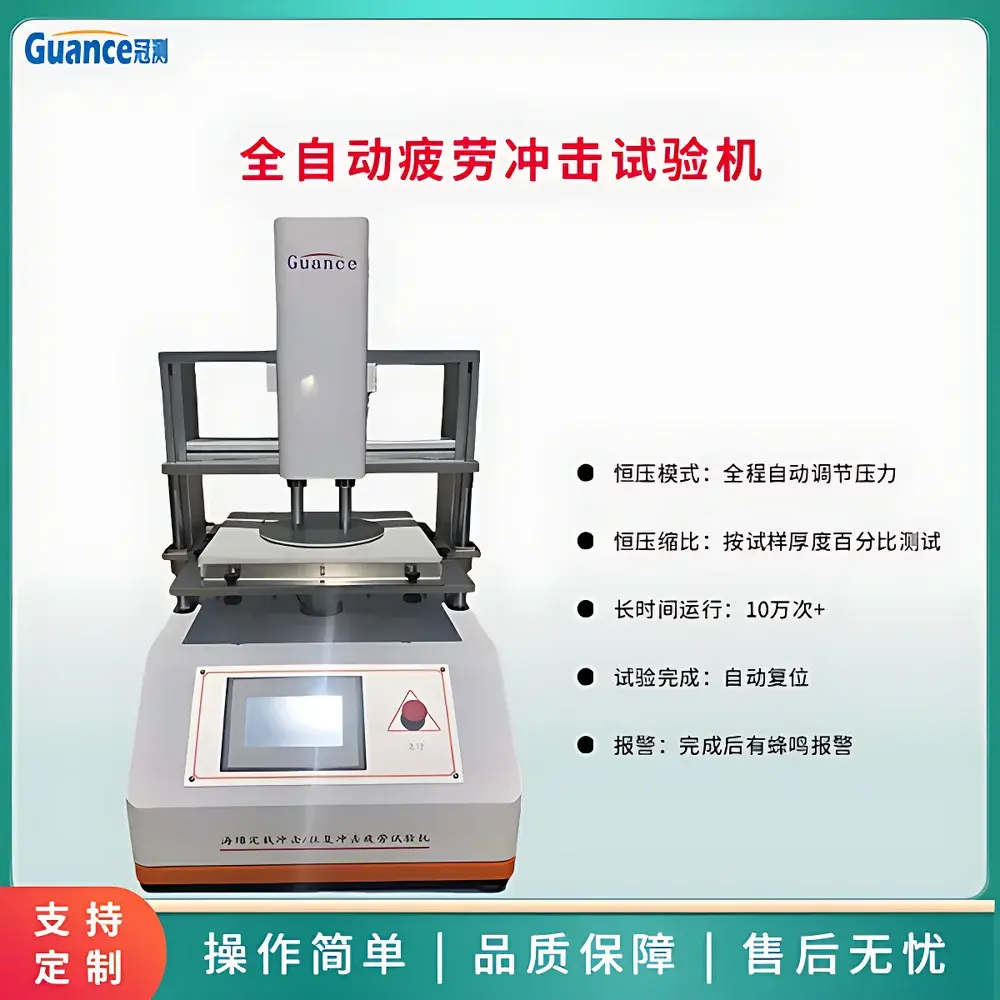
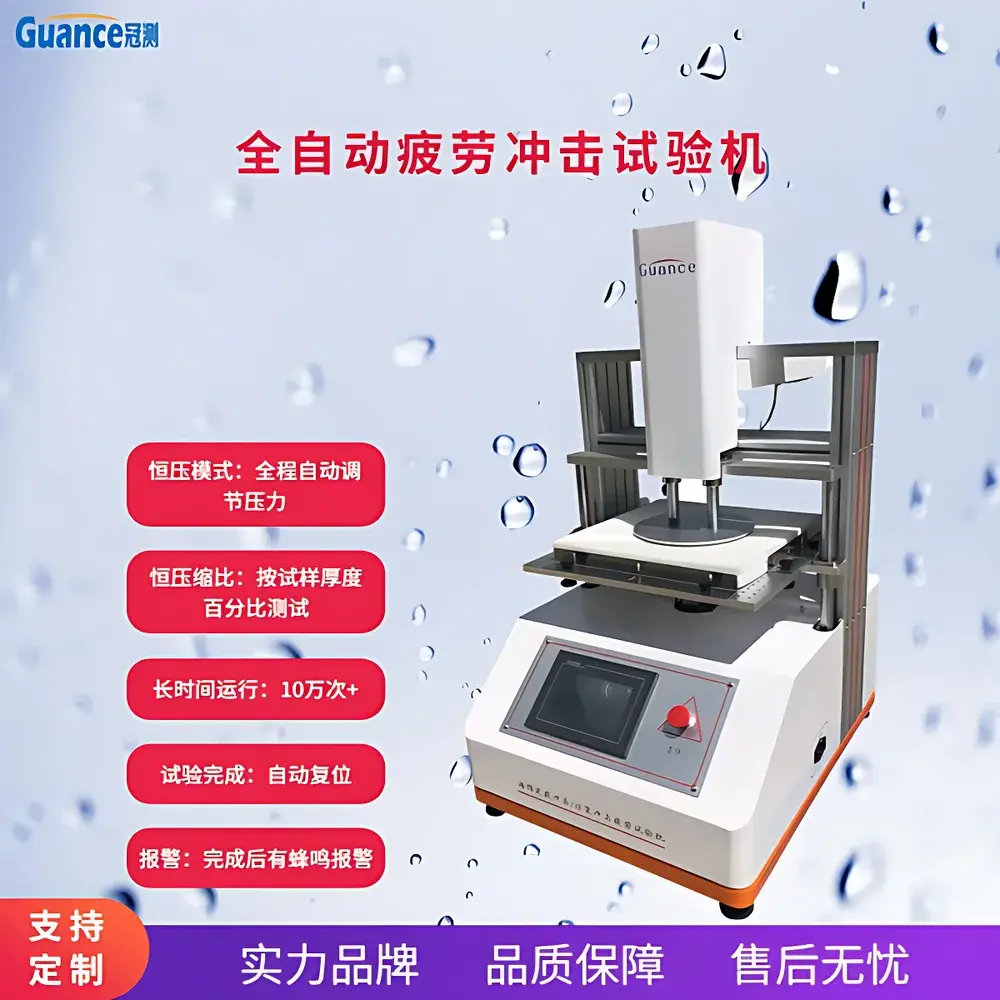
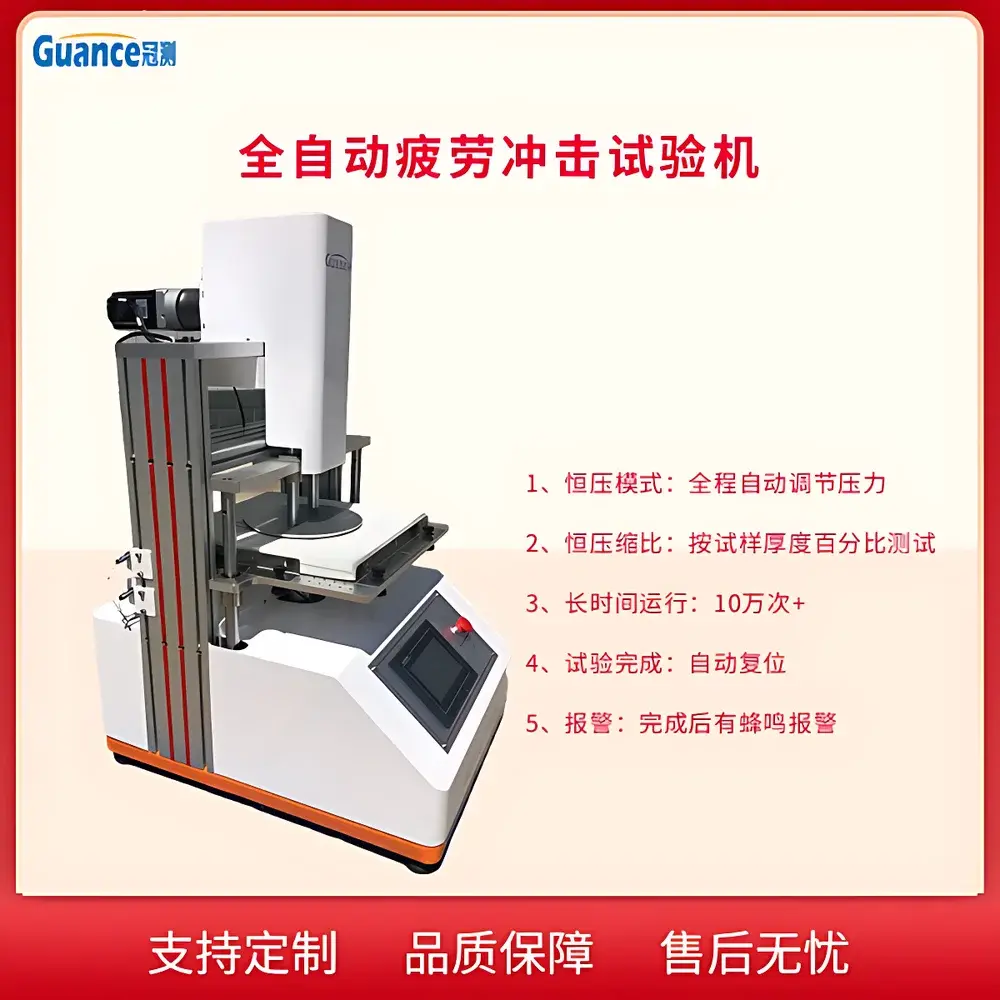
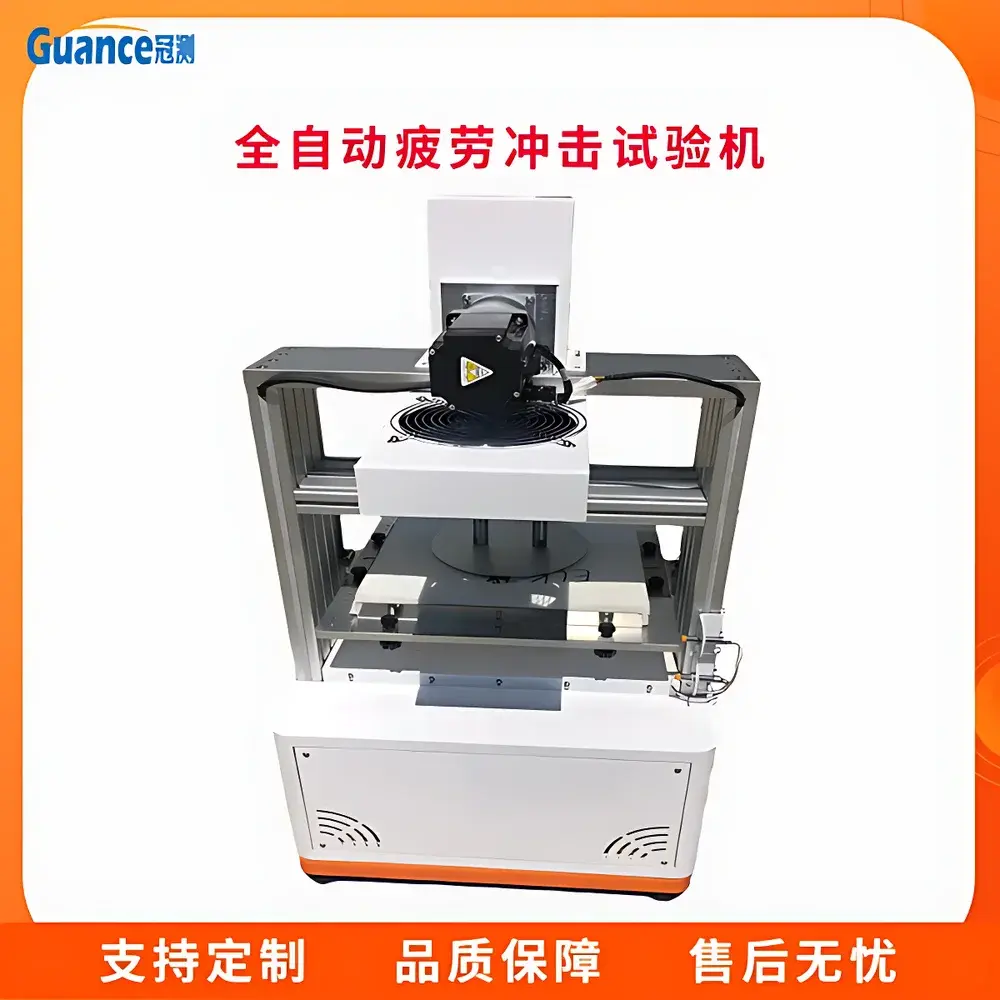
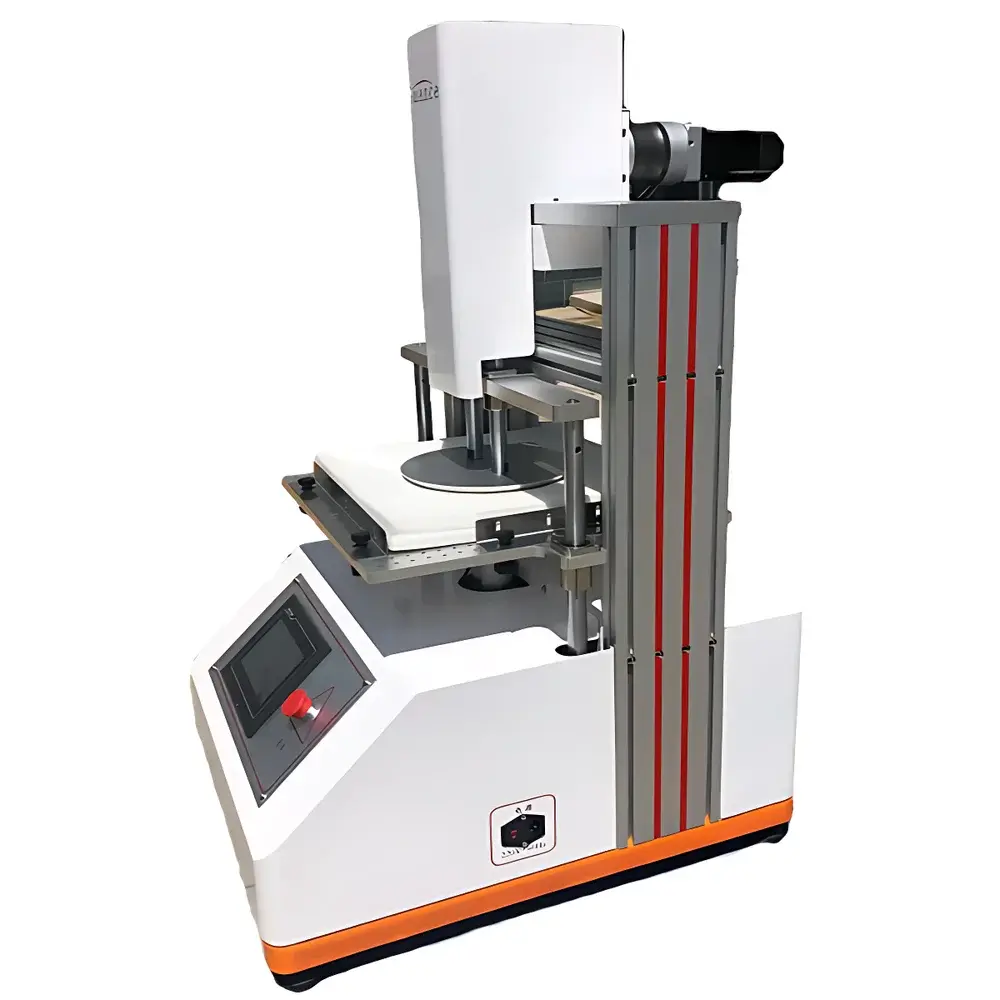
GuanCe PMPL-2000A Constant-Load Reciprocating Impact Fatigue Tester for Flexible Polymeric Foams
| Key | Brand: GuanCe Instruments |
|---|---|
| Origin | Beijing, China |
| Manufacturer Type | Authorized Distributor |
| Country of Origin | China |
| Model | PMPL-2000A |
| Max Test Force | 0–1000 N |
| Frequency Range | 10–100 cycles/min (Standard Compliance: 70 ± 5 cycles/min) |
| Host Weight | 100 kg |
| Platen Diameter | Ø250 ± 1 mm, Edge Radius: R25 ± 1 mm |
| Specimen Support Table | 500 × 500 × 10 mm, Perforated (Ø6.35 mm holes, 20 mm pitch) |
| Specimen Dimensions | 500 × 500 × (50 ± 2) mm |
| Drive System | Servo Motor |
| Control Interface | 7-inch Color Touchscreen HMI |
| Control Logic | Siemens PLC |
| Test Modes | Constant-Load Mode / Thickness-Reduction Percentage Mode |
| Max Cycles | >100,000 |
| Real-time Peak Force Display | Yes |
| End-of-Test Action | Audible Alarm + Automatic Tray Return to Zero Position |
| Power Supply | 220 VAC / 50 Hz |
| Footprint | 800 × 500 × 1200 mm (L×W×H) |
Overview
The GuanCe PMPL-2000A Constant-Load Reciprocating Impact Fatigue Tester is a precision-engineered mechanical testing system designed specifically for evaluating the dynamic fatigue behavior of flexible polymeric foams under repeated compressive loading. It operates on the principle of controlled, cyclic impact compression—where a calibrated load is applied vertically to a foam specimen at a defined frequency and stroke, simulating long-term mechanical stress encountered in real-world applications such as automotive seating, mattress cores, and cushioning packaging. The instrument conforms to internationally recognized test standards including ISO 3385 (Flexible cellular polymeric materials — Determination of fatigue by constant-load impact), GB/T 18941 (Chinese national adoption of ISO 3385), QB/T 2819–2006 (Long-term fatigue performance of flexible foam materials), QC/T 56–93 (Test methods for automotive seat cushion materials), and JASO B408–84 (Japanese Automotive Standards Organization specification for foam durability). Its core function is to quantify residual deformation (thickness loss) and hardness reduction after a prescribed number of impact cycles—key indicators of material resilience, viscoelastic recovery, and structural degradation.
Key Features
- Constant-load maintenance via closed-loop height adjustment: As specimen compression set accumulates during testing, the servo-driven support tray automatically elevates to maintain the applied force within ±2% of the user-defined setpoint—ensuring strict compliance with ISO 3385’s constant-load requirement.
- Dual test mode operation: Users may select either constant-force mode (maintaining fixed Newton-level load throughout the test) or thickness-reduction percentage mode (stopping when specimen thickness decreases by a pre-specified % of initial value).
- Siemens S7-1200 PLC-based control architecture with deterministic real-time response, integrated into a 7-inch industrial-grade touchscreen HMI for intuitive parameter configuration, cycle monitoring, and event logging.
- High-stability mechanical frame with rigid cast-iron base and guided vertical actuation column, minimizing lateral deviation and ensuring repeatable platen alignment across >100,000 cycles.
- Calibrated load cell with real-time peak force display and automatic zero-tracking compensation—critical for detecting progressive load drift due to thermal or mechanical drift.
- End-of-test protocol includes audible alarm activation and automatic return of the specimen support tray to its home position, facilitating unattended operation and safe post-test handling.
Sample Compatibility & Compliance
The PMPL-2000A accommodates standard foam specimens measuring 500 mm × 500 mm × (50 ± 2) mm, mounted on a perforated stainless-steel support table (500 × 500 × 10 mm, Ø6.35 mm holes on 20 mm centers) that permits air displacement and prevents hydrostatic pressure buildup beneath the specimen. The Ø250 mm ± 1 mm impact platen features a smoothly radiused lower edge (R25 ± 1 mm) to minimize localized stress concentration and edge effects—consistent with ISO 3385 geometry requirements. All mechanical and control subsystems are validated against traceable calibration protocols aligned with ISO/IEC 17025 principles. The system supports full audit trails for test parameters, start/stop timestamps, and force history—enabling compliance with GLP and internal quality assurance procedures in regulated environments.
Software & Data Management
While the PMPL-2000A operates via embedded PLC logic without external PC dependency, its HMI stores complete test records—including cycle count, elapsed time, peak force per cycle, and final thickness measurement—in non-volatile memory. Data export is supported via USB flash drive (FAT32 formatted) in CSV format for downstream analysis in Excel, MATLAB, or statistical process control platforms. Optional RS-485 Modbus RTU interface enables integration into centralized laboratory information management systems (LIMS) for automated data ingestion and electronic record retention. All test logs include operator ID (manually entered), test method reference (e.g., “ISO 3385-2014”), and environmental notes—supporting 21 CFR Part 11–aligned documentation practices where required.
Applications
- Automotive interior component validation: Seat cushion foam, headrest inserts, and door panel padding subjected to simulated 10-year usage profiles.
- Consumer goods R&D: Mattress comfort layers, sofa backrest foams, and athletic shoe midsoles requiring quantifiable fatigue life metrics.
- Quality control laboratories: Batch-to-batch consistency verification for slabstock and molded polyurethane, latex, and thermoplastic elastomer foams.
- Regulatory submission support: Generating standardized fatigue data for certification reports submitted to OEMs, UL, or regional safety authorities.
- Material formulation studies: Correlating polymer chemistry (e.g., crosslink density, filler content) with macroscopic fatigue resistance and permanent set behavior.
FAQ
What standards does the PMPL-2000A directly support?
It is fully configured to execute ISO 3385, GB/T 18941, QB/T 2819–2006, QC/T 56–93, and JASO B408–84 test protocols without hardware modification.
Can the system perform tests at frequencies outside the 70 ± 5 cycles/min range?
Yes—the frequency is programmable from 10 to 100 cycles/min; however, only tests conducted at 70 ± 5 cycles/min satisfy the mandatory condition for ISO 3385 conformance reporting.
Is force calibration traceable to national metrology institutes?
Force transducers are supplied with factory calibration certificates traceable to CNAS-accredited laboratories; users may perform field verification using certified deadweight sets per ISO 376.
Does the system meet electromagnetic compatibility (EMC) requirements for lab environments?
Yes—it complies with IEC 61326-1 (industrial EMC) and has passed conducted/radiated emissions testing per EN 61000-6-3 and immunity per EN 61000-6-2.
How is specimen misalignment prevented during extended testing?
Mechanical centering pins on the support table and adjustable side guides ensure positional stability over 100,000+ cycles, eliminating lateral creep or rotation-induced eccentric loading.



