
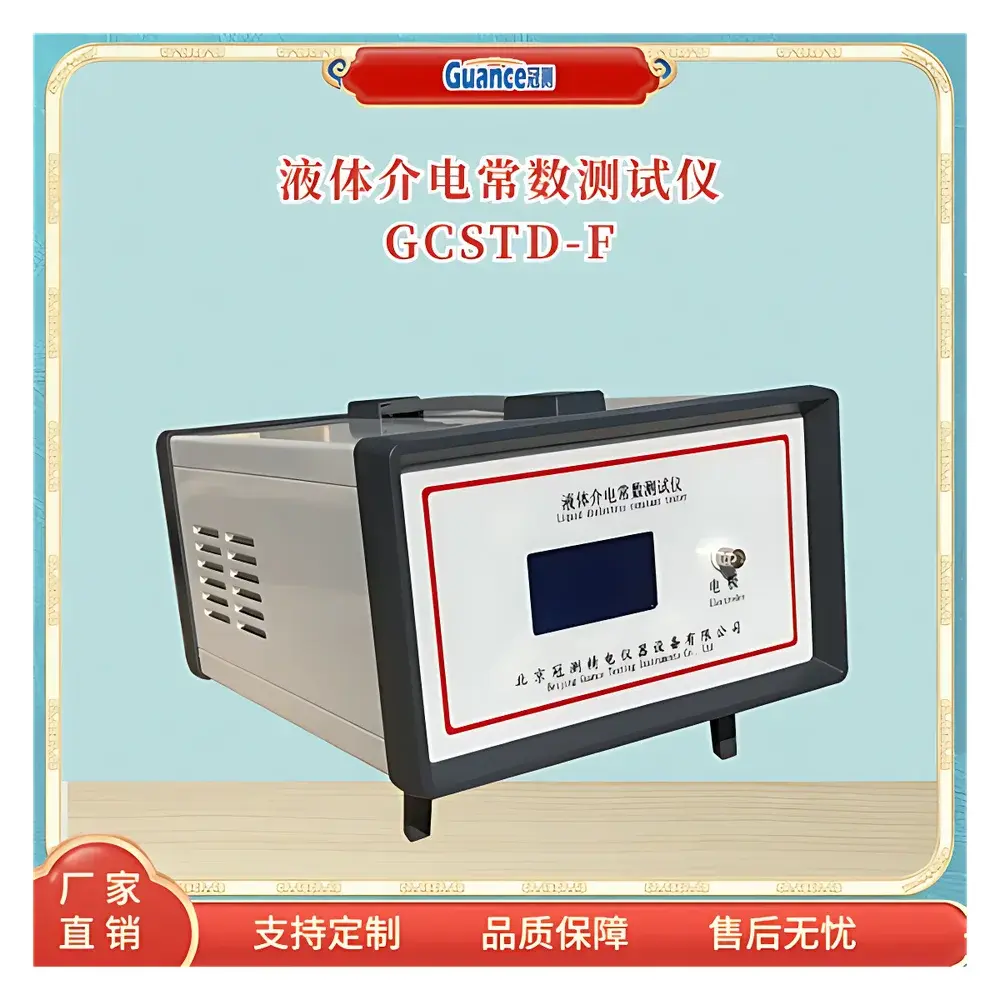
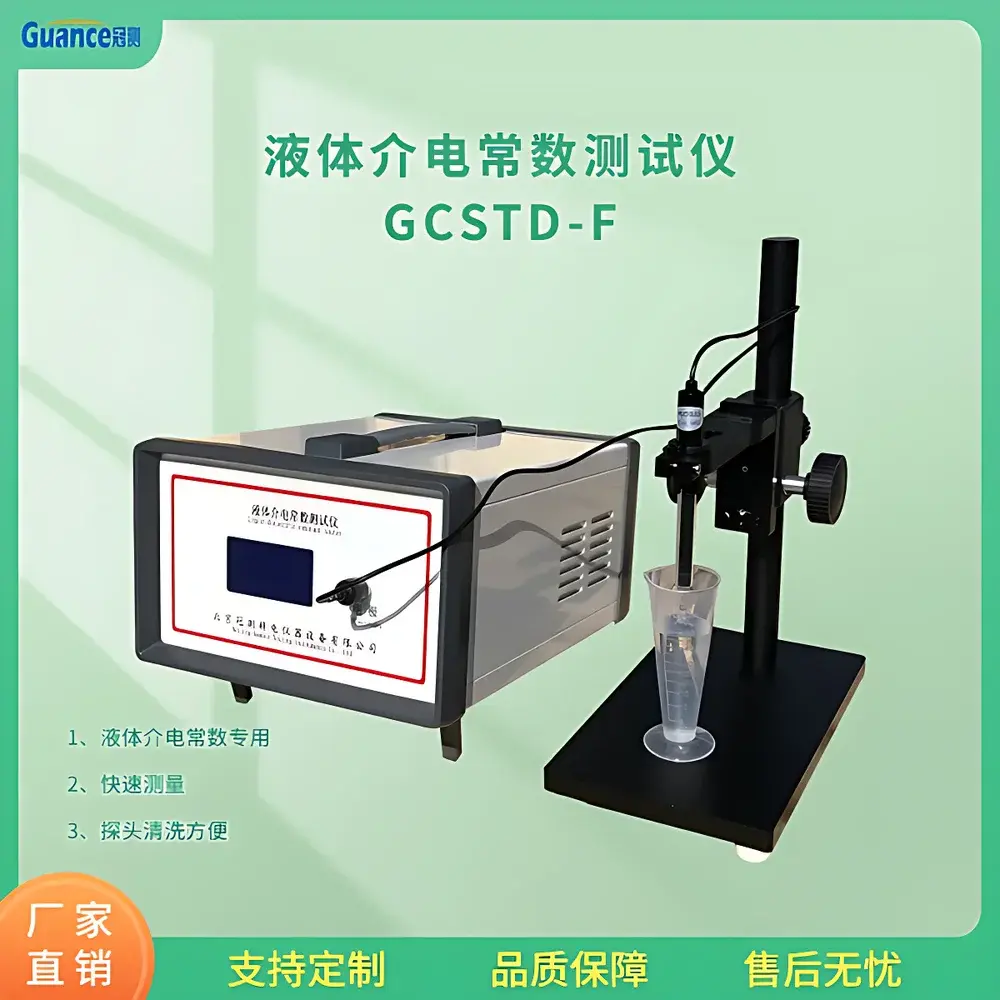
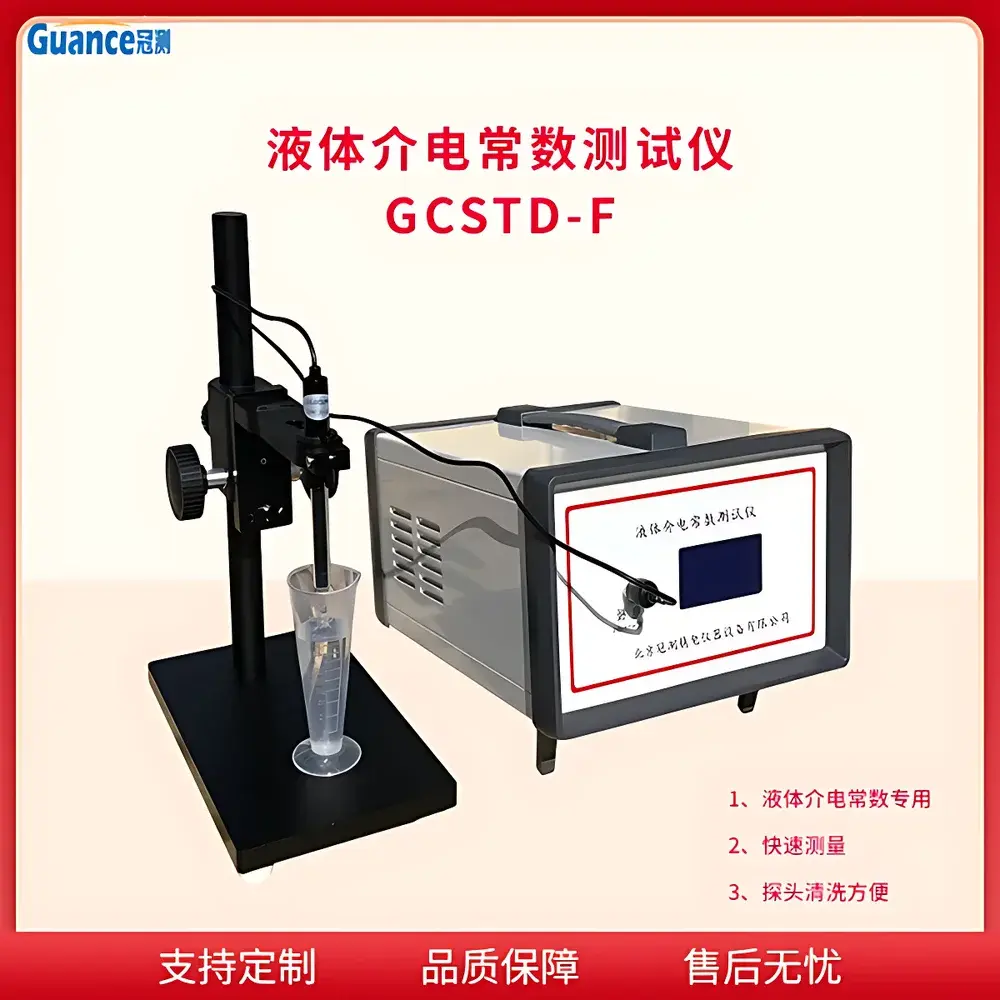
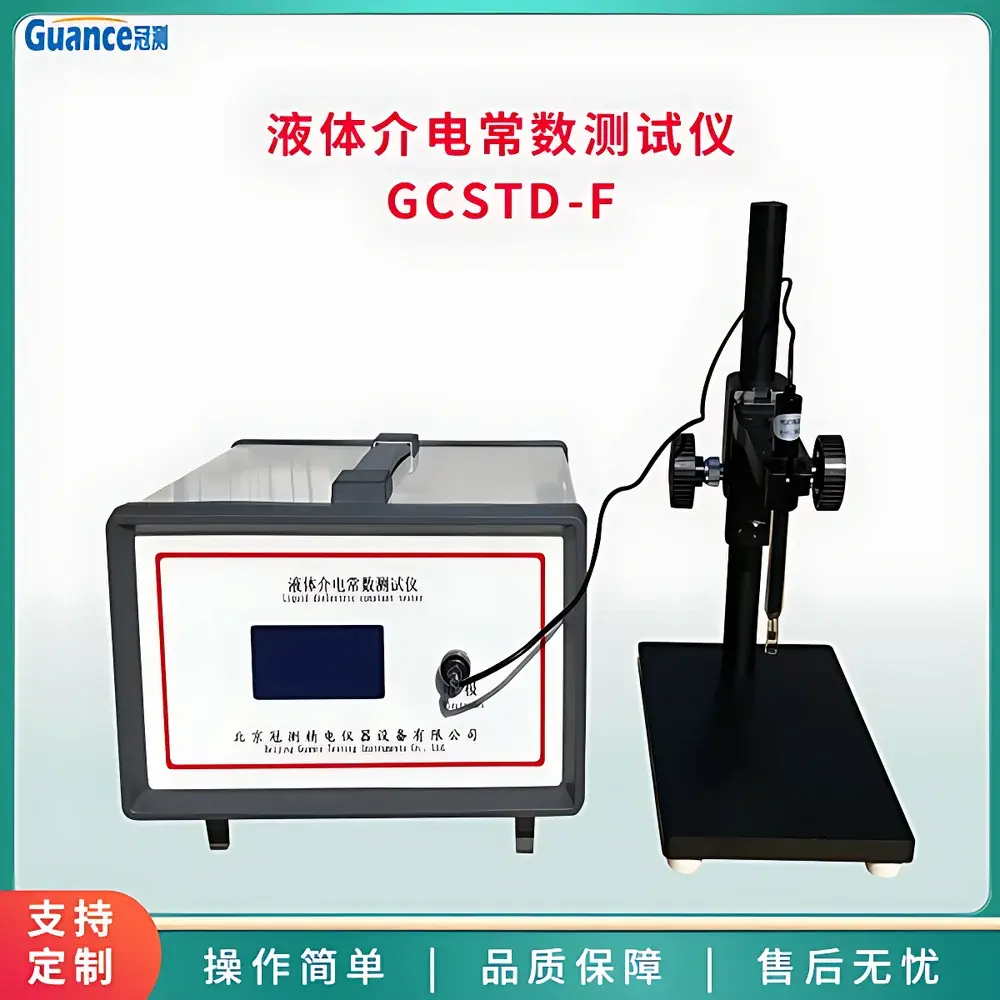
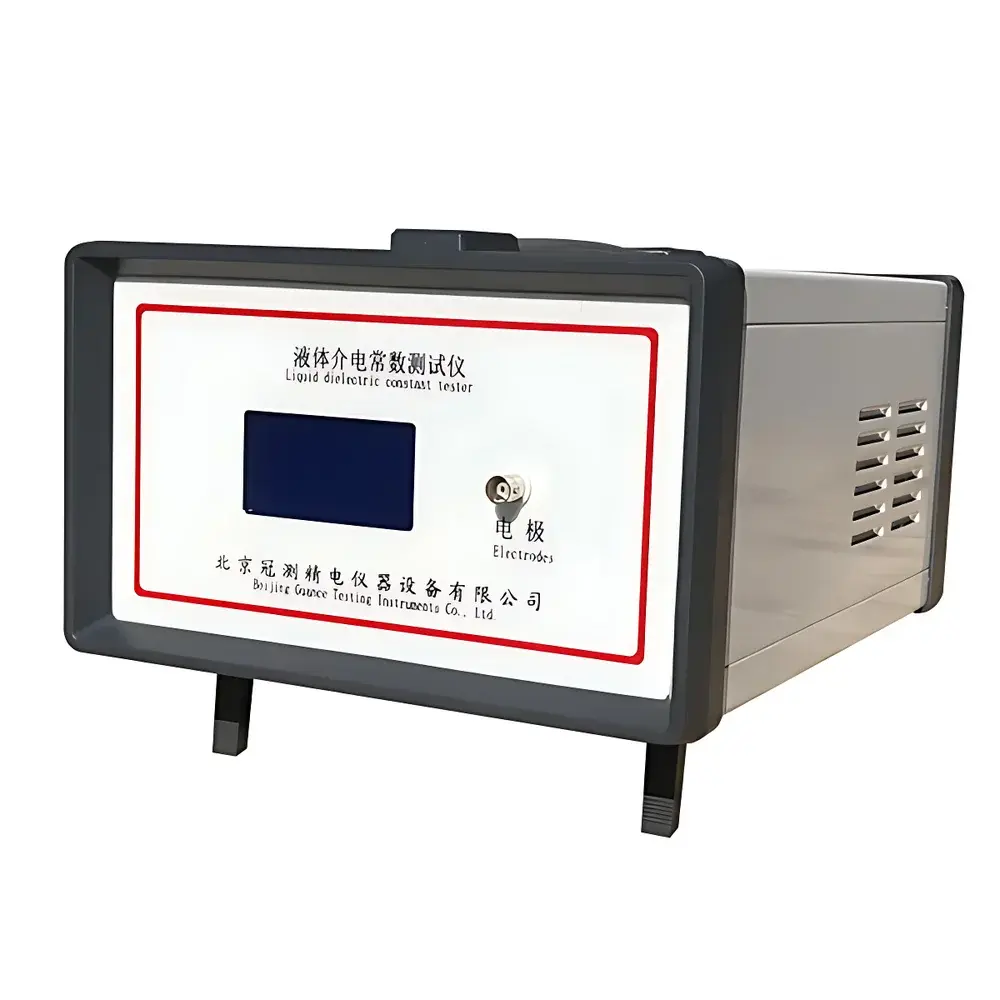
GuanCe Instruments GCSTD-F.4 High-Low Frequency Liquid Dielectric Constant Analyzer
| Brand | GuanCe Instruments |
|---|---|
| Origin | Beijing, China |
| Model | GCSTD-F.4 |
| Frequency Range | 10 Hz – 10 MHz (typical for F-series) |
| Electrode Configuration | Coaxial Cylindrical (316 Stainless Steel Outer/Inner Cylinders) |
| Electrode Spacing | Fixed via Six Nylon Set Screws |
| Material Compatibility | Stainless Steel / Nylon / PTFE |
| Cleaning Protocol | Solvent Immersion (Acetone/Ethanol) + Ultrasonic Bath |
| Calibration Support | Two-Point Capacitance-Based Calibration (Air & Standard Liquid Reference) |
| Compliance Context | Designed for ASTM D150, IEC 60250, and ISO 18738-compliant dielectric characterization workflows |
Overview
The GuanCe Instruments GCSTD-F.4 High-Low Frequency Liquid Dielectric Constant Analyzer is a precision benchtop instrument engineered for the quantitative determination of complex permittivity (ε* = ε′ − jε″) of liquid samples across a broad frequency spectrum—from 10 Hz to 10 MHz. It operates on the fundamental principle of coaxial cylindrical capacitance measurement, where the sample serves as the dielectric medium between two concentric 316 stainless steel electrodes. Under applied AC excitation, the instrument measures the resulting impedance magnitude and phase angle, enabling calculation of both the real part (dielectric constant, ε′) and imaginary part (dielectric loss factor, ε″) of the complex permittivity. This dual-parameter output supports rigorous analysis of molecular polarity, intermolecular relaxation dynamics, ionic conduction contributions, and temperature-dependent polarization behavior—critical for formulation development in electrolytes, lubricants, biofluids, and functional solvents.
Key Features
- Fixed-geometry coaxial electrode system fabricated from corrosion-resistant 316 stainless steel, ensuring long-term dimensional stability and reproducible field distribution.
- Non-disassemblable electrode assembly—maintains certified geometric constants essential for traceable capacitance-to-permittivity conversion; disassembly voids calibration integrity.
- Modular cleaning interface compatible with common organic solvents (acetone, ethanol, chloroform) and ultrasonic bath treatment—enabled by inert PTFE and nylon structural components.
- Integrated temperature stabilization port (optional external circulator coupling) for controlled isothermal measurements per ASTM D150 Section 8 requirements.
- Front-panel digital display with real-time capacitance (pF), dissipation factor (D), and calculated ε′/ε″ values—no PC dependency for basic operation.
- Built-in reference calibration mode using dry air (ε′ ≈ 1.00054) and certified standard liquids (e.g., cyclohexane, methanol) to validate system linearity and electrode cleanliness.
Sample Compatibility & Compliance
The GCSTD-F.4 accommodates homogeneous, non-volatile, and low-conductivity liquids—including hydrocarbons, alcohols, esters, ionic liquids, and diluted aqueous solutions—with viscosities up to 500 mPa·s. Samples must be free of suspended particulates or gas bubbles to avoid field distortion. The instrument’s electrode geometry and signal processing architecture comply with the physical measurement conventions defined in ASTM D150 (“Standard Test Methods for Dielectric and Resistivity Properties of Solid Electrical Insulating Materials”) and IEC 60250 (“Methods of Test for Determination of the Permittivity and Dielectric Dissipation Factor of Electrical Insulating Materials”). While designed for laboratory R&D and QC environments, its data structure supports traceability frameworks aligned with GLP documentation practices when paired with external logging systems.
Software & Data Management
The GCSTD-F.4 operates autonomously but supports optional USB/RS-232 connectivity for data export to third-party analysis platforms (e.g., MATLAB, Origin, Excel). Exported datasets include frequency stamp, measured Cp, D, ε′, ε″, and user-defined metadata fields (sample ID, operator, ambient T/P). No proprietary software suite is bundled; instead, the device adheres to SCPI-like command syntax for integration into automated test sequences. Audit trail functionality is not embedded but can be implemented externally via timestamped CSV log ingestion in LIMS or ELN systems compliant with FDA 21 CFR Part 11 requirements when combined with appropriate electronic signature controls.
Applications
- Quality control of transformer oils and insulating fluids per IEEE C57.106 guidelines.
- Formulation screening of battery electrolytes (LiPF6/carbonate blends) to correlate ε′ with ion dissociation efficiency.
- Stability assessment of emulsions and microemulsions through time-resolved ε″ peaks linked to interfacial relaxation.
- Validation of molecular dynamics simulations by benchmarking computed ε′ against experimental 1 kHz–1 MHz spectra.
- Temperature-dependent dielectric spectroscopy of polymer precursor solutions during solvent evaporation kinetics studies.
FAQ
Can the electrode assembly be disassembled for cleaning?
No. The coaxial geometry is factory-aligned and mechanically locked via six nylon screws. Disassembly permanently alters inter-cylinder spacing and invalidates all calibration coefficients.
What solvents are safe for electrode cleaning?
All common organic solvents—including acetone, ethanol, isopropanol, chloroform, and toluene—are compatible due to the PTFE-sealed nylon fasteners and passivated 316 SS surfaces.
Is temperature control integrated into the instrument?
The GCSTD-F.4 includes a threaded port for coupling an external recirculating chiller or heating bath; no built-in Peltier or oven module is provided.
Does the instrument support automatic frequency sweeps?
Yes—manual or pre-programmed multi-point frequency stepping (10 Hz to 10 MHz, logarithmic or linear spacing) is supported via front-panel navigation or serial command protocol.
How is measurement accuracy verified?
Accuracy relies on periodic two-point validation: first in ambient air (ε′ = 1.00054), then in a certified reference liquid (e.g., pure cyclohexane at 25 °C, ε′ = 2.023 ± 0.002), following ISO 18738 Annex B procedures.



