
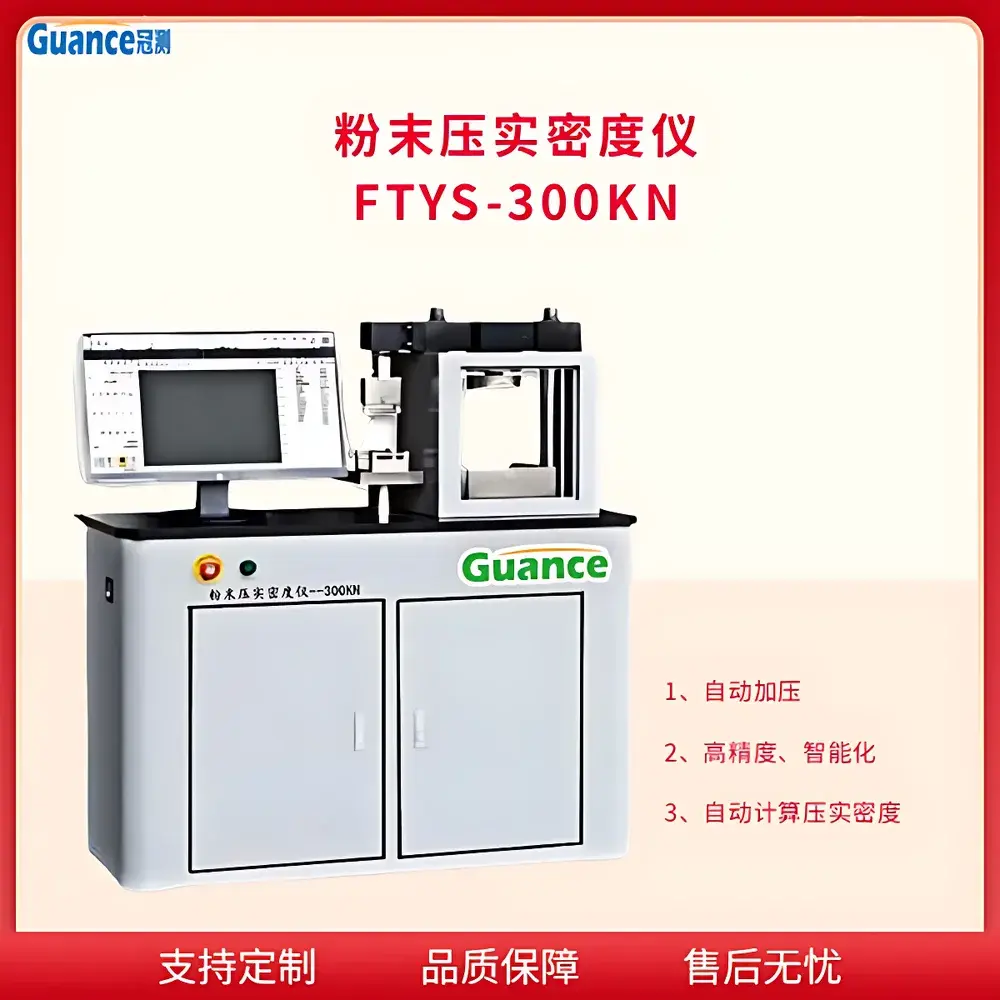
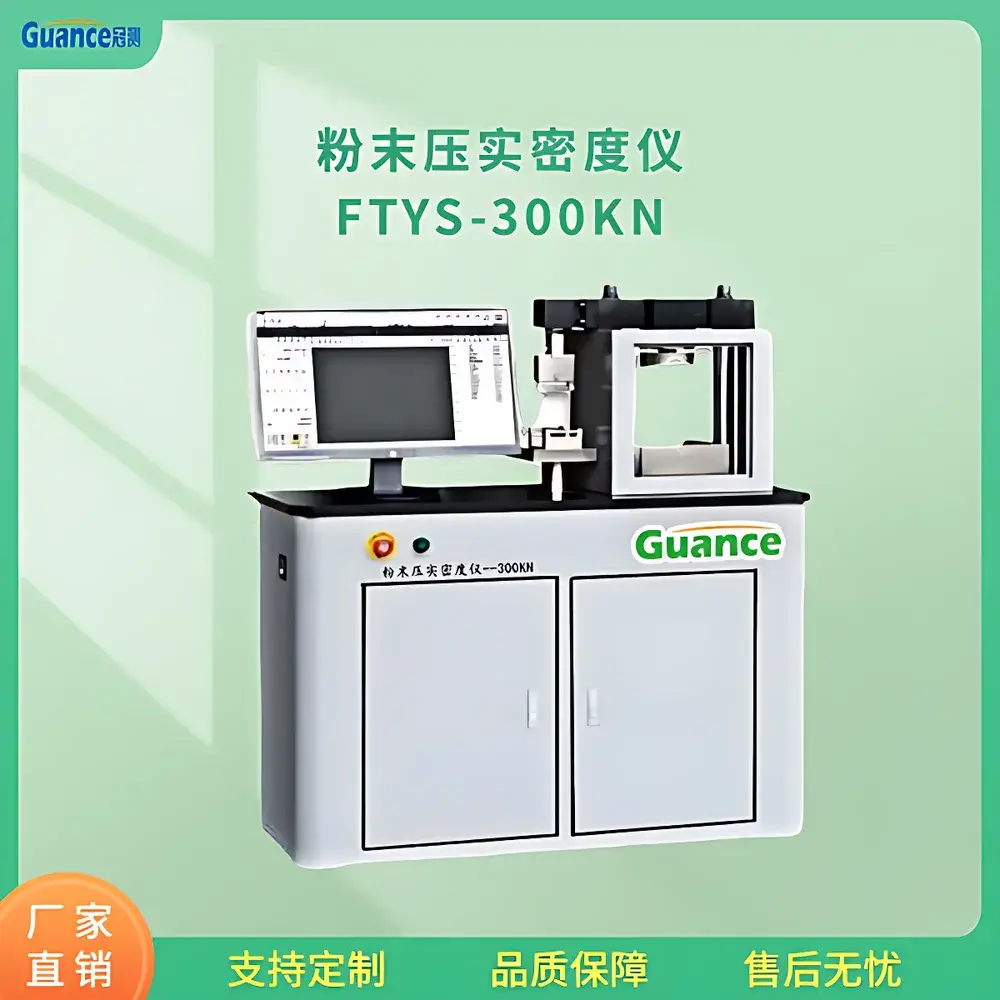
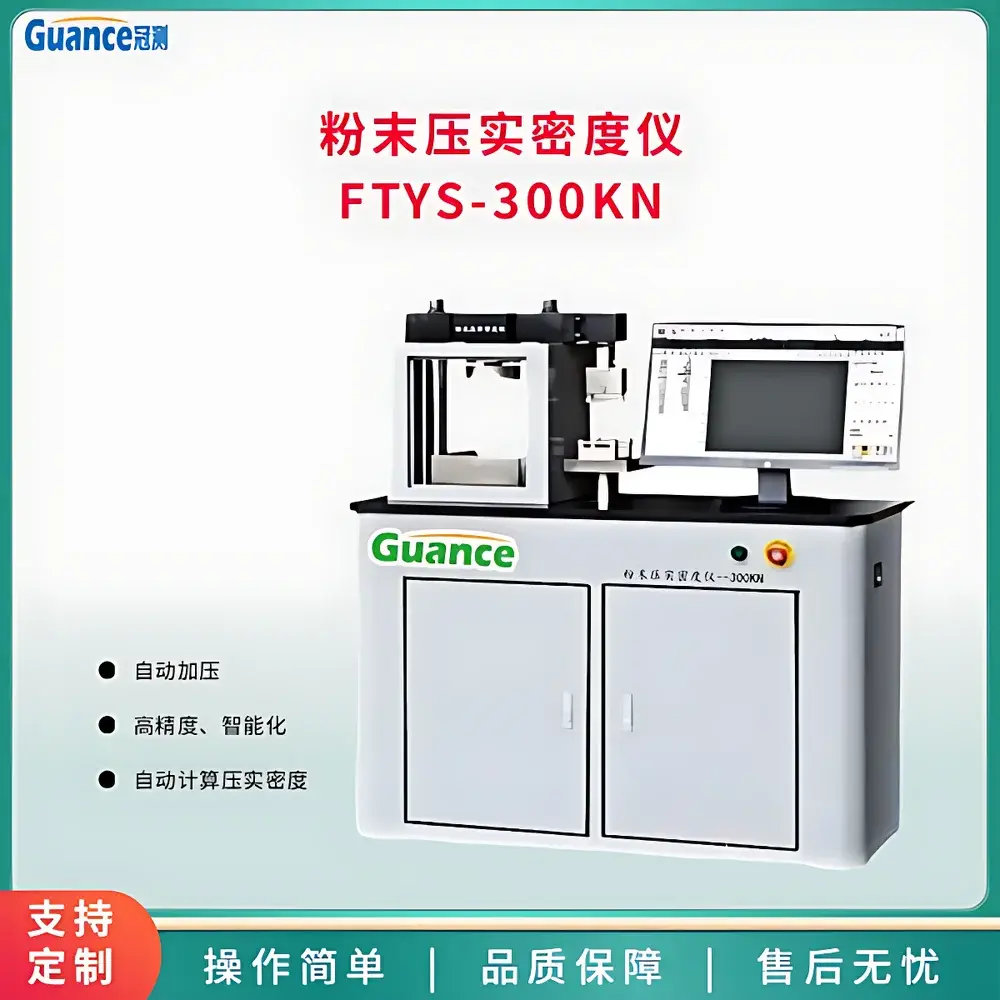
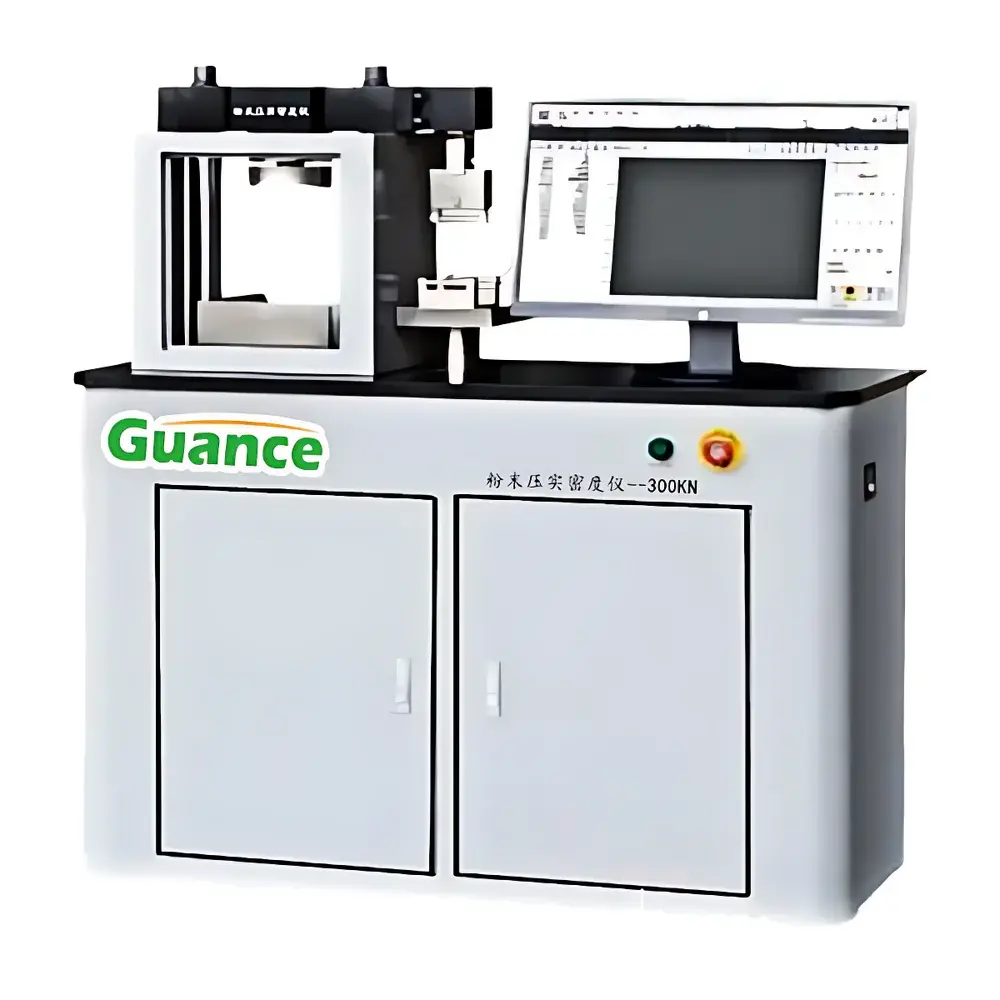
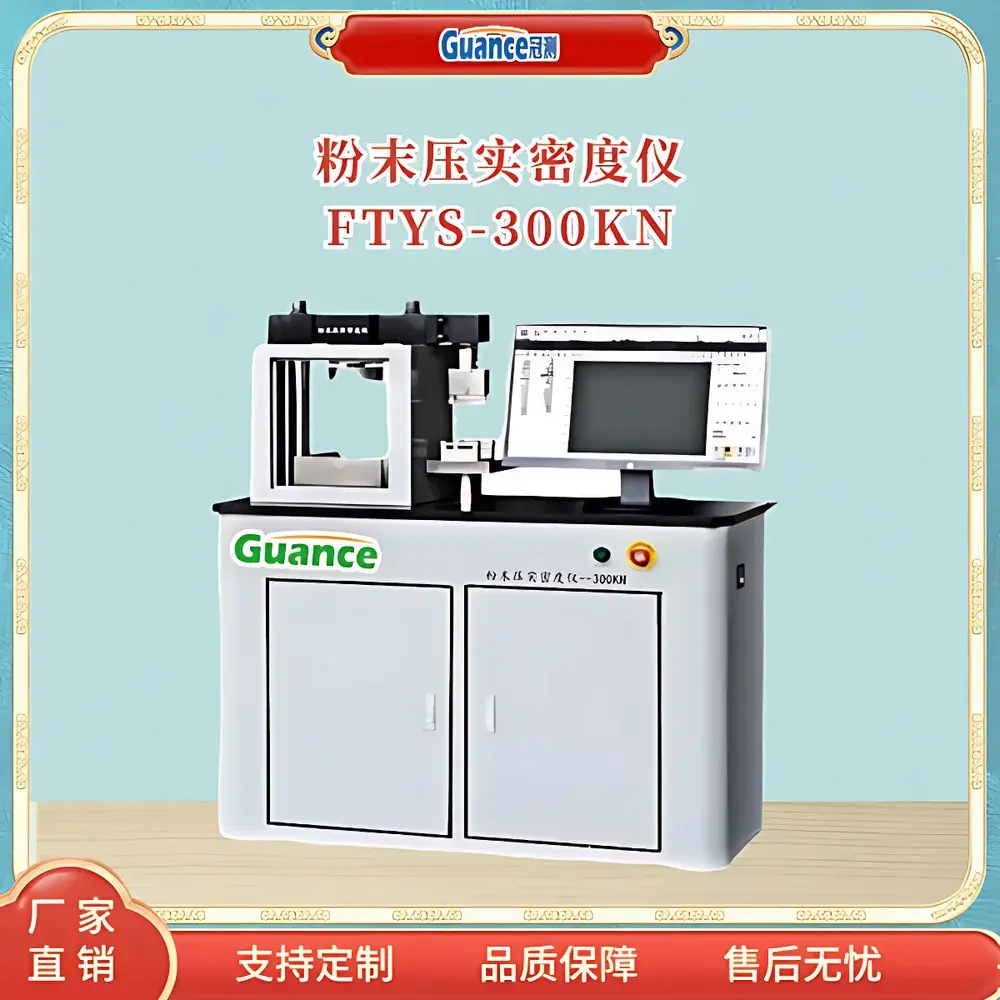
Guance Instruments FTYS300KN Powder Compaction Density Tester for Lithium Nickel Oxide Cathode Materials
| Key | Brand: Guance Instruments |
|---|---|
| Model | FTYS300KN |
| Application | Compaction density measurement of battery electrode powders (e.g., LiNiO₂, graphite anodes) |
| Instrument Type | Benchtop powder compaction densitometer |
| Measurement Principle | Mechanical uniaxial compression + high-precision load/displacement sensing |
| Max Applied Load | 300 kN |
| Load Accuracy | ±0.1% FS |
| Displacement Resolution | 0.001 mm |
| Repeatability | ±0.01 kN (load), ±0.002 mm (displacement) |
| Temperature Operating Range | 0–40 °C |
| Sample Mass Range | 0.1–50 g |
| Compliance Standard | GB/T 24533–2009 |
| Data Output | Digital display + PC-based software with audit trail |
| Software Compliance | Supports GLP/GMP-aligned data integrity features (user access control, electronic signatures, change history logging) |
| Power Supply | AC 220 V ±10%, 50 Hz |
| Dimensions (W×D×H) | 850 × 720 × 1650 mm |
| Weight | ~1,200 kg |
Overview
The Guance Instruments FTYS300KN Powder Compaction Density Tester is a precision-engineered benchtop system designed specifically for the quantitative determination of compaction density in lithium-ion battery electrode active materials—particularly nickel-rich cathode powders such as LiNiO₂ and layered NMC variants, as well as graphite and silicon-based anode materials. It operates on the principle of controlled uniaxial mechanical compression under programmable load-displacement profiles, enabling reproducible simulation of industrial calendering processes. Unlike conventional pycnometers or gas pycnometry systems, this instrument measures *compacted* density—not true or skeletal density—but rather the bulk density achieved under defined compressive stress, directly correlating to electrode porosity, tortuosity, and ion transport efficiency. The test method conforms rigorously to GB/T 24533–2009, the Chinese national standard for graphite anode material compaction density testing, and aligns with analogous practices referenced in ISO 13320 (laser diffraction particle sizing) and ASTM D5712 (electrode slurry rheology and coating uniformity assessment) for cross-method validation.
Key Features
- High-force electro-mechanical actuation: 300 kN maximum static load capacity delivered via high-torque AC servo motor and precision-ground ball screw assembly, ensuring stable force application without thermal drift during extended operation.
- Dual-channel closed-loop control: Simultaneous real-time regulation of load rate (kN/s) and displacement rate (mm/min), supporting standardized ramp-hold sequences per GB/T 24533–2009 Section 6.3.
- Integrated metrology subsystem: High-stability wheel-spoke load cell (±0.1% full-scale accuracy) paired with sub-micron linear encoder (0.001 mm resolution) for synchronized force–displacement data acquisition.
- Benchtop structural architecture: Fully welded steel frame with reinforced base plate and guided compression platen, minimizing lateral deflection and ensuring axial loading fidelity across repeated cycles.
- Modular tooling interface: Interchangeable compression dies (standard Ø25 mm, optional Ø13 mm/Ø32 mm) with hardened stainless-steel surfaces and calibrated height stops to ensure consistent sample volume definition.
- 7×24 operational readiness: Fan-cooled servo drive and low-duty-cycle thermal management enable uninterrupted testing under laboratory QA/QC schedules without performance degradation.
Sample Compatibility & Compliance
The FTYS300KN accommodates free-flowing, cohesive, and agglomerated fine powders typical of cathode precursors (LiNiO₂, NCA, NMC811), anode materials (spherical graphite, SiOₓ/C composites), and conductive additives (Super P, carbon nanotubes). Samples are loaded into precision-machined cylindrical dies; minimum mass requirement is 0.1 g, though optimal repeatability is achieved at ≥5 g for statistically robust density calculation. All mechanical and electrical components comply with IEC 61000-6-2 (EMC immunity) and IEC 61000-6-4 (EMC emission) standards. The system supports traceable calibration per ISO/IEC 17025 requirements when operated with certified reference loads and displacement artifacts. Test reports generated by the software include metadata fields required for GLP audits: operator ID, environmental conditions (temperature/humidity), equipment calibration status, and raw force–displacement time-series export.
Software & Data Management
The included MaxTest v8.0 software suite runs natively on Windows 10/11 platforms and provides full control over test sequencing, parameter scripting, and post-processing. Key capabilities include: automatic calculation of compaction density (ρc = m / [π·r²·h], where h is final compressed thickness measured in situ), derivation of relative density (% RD) against theoretical crystallographic density, and generation of pressure–density curves. Audit trail functionality logs all user actions—including method edits, result deletions, and calibration events—with timestamps and operator credentials. Export options include CSV (for Excel/LabVIEW integration), PDF test certificates (with digital signature support), and XML formats compatible with LIMS environments. Software validation documentation (IQ/OQ protocols) is available upon request to meet FDA 21 CFR Part 11 compliance requirements.
Applications
This instrument serves critical roles in R&D laboratories and production QA departments across the lithium-ion battery supply chain. Primary use cases include: optimization of cathode slurry formulation viscosity and binder distribution prior to coating; evaluation of roller-compaction parameters for dry electrode processing; correlation of powder morphology (BET surface area, particle size distribution) with achievable density limits; failure analysis of low-capacity or high-impedance cells linked to insufficient cathode densification; and supplier qualification testing against contractual density specifications (e.g., LiNiO₂ cathodes requiring ρc ≥ 3.2 g/cm³ at 200 MPa). It is also employed in academic research on solid-state battery composite electrodes, where interfacial contact resistance is highly sensitive to cold-pressing density.
FAQ
What is the difference between “compaction density” and “true density”?
Compaction density reflects the bulk density of a powder after mechanical consolidation under defined stress—it includes interparticle voids and is directly relevant to electrode manufacturing. True density (or skeletal density), measured via helium pycnometry, excludes all pores and represents only the solid-phase material volume.
Can this system be used for wet slurry compression testing?
No—the FTYS300KN is designed exclusively for dry powder compaction. Slurry compression requires environmental control (humidity, solvent vapor management) and dynamic rheological characterization not supported by this configuration.
Is third-party calibration certification available?
Yes—Guance Instruments partners with CNAS-accredited metrology labs to provide ISO/IEC 17025-compliant calibration certificates for both load and displacement channels, including uncertainty budgets.
Does the software support multi-user role-based access control?
Yes—administrator, technician, and viewer roles can be assigned with granular permissions for method editing, test execution, and report generation.
What maintenance is required for long-term accuracy?
Annual verification of load cell linearity and encoder resolution is recommended; routine cleaning of die surfaces and lubrication of guide rails per the maintenance schedule in the operator manual ensures >10,000 cycle durability.



