
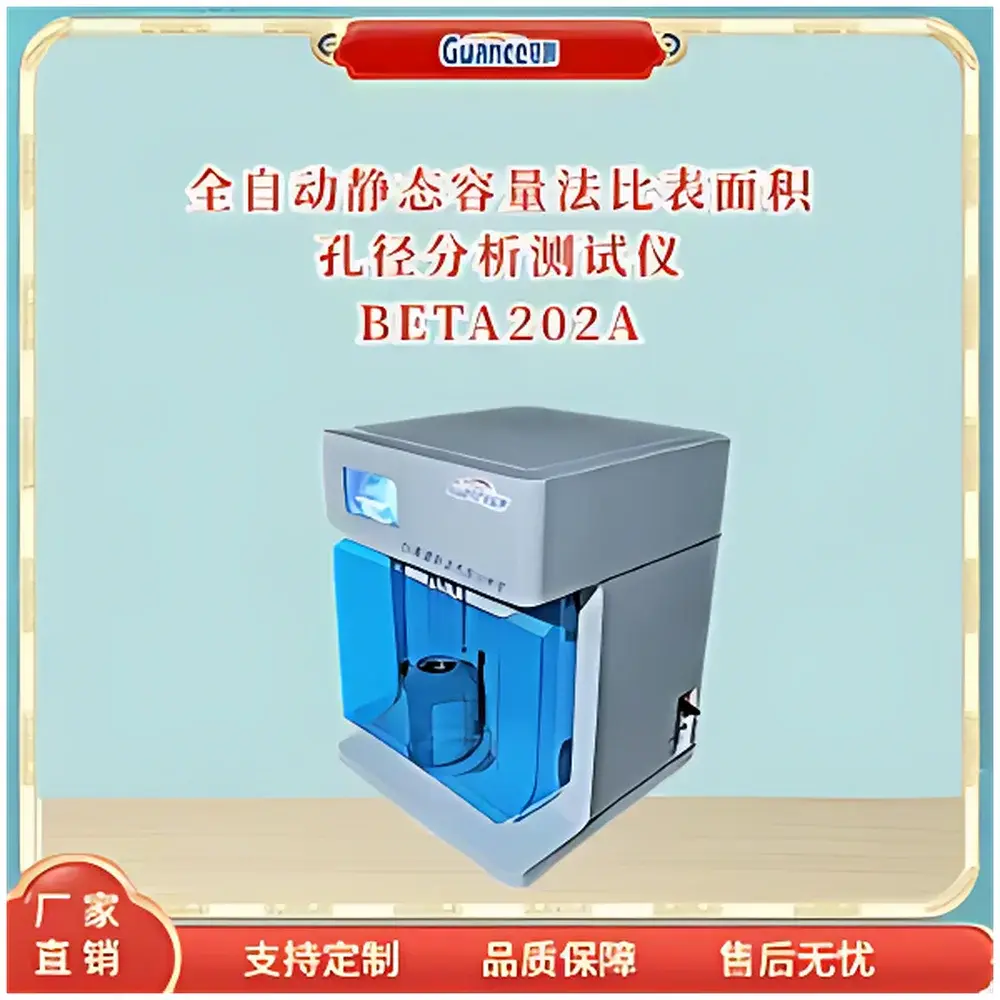
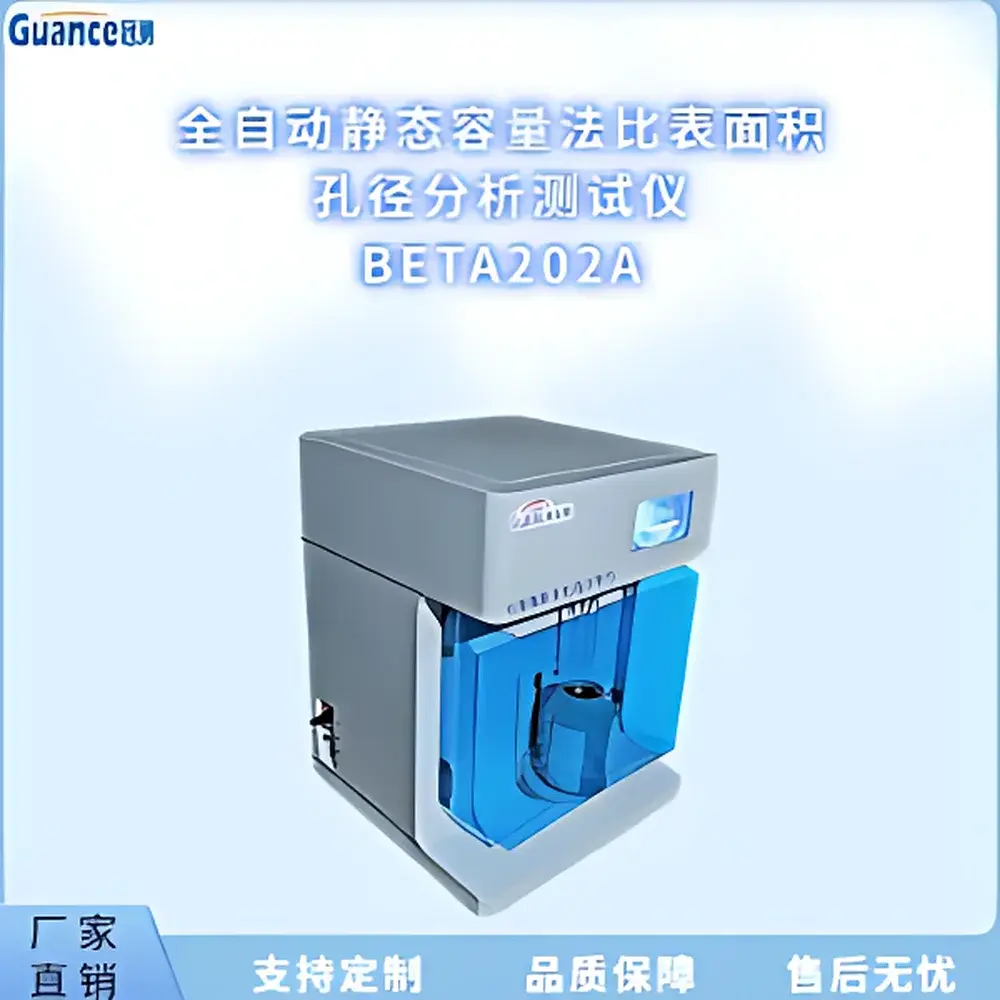
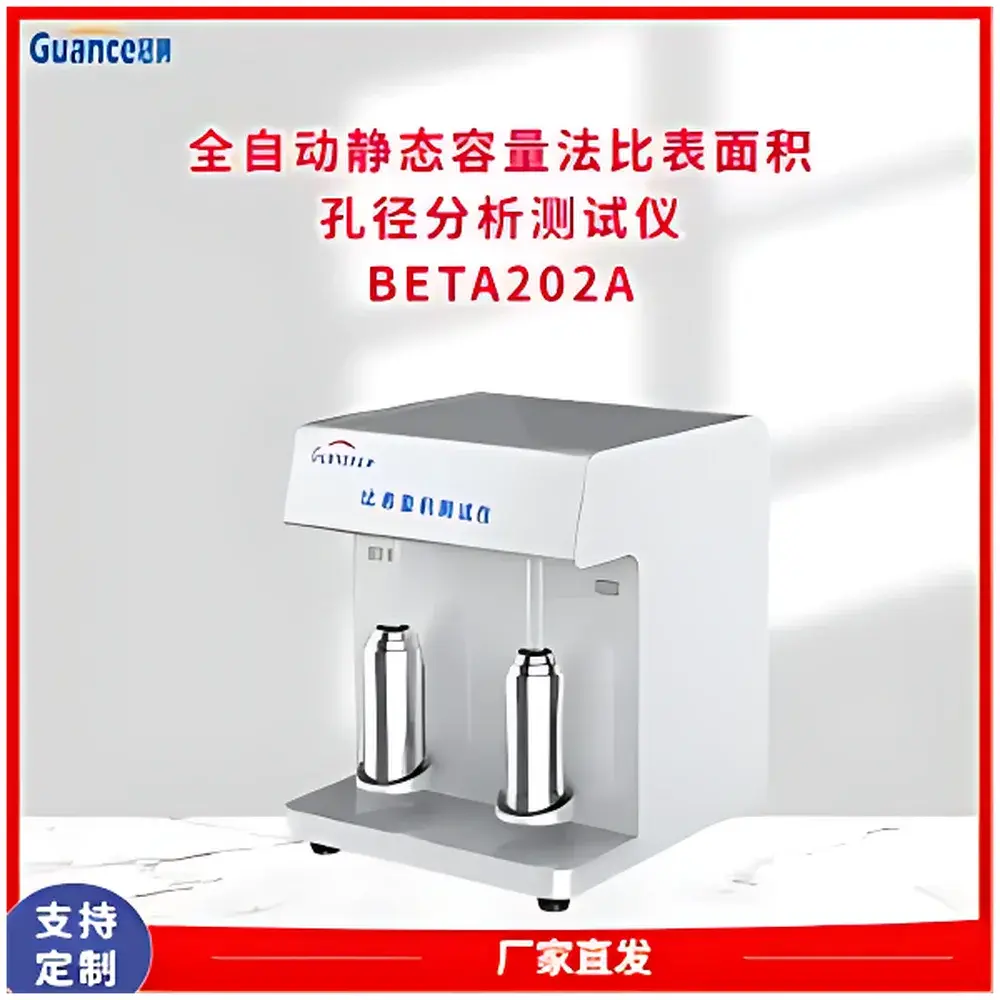
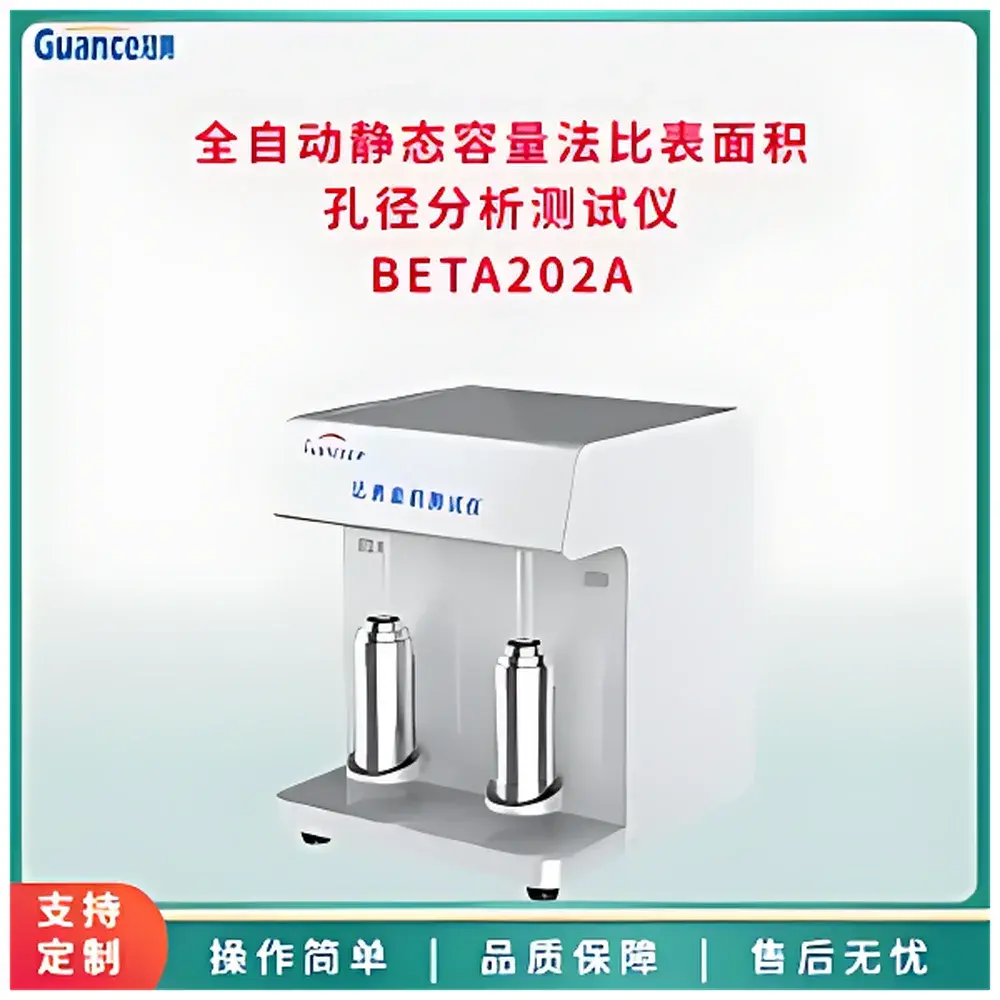
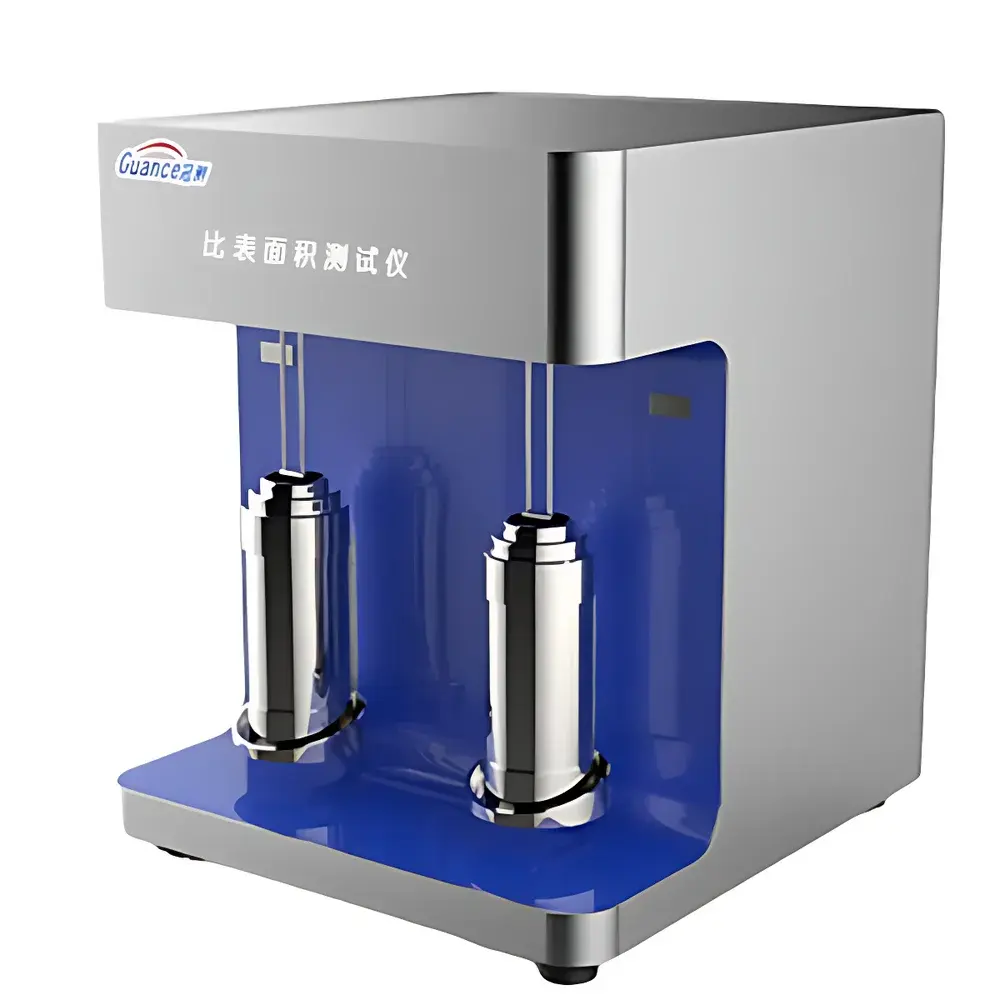
GuanCe Instruments BETA202A4 Specific Surface Area and Pore Size Analyzer
| Brand | GuanCe Instruments |
|---|---|
| Origin | Beijing, China |
| Manufacturer Type | Authorized Distributor |
| Product Category | Domestic |
| Model | BETA202A4 |
| Instrument Type | Specific Surface Area and Pore Size Analyzer |
| Measurement Principle | Static Volumetric Gas Adsorption (BET, BJH, DFT, NLDFT, t-plot, αs-method) |
| Number of Analysis Stations | 10 |
| Specific Surface Area Range | 0.0005 m²/g (Kr) to unlimited |
| Pore Size Range | 0.35 nm – 500 nm |
| Pressure Range | 10⁻⁸ Torr – 1000 Torr |
| Relative Pressure (P/P₀) Resolution | Down to 10⁻⁷ |
| Repeatability | < ±1% (for N₂ at 77 K) |
| Detection Limit for Pore Volume | 0.0001 cm³/g |
| Vacuum System Base Pressure | ≤1×10⁻⁸ Torr (with optional turbomolecular pump) |
| Thermal Management | Integrated liquid nitrogen isothermal jacket with 70-hour autonomy |
| Gas Compatibility | N₂, Ar, Kr, CO₂, NH₃, H₂, CO, O₂, CH₄, C₄H₁₀ (non-corrosive only) |
| Data Acquisition | 24-bit ADC, dual-capacitance manometers (0–10 Torr & 0–1000 Torr), dedicated P₀ reference sensor |
| Connectivity | USB 2.0 or Ethernet (TCP/IP), remote control & multi-instrument management supported |
Overview
The GuanCe Instruments BETA202A4 Specific Surface Area and Pore Size Analyzer is a high-precision, static volumetric gas adsorption system engineered for rigorous physical characterization of porous and powdered materials. It operates on the fundamental principles of gas adsorption isotherm measurement at cryogenic temperatures—primarily using nitrogen at 77 K, but fully compatible with argon (87 K), krypton (77 K), carbon dioxide (273 K), and other non-corrosive probe gases. The instrument implements internationally recognized theoretical models—including BET (Brunauer–Emmett–Teller) for specific surface area, BJH (Barrett–Joyner–Halenda) for mesopore size distribution, and advanced density functional theory (DFT/NLDFT) kernels for micropore analysis—to deliver traceable, metrologically sound results aligned with ASTM D3663, ISO 9277, and IUPAC recommendations. Its 10-station configuration enables parallel sample preparation and sequential analysis, supporting high-throughput laboratory environments without compromising vacuum integrity or thermal stability.
Key Features
- Ultra-high vacuum architecture: All-stainless-steel fluid path with metal-sealed joints, silver-plated internal surfaces, and dual-layer vacuum shielding—achieving base pressures ≤1×10⁻⁸ Torr (with optional turbomolecular pumping)
- Dedicated P₀ reference manifold with independent capacitance manometer ensures continuous, real-time saturation pressure monitoring at P/P₀ up to 0.9995
- Triple-sensor configuration: One P₀ sensor + two high-resolution absolute pressure transducers (0–10 Torr and 0–1000 Torr), each with 0.1% full-scale accuracy and 24-bit data acquisition
- Integrated isothermal jacket with liquid nitrogen reservoir (70 h operational autonomy); optional auto-refill module supports unattended long-term experiments
- Intelligent vacuum management: Adaptive pump cycling reduces acoustic noise, extends pump service life, and maintains stable thermal equilibrium during degassing and analysis
- Unified degas/analysis station design eliminates cross-contamination—sample remains in situ throughout thermal pretreatment and adsorption measurement
- No manual controls: Fully computer-driven operation via Ethernet or USB; firmware supports remote diagnostics, multi-device orchestration over LAN, and audit-ready event logging
Sample Compatibility & Compliance
The BETA202A4 accommodates diverse solid-state samples including inorganic oxides (e.g., SiO₂, Al₂O₃, TiO₂), carbonaceous materials (activated carbon, graphene, CNTs), zeolites, MOFs, battery cathode/anode powders, pharmaceutical excipients, soil aggregates, and fibrous polymers. Sample forms include powders, granules, monoliths, foams, and thin films—compatible with standard 6 mm and 9 mm quartz sample tubes. All hardware and software modules comply with GLP documentation requirements. Raw data files retain full traceability (timestamp, operator ID, instrument serial, calibration history). Optional 21 CFR Part 11 compliance packages provide electronic signature support, role-based access control, and immutable audit trails for regulated QC/QA laboratories.
Software & Data Management
The proprietary GuanCe DataStation™ v5.x platform offers bilingual (English/Chinese) GUI, configurable workflow templates, and modular analysis libraries—including single-point/multi-point BET, t-plot micropore analysis, HK (Horvath–Kawazoe), DA (Dubinin–Astakhov), and QSDFT kernel options. Data export supports PDF reports (customizable layout), Excel (.xlsx) spreadsheets (raw isotherms, derived parameters, statistical summaries), and CSV for third-party modeling. Comparative analysis tools enable overlay of multiple isotherms under identical conditions; time-series tracking supports longitudinal material aging studies. Database stores >50 pre-validated test protocols; users may define custom degas ramps, equilibration thresholds, and pressure step sequences. Power-loss recovery preserves all acquired points and resumes from last stable state—critical for extended pore distribution measurements lasting >3 hours.
Applications
This analyzer serves core R&D and quality control functions across advanced materials science, catalysis, energy storage, environmental engineering, and pharmaceutical development. Typical use cases include: quantifying active surface area of catalyst supports prior to metal loading; evaluating pore structure evolution in Li-ion battery electrodes after cycling; characterizing mesoporous silica carriers for controlled drug release; assessing carbon black dispersion in rubber compounding; verifying consistency of fumed silica (e.g., pyrogenic SiO₂) used as thixotropic agents; and validating pore network connectivity in geopolymer binders. Its Kr-adsorption capability extends low-surface-area detection to <0.001 m²/g—essential for dense ceramics, metals, and highly sintered oxides.
FAQ
Does the BETA202A4 require helium for free space calibration?
No. It employs a dedicated P₀ reference sensor and standardized N₂ or Ar dosing protocols—eliminating dependency on helium and reducing operational cost and supply chain complexity.
Can the system perform simultaneous analysis on multiple samples?
It features 10 independent degas ports and 2 parallel analysis stations—enabling concurrent measurement of two samples while preparing up to eight others under vacuum or inert purge.
What vacuum level is achievable with the base configuration?
Standard configuration achieves ≤1×10⁻⁴ Torr (10⁻² Pa); optional turbomolecular pump upgrade extends performance to ≤1×10⁻⁸ Torr for ultra-microporous materials.
Is CO₂ adsorption supported for narrow micropore analysis?
Yes. The system includes temperature-controlled CO₂ dosing (273 K) and integrated DFT kernels validated for slit-pore and cylindrical carbon models per IUPAC Technical Report 2015.
How is data integrity maintained during extended unattended runs?
All acquisitions are timestamped and checksum-verified; power interruption triggers automatic state snapshotting and seamless resumption without loss of isotherm points or calibration metadata.



