
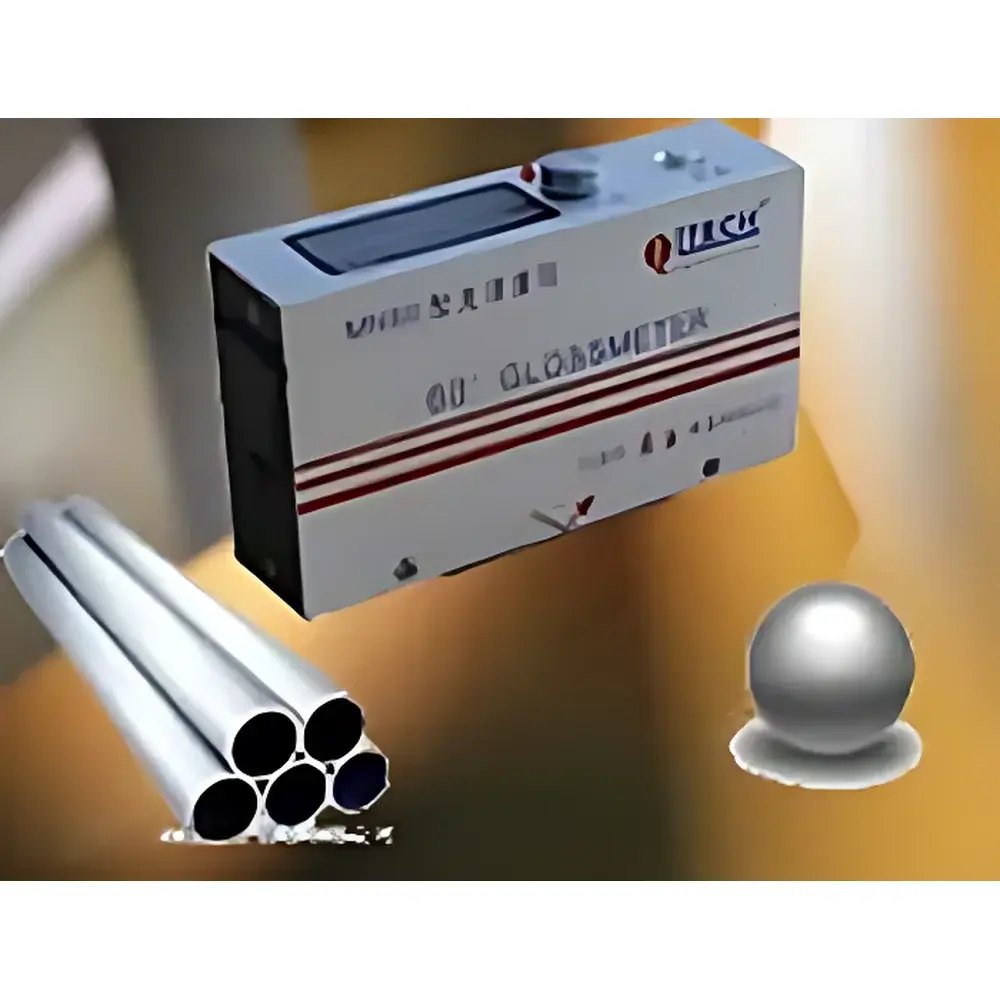
MN60-C Small-Aperture Curved-Surface Gloss Meter
| Origin | Tianjin, China |
|---|---|
| Manufacturer Type | Authorized Distributor |
| Origin Category | Domestic (PRC) |
| Model | MN60-C |
| Pricing | Available Upon Request |
Overview
The MN60-C Small-Aperture Curved-Surface Gloss Meter is a precision optical instrument engineered for quantitative gloss measurement on non-planar and geometrically constrained surfaces. Unlike conventional 60° gloss meters with standard 12–20 mm apertures, the MN60-C employs a tightly defined 4 mm circular measurement spot—enabling reliable, repeatable gloss assessment on convex, concave, or highly contoured substrates where spatial constraints preclude use of conventional geometry. Its optical design follows the principle of specular reflectance measurement at a fixed 60° incident angle, in strict conformance with ISO 2813:2014, ASTM D523–14, DIN 67530, and GB/T 9754–2007 (replacing GB 9754-88) for non-metallic coatings, as well as GB/T 9966.5–2001 for natural stone surface evaluation. The instrument delivers traceable gloss units (GU) calibrated against certified ceramic standards traceable to NIM (National Institute of Metrology, China), ensuring metrological integrity across laboratory, QC, and production environments.
Key Features
- 4 mm diameter measurement aperture—optimized for curved, recessed, embossed, or narrow-profile surfaces including automotive trim, injection-molded plastic housings, coated metal fasteners, and laminated packaging substrates.
- Fixed 60° geometry compliant with international gloss measurement standards for medium-gloss range (10–70 GU typical), offering high angular reproducibility and minimal cosine error.
- Integrated temperature-compensated silicon photodiode detector with spectral response matched to the CIE standard observer (1931), minimizing metamerism-related deviation.
- Rugged aluminum alloy housing with anti-static anodized finish, IP52-rated ingress protection, and shock-absorbing rubber overmold for industrial floor durability.
- Real-time digital display with backlight, auto-zero function, and manual/automatic mode selection; supports single-point calibration using supplied reference tile (99.9 ± 0.2 GU).
Sample Compatibility & Compliance
The MN60-C accommodates diverse substrate geometries without requiring sample flattening or fixture adaptation. It is routinely deployed for quality verification of chrome-plated grilles, curved smartphone casings, thermoformed medical device trays, and lacquered wood veneers. Its compact probe head (Ø28 × 85 mm) permits access to radii as low as R3 mm (measured centerline). All optical path components—including collimating lens, aperture stop, and detector alignment—are factory-aligned and sealed to prevent drift. Regulatory compliance includes full adherence to ISO/IEC 17025:2017 calibration traceability requirements when used with accredited calibration services. While not inherently 21 CFR Part 11-compliant (as it lacks audit trail functionality), its measurement data output is compatible with validated LIMS and QMS platforms supporting GLP/GMP documentation workflows.
Software & Data Management
The MN60-C operates as a standalone instrument but supports optional RS-232 serial interface (DB9) for integration into automated test stations. Raw gloss values (GU), measurement timestamp, and instrument ID can be streamed to host systems for batch logging, SPC charting, or statistical process control. Third-party software drivers are available for compatibility with LabVIEW™, MATLAB®, and common MES platforms. Calibration history and operator ID fields may be appended via external database linkage—enabling full audit readiness under ISO 9001:2015 clause 7.1.5. No proprietary cloud service or firmware-over-the-air updates are provided; all configuration remains local and deterministic.
Applications
- Automotive: Gloss consistency validation on B-pillars, door handles, and instrument panel bezels with compound curvature.
- Packaging: In-line verification of matte-finish PET film lamination uniformity on blister packs and foil-laminated cartons.
- Plastics & Polymers: Batch-to-batch comparison of injection-molded ABS housings post-paint or vapor deposition.
- Architectural Finishes: Quantitative assessment of honed granite countertops and curved ceramic tile installations per ASTM C97/C97M.
- Electronics: Surface finish control of anodized aluminum enclosures and PVD-coated connectors where micro-topography affects perceived gloss.
FAQ
Does the MN60-C support 20° or 85° geometry measurements?
No—the MN60-C is a dedicated 60° gloss meter. Its optical path is mechanically fixed and non-adjustable to maintain alignment stability and regulatory compliance.
Can it measure on transparent films or glass substrates?
Yes, provided the substrate is backed by a non-reflective, matte-black surface (e.g., black felt or calibration backing plate) to eliminate interference from transmitted light and substrate rear reflections.
Is calibration certificate included with shipment?
A factory calibration report (non-accredited) is supplied. For ISO/IEC 17025 traceability, users must schedule third-party calibration using NIST-traceable or NIM-certified standards.
What is the recommended recalibration interval?
Annual recalibration is advised under normal usage; more frequent verification (e.g., daily zero check and weekly standard tile verification) is required in regulated manufacturing environments per internal SOPs.
Does the instrument meet FDA or EU MDR requirements for medical device surface characterization?
While not certified as a medical device, the MN60-C is routinely employed in Class II/III device manufacturing for surface finish verification—provided its use is documented within a validated measurement process per ISO 13485:2016 clause 7.6.





