
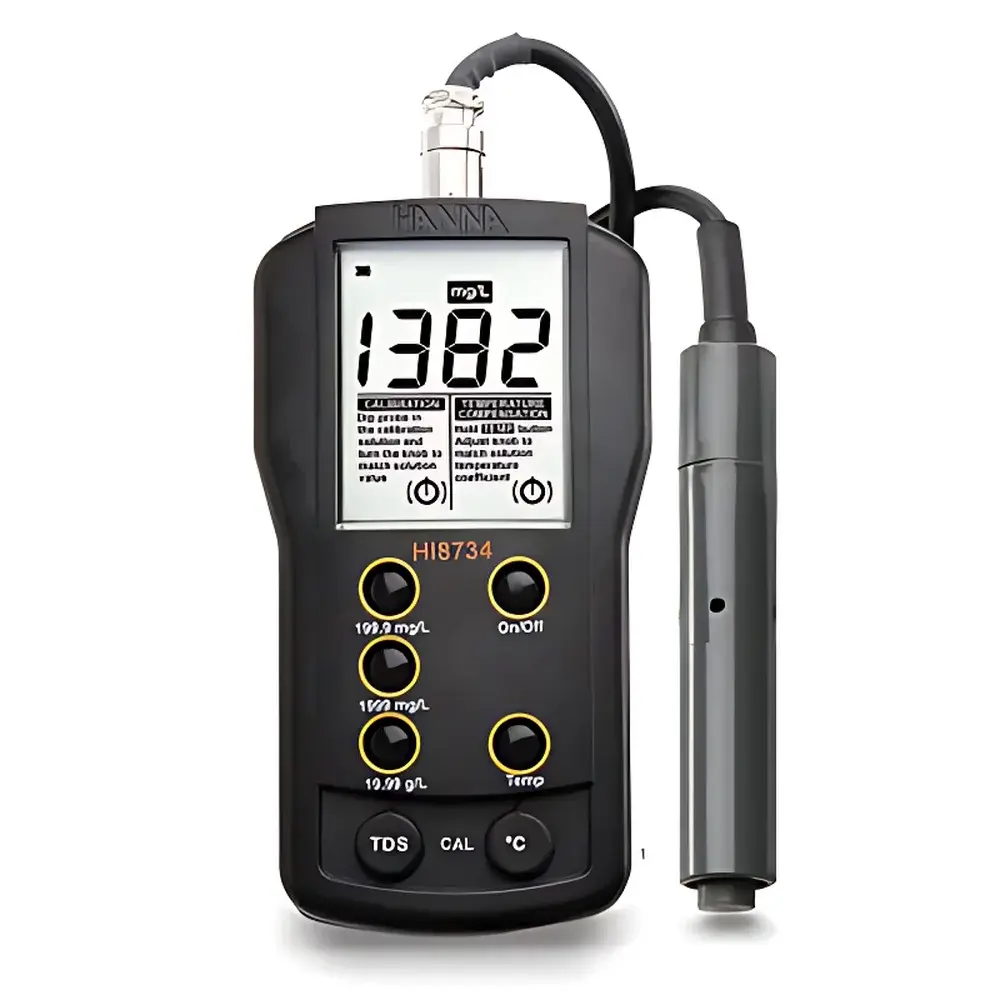
Hanna HI8734 Portable Microprocessor-Based TDS Meter
| Brand | Hanna Instruments |
|---|---|
| Origin | Italy |
| Model | HI8734 Portable TDS Meter |
| Instrument Type | Portable |
| Parameter Type | Single-Parameter |
| Measurement Range | 00.0 to 199.9 mg/L (ppm), 0 to 1999 mg/L (ppm), 0.00 to 19.99 g/L (ppt) |
| Resolution | 0.1 mg/L (ppm), 1 mg/L (ppm), 0.01 g/L (ppt) |
| Accuracy | ±1% F.S. @ 20°C (excluding probe error) |
| Calibration | Manual single-point calibration |
| Temperature Compensation | Manual, 10 to 50°C, β = 2%/°C |
| TDS Conversion Factor | 0.5 |
| Power Supply | 9 V battery |
| Operating Environment | 0 to 50°C, RH ≤ 100% |
| Dimensions | 145 × 80 × 36 mm |
| Weight | 230 g |
Overview
The Hanna HI8734 Portable Microprocessor-Based TDS Meter is a precision electrochemical instrument engineered for reliable, field-deployable total dissolved solids (TDS) measurement in water quality assessment, process monitoring, and environmental sampling. Unlike conventional two-electrode conductivity-based TDS meters that require multiple probes or frequent recalibration across ranges, the HI8734 integrates a proprietary four-ring stainless steel electrode with integrated temperature sensor—enabling stable, low-drift measurements across three decades of concentration without electrode swapping. TDS is derived from electrical conductivity (EC) using a fixed conversion factor (default 0.5), consistent with ASTM D1125 and ISO 7888 methodologies for non-specific ionic solute estimation. Its microprocessor-controlled analog-to-digital conversion ensures linearity and repeatability under variable thermal conditions, while the rugged PVC-bodied probe supports immersion in freshwater, brackish water, and low-conductivity process streams—including deionized water and aquaculture effluents.
Key Features
- Four-range manual selection (0.0–199.9 mg/L, 0–1999 mg/L, 0.00–19.99 g/L) via intuitive front-panel buttons—no menu navigation required
- Large backlit LCD display with simultaneous TDS reading, selected range indicator, and battery status
- Manual temperature compensation (10–50°C) with adjustable β coefficient (2%/°C default), compliant with standard EC-to-TDS conversion protocols
- Single-point calibration workflow: users select a calibration standard closest to expected sample concentration from three pre-defined ranges—minimizing systematic offset and improving traceability
- IP67-rated housing and PVC-shielded electrode for dust resistance and brief submersion (up to 1 m for 30 min), validated per IEC 60529
- Low-power design with auto-off after 8 minutes; powered by a single 9 V alkaline battery (typical life > 200 hours)
Sample Compatibility & Compliance
The HI8734 is optimized for aqueous samples with conductivity below 20 mS/cm—covering applications from ultrapure water (≤ 10 µS/cm) to seawater-strength brines (~50 mS/cm equivalent). It complies with fundamental requirements of ISO/IEC 17025 for field instrumentation used in accredited testing laboratories when operated within specified environmental limits (0–50°C, non-condensing humidity). While not inherently 21 CFR Part 11 compliant due to lack of electronic audit trail, its manual calibration log and fixed TDS factor support GLP-aligned documentation when paired with lab notebook entries. The instrument meets CE marking directives for electromagnetic compatibility (2014/30/EU) and low-voltage safety (2014/35/EU).
Software & Data Management
The HI8734 operates as a standalone, firmware-embedded system with no external software dependency. All operational parameters—including calibration date, selected range, and temperature compensation setting—are retained in non-volatile memory during battery replacement. Data output is limited to real-time display only; no USB, Bluetooth, or analog output is provided. For regulated environments requiring data integrity, users are advised to record readings manually or integrate the meter into a validated paper-based or LIMS-linked observation protocol. Calibration verification can be performed using NIST-traceable KCl standards (e.g., 84 µS/cm, 1413 µS/cm, 12.88 mS/cm) aligned with USP conductivity verification guidelines.
Applications
- Drinking water and wastewater treatment: rapid verification of reverse osmosis (RO) reject/permeate quality and disinfection byproduct precursor screening
- Aquaculture and hydroponics: daily monitoring of nutrient solution salinity and osmotic stability
- Food & beverage production: incoming water qualification, boiler feedwater control, and rinse water validation
- Environmental field surveys: stream, lake, and groundwater TDS profiling in EPA Region 10 or EU WFD monitoring programs
- Educational labs: hands-on instruction in electrochemical principles, calibration theory, and water chemistry fundamentals
FAQ
What TDS conversion factor does the HI8734 use by default?
The instrument applies a fixed TDS factor of 0.5 (50% of measured conductivity), consistent with sodium chloride-dominated matrices and widely adopted in municipal water testing.
Can the HI8734 measure conductivity directly?
No—the HI8734 is a dedicated TDS meter; it does not display raw conductivity values or allow user-adjustable TDS factors beyond factory-set defaults.
Is automatic temperature compensation (ATC) available?
No—temperature compensation is manual; users must input ambient or sample temperature prior to measurement to apply the β = 2%/°C correction.
How often should the electrode be cleaned and recalibrated?
Clean the four-ring probe with mild detergent and deionized water after each use in turbid or organic-rich samples; recalibrate before each analytical session or when drift exceeds ±2% of full scale.
Does the HI8734 meet ISO 5667-3 for water sampling?
While the meter itself is not certified to ISO 5667-3, its measurement capability supports compliance when used per Section 8.3.2 (field instrumentation requirements) in conjunction with documented SOPs for probe handling and calibration verification.




