
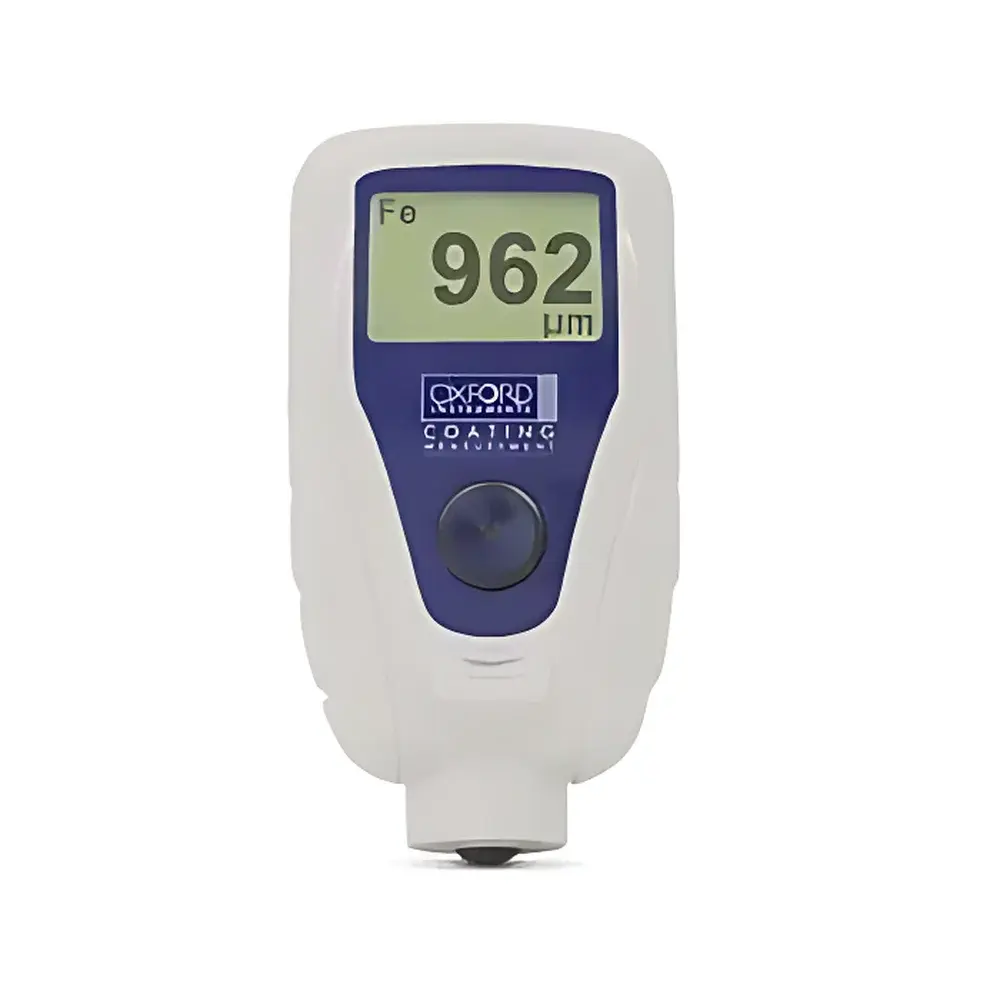
Oxford Instruments CMI153 Electromagnetic Eddy Current & Magnetic Induction Coating Thickness Gauge
| Brand | Oxford Instruments |
|---|---|
| Origin | USA |
| Model | CMI153 |
| Measurement Range (Ferrous) | 0.001–2.04 mm (0.1–80 mil) |
| Measurement Range (Non-Ferrous) | 0.001–1.52 mm (0.1–60 mil) |
| Minimum Substrate Thickness | 305 µm (12 mil) |
| Dimensions | 9.53 × 5.08 × 2.52 cm |
| Weight | 71 g |
| Power | 2 × AA batteries |
| Units | Auto-switching between metric and imperial |
| Compliance | ASTM B499, B530, B244, B529 |
Overview
The Oxford Instruments CMI153 is a handheld dual-technology coating thickness gauge engineered for high-precision, non-destructive measurement of non-conductive coatings on non-ferrous substrates and non-magnetic coatings on ferrous substrates. It integrates two physically distinct electromagnetic principles—magnetic induction for ferrous base metals (e.g., steel, iron) and eddy current for non-ferrous conductive substrates (e.g., aluminum, copper, brass)—within a single compact, field-deployable instrument. Unlike single-mode gauges, the CMI153 automatically detects substrate type upon contact, eliminating manual mode selection and reducing operator-induced error. Its sensor architecture is optimized for surface conformity and edge sensitivity, making it suitable for curved, contoured, or narrow-area measurements common in automotive body panels, aerospace fasteners, and precision machined components. The device operates without calibration adjustment across certified substrate types, relying on factory-traceable calibration per international metrological standards.
Key Features
- Dual-sensing capability: Simultaneous magnetic induction (for steel/iron) and eddy current (for Al, Cu, Zn, brass) measurement in one probe head
- Automatic substrate recognition: Real-time discrimination between ferrous and non-ferrous base materials—no user mode switching required
- Pre-calibrated at manufacture: Fully compliant with ASTM, ISO, DIN, and BS standards; no field recalibration needed for routine use
- High-resolution display with unit toggle: Seamless switching between µm/mil via single keypress; resolution down to 0.1 µm (0.01 mil)
- Low-power design: Two AA batteries provide >100 hours of continuous operation; auto-power-off after 5 minutes of inactivity
- Ergonomic form factor: Compact footprint (9.53 × 5.08 × 2.52 cm), lightweight (71 g), and integrated belt-clip holster for hands-free lab or shop-floor use
- Robust mechanical construction: Sealed probe interface and shock-absorbing housing rated for industrial environments
Sample Compatibility & Compliance
The CMI153 is validated for use on standard engineering substrates meeting minimum thickness requirements: ≥305 µm (12 mil) for both ferrous and non-ferrous base metals. It measures insulating or non-magnetic layers including paint, enamel, epoxy, powder coating, anodized oxide films, PTFE, and electroplated deposits (e.g., Zn, Cd, Cr, Ni). Measurements are traceable to NIST-certified reference standards included with each unit. Regulatory alignment includes full adherence to ASTM B499 (magnetic induction), ASTM B244 (eddy current), ISO 2178 and ISO 2360, DIN 50981 and DIN 50984, and BS 5411 Parts 3, 9, and 11. The instrument supports GLP-compliant workflows through documented calibration history, stable zero-point retention, and repeatable inter-unit performance—critical for QA/QC labs operating under ISO/IEC 17025 or IATF 16949 frameworks.
Software & Data Management
While the CMI153 operates as a standalone, self-contained gauge, its measurement data can be exported via optional USB-to-serial adapter (sold separately) to Oxford Instruments’ proprietary CMI DataLink software. This Windows-based application enables batch export to CSV or Excel, statistical analysis (mean, SD, Cp/Cpk), pass/fail threshold setting, and report generation compliant with internal audit and FDA 21 CFR Part 11 requirements (when used with electronic signature modules). All stored readings retain timestamp, probe ID, substrate type, and unit mode metadata. Firmware updates are delivered via secure download portal, ensuring continued compliance with evolving industry test method revisions.
Applications
- Automotive OEMs and Tier-1 suppliers: In-line verification of e-coat, primer, topcoat, and clearcoat thickness on stamped steel and aluminum chassis components
- Aerospace MRO facilities: Thickness validation of anodized layers on aluminum airframes and corrosion-inhibiting primers on titanium fasteners
- Electroplating and metal finishing plants: Process control of zinc, nickel, and chromium plating thickness per ASTM B633 and AMS 2400 series specifications
- Coating formulation R&D labs: Rapid screening of film build during spray, dip, or roll-coating trials on standardized test panels
- Third-party inspection agencies: Field verification of coating compliance per SSPC-PA2, ISO 19840, or NORSOK M-501 requirements
- Paint and powder coating distributors: Technical support for end-users requiring rapid, standards-aligned thickness verification prior to curing or shipment
FAQ
Does the CMI153 require daily calibration verification?
No. The instrument is factory-calibrated against certified reference standards and maintains calibration stability over time. Daily verification using the supplied check standards is recommended but not mandatory for routine use per ASTM E177 guidelines.
Can it measure coatings on galvanized steel?
Yes—provided the zinc layer is non-magnetic (i.e., pure Zn or Zn-Al alloy) and the underlying steel substrate meets minimum thickness requirements (≥305 µm). Magnetic induction mode measures the total non-magnetic coating stack above ferrous base.
Is the probe interchangeable with other CMI-series models?
No. The CMI153 uses a proprietary dual-mode probe assembly optimized for its specific electronics and signal processing architecture. Probes from CMI150 or CMI200 are not mechanically or electrically compatible.
What environmental conditions affect measurement accuracy?
Extreme temperature gradients (>±10°C from calibration ambient), strong external magnetic fields (e.g., near welding equipment), or surface contamination (oil, rust, dust) may introduce deviation. Clean, dry, smooth surfaces yield optimal repeatability (±1% of reading or ±0.1 µm, whichever is greater).
Is firmware upgrade support available post-purchase?
Yes. Oxford Instruments provides free firmware updates for the lifetime of the product via registered user access to the Support Portal, including enhancements to measurement algorithms and regulatory reporting features.



