
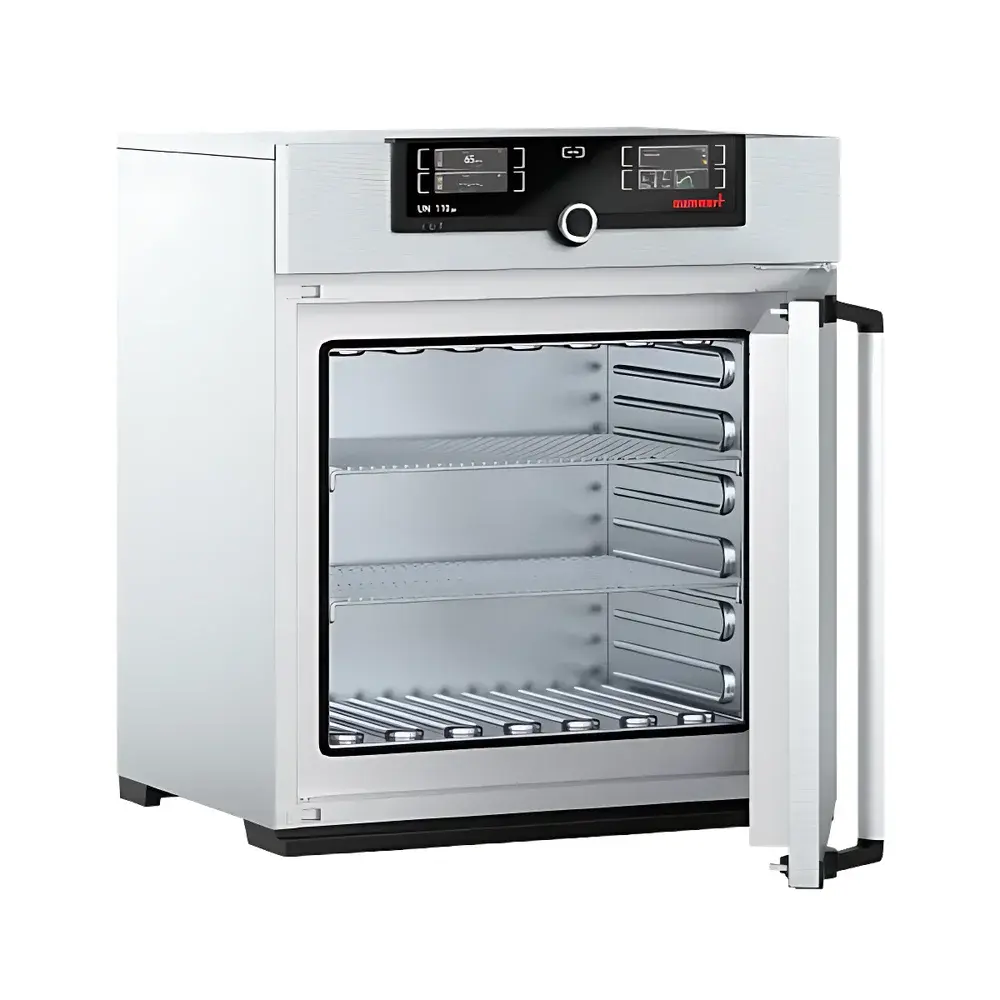
Memmert UNpa Series Paraffin Wax Oven
| Brand | Memmert |
|---|---|
| Origin | Germany |
| Manufacturer | Memmert GmbH & Co. KG |
| Model Variants | UNpa 30 / 55 / 75 / 110 |
| Temperature Range | 20–80 °C |
| Temperature Uniformity | ±0.5 °C |
| External Dimensions (W×H×D) | 585 × 704 × 434 mm |
| Internal Chamber Dimensions (W×H×D) | 400 × 320 × 250 mm |
| Chamber Material | AISI 304 Stainless Steel |
| Heating Configuration | Four-Side Radiant Heating |
| Compliance | CE, ISO 17025-supportive design, GLP-compatible operation |
Overview
The Memmert UNpa Series Paraffin Wax Oven is a purpose-engineered thermal processing system designed exclusively for the safe, precise, and reproducible heating and conditioning of paraffin wax in histopathology, tissue embedding, and biomedical research laboratories. Unlike conventional forced-air drying ovens, the UNpa operates on a static, convection-free heating principle—relying on four-sided radiant heating elements integrated into all chamber walls. This architecture eliminates air movement, preventing wax oxidation, evaporation loss, and particulate contamination from circulating dust or residual oils. The sealed internal chamber maintains near-hermetic conditions during operation, mitigating risks associated with paraffin’s high capillary action and low flash point (~200 °C), particularly when molten wax infiltrates narrow instrument gaps or electronic housings. Temperature control is achieved via a high-stability Pt100 sensor and microprocessor-based PID algorithm, delivering long-term stability and spatial uniformity within ±0.5 °C across the full 20–80 °C operating range—critical for consistent wax viscosity, infiltration kinetics, and embedding integrity.
Key Features
- Four-side radiant heating system ensures uniform thermal energy distribution without airflow-induced turbulence or localized hot spots
- AISI 304 stainless steel interior chamber with seamless welds and polished finish—resistant to paraffin residue adhesion and compatible with routine solvent cleaning (e.g., xylene, chloroform)
- Hermetically sealed chamber design minimizes oxygen ingress, reducing wax degradation and eliminating risk of oil mist ignition or condensation on control electronics
- Independent overtemperature protection circuit (mechanical safety thermostat) compliant with EN 61000-6-2 and IEC 61000-6-4 electromagnetic compatibility standards
- Intuitive membrane keypad interface with real-time temperature display, setpoint memory, and power-on default retention
- Modular footprint accommodating four standard internal volumes (UNpa 30/55/75/110), enabling scalability from benchtop histology stations to high-throughput core facilities
Sample Compatibility & Compliance
The UNpa oven is validated for use with medical-grade paraffin waxes (melting points 52–62 °C), low-viscosity infiltration media, and polymer-based embedding compounds requiring stable sub-boiling thermal conditioning. Its design supports compliance with ISO 15189 (medical laboratories), CLIA regulations (US clinical labs), and Good Laboratory Practice (GLP) documentation requirements. While not classified as a Class II medical device under FDA 21 CFR Part 860, its temperature traceability—supported by factory calibration certificates (NIST-traceable Pt100 sensor) and optional external validation ports—facilitates IQ/OQ/PQ protocols. No airflow means no requirement for HEPA filtration or ducted exhaust, simplifying installation in ISO Class 5–7 cleanroom-adjacent environments.
Software & Data Management
The UNpa operates as a standalone instrument with embedded firmware; no PC connectivity or proprietary software is required for routine operation. However, it supports analog output (0–10 V or 4–20 mA) for integration into centralized building management systems (BMS) or laboratory information management systems (LIMS). Optional data logging modules (e.g., Memmert LogControl) enable time-stamped temperature recording compliant with FDA 21 CFR Part 11 audit trail requirements—including user authentication, electronic signatures, and immutable event logs. Calibration intervals are configurable per institutional SOPs, with built-in self-diagnostics reporting heater status, sensor drift, and door seal integrity.
Applications
- Tissue processing workflows: Pre-warming paraffin baths, maintaining wax reservoirs at constant viscosity prior to infiltration and embedding
- Histology quality assurance: Standardized conditioning of embedding molds, metal cassette carriers, and forceps to minimize thermal shock during specimen transfer
- Research applications: Controlled phase-change studies of hydrocarbon-based embedding matrices, thermal aging of biomaterial scaffolds, and solvent-free polymer annealing
- Diagnostic lab infrastructure: Integration into automated tissue processors where ambient temperature stability directly impacts sectioning quality and staining consistency
- Education & training: Demonstrating principles of conductive heat transfer, thermal inertia, and closed-system thermoregulation in biomedical engineering curricula
FAQ
Is the UNpa oven suitable for melting solid paraffin blocks directly?
Yes—its 80 °C maximum temperature and uniform four-wall heating ensure complete, bubble-free melting without surface scorching or thermal stratification.
Can the chamber be sterilized using vaporized hydrogen peroxide (VHP)?
No—VHP is incompatible with the chamber’s elastomeric door gasket and internal electronics; only liquid disinfectants approved for stainless steel (e.g., 70% ethanol, isopropanol) are recommended.
Does Memmert provide IQ/OQ documentation templates?
Yes—validated protocol templates aligned with ISO/IEC 17025 and GxP expectations are available upon request through Memmert’s Technical Support team.
What maintenance is required to sustain ±0.5 °C uniformity over time?
Annual verification using a calibrated reference thermometer and quarterly visual inspection of door seal compression are sufficient; no recalibration of factory-set PID parameters is needed under normal use.
Is the UNpa series compatible with explosion-proof laboratory zones?
No—it lacks ATEX or IECEx certification; use in hazardous locations requires third-party enclosure retrofitting and risk assessment per local authority requirements.



