
HACH Pocket Colorimeter II for Residual Chlorine and Chlorine Dioxide
| Brand | HACH |
|---|---|
| Origin | USA |
| Model | PCII Portable Colorimeter |
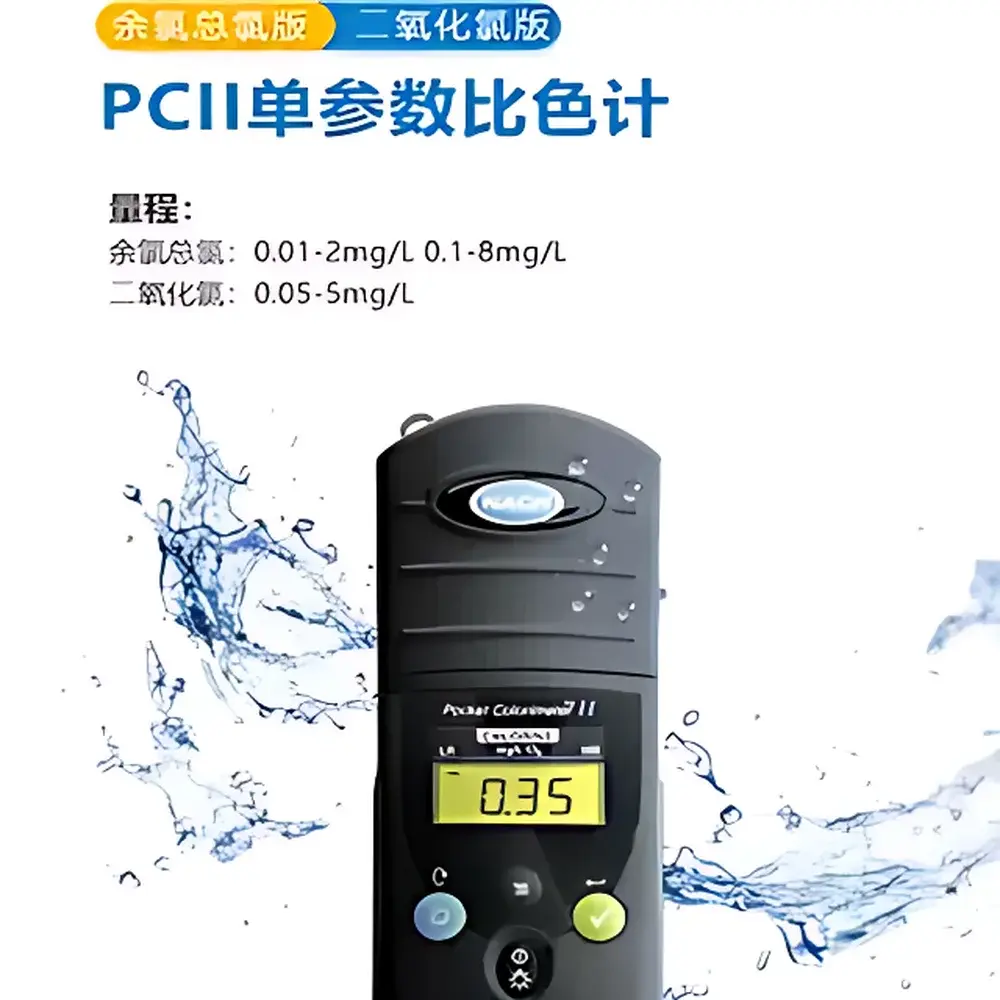
| Measurement Range | Free/Total Chlorine: 0.01–2 mg/L (LR) and 0.1–8 mg/L (HR) |
| Chlorine Dioxide | 0.05–5 mg/L |
| Detection Limit | 0.01 mg/L Cl₂ (LR mode) |
| Optical System | LED-based fixed-wavelength photometry (525 nm for chlorine, 430 nm for ClO₂) |
| Display | Backlit LCD, 2-line alphanumeric |
| Data Storage | Up to 50 measurement records with timestamp |
| Enclosure Rating | IP67 |
| Power | Two AAA batteries (approx. 2,000 measurements per set) |
| Compliance | Meets EPA Method 334.0 (chlorine), ASTM D1253, and ISO 7393-2 requirements for field chlorine analysis |
Overview
The HACH Pocket Colorimeter II for Residual Chlorine and Chlorine Dioxide is a compact, field-deployable photometric analyzer engineered for rapid, reliable quantification of free chlorine, total chlorine, and chlorine dioxide in drinking water, wastewater effluent, swimming pools, and distribution systems. It operates on the principle of fixed-wavelength absorbance photometry: sample reagents react selectively with target analytes to form colored complexes—free/total chlorine forms a pink-colored chlorophenol red complex at pH 6.2–6.5, while chlorine dioxide generates a stable yellow-orange chromophore in acidic buffer. The instrument measures absorbance at pre-optimized wavelengths (525 nm for chlorine species, 430 nm for ClO₂) using calibrated LED light sources and silicon photodetectors. Its optical architecture eliminates manual wavelength selection and minimizes inter-unit variability, ensuring high reproducibility across operators and sites. Designed for compliance-driven environments, the PCII delivers trace-level detection (0.01 mg/L Cl₂ in low-range mode) without requiring benchtop infrastructure or skilled spectroscopists.
Key Features
- Pre-programmed, NIST-traceable calibration curves for free chlorine, total chlorine, and chlorine dioxide—no user calibration required under routine operation
- IP67-rated enclosure providing full dust ingress protection and submersion resistance up to 1 m for 30 minutes, validated per IEC 60529
- Backlit, two-line alphanumeric LCD display with intuitive icon-driven menu navigation and real-time unit indication (mg/L Cl₂ or mg/L ClO₂)
- Integrated data logging capability storing up to 50 measurements with date/time stamps—exportable via optional IR interface (HACH IR-USB adapter)
- Dual-range measurement capability: Low Range (0.01–2 mg/L Cl₂) optimized for regulatory compliance in potable water; High Range (0.1–8 mg/L Cl₂) suitable for disinfection process monitoring in treatment plants
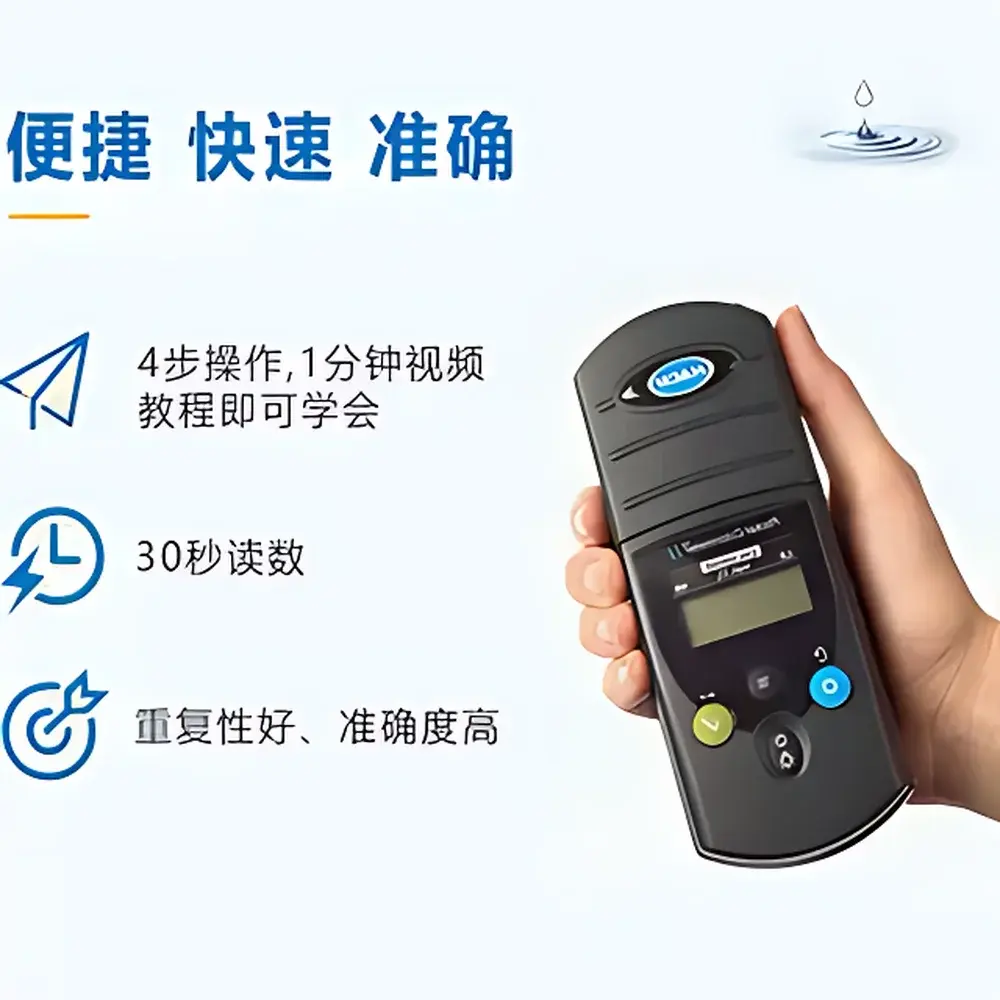
- Battery-powered operation (2 × AAA) supporting >2,000 measurements per set, with low-battery indicator and auto-power-off after 10 minutes of inactivity
Sample Compatibility & Compliance
The PCII is validated for use with HACH’s proprietary reagent kits (e.g., 2105569 for free/total chlorine, 2105869 for chlorine dioxide), which include stabilized DPD (N,N-diethyl-p-phenylenediamine) and specific acid buffers to ensure stoichiometric reaction completeness and interference suppression. It accommodates standard 10-mL and 25-mL square glass or plastic cuvettes (included), with built-in cuvette detection to prevent erroneous readings from improper insertion. The system meets method performance criteria outlined in U.S. EPA Method 334.0 for residual chlorine determination and aligns with ASTM D1253 (Standard Test Method for Total Chlorine in Water) and ISO 7393-2 (Water Quality – Determination of Free and Total Chlorine – Part 2: Colorimetric Method). While not a GLP-compliant instrument per se, its audit-ready data logs and consistent reagent lot traceability support routine QA/QC documentation in municipal and industrial water laboratories operating under ISO/IEC 17025 frameworks.
Software & Data Management
The PCII operates as a standalone analytical endpoint with no embedded firmware update capability; however, measurement records are retrievable via optional infrared communication using HACH’s DR/IR software suite (v3.2+). Exported CSV files contain columns for sample ID (user-assigned), measured concentration, measurement mode (LR/HR), date, time, and instrument serial number—facilitating integration into LIMS platforms or Excel-based trending dashboards. No cloud connectivity or remote configuration is supported, preserving data sovereignty and minimizing cybersecurity exposure in critical infrastructure settings. All stored data retain factory-set time stamps synchronized at first power-on; manual time adjustment is disabled to maintain chain-of-custody integrity during field audits.
Applications
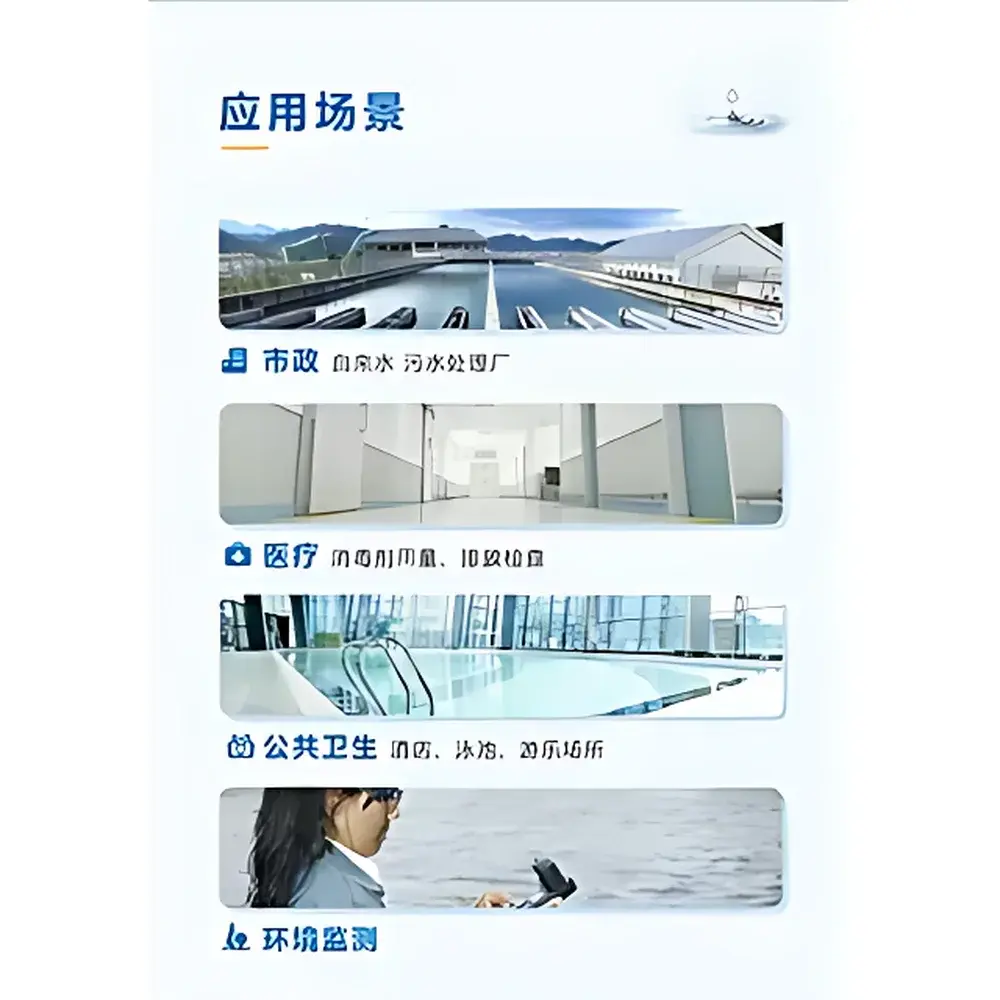
- Routine verification of residual disinfectant levels at finished water points in drinking water treatment plants
- Field validation of chlorine decay profiles across distribution networks during hydraulic modeling studies
- Compliance monitoring for NSF/ANSI Standard 50-certified pool and spa systems
- Emergency response screening following natural disasters or infrastructure failures where rapid chlorine residual assessment is critical
- Process control support for chlorine dioxide generation systems in pulp/paper and food processing facilities
- Educational laboratory use for undergraduate environmental chemistry courses emphasizing EPA-approved field methods
FAQ
Does the PCII require annual recalibration by an accredited lab?
No—its optical path and LED output are factory-stabilized for the instrument’s service life. Users perform functional verification using HACH’s certified reference standards (e.g., 2105571 Chlorine Standard Set) before each sampling shift.
Can the same reagent kit be used for both free and total chlorine measurements?
Yes—HACH’s DPD-based kits (e.g., 2105569) include separate vials for free chlorine (DPD #1 only) and total chlorine (DPD #1 + #3), with the PCII automatically applying the correct curve based on selected test mode.
Is the device compatible with third-party reagents?
HACH does not validate or support non-HACH reagents. Use of alternate chemistries may compromise accuracy, repeatability, and regulatory acceptability of results.
What is the temperature operating range for field deployment?
The PCII functions reliably between 0 °C and 50 °C ambient temperature, with internal thermal compensation correcting for LED drift within this interval.
How is measurement uncertainty characterized for reporting purposes?
Per HACH Technical Bulletin TB009, typical combined standard uncertainty at mid-range (1.0 mg/L Cl₂ LR) is ±0.03 mg/L (k=2), derived from repeatability, reagent lot variance, and photometric noise contributions.
Related Products







