
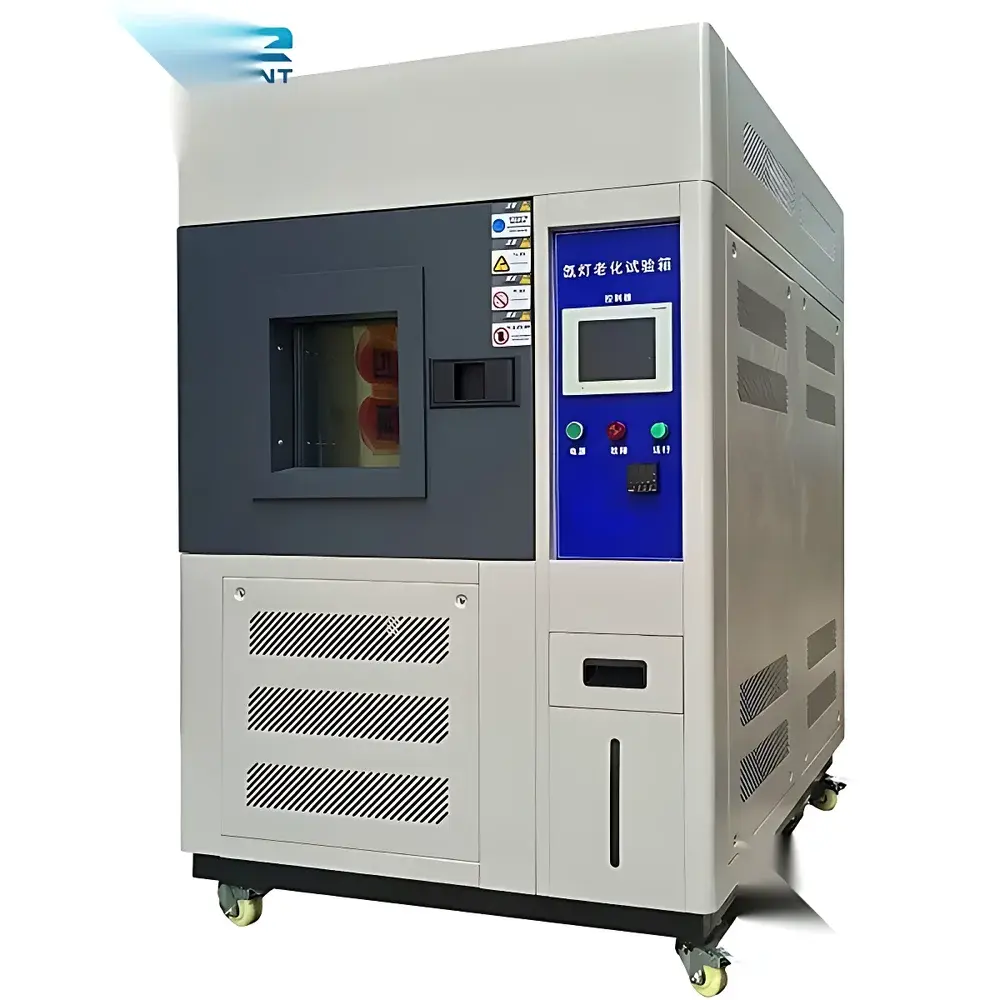
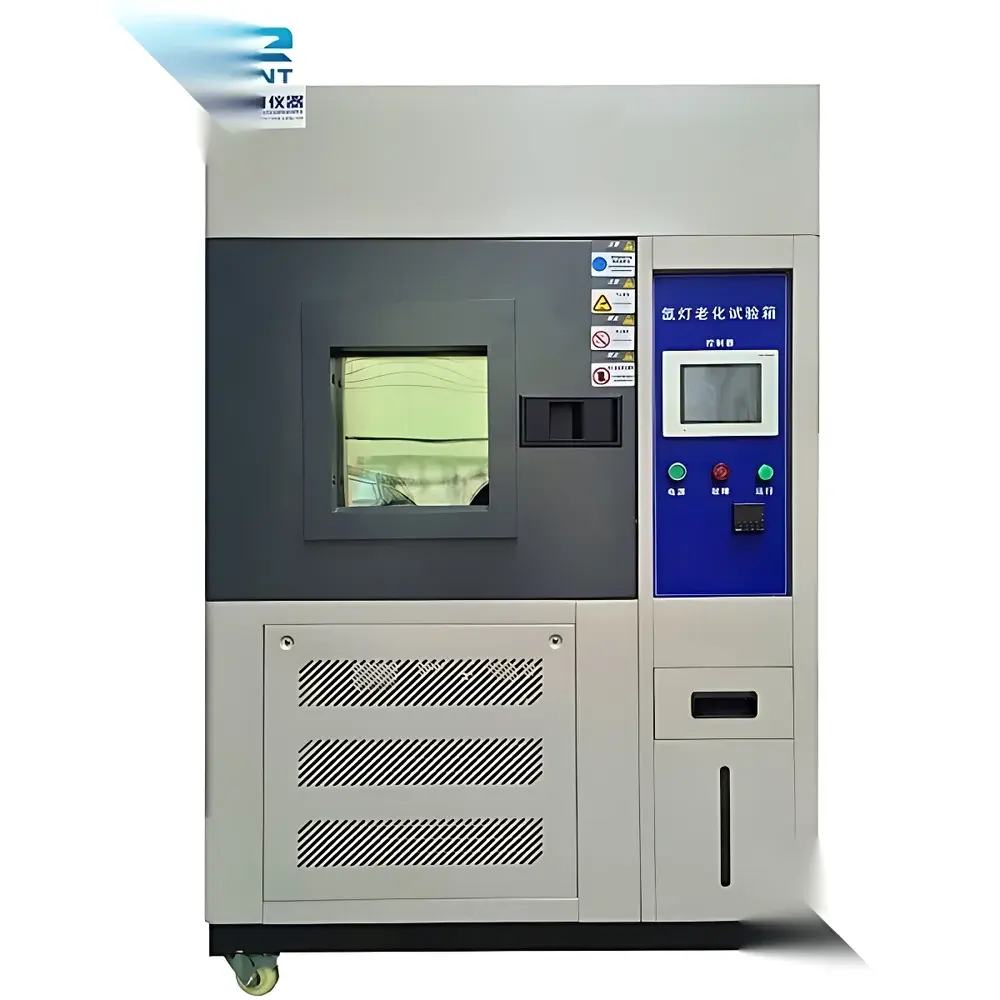
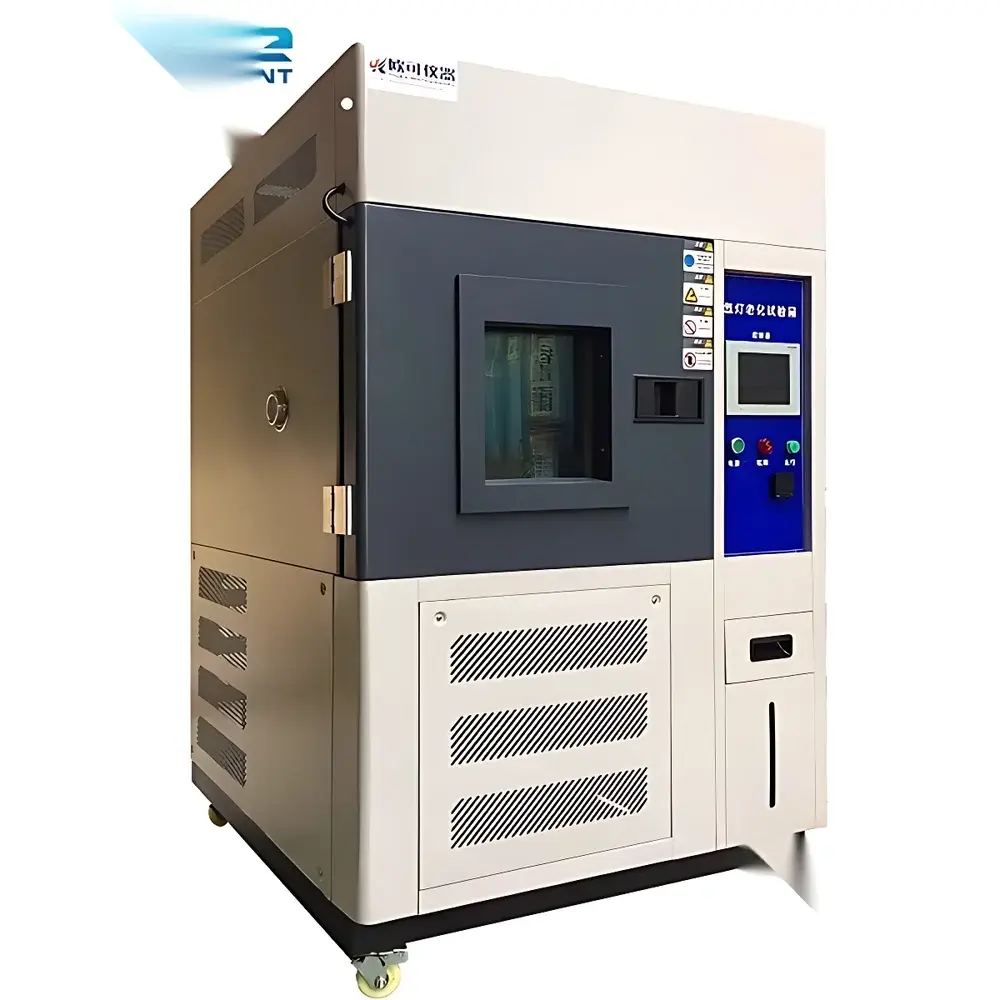
OK-XD-225 Xenon Arc Weathering Test Chamber
| Brand | OEM / Custom Brand |
|---|---|
| Origin | Imported |
| Manufacturer Type | Authorized Distributor |
| Price | USD 5,300 (FOB Reference) |
| Chamber Volume | 225 L |
| Internal Dimensions (H×W×D) | 500 × 750 × 600 mm |
| External Dimensions (W×H×D) | 1260 × 1500 × 1100 mm |
| Temperature Range | RT+10°C to 80°C (adjustable) |
| Black Panel Temperature | 63°C or 100°C ±3°C |
| Humidity Range | 45–90% RH (adjustable) |
| Temperature Uniformity | ±0.5°C |
| Irradiance Control | 550 W/m² (290–800 nm) |
| Spectral Filter | <255 nm blocked |
| Lamp Type | 2.5 kW DC air-cooled xenon arc lamp (single tube) |
| Lamp Lifetime | 800–1000 h |
| Sample Tray Size | 450 × 720 mm |
| Rain Cycle Timer | 0–9999 min (continuous) / 0–240 min (interval) |
| Nozzle Orifice | Ø0.8 mm |
| Total Power Consumption | ~9.0 kW |
| Compliance | GB/T 16422.2, ASTM D529, ISO 4892-2 |
Overview
The OK-XD-225 Xenon Arc Weathering Test Chamber is an engineered environmental simulation system designed to replicate the full-spectrum solar radiation, temperature, and humidity conditions that accelerate material degradation in real-world outdoor exposure. Based on the principles of xenon arc irradiation—where a high-intensity DC-powered xenon lamp emits a spectral output closely matching natural sunlight (290–800 nm)—this chamber enables standardized accelerated weathering testing for polymers, coatings, textiles, automotive interiors, and architectural materials. Its optical filtration system eliminates harmful short-wavelength UV below 255 nm while maintaining >90% transmittance across the visible and near-infrared bands (400–800 nm), ensuring photometric fidelity to terrestrial solar irradiance. The chamber operates under controlled black panel temperature (63°C or 100°C ±3°C), relative humidity (45–90% RH), and programmable water spray cycles—fully aligned with international test protocols for photochemical aging evaluation.
Key Features
- Robust dual-layer stainless steel construction (interior and exterior) ensures long-term corrosion resistance, cleanability, and structural integrity in high-humidity and saline environments.
- Modular three-zone architecture: upper-left test compartment with insulated inner chamber and single swing door; right-side control console housing PID-based temperature/humidity controllers, irradiance monitoring interface, and fault-status LEDs; lower mechanical bay containing air-cooling fan assembly, solenoid-controlled water manifold, quartz filter housing, and lamp power supply unit.
- Precise irradiance regulation at 550 W/m² (integrated 290–800 nm band), maintained via closed-loop feedback from a calibrated broadband radiometer mounted adjacent to the sample plane.
- Programmable water spray system with Ø0.8 mm nozzles supports both continuous (0–9999 min) and interval cycling (0–240 min), simulating dew, rain, and thermal shock effects per ISO 4892-2 Annex B.
- Stable thermal environment: ±0.5°C temperature fluctuation across the 225 L working volume, validated under no-load, ambient-pressure conditions per IEC 60068-3-5.
- Single 2.5 kW DC air-cooled xenon lamp with documented 800–1000 h service life; lamp spectral output certified traceable to NIST-standard reference lamps.
Sample Compatibility & Compliance
The OK-XD-225 accommodates flat-panel specimens up to 450 × 720 mm on its adjustable sample tray, supporting standard specimen holders per ASTM G155 and ISO 4892-2. It meets the core performance requirements of GB/T 16422.2 (China), ASTM D529 (plastics), and ISO 4892-2 (plastics—xenon-arc methods), including spectral irradiance distribution, temperature uniformity, humidity control accuracy, and spray cycle repeatability. All operational parameters—including irradiance setpoint, black panel temperature, chamber humidity, and rain timing—are logged with timestamped metadata, supporting GLP-compliant test documentation. Optional audit trail and user access control modules are available to meet FDA 21 CFR Part 11 data integrity requirements for regulated industries.
Software & Data Management
The chamber integrates with OK-WeaTest™ v3.2 control software (Windows-based, USB/RS485 interface), enabling full test sequence programming—including multi-step irradiance ramps, dynamic humidity profiles, and synchronized rain-on/off triggers. Real-time graphs display irradiance (W/m²), black panel temperature (°C), chamber RH (%), and elapsed time. Export formats include CSV and PDF test reports compliant with ISO/IEC 17025 laboratory recordkeeping standards. Data logs retain full traceability: operator ID, calibration certificate numbers, lamp usage hours, and system diagnostic flags—all stored locally and exportable for third-party review or regulatory submission.
Applications
- Evaluation of UV resistance and color fade in automotive clearcoats, interior trim, and dashboard materials per SAE J2527.
- Weathering validation of architectural sealants, roofing membranes, and PVC siding per ASTM D4329 and ISO 4892-2.
- Accelerated aging of medical device polymer housings and packaging films under simulated tropical or desert climatic profiles.
- Quality assurance testing for textile dyes, outdoor signage substrates, and agricultural mulch films.
- R&D screening of new stabilizer packages (HALS, UV absorbers) in polyolefin and elastomer formulations.
FAQ
What standards does the OK-XD-225 comply with?
It is validated against GB/T 16422.2, ASTM D529, and ISO 4892-2 for irradiance spectrum, temperature control, humidity regulation, and spray functionality.
Is the irradiance value adjustable?
Yes—the system maintains a stable 550 W/m² (290–800 nm) by default, but optional firmware upgrades support user-defined irradiance setpoints between 400–750 W/m² with recalibrated radiometer compensation.
How is lamp spectral output verified?
Each lamp batch is supplied with a NIST-traceable spectral power distribution (SPD) report; in-chamber verification is performed using a handheld spectroradiometer (optional accessory) prior to qualification runs.
Can the chamber operate without water spray?
Yes—spray function is fully independent and can be disabled during dry-heat or dark-cycle phases within any test program.
What maintenance intervals are recommended?
Lamp replacement every 800–1000 h; quartz filter cleaning weekly; humidity sensor calibration quarterly; full system verification annually per ISO/IEC 17025 internal audit checklist.



