
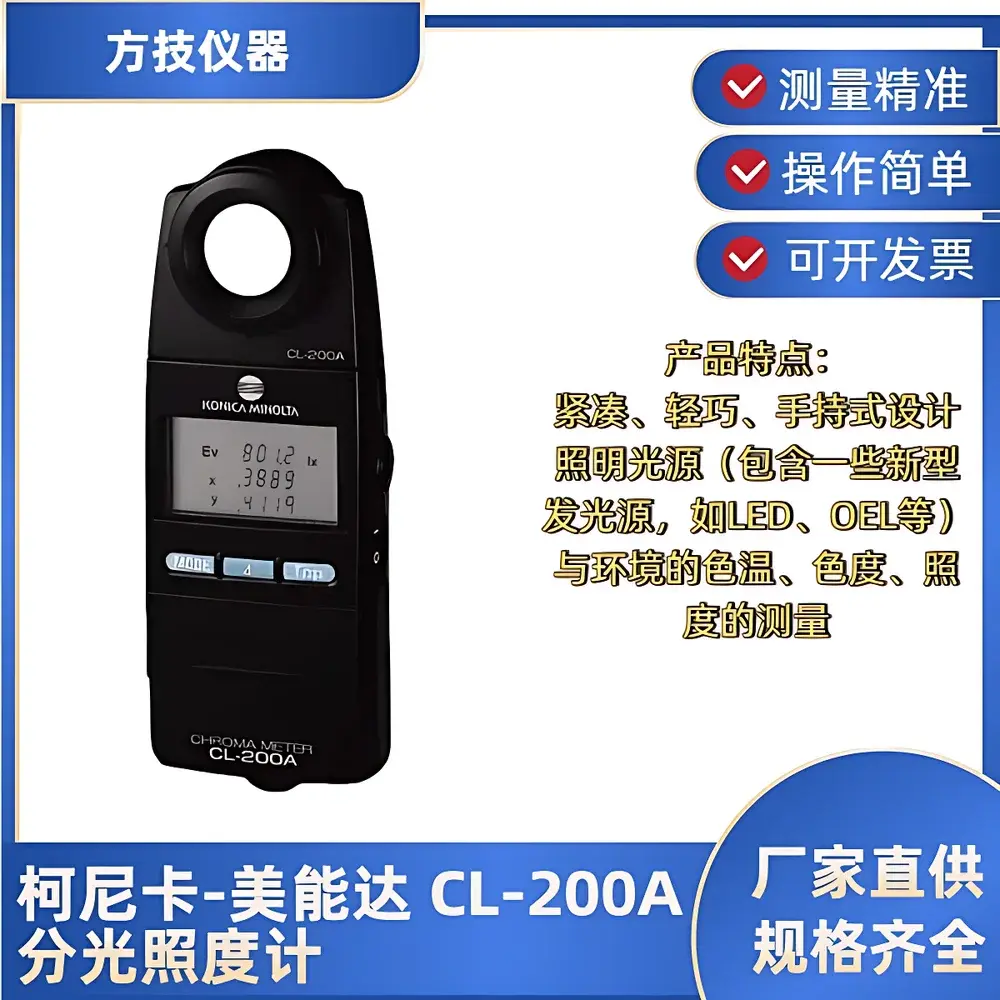
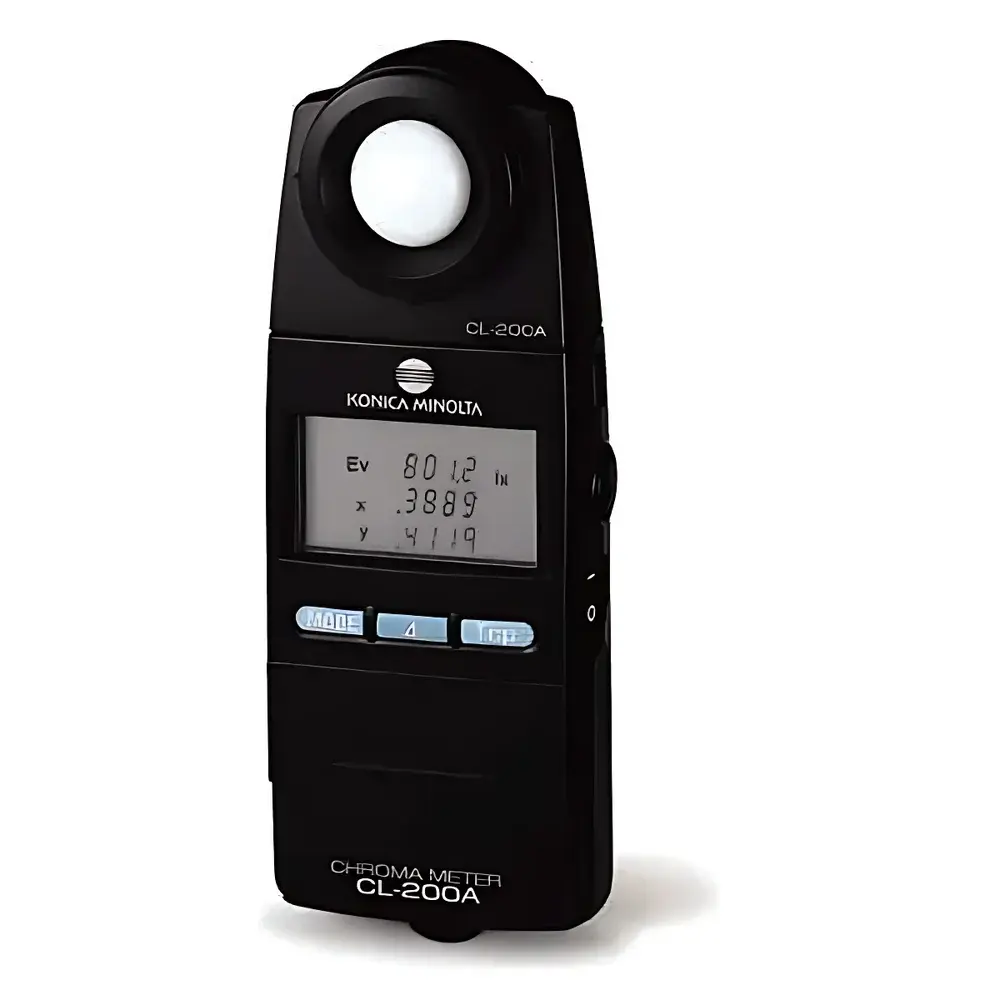
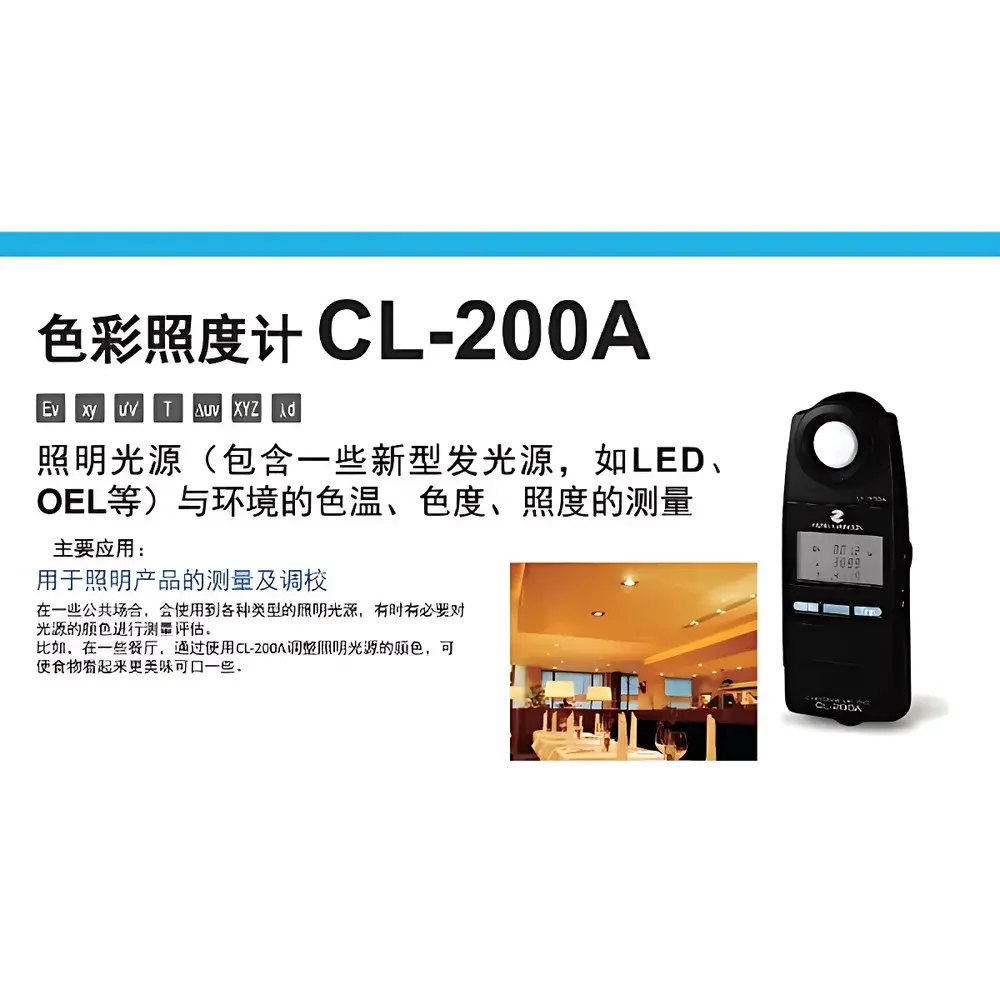
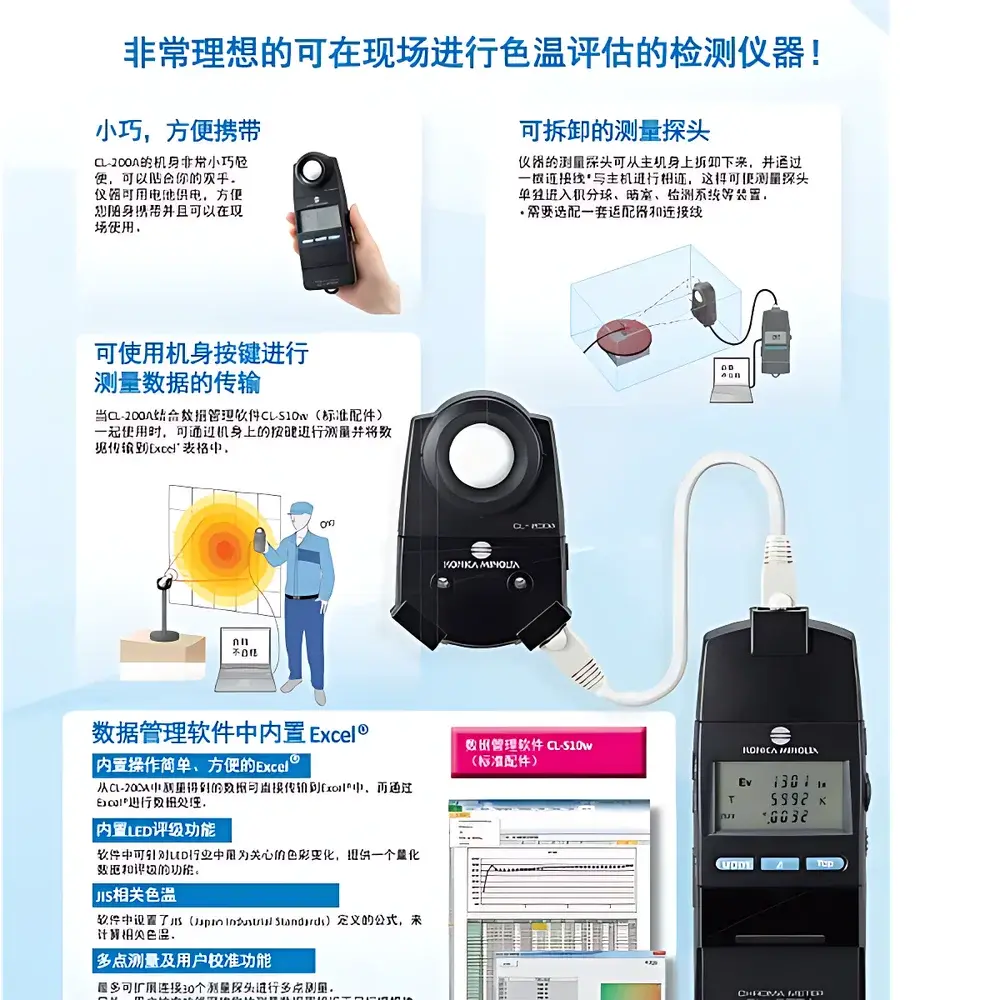
Konica Minolta CL-200A Series Handheld Precision Color Illuminance Meter
| Brand | Konica Minolta |
|---|---|
| Origin | Japan |
| Type | Imported Instrument |
| Model | CL-200A Series |
| Power Supply | 4 × AA batteries (alkaline or Ni-MH) |
| Display | Backlit LCD with real-time color and illuminance values |
| Measurement Modes | Illuminance (lx), Chromaticity (CIE 1931 xy, u'v'), Correlated Color Temperature (CCT, K), Duv, Color Rendering Index (CRI Ra, R1–R14), LED-specific metrics (Δu'v', TM-30 parameters optional via software) |
| Probe Connectivity | Detachable sensor head with proprietary 1.5 m cable (adapter required for integration into integrating spheres or dark chambers) |
| Data Interface | USB 2.0 (virtual COM port) |
| Software | CL-S10w Data Management Software (included) with Excel®-direct export, JIS Z 9112-compliant CCT calculation, LED binning support, multi-point synchronization (up to 30 probes), user calibration (single-point or RGB-based), audit trail logging, and GLP-compliant report generation |
Overview
The Konica Minolta CL-200A Series is a handheld precision color illuminance meter engineered for field-deployable photometric and colorimetric characterization of light sources under real-world conditions. Based on tristimulus colorimetry (CIE 1931 XYZ color matching functions), the instrument integrates a silicon photodiode array with interference-filtered spectral response closely matched to the CIE standard observer curves. Its optical architecture ensures high angular acceptance (f/2.5 lens system) and minimal cos(θ) error—critical for accurate illuminance measurements across non-perpendicular incidence angles. Designed for compliance with JIS Z 9112 (2017) and ISO/CIE 11664-1:2019, the CL-200A delivers traceable chromaticity coordinates (x, y and u’v’), correlated color temperature (CCT), Duv deviation, and full spectral fidelity-derived indices including general CRI (Ra) and extended R1–R14 values. The device operates independently of external power, enabling continuous operation for up to 20 hours on four AA batteries—making it suitable for architectural lighting surveys, LED manufacturing QA/QC, museum lighting validation, and daylight harvesting system commissioning.
Key Features
- Detachable probe design with 1.5 m shielded cable—enables remote sensing in confined or optically isolated environments (e.g., integrating spheres, light-tight enclosures, or optical test benches) when used with optional adapter kits.
- Real-time dual-display of illuminance (lx) and chromaticity (CIE 1931 xy or u’v’) with simultaneous CCT and Duv readout—supporting rapid pass/fail assessment against specification limits.
- On-device data logging (up to 1,000 measurement records) with timestamp and GPS metadata (via optional Bluetooth module).
- Integrated LED-specific evaluation: Δu’v’ tolerance mapping, TM-30-15 Annex A compliance reporting (via CL-S10w), and industry-standard binning visualization aligned with JEDEC JS-709E recommendations.
- Multi-probe synchronization capability: Up to 30 CL-200A units can be daisy-chained and time-synchronized via USB hub for spatially distributed luminous environment mapping.
- User calibration support: Two modes—single-point reference calibration using NIST-traceable standards, or full RGB matrix calibration for application-specific spectral weighting compensation.
Sample Compatibility & Compliance
The CL-200A is validated for stable measurement of steady-state and pulsed light sources with modulation frequencies up to 1 kHz (suitable for PWM-driven LEDs). It meets IEC 62471:2006 photobiological safety classification requirements for measurement instrumentation and conforms to JIS Z 8722:2012 (colorimetry), JIS Z 9112:2017 (CCT calculation methodology), and ISO/CIE 13406-2:2001 (display viewing condition assessment). All factory calibrations are performed at Konica Minolta’s A2LA-accredited calibration laboratory (Certificate No. 2318.01), with traceability to NMIJ (National Metrology Institute of Japan) primary standards. The instrument supports GLP/GMP workflows through CL-S10w’s electronic signature, change control logs, and 21 CFR Part 11–compliant audit trail export.
Software & Data Management
CL-S10w is a Windows-based data management platform supplied as standard equipment. It provides direct Excel®-formatted output without third-party plugins—measurements appear natively in .xlsx workbooks with column headers mapped to CIE, JIS, and IESNA conventions. The software implements JIS Z 9112’s polynomial-based CCT algorithm and includes configurable pass/fail thresholds per parameter. Advanced features include batch statistical analysis (mean, SD, CPK), spatial heatmap generation from multi-point datasets, automated report generation (PDF/CSV), and secure user role management (admin/operator/viewer). Audit trails record all calibration events, parameter changes, and data exports with timestamps and operator IDs—fully compliant with ISO/IEC 17025:2017 clause 7.7 and FDA 21 CFR Part 11 Subpart B.
Applications
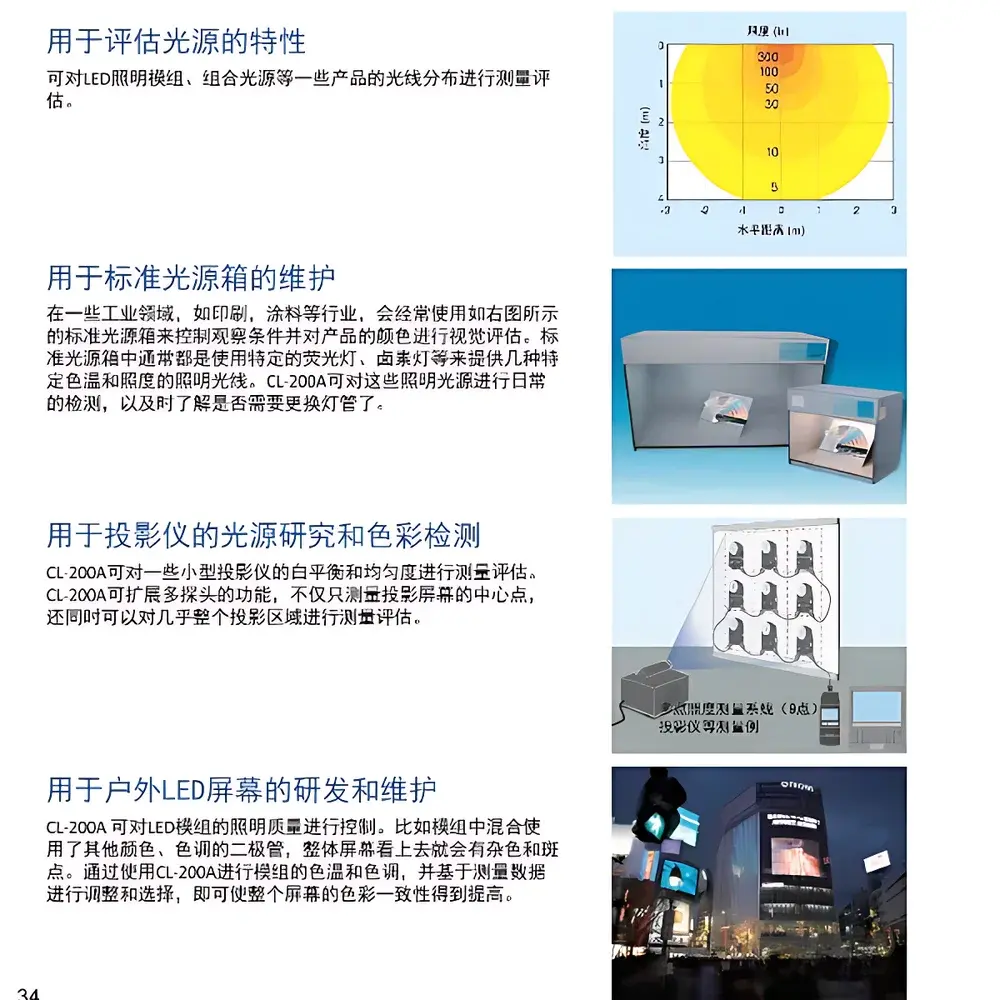
- LED product development and production line verification—monitoring chromaticity shift over thermal cycling and drive current variation.
- Architectural lighting design validation—assessing uniformity, CCT consistency, and glare index (UGR) input parameters across façades and interiors.
- Museum and archival lighting compliance—ensuring UV-free illumination and strict lux/CCT limits for sensitive artifacts per ICOM-CC guidelines.
- Automotive interior lighting certification—verifying ambient light quality metrics per SAE J1383 and UNECE R128.
- Educational laboratories—teaching CIE color space fundamentals, metamerism, and spectral power distribution interpretation.
- Horticultural lighting optimization—correlating PAR-weighted illuminance with photosynthetic photon flux density (PPFD) models.
FAQ
Does the CL-200A support flicker measurement?
No—the CL-200A is optimized for steady-state and low-frequency modulated light characterization. Flicker analysis (percent flicker, flicker index, SVM) requires the separate Konica Minolta CL-500A or CA-410 series.
Can I perform calibration traceable to NIST?
Yes—Konica Minolta offers accredited calibration services (A2LA Certificate No. 2318.01) with NMIJ traceability; users may also perform in-house verification using certified reference lamps (e.g., FEL, QTH) with documented uncertainty budgets.
Is CL-S10w compatible with macOS or Linux?
CL-S10w is Windows-only (Windows 10/11, 64-bit); however, exported Excel® files are fully interoperable with LibreOffice Calc and Apple Numbers.
What is the maximum cable length between probe and main unit?
The standard cable is 1.5 m; extension cables up to 5 m are available as optional accessories—beyond this length, signal integrity degradation may affect low-light accuracy below 1 lx.
How does user RGB calibration improve measurement accuracy?
RGB calibration applies a 3×3 transformation matrix to compensate for known spectral mismatches between the instrument’s sensor response and the CIE standard observer—particularly beneficial when measuring narrow-band LEDs or phosphor-converted white sources.





