
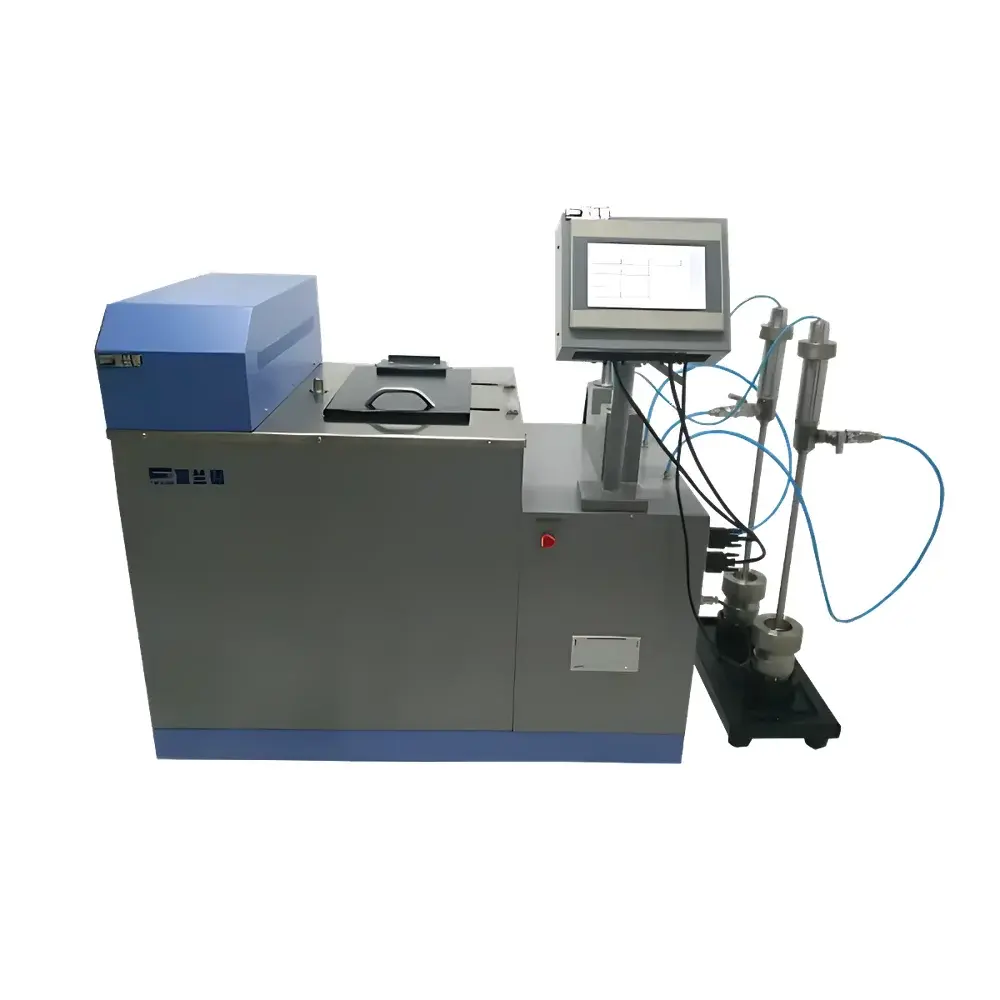
Freeland FDH-0171 Automated Rotary Bomb Oxidation Stability Tester (RBOT)
| Brand | Freeland / csfriend |
|---|---|
| Origin | Hunan, China |
| Model | FDH-0171 |
| Power Supply | AC 220 V ±10% |
| Heating Power | 2500 W |
| Pressure Sensor Range | 0–1.6 MPa, Accuracy: ±0.2% FS |
| Oil Bath Temperature Range | Ambient to 200.0 °C (adjustable), Typical Test Temp: 150.0 °C |
| Temperature Control Accuracy | ±0.1 °C |
| Dual-Bomb Configuration | Yes |
| Rotation Speed | 100 ±5 rpm |
| Bomb Tilt Angle | 30° from Horizontal |
| Oil Bath Volume | 30 L |
| Dimensions (W×D×H) | 664 × 574 × 920 mm |
| Weight | ~45 kg |
Overview
The Freeland FDH-0171 Automated Rotary Bomb Oxidation Stability Tester is a precision-engineered instrument designed for quantitative assessment of oxidation resistance in lubricating oils and greases under accelerated, high-pressure oxygen environments. Based on the standardized Rotary Bomb Oxidation Test (RBOT) method—aligned with ASTM D2272, IP 229, and ISO 2078—this system subjects oil samples to controlled thermal stress (typically at 150.0 °C) inside sealed copper alloy bombs pressurized with pure oxygen (initially 620 kPa), while rotating the bombs at 100 ±5 rpm at a fixed 30° tilt angle. Oxidation progress is monitored in real time via high-fidelity pressure transduction; the onset of rapid pressure drop—indicative of volatile acid formation and hydroperoxide decomposition—is automatically detected as the induction period endpoint. This thermodynamic and kinetic measurement provides critical data for formulating stable base stocks, evaluating antioxidant package efficacy, and qualifying lubricants for turbine, hydraulic, and engine applications where long-term oxidative integrity is mission-critical.
Key Features
- Patented dual-directional liquid-sealed rotary interface: Replaces conventional slip-ring or carbon-brush assemblies with a hermetic fluid-coupled signal transmission system, eliminating mechanical wear, electrical noise, and signal drift during continuous 100 rpm rotation—ensuring long-term metrological stability and traceable pressure data acquisition.
- Motorized, height- and tilt-adjustable 7-inch color TFT-LCD display: Enables ergonomic operator positioning across diverse laboratory workspaces and user anthropometrics; supports glove-compatible touch interaction without compromising viewing clarity or thermal isolation.
- Fully autonomous test execution: From sample loading and oxygen pressurization to temperature ramping, rotational initiation, real-time pressure logging, endpoint detection, and post-test cooling—no manual intervention required. Each run generates a complete oxidation curve (pressure vs. time), with automatic timestamped storage and optional thermal-printer output.
- Dual-bomb architecture: Two independent, identically conditioned oxygen bombs operate simultaneously under identical thermal and rotational parameters—enabling statistically robust parallel testing per ASTM D2272 requirements and reducing inter-run variability.
- Embedded Linux-based control platform: Provides deterministic real-time task scheduling, non-volatile memory retention, and fail-safe state recovery—critical for unattended overnight or multi-day oxidation studies.
- Integrated safety subsystems: Includes patented rotating-bomb entanglement guard (mechanical barrier preventing hair/clothing contact), overtemperature cutoff (dual independent sensors), overpressure venting, and galvanically isolated power regulation to suppress line transients and sustain operational integrity under unstable utility conditions.
Sample Compatibility & Compliance
The FDH-0171 accommodates standard ASTM D2272-compliant copper bomb assemblies (60 mL capacity) and accepts mineral-, synthetic-, and bio-based lubricants—including turbine oils, hydraulic fluids, gear oils, and greases—provided they remain fluid at test temperature and do not corrode copper surfaces. All hardware interfaces, pressure calibration protocols, and software algorithms are validated against NIST-traceable reference standards. The system supports GLP-compliant operation through audit-trail-enabled data logging (user ID, timestamp, method version, raw pressure traces, and final induction period), and its deterministic firmware architecture meets foundational requirements for FDA 21 CFR Part 11 readiness when deployed with validated electronic signature modules and networked storage.
Software & Data Management
The embedded GUI features intuitive menu navigation with context-sensitive help, parameter lockout for SOP enforcement, and export-ready data formats (CSV, PDF report templates). Raw pressure-time datasets are stored with full metadata—including ambient lab conditions, calibration certificate IDs, and operator annotations—and support post-acquisition reprocessing using built-in baseline correction and derivative analysis tools. Optional PC connectivity enables centralized fleet monitoring, remote diagnostics, and integration into LIMS via TCP/IP or RS-232 serial protocols. All firmware updates are digitally signed and verified prior to installation to maintain regulatory integrity.
Applications
- Quality control of new lubricant batches against specification limits (e.g., minimum RBOT induction period ≥ 200 min for steam turbine oils)
- Accelerated aging studies to predict service life under high-temperature operating conditions
- Comparative evaluation of antioxidant additives (e.g., hindered phenols, aromatic amines) and synergistic blends
- Failure analysis of in-service oils exhibiting premature sludge or varnish formation
- Supporting OEM equipment qualification programs requiring documented oxidation resistance data
- Academic research on oxidation kinetics, metal-catalyzed degradation pathways, and structure–stability relationships in base oils
FAQ
What standards does the FDH-0171 comply with?
It is fully aligned with ASTM D2272, IP 229, and ISO 2078 for rotary bomb oxidation testing.
Can the instrument perform single-bomb tests?
Yes—the dual-bomb design allows independent operation of either bomb; one may be used while the other remains idle or undergoes maintenance.
Is pressure sensor calibration traceable to national standards?
Yes—factory calibration is performed using dead-weight testers certified to ISO/IEC 17025-accredited laboratories, with full documentation provided.
How is data integrity ensured during extended unattended runs?
All measurements are logged to redundant non-volatile memory with cyclic checksum verification; power-loss recovery preserves the last valid timestamp and pressure reading.
Does the system support custom test profiles beyond 150 °C?
Yes—temperature setpoints are freely adjustable from ambient to 200.0 °C in 0.1 °C increments, enabling method development for non-standard materials or research protocols.
Related Products





