
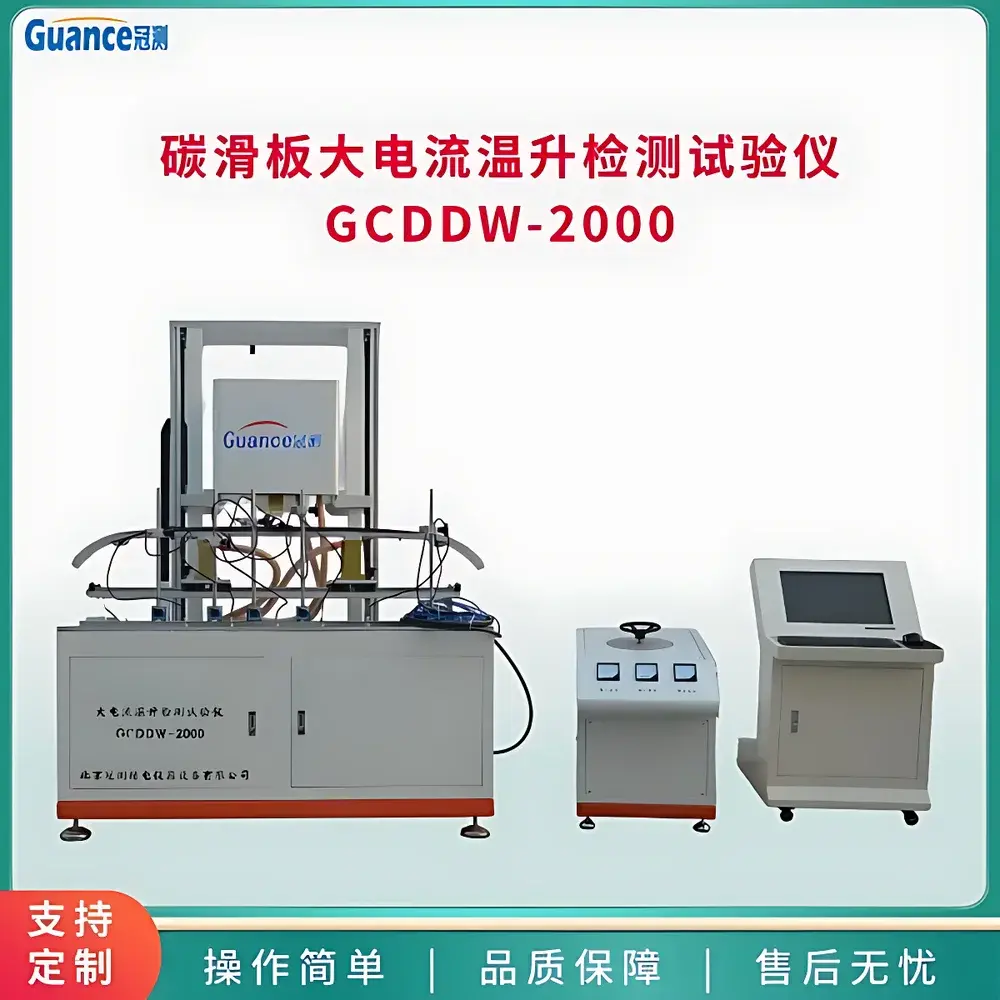
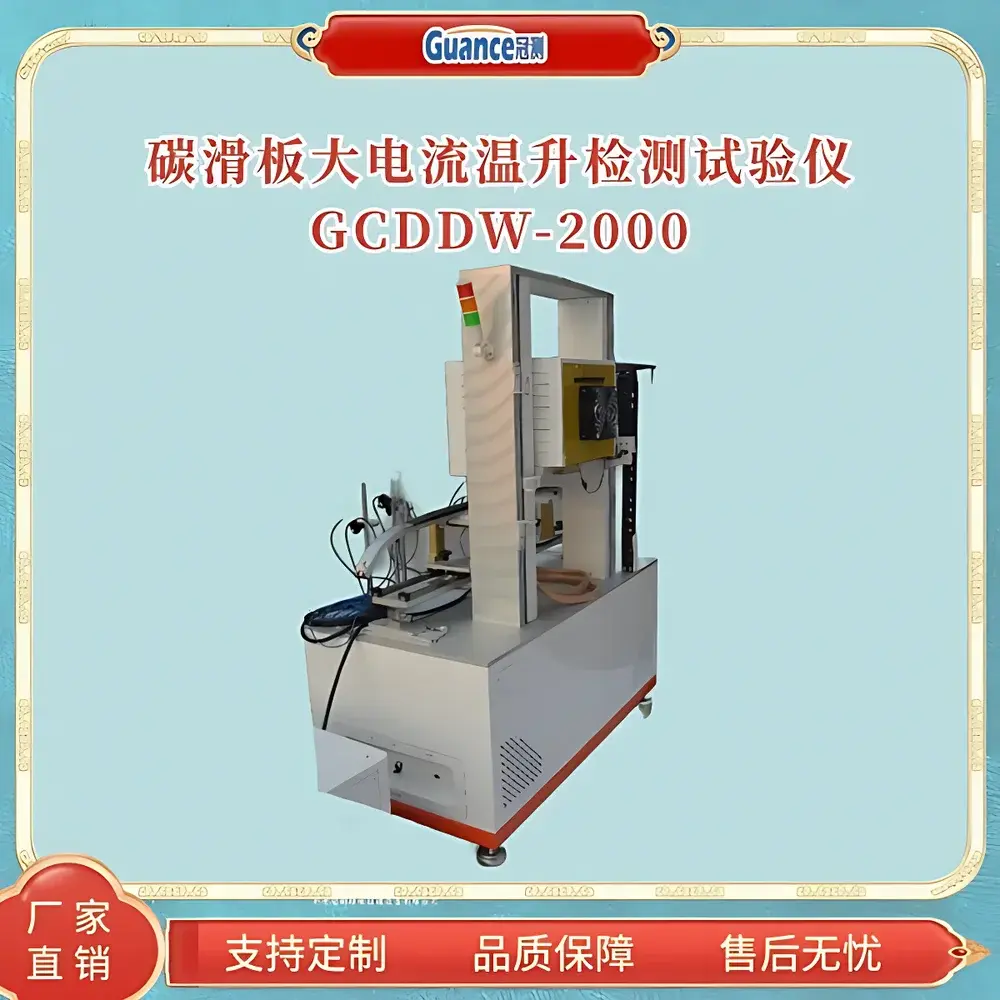
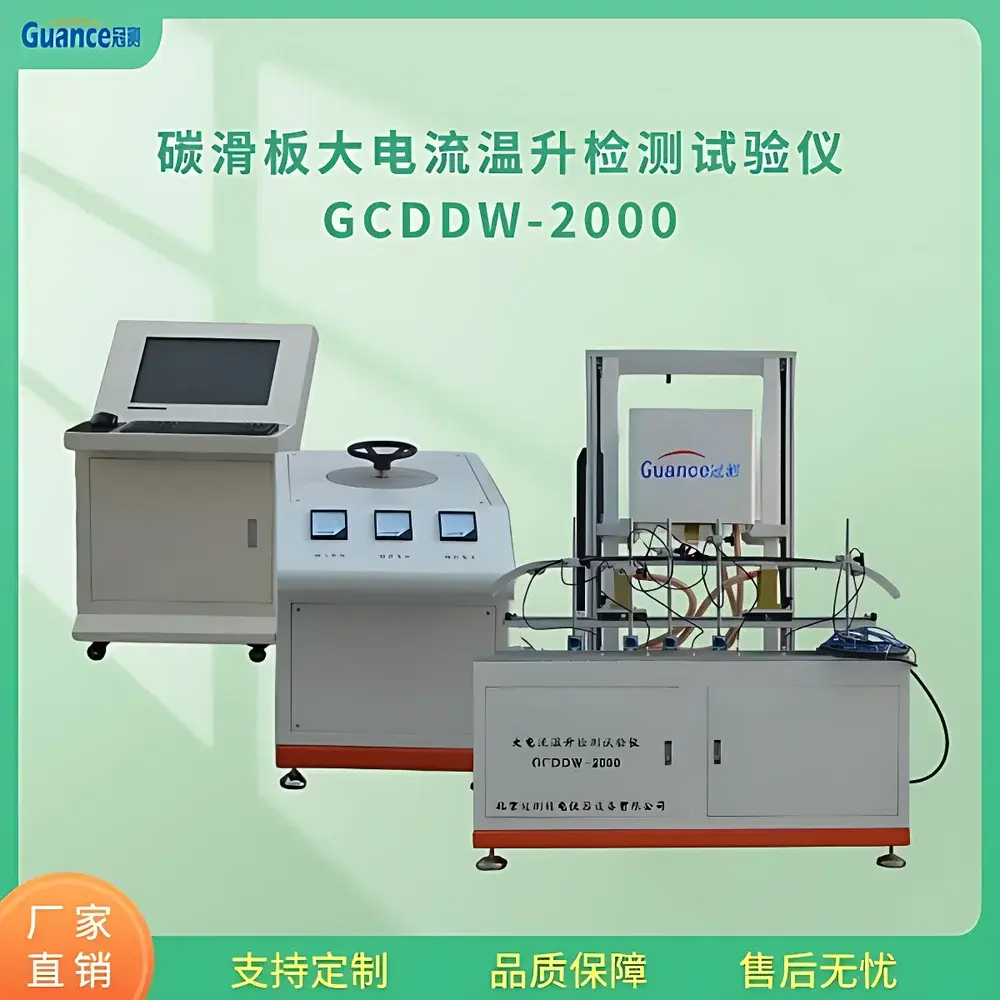
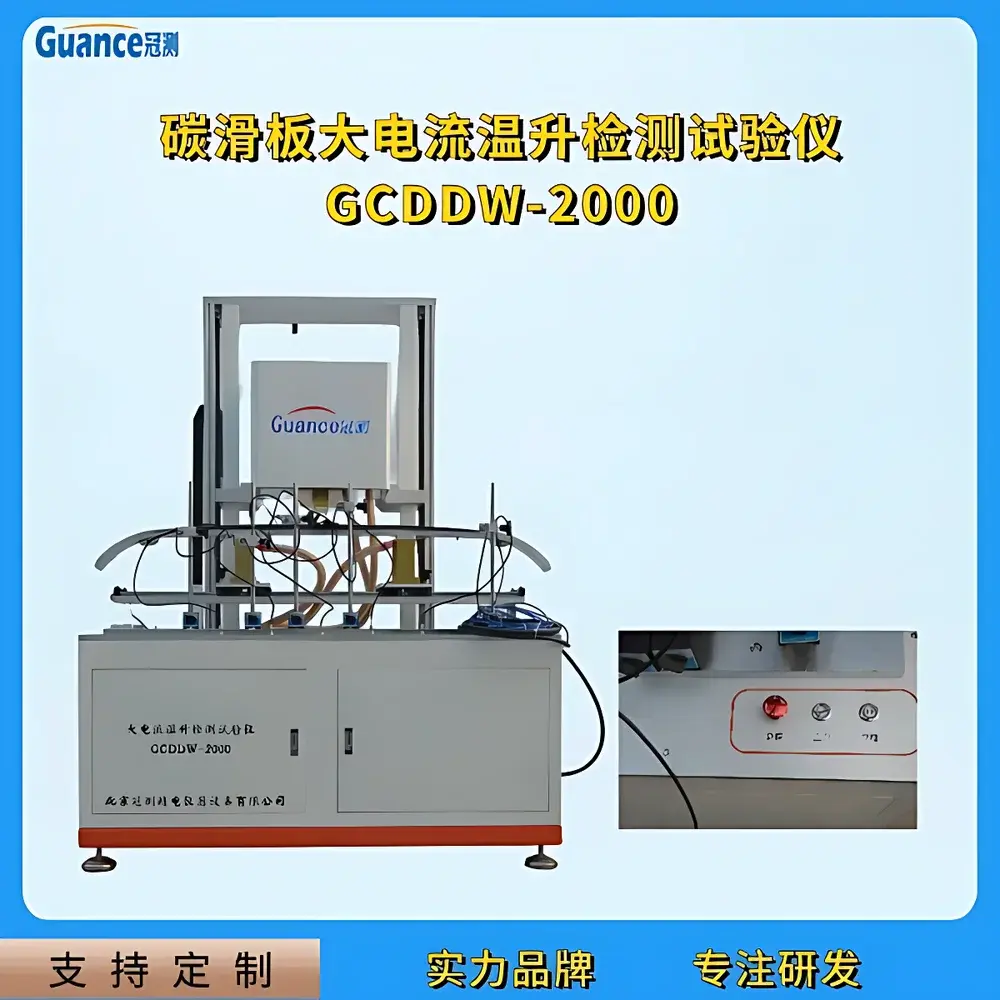
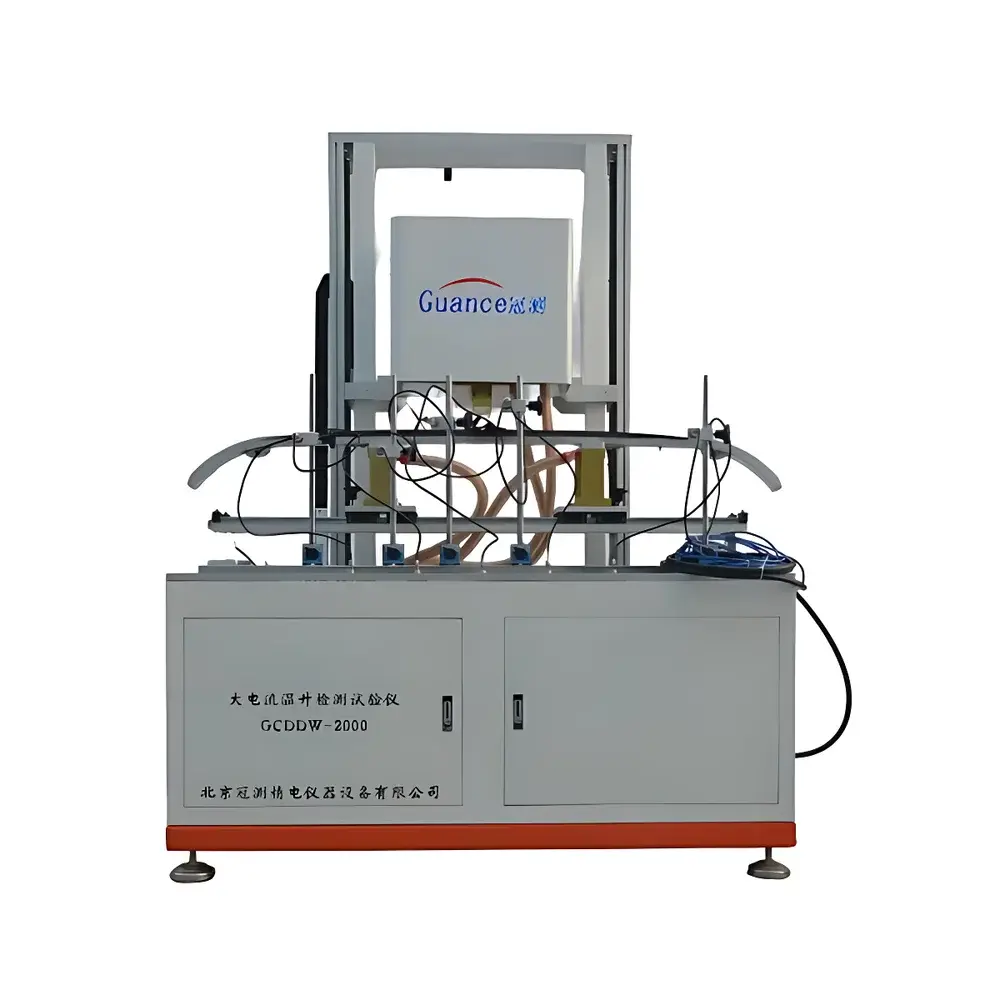
GuanCe GCDDW-2000 High-Current Thermal Rise Tester for Carbon Current Collectors
| Brand | GuanCe |
|---|---|
| Model | GCDDW-2000 |
| Origin | Beijing, China |
| Type | Tribological Tester (High-Current Resistive Heating & Thermal Monitoring System) |
| Max Friction Force | 20 N |
| Friction Force Resolution | 0.001 N |
| Max Operating Temperature | 200 °C |
| Input Voltage | AC 380 V |
| Rated Power | 30 kW |
| Electrode Stroke | 300 mm |
| Current Source Output | AC 5 V / 0–2000 A |
| Adjustable AC Supply | 0–450 V (20 kVA Autotransformer) |
| Load Cell Range | 1 kN |
| IR Temperature Sensor Range | 0–800 °C |
| Dimensions (L×W×H) | 1500 × 1000 × 1980 mm |
| Weight | 500 kg |
Overview
The GuanCe GCDDW-2000 High-Current Thermal Rise Tester is an engineered system designed for controlled resistive heating and real-time surface temperature monitoring of carbon-based current collector materials—specifically carbon pantograph slides used in railway electrification systems. It operates on the principle of Joule heating under simulated service conditions: a copper electrode applies calibrated normal force to the carbon specimen while delivering precisely regulated high-current AC (up to 2000 A at ≤5 V), inducing thermal gradients across the contact interface. Simultaneous measurement of interfacial friction force, electrode displacement, and spatially resolved surface temperature enables quantitative assessment of thermal stability, contact resistance evolution, and degradation onset under dynamic electrical–mechanical loading. This configuration aligns with functional test requirements defined in IEC 62196, EN 50317, and GB/T 21563-2018 for current collection components subjected to high-current transient conditions.
Key Features
- Programmable vertical actuation via stepper motor-driven ball screw mechanism with linear guide constraint—stroke range 300 mm, max speed 8 mm/s, repeatable positioning accuracy ±0.02 mm.
- Integrated dual-load-cell force measurement system (1 kN full scale per sensor) providing real-time normal load feedback with 0.001 N resolution; total applied force derived from sum of dual-channel analog outputs.
- Five-channel non-contact infrared temperature sensing array (0–800 °C range, spectral response 8–14 µm), enabling spatially distributed thermal mapping across the carbon slide surface during current flow.
- Dedicated high-current delivery subsystem: 20 kVA autotransformer (input AC 380 V, output 0–450 V) feeding a custom step-down transformer to deliver stable AC 0–5 V / 0–2000 A output with low-impedance secondary winding and thermally stabilized busbar connections.
- Industrial-grade Siemens PLC-based control architecture handling synchronized acquisition of force, position, current, voltage, and five IR temperature channels at ≥10 Hz sampling rate; data streamed via Ethernet to host PC running proprietary acquisition software.
- Rugged structural frame (500 kg mass) with adjustable leveling feet and reinforced base plate to minimize vibration-induced measurement noise during high-current pulsing.
Sample Compatibility & Compliance
The GCDDW-2000 accommodates standard carbon pantograph slide specimens (e.g., ISO 16840-2 compliant geometries) mounted in interchangeable fixtures. Specimen thickness range: 15–40 mm; maximum width: 120 mm; length limited only by fixture design. The system supports testing under ambient or pre-heated chamber conditions (optional accessory). All electrical safety design complies with IEC 61000-4 electromagnetic compatibility standards and GB 5226.1-2019 (equivalent to EN 60204-1) for industrial machinery. Force and temperature transducers are traceably calibrated to national metrology standards (CNAS-accredited). Data logging meets GLP-aligned audit trail requirements, including timestamped parameter records, operator ID input, and configuration change logs.
Software & Data Management
Acquisition and analysis are performed using GuanCe’s Windows-based TestControl Suite v3.2, supporting real-time visualization of up to eight synchronized parameters (current, voltage, normal force, displacement, and five IR channel temperatures). Software features include configurable test sequences (ramp-hold-step profiles), automatic thermal gradient calculation (dT/dx), time-to-reach-threshold reporting (e.g., time required to reach ΔT = 100 K above ambient), and export to CSV, Excel, or MATLAB-compatible formats. Audit-trail functionality satisfies FDA 21 CFR Part 11 requirements for electronic records: user authentication, electronic signatures for test initiation/completion, and immutable raw data archiving with SHA-256 hash verification.
Applications
- Qualification testing of carbon–copper interface thermal behavior in overhead catenary systems (OCS).
- Comparative evaluation of carbon grade formulations for thermal runaway resistance under short-duration overcurrent events.
- Correlation of contact resistance drift with surface oxidation kinetics observed via IR thermography.
- Validation of finite element models simulating coupled electro-thermal-mechanical response in current collectors.
- Supporting root-cause analysis of arcing-related failures through controlled thermal stress cycling protocols.
- Pre-compliance screening for EN 50317 Annex C thermal performance criteria prior to full-system validation.
FAQ
What is the maximum continuous current rating of the GCDDW-2000?
The system delivers up to 2000 A RMS at ≤5 V AC for durations up to 60 seconds per test cycle, with mandatory cooldown intervals between cycles to maintain thermal stability of the transformer and electrodes.
Can the IR sensors be recalibrated in-house?
Yes—each sensor includes NIST-traceable calibration coefficients stored in EEPROM; field recalibration requires a blackbody source (±0.5 °C uncertainty at 200 °C) and GuanCe’s Calibration Utility module.
Is the PLC program source code accessible for customization?
No—the ladder logic is locked firmware; however, I/O mapping and alarm thresholds are fully configurable via the HMI interface without requiring engineering mode access.
Does the system support third-party DAQ integration?
Yes—Ethernet TCP/IP Modbus RTU gateway enables read-only access to all live process variables for integration with LabVIEW, Python, or SCADA platforms.
What safety interlocks are implemented?
Hardware-enforced interlocks include emergency stop circuit interrupting both main power and current supply, overtemperature cutoff (>850 °C at electrode housing), and loss-of-force detection triggering immediate current shutdown.



