
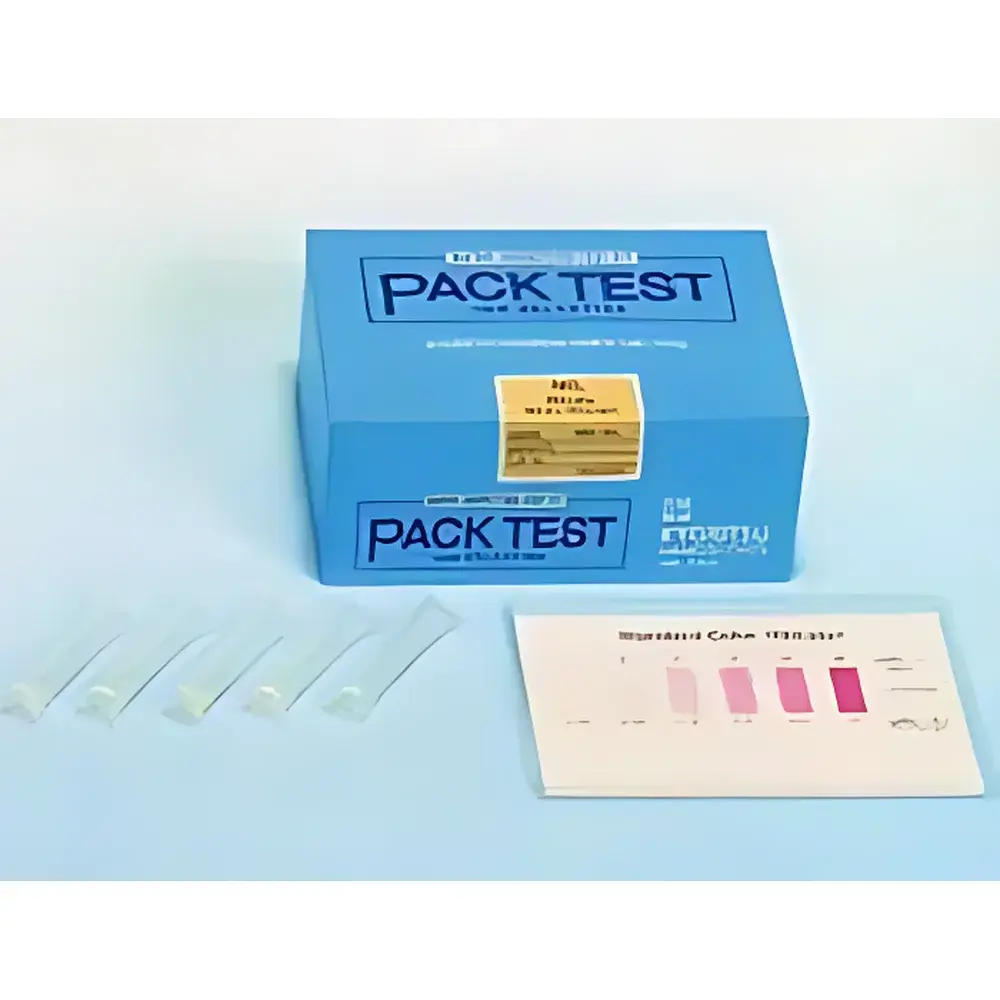
Kyoritsu WAK Portable Colorimetric Water Quality Test Kit
| Brand | Kyoritsu |
|---|---|
| Origin | Japan |
| Model | WAK |
| Instrument Type | Portable / Handheld Colorimetric Water Quality Analyzer |
| COD Measurement Ranges | COD(H) 0–250+ mg/L, COD 0–100 mg/L, COD(D) 0–8+ mg/L |
| Reaction Time | 3 min (COD), typically ≤5 min for most parameters |
| Test Capacity | 40–50 tests per vial pack |
| Detection Method | Visual colorimetric comparison against standardized chromatic scales |
| Compliance | Designed for field-deployable screening per ISO 9001–certified manufacturing |
Overview
The Kyoritsu WAK Portable Colorimetric Water Quality Test Kit is a field-deployable, single-use analytical system engineered for rapid, semi-quantitative assessment of over 41 water quality parameters—including chemical oxygen demand (COD), residual chlorine, heavy metals (e.g., Cr(VI), Cu, Ni, Zn), nutrients (NH₄⁺-N, NO₂⁻-N, NO₃⁻-N, PO₄³⁻-P), pH, hardness, and trace contaminants (e.g., As, CN⁻, F⁻, H₂O₂). Each test employs sealed polyethylene (PE) reaction vials—7 cm in length, 1 cm outer diameter—pre-loaded with precise, stabilized reagent doses. The method relies on well-characterized color-forming reactions (e.g., dichloroquinone chlorimide for COD, DPD for free chlorine, ferrozine for iron, and Nesslerization derivatives for ammonium), enabling visual quantification via side-by-side comparison to calibrated color charts under controlled ambient lighting. This principle aligns with ISO 8466-1 and ASTM D5117 for qualitative/semi-quantitative colorimetric screening, offering reproducible results without instrumentation, power supply, or laboratory infrastructure.
Key Features
- Pre-calibrated, factory-sealed PE vials eliminate reagent handling errors and ensure lot-to-lot consistency; each vial weighs ≈1 g and is impact-resistant and chemically inert.
- No pH adjustment required for most assays—operational across pH 5.0–9.5 (standard range) and extended ranges (pH 1.6–3.4, 3.6–6.2, etc.) using indicator-specific vials (BCG, BTB, TBH).
- Rapid analysis: COD determination completes in 3 minutes; >90% of parameters yield interpretable results within 5 minutes.
- Integrated pull-wire sampling mechanism enables direct aspiration of unfiltered water samples—no pipettes, syringes, or dilution steps needed.
- Multi-range COD capability: Three dedicated vial types cover low (0–8+ mg/L), standard (0–100 mg/L), and high-concentration (0–250+ mg/L) applications—supporting wastewater, surface water, and potable water matrices.
- Trace metal detection down to sub-ppm levels (e.g., As: 0.2–10 mg/L; CN⁻: 0.02–2 mg/L) using selective chelation and oxidation-reduction chromogenic chemistry.
Sample Compatibility & Compliance
The WAK kit is validated for use with raw, filtered, clarified, or mildly turbid aqueous samples—including municipal drinking water, industrial process water, boiler feedwater, wastewater effluents, aquaculture systems, groundwater, river/lake water, and emergency response sources. It complies with foundational regulatory frameworks for preliminary screening: ASTM D1253 (residual chlorine), ISO 6060 (COD), ISO 7888 (free chlorine), and EPA Method 150.1 (total chlorine) for field triage. While not intended for final compliance reporting under US EPA 40 CFR Part 136 or EU Directive 2000/60/EC, the kit satisfies GLP-aligned pre-screening requirements for anomaly detection, trend monitoring, and operational readiness verification. All vials are manufactured under ISO 9001-certified processes at Kyoritsu’s Japanese facilities; CE marking applies for non-medical environmental use in EEA markets.
Software & Data Management
The WAK system operates entirely offline and requires no software, firmware, or connectivity. Quantitative interpretation is performed visually using included laminated color comparator cards—each printed with photometrically stable, batch-calibrated reference hues. For digital documentation, users may photograph results alongside the comparator card under standardized CIE D65 illumination and archive images with metadata (date, location, operator ID, sample ID) in LIMS-compatible formats (e.g., PDF, CSV). Though lacking electronic data logging, the kit supports audit-ready recordkeeping when integrated into SOPs referencing ISO/IEC 17025 Clause 7.5 (data control) and FDA 21 CFR Part 11 principles for manual entry validation.
Applications
- Environmental Monitoring: River basin surveys, acid rain studies, thermal discharge tracking, pollution source identification, and marine outfall verification.
- Water Utility Operations: Intake monitoring, disinfection by-product precursor screening, distribution system chlorine decay profiling, and post-flushing validation.
- Industrial Process Control: Boiler water alkalinity/hardness checks, cooling tower biocide residual confirmation, rinse water COD verification, and electroplating bath contaminant surveillance.
- Aquaculture & Agriculture: Pond DO/COD/NH₄⁺ balance management, hydroponic nutrient solution stability, livestock drinking water safety audits, and irrigation source screening.
- Emergency Response: Post-disaster potable water verification (WHO Emergency Guidelines), field hospital water safety, and refugee camp water quality triage.
- Education & Research: Undergraduate environmental science labs, K–12 STEM field investigations, and pre-analytical validation prior to ICP-MS or HPLC-IC analysis.
FAQ
Can the WAK kit replace laboratory-grade COD analyzers for regulatory reporting?
No. It is designed for rapid field screening and process troubleshooting—not definitive compliance measurement per ISO 6060 or EPA 405.1. Confirmatory analysis requires certified lab methods.
Are the color charts traceable to NIST or equivalent standards?
Yes. Comparator cards are calibrated against spectrophotometric reference standards traceable to JCSS (Japan Calibration Service System), aligned with ISO/IEC 17025 calibration hierarchy.
How should used vials be disposed of?
Vials containing heavy metal or cyanide reagents must be treated as hazardous waste per local regulations (e.g., RCRA in the U.S., Waste Electrical and Electronic Equipment Directive in EU). Non-hazardous vials (e.g., pH, hardness) may be disposed of as general plastic waste.
Is training required to achieve reliable results?
Minimal training suffices: operators must recognize color transitions, avoid glare/reflections during comparison, and adhere to specified reaction times. Kyoritsu provides multilingual SOP booklets and video-based competency modules.
What is the shelf life and storage requirement?
Unopened vials retain accuracy for 24 months when stored at 5–30°C, protected from UV light and humidity. Do not freeze or expose to temperatures >40°C.
Related Products







