
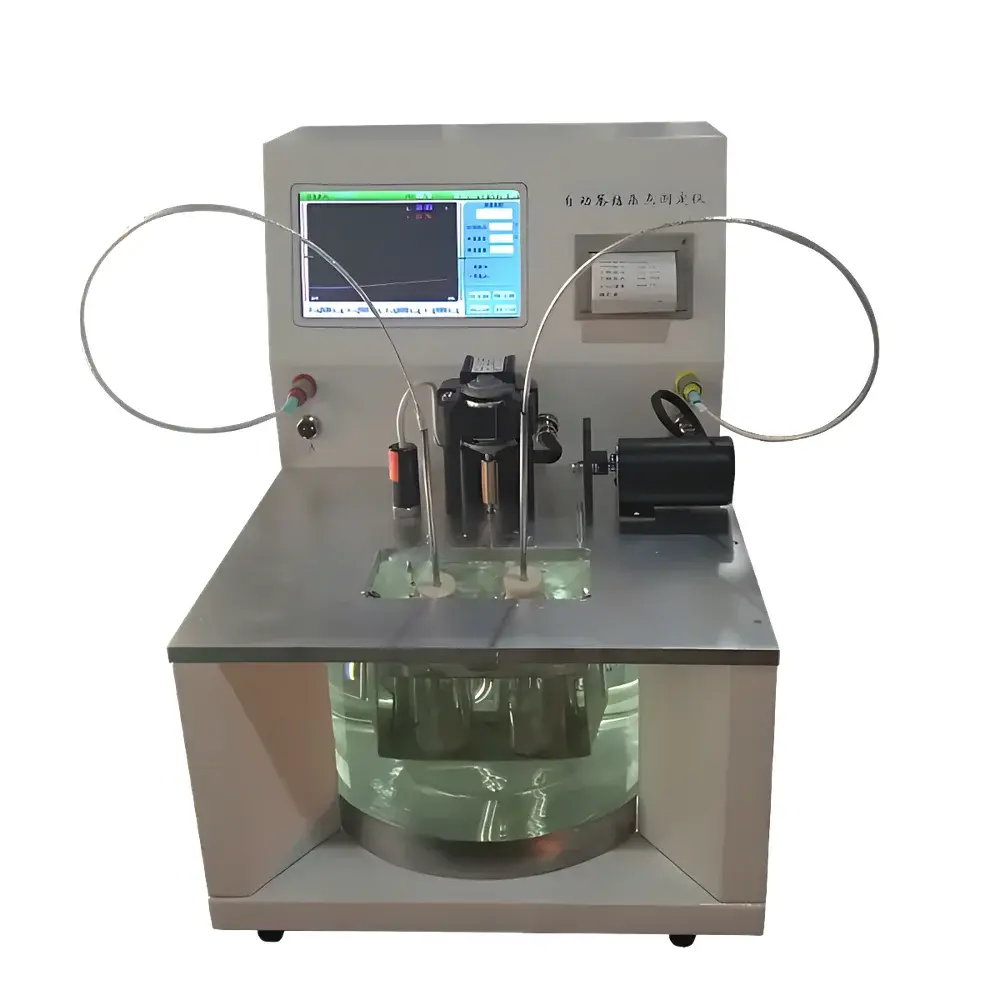
Fuland FDR-4171 Fully Automated Naphthalene Crystallization Point Analyzer
| Brand | Fuland (csfriend) |
|---|---|
| Model | FDR-4171 |
| Origin | Hunan, China |
| Compliance Standard | GB/T 30963 |
| Temperature Control Method | Microcomputer-controlled bath & sample temperature |
| Stirring Method | Automatic mechanical stirring |
| Data Output | On-screen real-time crystallization curve + thermal profile display, storage and thermal printer output |
| Power Supply | AC 220 V ±10%, 50 Hz |
| Rated Power | 1 kW |
| Operating Environment | 0–45 °C, RH <80% |
| Heating Element | Dry-burn-resistant electric heating tube |
Overview
The Fuland FDR-4171 Fully Automated Naphthalene Crystallization Point Analyzer is engineered for precise, repeatable determination of the crystallization point of naphthalene and related aromatic hydrocarbon samples in accordance with GB/T 30963. This instrument employs a dual-temperature control architecture—simultaneously regulating both the cooling bath temperature and the sample temperature—with high-resolution thermistor sensing and PID-based feedback loops. Crystallization onset is detected via real-time monitoring of thermal behavior during controlled cooling, leveraging the characteristic latent heat release associated with solid-phase nucleation. The system implements a dynamic cooling protocol that balances thermal inertia reduction and kinetic resolution, ensuring compliance with the fundamental thermodynamic definition of crystallization point as the temperature at which the first stable crystal nuclei form under equilibrium-cooling conditions. Designed for routine QC laboratories in petrochemical refineries, coal tar processing facilities, and ISO/IEC 17025-accredited testing centers, the FDR-4171 replaces subjective visual observation with objective, algorithm-driven phase transition detection.
Key Features
- 7-inch color TFT touchscreen interface with intuitive Chinese-language menu navigation and real-time graphical display of sample temperature vs. time, including derivative (dT/dt) curve overlay for unambiguous crystallization onset identification
- Fully automated sequence execution: bath pre-cooling, sample immersion, controlled descent rate, automatic oscillation initiation upon approach to expected crystallization zone, and endpoint validation via dual-threshold thermal stability criteria
- Integrated dry-burn-resistant electric heating tube with overtemperature cut-off and thermal fuse redundancy, enabling safe, stable bath temperature recovery between tests
- Motor-driven vertical stirrer with programmable speed profile (0–120 rpm), synchronized with cooling rate to suppress supercooling and promote homogeneous nucleation
- Embedded microcontroller architecture with non-volatile flash memory for secure local storage of ≥1,000 test records, each timestamped and tagged with operator ID, ambient conditions, and calibration verification status
Sample Compatibility & Compliance
The FDR-4171 is validated for use with purified naphthalene (≥99.5% purity), technical-grade naphthalene, and naphthalene-containing coal tar distillates meeting ASTM D235 or GB/T 2288 specifications. Sample volume requirement is 25 ±0.5 mL in standardized borosilicate glass crystallization tubes (ID 18 mm, height 150 mm). All hardware components contacting sample or vapor phase are chemically inert (316 stainless steel, PTFE, and borosilicate glass). The analyzer conforms to GB/T 30963–2014 “Determination of Crystallization Point of Naphthalene” and supports traceability requirements per ISO/IEC 17025:2017 Clause 7.7 (Measurement Traceability) and Clause 7.8.2 (Reporting of Results). Optional audit trail logging enables alignment with GLP principles for regulated environments.
Software & Data Management
The proprietary Fuland Analytical Suite (v3.2+) provides instrument control, data visualization, and report generation. Software features include customizable test templates, configurable pass/fail limits per sample batch, CSV export with metadata headers (test ID, date/time, operator, ambient T/RH, calibration due date), and PDF report generation compliant with internal QA documentation standards. Data integrity safeguards include user-level access control (admin/operator/guest), electronic signature prompts for result approval, and immutable record timestamps logged to internal RTC with battery backup. While not FDA 21 CFR Part 11-certified out-of-the-box, the system supports configuration for Part 11 readiness—including audit trail activation, electronic signature workflows, and role-based permissions—when deployed in pharmaceutical excipient or regulatory-compliant petrochemical QA settings.
Applications
- Quality control of naphthalene feedstock in phthalic anhydride production lines
- Specification verification of industrial naphthalene per GB/T 6699 or ISO 1042
- Stability assessment of naphthalene-based phase change materials (PCMs)
- Research on crystallization kinetics of polycyclic aromatic hydrocarbons (PAHs) under controlled cooling gradients
- Interlaboratory comparison studies requiring method harmonization across GB/T 30963 and ASTM D1015 (for analogous systems)
FAQ
What reference standards are recommended for daily calibration verification?
NIST-traceable naphthalene certified reference material (CRM) with assigned crystallization point uncertainty ≤ ±0.03 °C is recommended; secondary verification may be performed using reagent-grade anthracene (crystallization point ≈ 216.2 °C) under identical test parameters.
Can the FDR-4171 be integrated into a LIMS environment?
Yes—via RS-232 or optional USB-to-serial interface, the instrument supports ASCII-based data streaming compatible with common LIMS ingestion protocols (e.g., ASTM E1384, HL7 v2.x); Fuland provides documented command syntax and sample Python scripts for middleware integration.
Is manual override available during automated testing?
No—full automation is enforced by design to eliminate operator-induced variability; however, emergency stop, bath temperature hold, and manual data save functions remain accessible via the touchscreen during active runs.
What maintenance intervals are specified for long-term reliability?
Bath coolant replacement every 12 months, stirrer shaft O-ring inspection quarterly, and thermistor calibration verification semiannually using a calibrated dry-block calibrator (±0.05 °C accuracy) are specified in the Operation & Maintenance Manual (OMM Rev. 4.1).





