
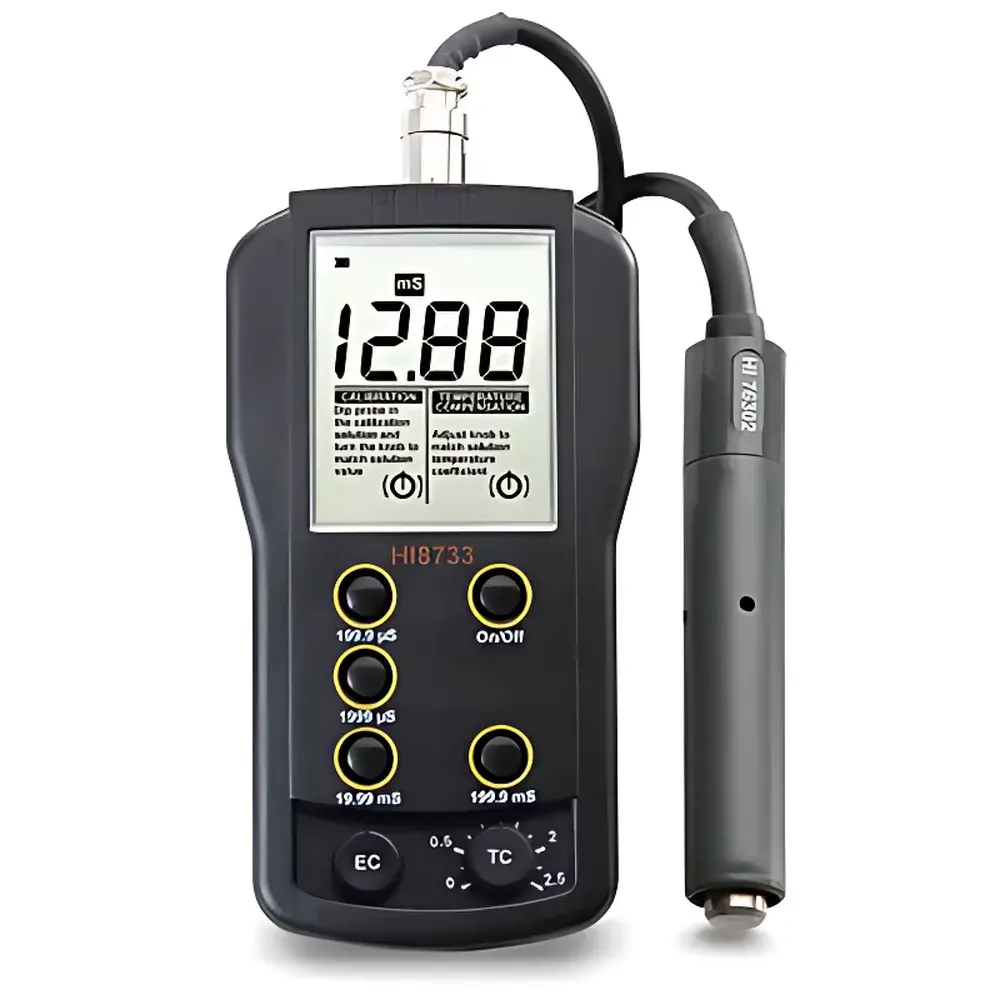
Hanna HI8733 Portable Microprocessor-Based Conductivity (EC) Meter with Automatic Temperature Compensation
| Brand | Hanna Instruments |
|---|---|
| Origin | Italy |
| Model | HI8733 |
| Instrument Type | Portable |
| Parameter Type | Single-Parameter (Conductivity/EC) |
| Measurement Range | 0.0 to 199.9 µS/cm, 0 to 1999 µS/cm, 0.00 to 19.99 mS/cm, 0.0 to 199.9 mS/cm |
| Resolution | 0.1 µS/cm, 1 µS/cm, 0.01 mS/cm, 0.1 mS/cm |
| Accuracy | ±1% F.S. @ 20°C (68°F) |
| Calibration | Manual single-point calibration |
| Temperature Compensation | Automatic (0 to 50°C, β adjustable 0.0 to 2.5%/°C) or manual (fixed β = 2.0%/°C) |
| Included Electrode | HI76302W (DIN connector, 1 m cable, integrated Pt1000 temperature sensor) |
| Power | 9V battery |
| Operating Environment | 0 to 50°C, ≤95% RH (non-condensing) |
| Dimensions (H×W×D) | 145 × 80 × 36 mm |
| Weight | 230 g |
Overview
The Hanna HI8733 is a rugged, handheld conductivity (EC) meter engineered for field-deployable and laboratory-grade precision in aqueous solution analysis. It operates on the principle of four-electrode (tetrapolar) AC conductivity measurement—eliminating polarization effects and electrode fouling errors common in two-electrode systems. This architecture ensures stable, reproducible readings across wide dynamic ranges without recalibration between scales. Designed specifically for environmental monitoring, hydroponics, aquaculture, irrigation management, and wastewater pre-screening, the HI8733 delivers trace-level resolution in low-conductivity waters (down to 0.1 µS/cm) and robust performance up to 199.9 mS/cm—covering freshwater, brackish, and moderately saline matrices. Its microprocessor-controlled circuitry integrates real-time temperature compensation using a built-in Pt1000 sensor within the HI76302W probe, applying user-adjustable linear temperature coefficients (β = 0.0–2.5%/°C) per ASTM D1125 and ISO 7888 standards.
Key Features
- Four-ring (tetrapolar) conductivity cell design—minimizes polarization drift and contact resistance artifacts during extended field use
- Four auto-ranging measurement spans: 0.0–199.9 µS/cm, 0–1999 µS/cm, 0.00–19.99 mS/cm, and 0.0–199.9 mS/cm—selected manually via intuitive front-panel buttons
- Integrated automatic temperature compensation (ATC) with programmable β coefficient (0.0–2.5%/°C), compliant with USP and EPA Method 120.1 requirements for EC reporting
- High-contrast, large-format LCD with dual-parameter display: primary EC value + simultaneous temperature reading (°C)
- Single-point calibration protocol aligned with NIST-traceable KCl standard solutions (e.g., 1413 µS/cm and 12880 µS/cm at 25°C); no calibration slope calculation required
- PVC-bodied HI76302W probe with DIN connector and 1-meter shielded cable—optimized for mechanical durability and chemical resistance in outdoor and industrial settings
- Low-power 9V battery operation (typical life >200 hours), IP67-rated housing seal integrity under transient immersion (per IEC 60529)
Sample Compatibility & Compliance
The HI8733 is validated for use with aqueous samples exhibiting total dissolved solids (TDS) concentrations up to ~120 g/L and temperatures from 0 to 50°C. It complies with key international metrological frameworks including ISO/IEC 17025:2017 (clause 5.9 on equipment verification) and supports GLP documentation workflows through its unambiguous calibration log structure and non-volatile parameter storage. While not 21 CFR Part 11–enabled due to its standalone architecture, the instrument satisfies FDA-regulated environmental monitoring prerequisites when paired with documented SOPs for calibration frequency (daily pre-use), probe maintenance (rinse/dry protocol), and standard verification (post-calibration check). The HI76302W electrode meets EN 27888 specifications for conductivity sensors used in surface water quality assessment.
Software & Data Management
As a dedicated portable meter, the HI8733 does not feature onboard data logging or Bluetooth/Wi-Fi connectivity. All measurements are displayed in real time only; no internal memory or export interface is provided. This design prioritizes operational simplicity, electromagnetic immunity in remote locations, and regulatory transparency—eliminating concerns related to data integrity, audit trails, or firmware validation. Users are expected to record results manually or interface externally via compatible Hanna accessories (e.g., HI92000-compatible data transfer kits, sold separately). For laboratories requiring electronic records, the HI8733 serves as a primary screening tool preceding confirmatory analysis on GLP-compliant benchtop systems such as the HI5522 or HI2550.
Applications
- Environmental field surveys: stream, lake, and groundwater EC profiling per USGS NWIS protocols
- Hydroponic nutrient solution monitoring—tracking EC drift indicative of ion depletion or accumulation
- Aquaculture system management: salinity trend analysis in hatcheries and recirculating aquaculture systems (RAS)
- Irrigation water quality screening: detection of sodium adsorption ratio (SAR)-relevant EC thresholds in agricultural runoff
- Wastewater pretreatment verification: rapid EC checks before discharge to municipal sewer networks (EPA NPDES compliance support)
- Educational labs: hands-on instruction in electrolyte theory, ionic strength relationships, and temperature-dependent conductivity behavior
FAQ
What calibration standards are recommended for the HI8733?
NIST-traceable KCl solutions at 1413 µS/cm (for low-to-mid range) and 12880 µS/cm (for high-range validation) are specified in the manual; both are included in the HI8733D kit.
Can the HI8733 measure TDS directly?
No—it reports EC only. TDS must be calculated externally using industry-standard conversion factors (e.g., 0.5–0.7 × EC in µS/cm), as defined in ASTM D5391 and ISO 10523.
Is the HI76302W electrode suitable for high-salinity seawater?
Yes—its tetrapolar geometry and PVC body resist chloride-induced corrosion; however, post-measurement rinsing with deionized water is mandatory to prevent crystallization-induced contact resistance.
Does the HI8733 support automatic ranging?
No—range selection is manual via dedicated front-panel keys to ensure operator awareness of scale context and avoid misinterpretation of trailing zeros.
How often should the HI76302W electrode be cleaned?
After each use in turbid or organic-rich samples; weekly minimum for clean-water applications—using mild detergent or 0.1 M HNO₃ soak followed by thorough DI water rinse.



