
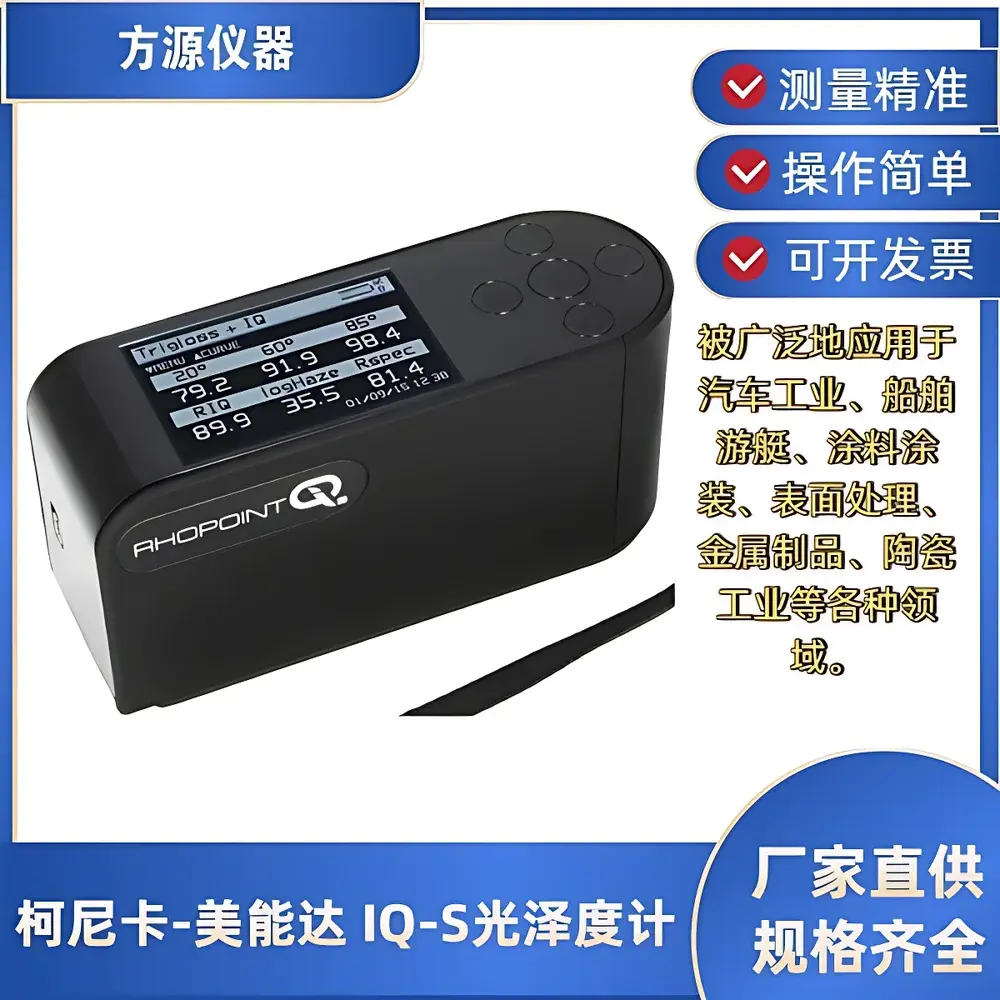
Konica Minolta Rhopoint IQ-S Trigloss and Appearance Analyzer
| Brand | Konica Minolta |
|---|---|
| Origin | Japan |
| Model | Rhopoint IQ-S |
| Instrument Type | Benchtop |
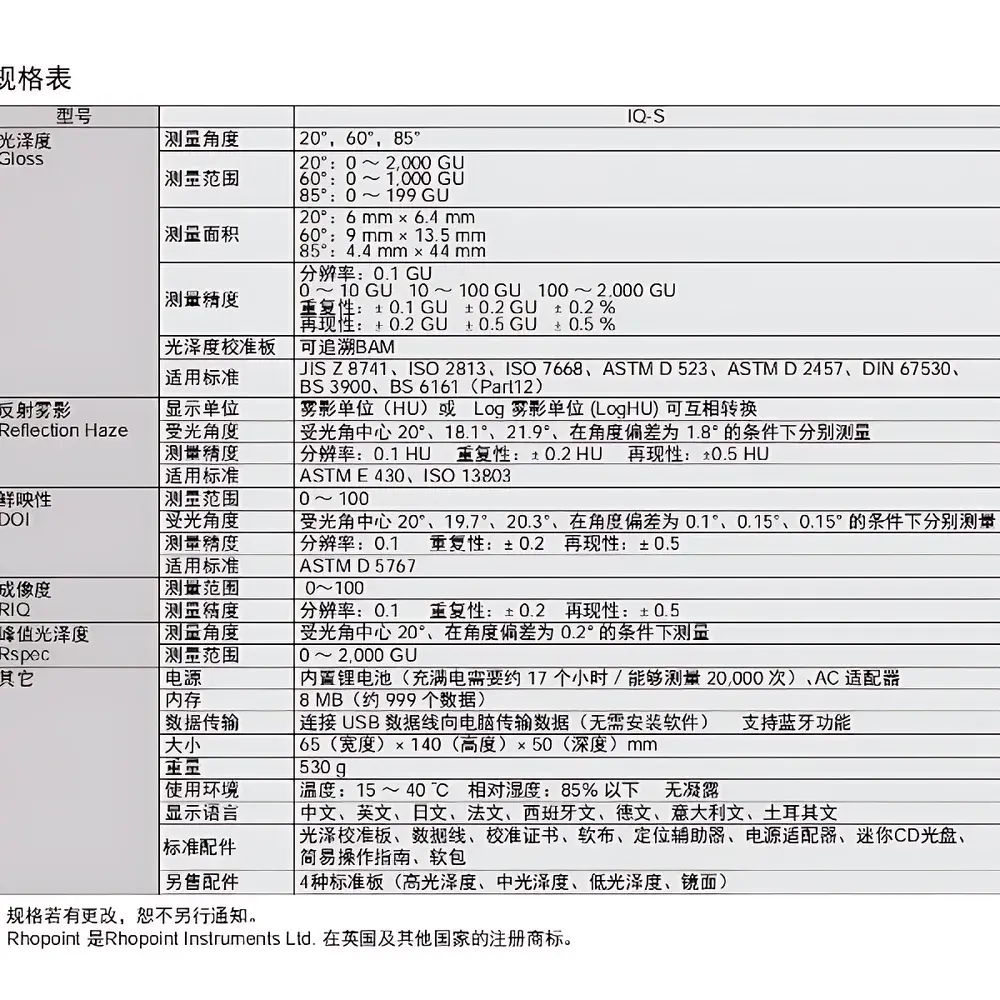
| Measurement Angles | 20°, 60°, 85° |
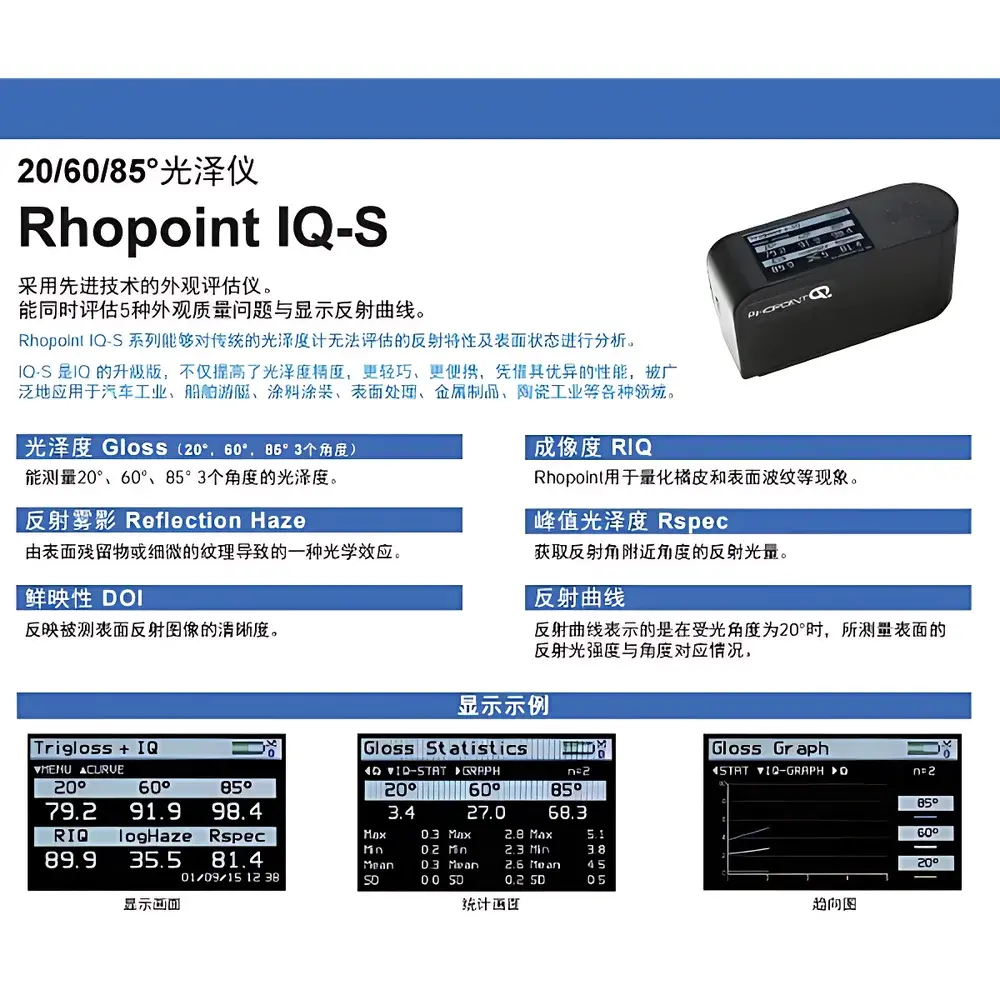
| Gloss Metrics | Gloss (20°/60°/85°), Reflected Image Quality (RIQ), Reflection Haze (logHaze), Specular Peak Reflectance (Rspec), Distinctness of Image (DOI) |
| Reflectance Curve Acquisition | Yes (20° incident, ±30° angular scan) |
| Compliance | ISO 2813, ASTM D523, ASTM E430, ISO 13803, ISO 10216, ISO 17299 |
| Software | Rhopoint IQ Software v5.0+ with GLP-compliant audit trail, data export (CSV, PDF, XML), statistical reporting (mean, SD, min/max, n≥2), curve overlay & comparative analysis |
Overview
The Konica Minolta Rhopoint IQ-S is a benchtop trigloss and multi-parameter appearance analyzer engineered for objective, quantitative assessment of surface optical properties in industrial quality control and R&D environments. Unlike conventional single-angle glossmeters, the IQ-S implements dual-beam geometry with precision goniometric scanning to capture directional reflectance behavior—specifically at 20°, 60°, and 85° incidence angles—enabling robust characterization of specular, semi-specular, and diffuse reflection regimes. Its core measurement principle integrates photometric detection with calibrated angular interpolation to generate high-resolution reflectance curves (±30° around 20° incidence), supporting traceable evaluation of surface microstructure effects such as orange peel, waviness, and micro-roughness-induced scattering. Designed and manufactured in Japan under stringent JIS Q 9001 quality management protocols, the IQ-S meets international standards including ISO 2813 (gloss), ASTM D523 (specular gloss), ASTM E430 (distinctness of image), ISO 13803 (haze), and ISO 10216 (RIQ). It serves as a primary metrology tool in regulated sectors where surface appearance directly correlates with functional performance and customer perception—particularly in automotive OEM paint shops, marine coating certification, coil coating lines, and high-gloss ceramic tile production.
Key Features
- Triple-angle gloss measurement (20°, 60°, 85°) compliant with ISO 2813 and ASTM D523, with repeatability ≤0.2 GU (gloss units) at 60° on certified reference tiles
- Reflected Image Quality (RIQ) quantification—logarithmic metric derived from spatial frequency analysis of reflected line patterns, aligned with ISO 17299 for structured surface defect sensitivity
- Reflection Haze (logHaze) calculation per ASTM E430 Annex A2, detecting sub-micron particulate contamination or nano-texture scattering
- Specular Peak Reflectance (Rspec) measurement—determines maximum reflectance within ±1.5° of mirror angle, critical for evaluating topcoat smoothness in clearcoats
- Distinctness of Image (DOI) computation using edge gradient analysis of reflected test charts, referenced to ISO 2813 Annex B and USP optical system verification guidelines
- Real-time 20° reflectance curve acquisition (–30° to +30° angular range) with 0.1° resolution, enabling spectral shape profiling for root-cause analysis of appearance anomalies
- Benchtop architecture with integrated thermal stabilization and vibration-damped optical base, ensuring measurement stability across ambient temperature fluctuations (15–30°C)
Sample Compatibility & Compliance
The Rhopoint IQ-S accommodates flat, curved, and moderately textured surfaces with radii ≥25 mm, supporting sample sizes up to 150 × 150 mm. Its non-contact optical design eliminates surface loading or contamination risk, making it suitable for soft coatings (e.g., wet-bake automotive basecoats), polished metals, anodized aluminum, vitrified ceramics, and laminated composites. All measurement modes are validated against NIST-traceable ceramic and polymer reference standards (SRM 2011, SRM 2035). The instrument’s firmware and software comply with FDA 21 CFR Part 11 requirements for electronic records and signatures when operated with IQ Software v5.0 or later—including user authentication, audit trail logging (with timestamp, operator ID, parameter changes), and immutable data archiving. Full documentation packages support GLP/GMP audits per ISO/IEC 17025:2017 Clause 7.8.2.
Software & Data Management
Rhopoint IQ Software provides a validated, Windows-based platform for instrument control, data visualization, and statistical reporting. It supports automated batch testing with customizable pass/fail limits per parameter (e.g., DOI ≥85, logHaze ≤32.5), trend charting over time (SPC-compatible X-bar/R charts), and multi-sample curve overlay for comparative analysis. Raw reflectance curve data is exportable in CSV format for third-party spectral modeling (e.g., Zemax OpticStudio, MATLAB), while PDF reports include embedded calibration certificates, measurement metadata (date/time, operator, environment), and ISO-compliant uncertainty statements. The software maintains full revision history and enables secure role-based access control (administrator, technician, reviewer), satisfying ALCOA+ data integrity principles.
Applications
- Automotive: Clearcoat orange peel quantification pre- and post-baking; gloss uniformity mapping across body panels; supplier qualification per OEM specifications (e.g., Ford WSS-M2P195-A, GM 6091-M)
- Marine & Aerospace: Anti-fouling coating haze validation; composite fairing surface finish assessment per MIL-PRF-85285
- Architectural Coatings: Batch-to-batch consistency verification for high-sheen architectural paints (ASTM D2805)
- Ceramics & Glass: Glaze clarity grading in sanitaryware and tabletop porcelain; defect detection in tempered glass reflectivity profiles
- R&D Laboratories: Correlation studies between surface roughness (Ra, Rz) measured via profilometry and RIQ/DOI outputs; formulation optimization for low-haze UV-curable resins
FAQ
What standards does the Rhopoint IQ-S comply with for gloss measurement?
It conforms to ISO 2813, ASTM D523, and JIS Z 8741 for 20°, 60°, and 85° gloss, with factory calibration traceable to NIST SRM 2011.
Can the IQ-S measure curved surfaces?
Yes—within curvature radii ≥25 mm; measurement spot size is 12 mm diameter, and the optical head includes auto-focus assist for consistent working distance.
Is the reflectance curve data exportable for external analysis?
Yes—full angular intensity data (angle vs. intensity) is exportable as CSV, enabling integration with optical simulation tools and custom regression modeling.
How is measurement repeatability verified during routine operation?
Daily verification uses supplied ceramic reference tiles; built-in diagnostics perform LED intensity monitoring, detector linearity checks, and angle encoder calibration validation.
Does the software support electronic signature and audit trail for regulated environments?
Yes—IQ Software v5.0+ implements 21 CFR Part 11-compliant user authentication, immutable audit logs, and electronic signature workflows for report approval.



