
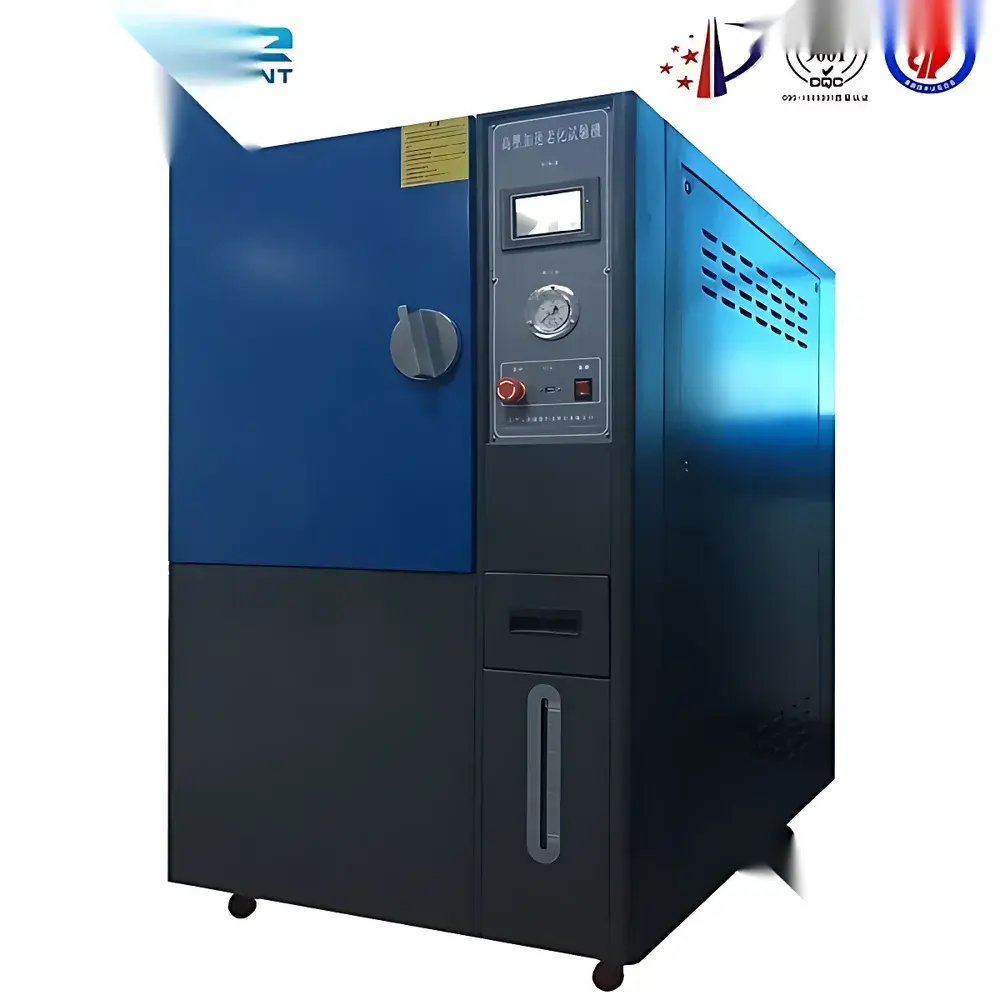
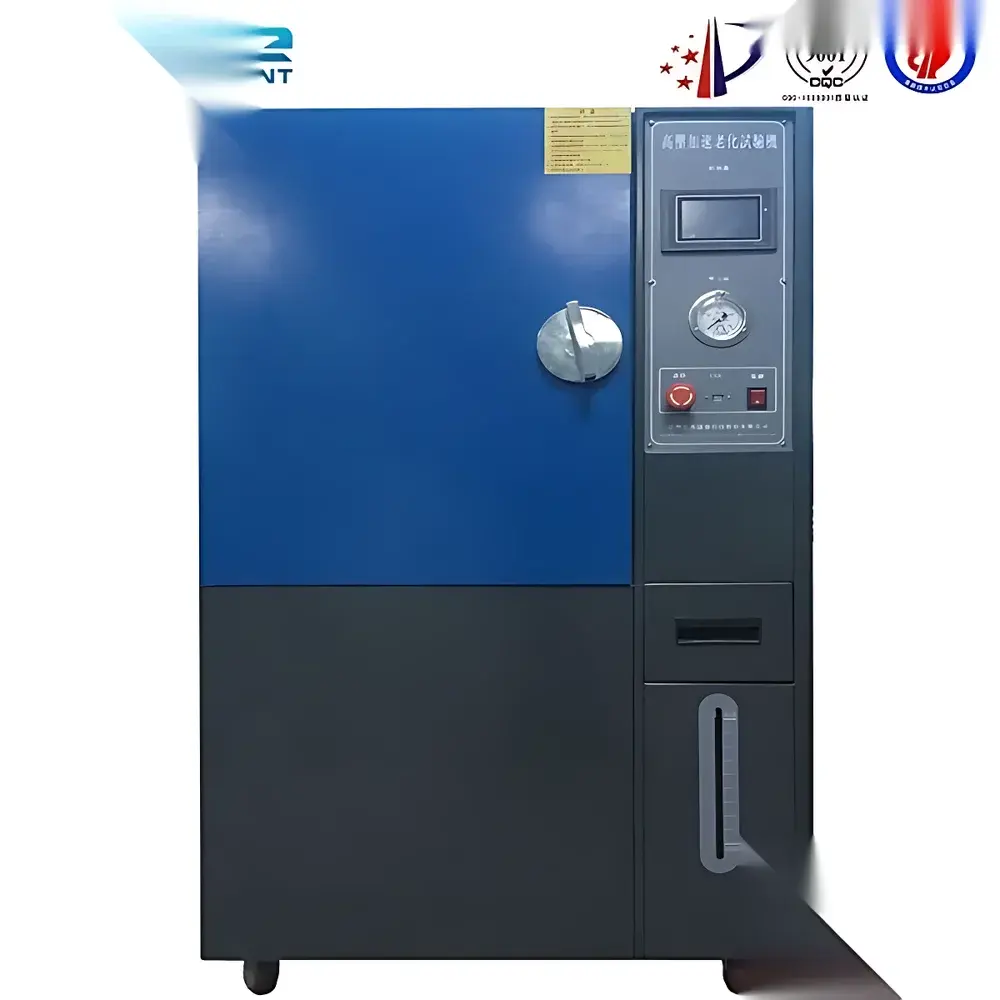
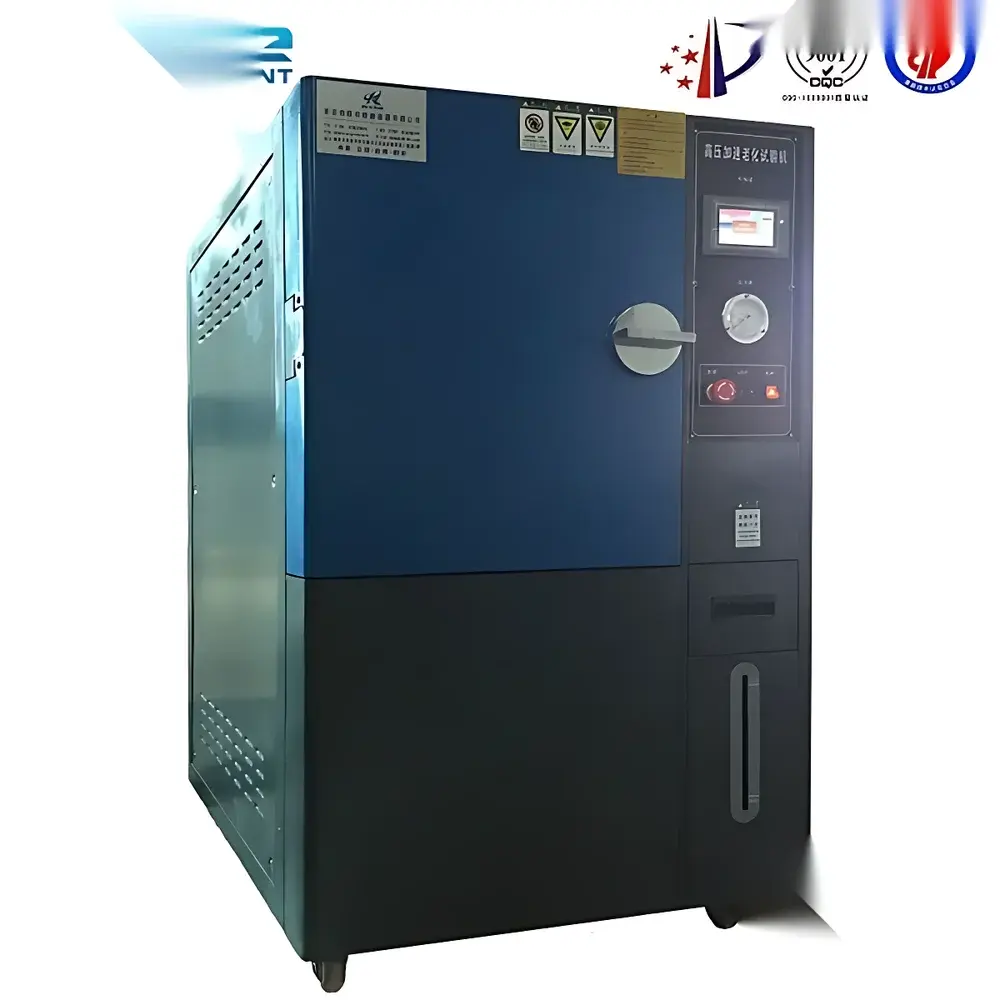
PCT Test Chamber – OK-PCT Series (OK-PCT-25 / OK-PCT-30 / OK-PCT-40 / OK-PCT-50) by OEKO Instruments
| Key | Brand: OEKO Instruments |
|---|---|
| Chamber Dimensions (ID × H) | Φ25×40 cm / Φ30×50 cm / Φ40×60 cm / Φ50×70 cm |
| Temperature Range | 100–132 °C |
| Humidity Condition | 100 % RH saturated steam |
| Pressure Range | Ambient + 0–4 kgf/cm² (≈0–392 kPa gauge) |
| Safety Certification | Dual-stage pressure relief, dual overheat protection, water-level sensor auto-refill, 140 °C tank-rated pressure vessel (2.65 MPa hydrostatic test compliance) |
| Max Continuous Operation | 400 hours |
| Steam Generation | Independent steam generator chamber |
| Air Purge | Pre-test and in-process cold-air purge cycle |
| Compliance | Designed for IPC-TM-650 2.6.25, JIS C 5023-4, MIL-STD-202 Method 108, and ISO 16750-4 environmental stress screening protocols |
Overview
The OEKO Instruments PCT Test Chamber (OK-PCT Series) is a precision-engineered pressure cooker test system designed for accelerated reliability assessment of hermetically sealed electronic components and assemblies under high-temperature, high-humidity, and elevated-pressure conditions. Operating on the fundamental principle of saturated steam pressurization—where temperature, pressure, and relative humidity are intrinsically coupled—the chamber subjects samples to rigorously controlled stress profiles that accelerate moisture ingress through micro-defects, enabling early detection of latent sealing failures. Unlike ambient-pressure humidity chambers, the OK-PCT series achieves true saturation at temperatures up to 132 °C by maintaining full 100 % RH via pressurized steam, thereby replicating real-world failure mechanisms such as popcorning, wire bond lift, and die attach delamination in IC packages, multilayer PCBs, LCD modules, and permanent magnets. Its architecture complies with the thermodynamic boundary conditions defined in IPC-TM-650 2.6.25 (Pressure Cooker Test) and supports qualification-level testing per JEDEC JESD22-A102 and A110.
Key Features
- Independent Steam Generator Chamber: Physically isolated from the test chamber to prevent direct steam impingement on DUTs—minimizing localized thermal shock and mechanical disturbance during pressurization.
- Dual-Stage Pressure Safety System: Combines microprocessor-controlled pressure regulation with a redundant mechanical safety valve rated for 2.65 MPa hydrostatic test pressure, ensuring fail-safe depressurization under fault conditions.
- Intelligent Water-Level Management: Real-time ultrasonic water-level sensing triggers automatic refill during operation without interrupting test continuity—critical for extended-duration qualification runs up to 400 hours.
- Cold-Air Purge Architecture: Two-stage air evacuation—pre-test and mid-cycle—removes residual non-condensable gases to stabilize partial pressure and improve repeatability of pressure/temperature ramp profiles.
- Ergonomic Door Lock Mechanism: Lever-actuated cam-lock design replaces legacy rotary handles, reducing operator effort and ensuring uniform gasket compression across all chamber sizes (OK-PCT-25 to OK-PCT-50).
- Dual Overtemperature Protection: Independent thermal cutoffs (electronic controller + bimetallic switch) trigger audible alarm and immediate heater deactivation if internal temperature exceeds setpoint tolerance.
- High-Integrity Pressure Vessel: Stainless steel inner tank rated for continuous service at 140 °C and validated per ASME BPVC Section VIII Division 1 requirements for pressure containment integrity.
Sample Compatibility & Compliance
The OK-PCT series accommodates a broad range of sample geometries—from individual IC packages (QFP, BGA, CSP) and wafer-level chips to assembled multilayer PCBs, flexible circuit substrates, and magnetized components. Chamber diameters (25–50 cm ID) and heights (40–70 cm) support vertical or horizontal fixture mounting while preserving uniform steam distribution. All models meet regulatory prerequisites for traceability and audit readiness: built-in event logging captures timestamped pressure, temperature, and water-level data; user access control aligns with FDA 21 CFR Part 11 requirements for electronic records; and calibration certificates are provided per ISO/IEC 17025-accredited procedures. The system is routinely deployed in GLP-compliant QA labs conducting qualification per IEC 60068-2-66 and automotive AEC-Q200 stress testing protocols.
Software & Data Management
Control firmware supports both standalone operation and PC-integrated supervision via RS-485/Modbus RTU or optional Ethernet interface. The embedded HMI enables full parameter configuration—including ramp rates, dwell times, purge cycles, and safety thresholds—with password-protected administrator mode. All operational events—including overtemperature alarms, low-water alerts, and pressure deviation warnings—are logged with millisecond timestamps and stored internally for ≥30 days. Exportable CSV reports include raw sensor traces synchronized to test phase markers (e.g., “Purge Start”, “Stabilization Achieved”, “Depressurize Initiated”), facilitating root-cause analysis in Six Sigma and FMEA workflows. Optional software package adds automated report generation compliant with ISO 17025 documentation standards and supports audit trail review for GMP validation.
Applications
- Qualification testing of moisture-sensitive devices (MSL level verification per J-STD-020)
- Seal integrity validation for MEMS sensors, optical modules, and hermetic ceramic packages
- Failure analysis of solder joint reliability under combined thermal-hygric stress
- Process development and lot acceptance testing for conformal coating and underfill materials
- Accelerated life testing of battery enclosures and EV power electronics housings
- Environmental stress screening (ESS) for aerospace avionics and defense-grade PCBAs
FAQ
What standards does the OK-PCT series comply with?
The system is engineered to meet IPC-TM-650 2.6.25, JEDEC JESD22-A102, ISO 16750-4, and MIL-STD-202 Method 108. Calibration and safety documentation support ISO/IEC 17025 and FDA 21 CFR Part 11 compliance.
Can the chamber operate unattended for extended durations?
Yes—integrated water-level auto-refill, dual overheat protection, and dual-stage pressure relief enable fully autonomous operation for up to 400 consecutive hours, with event logging and remote alert capability.
Is steam purity maintained throughout the test cycle?
The independent steam generator uses deionized water feed and incorporates condensate separation to minimize mineral carryover; steam quality is verified to meet ASTM E2912 specifications for particulate and ionic contamination.
How is pressure stability achieved during long-duration tests?
Pre-test and in-process cold-air purging eliminates non-condensable gases; combined with PID-controlled steam injection and redundant pressure transducers, this ensures ±0.5 kgf/cm² pressure stability over 96-hour dwell periods.
What maintenance intervals are recommended?
Quarterly verification of pressure transducer linearity, biannual replacement of steam generator heating elements, and annual hydrostatic re-certification of the pressure vessel per ASME BPVC guidelines.



