
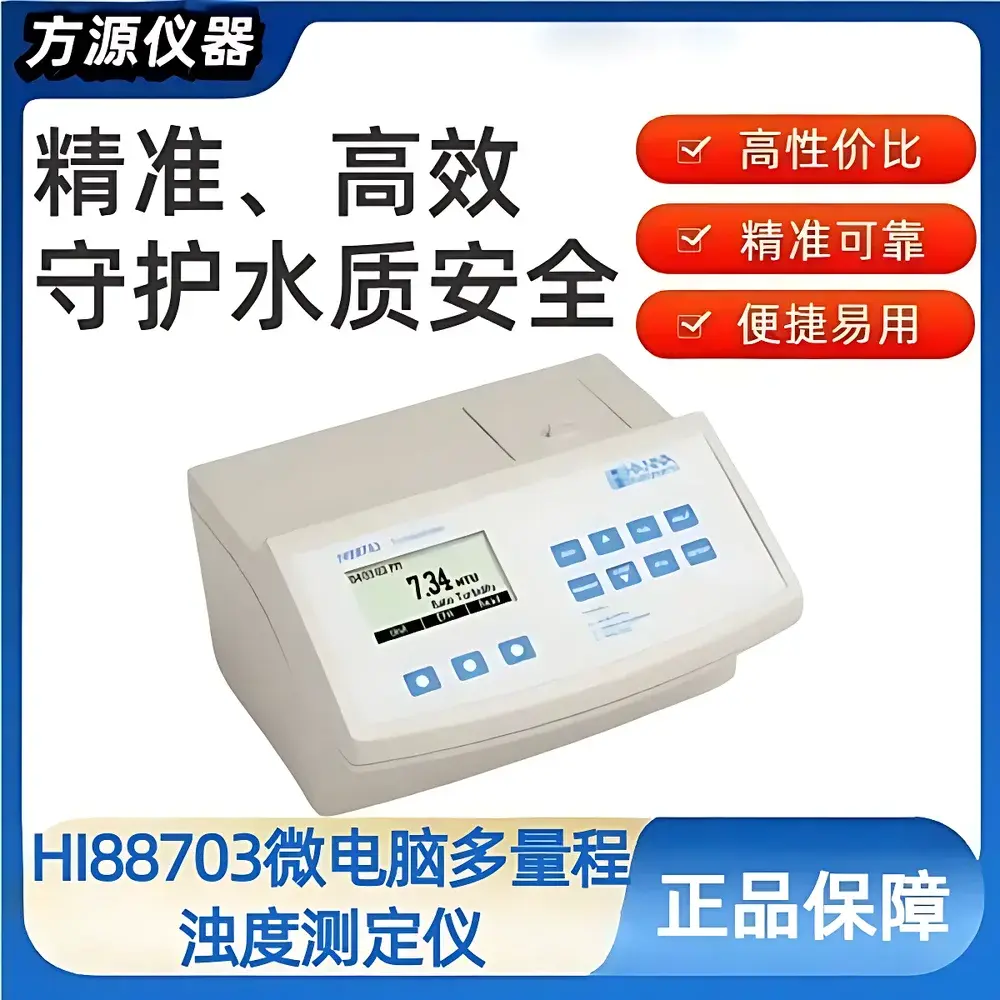
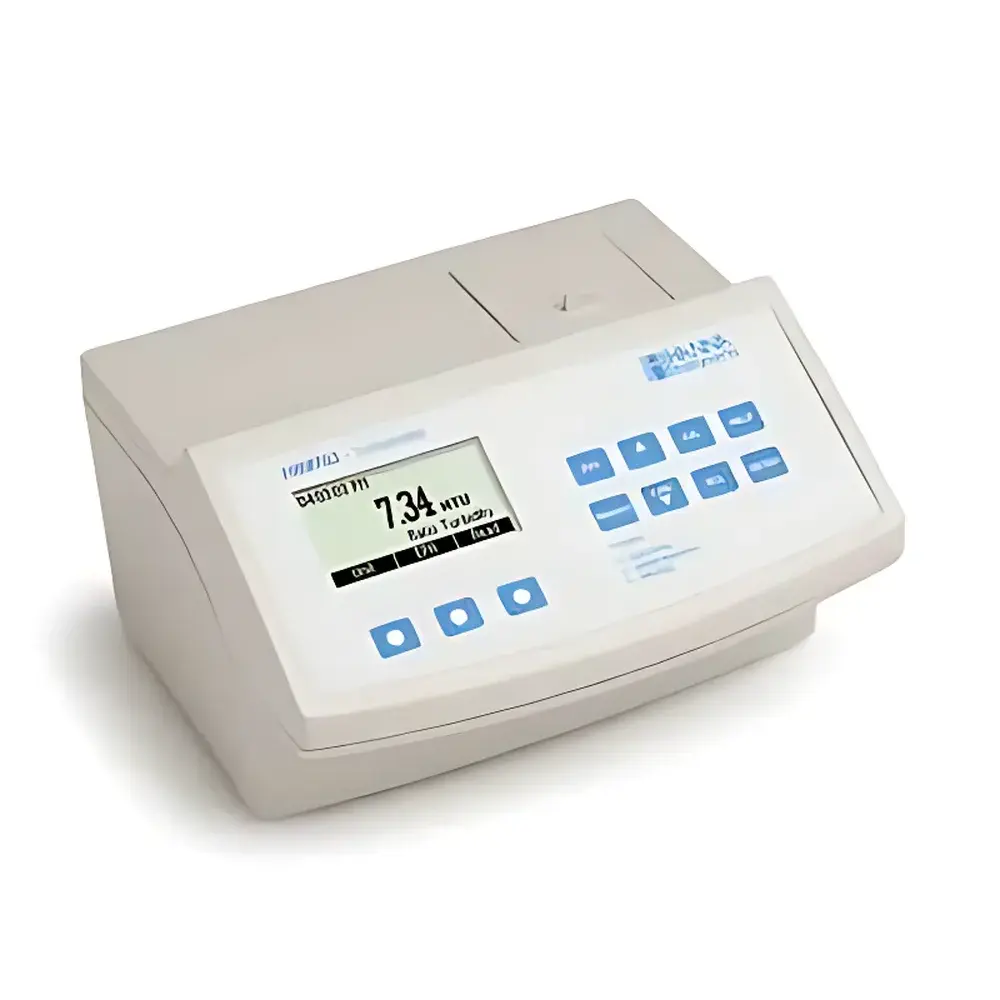
Hanna HI88703 Portable Multi-Range Turbidimeter
| Brand | Hanna Instruments |
|---|---|
| Origin | Italy |
| Model | HI88703 |
| Instrument Type | Portable |
| Parameter Type | Single-Parameter |
| Measurement Principle | Nephelometric (90° scatter) and Ratio (90°/180° backscatter), compliant with USEPA Method 108.1 and Standard Method 2130B |
| Measurement Ranges | 0.00–9.99 / 10.0–40.0 / 100–4000 NTU |
| Resolution | 0.01 / 0.1 / 1 NTU |
| Accuracy | ±2% or ±0.02 NTU (±0.15 Nephelos |
| Repeatability | ±1% + 0.02 NTU (±0.15 Nephelos |
| Detection Limit | <0.02 NTU |
| Calibration Points | Five-point manual calibration (≤0.1, 15, 100, 750, 2000 NTU) |
| Data Storage | 200 measurement sets with timestamp |
| Interface | USB 2.0 |
| Display | 64 × 128 pixel LCD with backlight (40 × 70 mm active area) |
| Power | AC 230 V / 50 Hz, 20 W |
| Operating Environment | 0–50 °C, RH ≤95% non-condensing |
| Dimensions | 230 × 200 × 145 mm |
| Weight | 2.5 kg |
Overview
The Hanna HI88703 Portable Multi-Range Turbidimeter is an EPA-compliant, laboratory-grade nephelometer engineered for precision turbidity measurement across drinking water, wastewater, process water, and beverage applications—including beer (EBC scale). It operates on the fundamental optical principle of light scattering: when a collimated beam passes through a liquid sample, suspended particles deflect photons at defined angles—primarily 90° (nephelometric mode) and optionally 180° (ratio mode)—which are quantified by a calibrated photodetector array. This physical measurement correlates directly to particle concentration, size distribution, and refractive index, making turbidity a critical surrogate parameter for pathogen risk assessment per USEPA guidance and WHO drinking water standards. Unlike absorbance-based methods, the HI88703’s dual-angle detection architecture minimizes interference from color, dissolved solids, or bubble artifacts—ensuring robustness in real-world field and plant environments.
Key Features
- EPA Method 108.1 and Standard Method 2130B compliance validated via traceable NIST-traceable calibration standards included in HI88703-11 kit
- Automatic range switching across three distinct turbidity scales: NTU (Nephelometric Turbidity Units), Nephelos (European industrial scale), and EBC (European Brewery Convention) — each with dedicated resolution and accuracy profiles
- Five-point manual calibration using pre-certified primary standards (≤0.1, 15, 100, 750, 2000 NTU) enabling full validation of linearity and low-end sensitivity
- GLP-compliant data management: time-stamped measurements include operator ID, calibration history, ambient temperature, and instrument firmware version
- Dual-mode optical system: selectable 90° scatter (standard) or ratio (90° + 180°) detection to correct for absorption effects in colored or highly turbid samples
- Integrated 200-set memory with USB export capability for audit-ready CSV files compatible with LIMS and QA/QC reporting workflows
Sample Compatibility & Compliance
The HI88703 accommodates standard 25-mm round glass cuvettes (HI731333N set included) and supports routine analysis of raw surface water, filtered potable water, secondary effluent, activated sludge supernatant, and finished beer. Its optical design meets ISO 7027:2016 requirements for instrument performance verification and aligns with regulatory frameworks including US EPA Clean Water Act discharge monitoring, EU Directive 98/83/EC for drinking water, and AS/NZS 2471:2014 for wastewater quality assurance. All calibration and measurement procedures adhere to Good Laboratory Practice (GLP) principles, with full traceability to national metrology institutes. The device satisfies FDA 21 CFR Part 11 readiness when paired with validated USB data transfer protocols and secure audit log retention.
Software & Data Management
No proprietary software is required: measurement data exports natively as comma-separated values (CSV) via USB interface for direct import into Excel, LabArchives, or enterprise LIMS platforms. Each stored record contains date/time stamp, measurement mode (single/continuous/average), selected scale (NTU/EBC/Nephelos), user-defined sample ID, and calibration verification status. Internal clock synchronization ensures temporal integrity across multi-shift operations. GLP reports—accessible via on-device menu—list all calibration events, including date, standard used, deviation from certified value, and technician signature field (entered via alphanumeric keypad). Data retention remains intact during power cycling, and memory is write-protected against accidental overwrite.
Applications
- Drinking water treatment plants: raw intake screening, filter effluent verification, and final disinfection validation per USEPA Stage 1 D/DBP Rule
- Municipal wastewater facilities: secondary clarifier performance monitoring, membrane bioreactor (MBR) permeate quality control, and NPDES permit compliance reporting
- Breweries and beverage manufacturers: EBC-scale haze quantification for lager stability, filtration efficiency tracking, and cold storage shelf-life prediction
- Environmental laboratories: field-deployable analysis of lake/reservoir clarity trends, sediment plume mapping, and stormwater runoff characterization
- Pharmaceutical water systems: PW and WFI distribution loop surveillance where turbidity serves as early indicator of particulate ingress or biofilm shedding
FAQ
Does the HI88703 meet USEPA approval requirements for regulatory reporting?
Yes—the instrument implements USEPA Method 108.1 and Standard Method 2130B, and its calibration standards (HI88703-11) are certified to NIST-traceable reference materials. Documentation supports submission under NPDES, SDWA, and state-level reporting mandates.
Can the HI88703 measure turbidity in colored samples such as wastewater or fruit juice?
Yes—its optional ratio mode (90° + 180° detection) compensates for absorbance-related signal attenuation, significantly improving accuracy in yellow-to-brown matrices without requiring dilution or filtration.
Is the internal memory sufficient for extended field campaigns?
With 200 timestamped entries and USB bulk export, the HI88703 supports multi-week deployments across 5–10 sampling points without data loss; exported logs retain full GLP metadata required for third-party audits.
What maintenance is required to ensure long-term accuracy?
Routine cleaning of the cuvette sleeve and detector window with HI93703-50 reagent and HI731318 microfiber cloth is recommended after every 10 measurements; annual verification against secondary standards is advised per ISO/IEC 17025 accreditation requirements.
How does the HI88703 handle low-turbidity measurements below 0.1 NTU?
Its optimized optical path and high-sensitivity photodiode achieve a detection limit of <0.02 NTU, with ±0.02 NTU absolute accuracy in the sub-1 NTU range—critical for ultrapure water and post-RO monitoring applications.






