
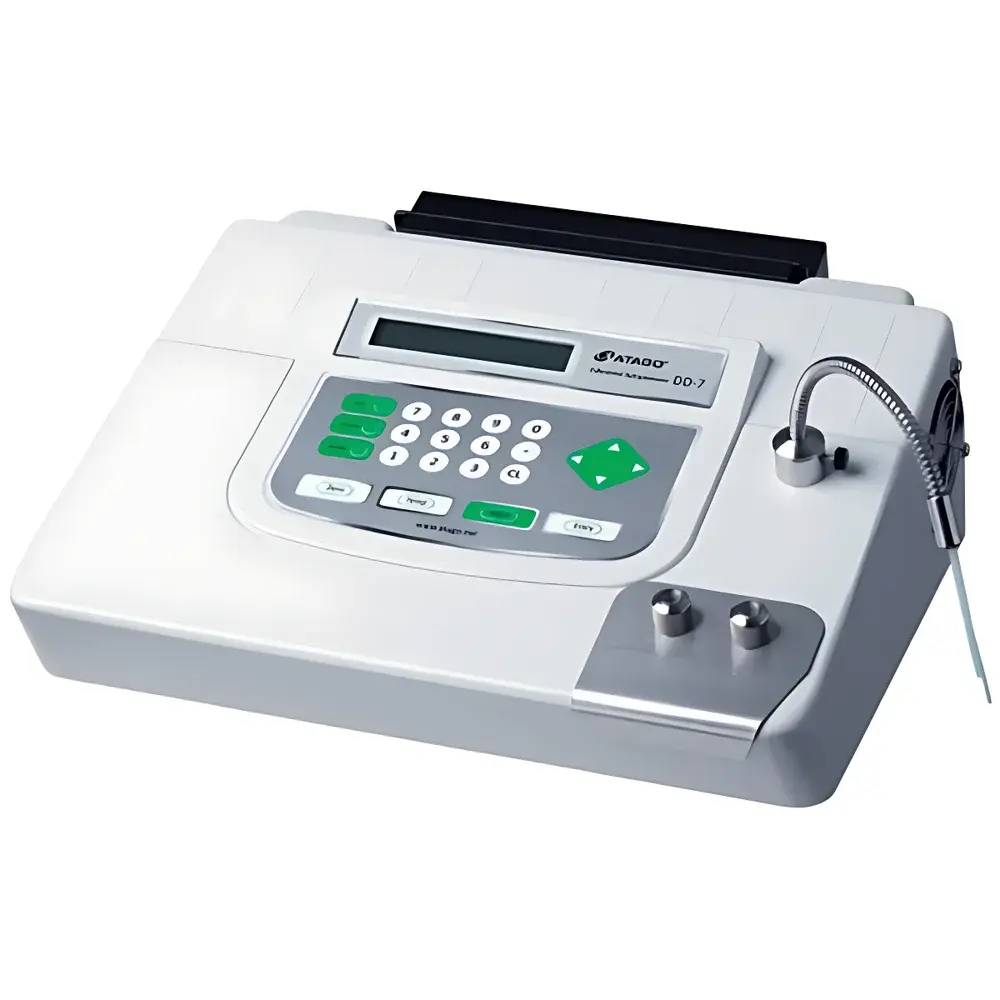
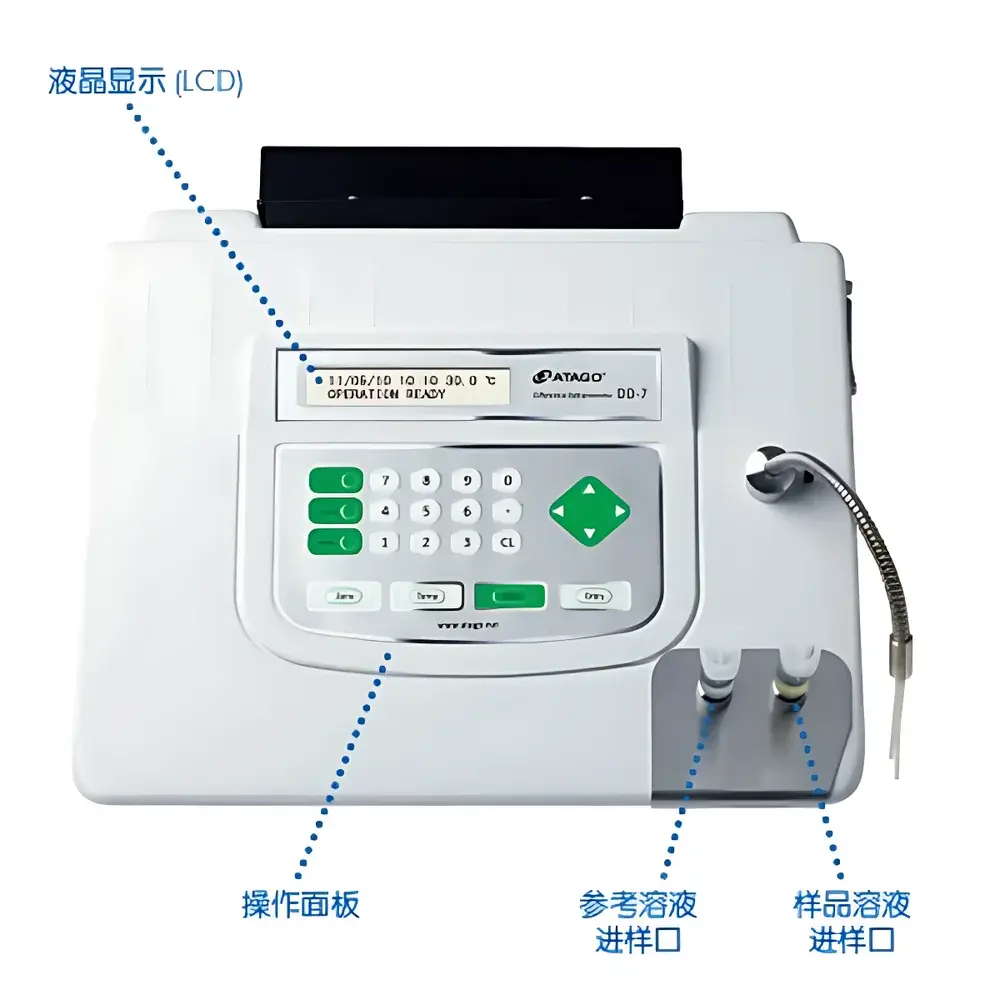
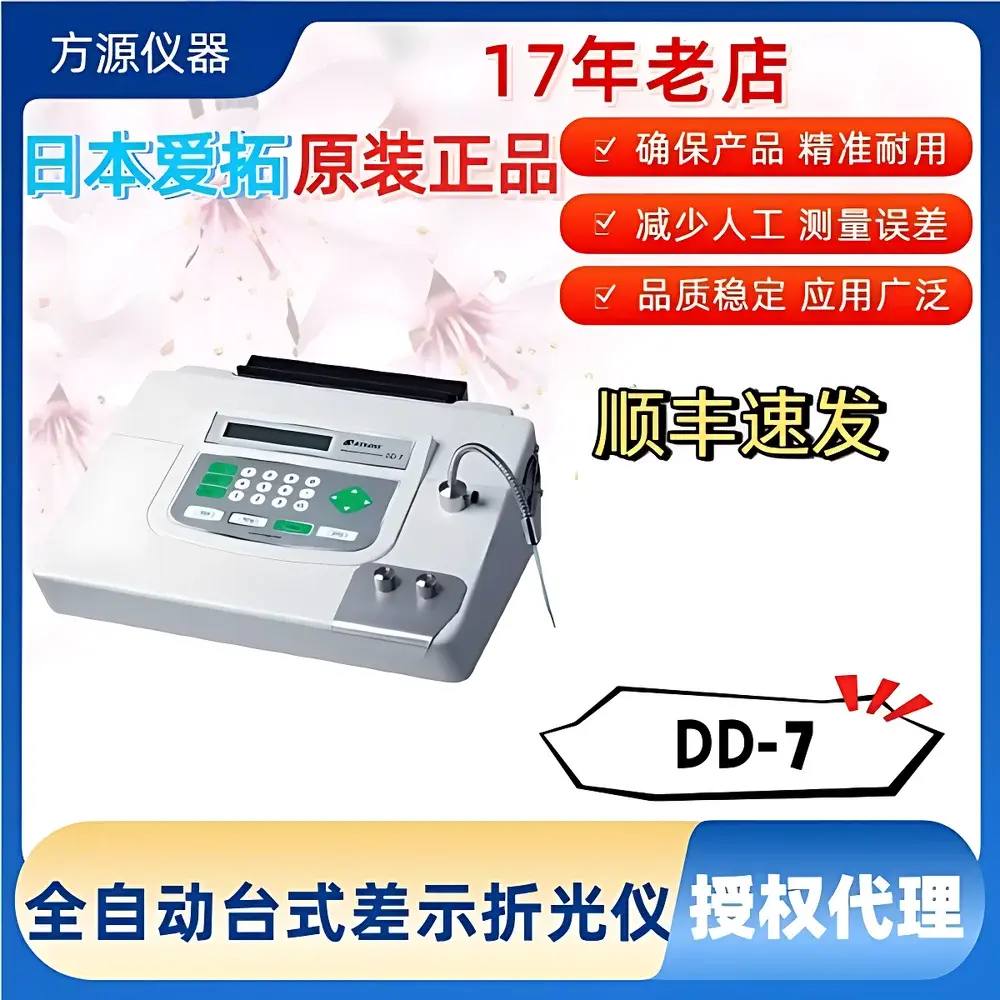
ATAGO DD-7 Desktop Differential Refractometer
| Brand | ATAGO |
|---|---|
| Origin | Japan |
| Model | DD-7 |
| Type | Benchtop Differential Refractometer |
| Measurement Range | 0–2% (w/w) |
| Display | Digital LCD |
| Temperature Control | None |
| Temperature Stability | ±0.5 °C (ambient-dependent) |
| Compliance | CE-marked, ISO/IEC 17025-compatible operation environment |
Overview
The ATAGO DD-7 Desktop Differential Refractometer is a precision optical instrument engineered for high-reproducibility refractive index difference measurements in quality control and R&D laboratories. Unlike conventional single-beam refractometers, the DD-7 employs a dual-beam differential measurement principle based on Abbe-type optics and critical angle detection, enabling direct quantification of minute refractive index deviations (Δn) between a reference solution and an unknown sample. This architecture eliminates baseline drift caused by ambient temperature fluctuations or prism contamination—common limitations in manual or single-cell systems. Designed for routine analysis of low-concentration aqueous solutions—including pharmaceutical buffers, enzyme reaction mixtures, dialysis effluents, and bioprocess monitoring streams—the DD-7 delivers trace-level sensitivity without requiring active thermal regulation. Its optical path is sealed and vibration-damped, ensuring stable performance under standard laboratory conditions (20–25 °C, <60% RH). The instrument complies with fundamental metrological requirements outlined in ISO 21348 (optical instrumentation—terminology and definitions) and supports traceable calibration using NIST-traceable sucrose standards.
Key Features
- Dual-beam differential optical design for real-time subtraction of environmental drift and prism surface artifacts
- High-resolution digital LCD display with automatic zero-point referencing prior to each measurement cycle
- Benchtop footprint (290 × 220 × 180 mm) optimized for integration into QC labs, cleanrooms, and analytical workstations
- Sample chamber accommodates standard 1.5 mL microcentrifuge tubes—no custom cuvettes required
- Self-diagnostic startup sequence verifying LED stability, photodetector linearity, and prism alignment integrity
- Non-invasive measurement principle: no sample heating, dilution, or reagent addition required
- Robust aluminum-alloy chassis with ESD-safe surface treatment for electromagnetic compatibility in regulated environments
Sample Compatibility & Compliance
The DD-7 is validated for transparent, low-turbidity aqueous solutions with refractive index differences ranging from 0.00005 to 0.00200 RIU (refractive index units), corresponding to concentration differentials of 0–2% (w/w) in sucrose-equivalent systems. It is routinely deployed in pharmaceutical upstream processing (e.g., harvest clarity verification), food ingredient consistency checks (e.g., whey protein isolate dilution uniformity), and academic biophysics labs studying macromolecular association equilibria. While not equipped with active Peltier temperature control, its optical design incorporates passive thermal mass buffering and ambient temperature compensation algorithms aligned with ASTM D1218 (Standard Test Method for Refractive Index of Hydrocarbon Liquids) and USP <851> (Refractometry). Instrument operation adheres to GLP documentation standards when paired with external audit-trail-capable LIMS interfaces.
Software & Data Management
The DD-7 operates as a standalone instrument with embedded firmware (v3.2+); no proprietary PC software is required for basic operation. All measurements are timestamped and stored internally (up to 500 records) with sample ID, operator code, and ambient temperature reading. Data export is supported via USB-C interface in CSV format—compatible with Excel, JMP, and LabWare LIMS platforms. For regulated environments, the device supports optional 21 CFR Part 11-compliant data integrity workflows when integrated with third-party electronic lab notebook (ELN) systems that provide user authentication, electronic signatures, and immutable audit trails. Calibration logs and maintenance history are retained separately and exportable per ISO/IEC 17025 clause 7.7.
Applications
- Verification of buffer exchange efficiency during size-exclusion chromatography (SEC) fraction collection
- Real-time monitoring of diafiltration endpoints in monoclonal antibody purification processes
- Quantitative assessment of glycerol or DMSO cryoprotectant residual levels post-thaw
- Batch-to-batch consistency testing of low-concentration enzyme formulations (e.g., ≤0.5 mg/mL)
- Supporting ICH Q5C stability studies where refractive index serves as a surrogate for solute aggregation state
- Teaching laboratories demonstrating colligative property relationships in physical chemistry curricula
FAQ
Does the DD-7 require daily recalibration?
No—calibration is recommended before first use, after major environmental shifts (>5 °C), and at the start of each analytical session per internal SOPs. Factory calibration uses NIST-traceable sucrose standards.
Can the DD-7 measure turbid or colored samples?
It is limited to optically clear, low-absorbance samples (A400nm < 0.3). Suspensions, emulsions, or highly pigmented solutions will yield unreliable Δn values due to scattered-light interference.
Is the instrument compatible with automated liquid handlers?
Yes—its trigger input port accepts TTL-level signals from third-party autosamplers (e.g., Hamilton STAR, Tecan Fluent), enabling unattended sequential analysis.
What is the minimum sample volume required?
1.2 mL per measurement, delivered via standard 1.5 mL microcentrifuge tube; no syringe loading or capillary filling is needed.
How is temperature stability ensured without active cooling/heating?
The instrument’s optical block is thermally isolated and acclimatizes to ambient lab temperature within 15 minutes; built-in compensation algorithms correct for slow ambient drift up to ±0.5 °C, as verified per manufacturer’s validation report #DD7-THERM-2023.




