
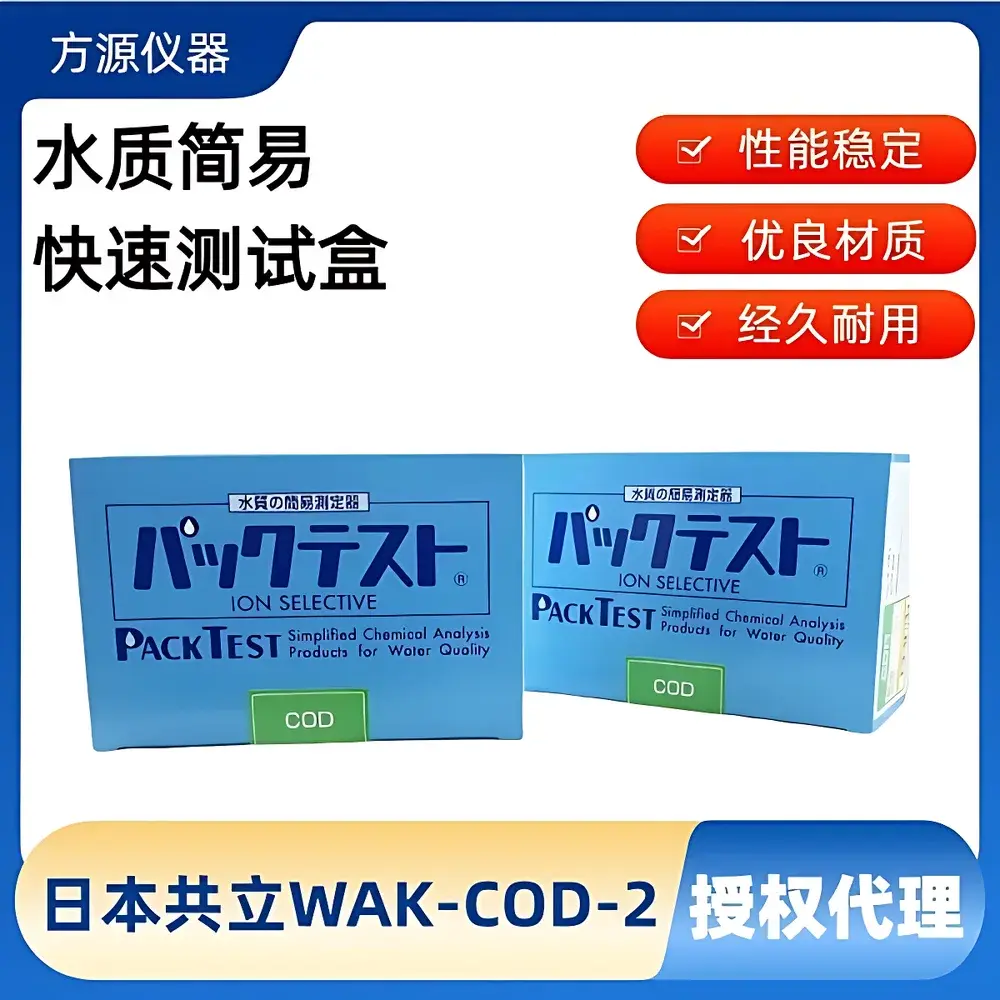
Kyoritsu WAK-COD-2 Ammonia Nitrogen and Total Nitrogen Test Kit for Industrial Wastewater
| Brand | Kyoritsu |
|---|---|
| Origin | Japan |
| Model | WAK-COD-2 |
| Type | Portable Colorimetric Reagent Kit |
| Measurement Principle | Nesslerization (Ammonia) & Persulfate Digestion + UV-Vis Spectrophotometry (Total Nitrogen) |
| Measurement Range (Ammonia-N) | 0–50 mg/L |
| Measurement Range (Total Nitrogen) | 0–20 mg/L |
| pH Compatibility | 4–10 |
| Compliance | ASTM D1426, ISO 7150-1, ISO 11905-1, JIS K 0102 |
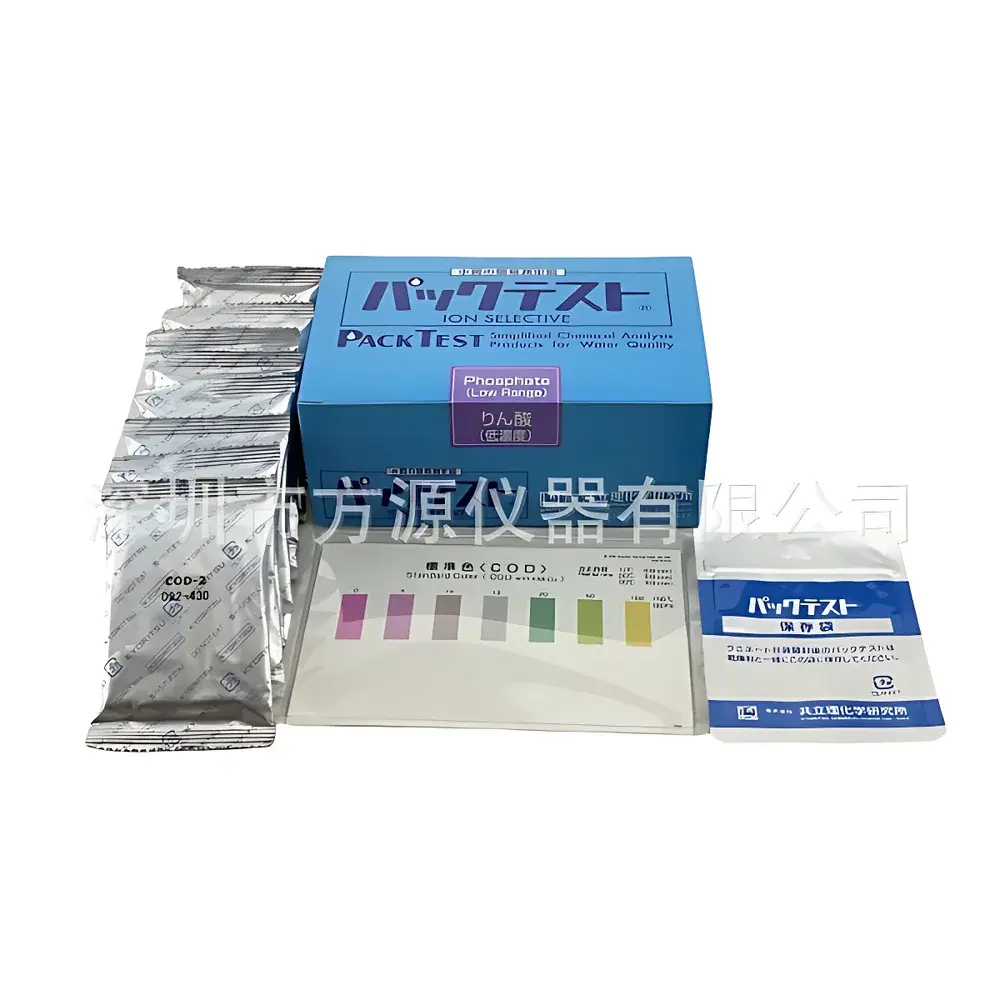
| Kit Format | Pre-filled, single-use reaction tubes with integrated calibration reference |
Overview
The Kyoritsu WAK-COD-2 is a field-deployable, pre-calibrated reagent-based test kit engineered for the simultaneous or independent determination of ammonia nitrogen (NH₃-N) and total nitrogen (TN) in industrial wastewater, municipal effluents, surface water, and process streams. Unlike instrumental analyzers requiring power, optics, or routine calibration, the WAK-COD-2 leverages standardized wet-chemistry principles—Nesslerization for ammonia quantification and alkaline persulfate digestion followed by spectrophotometric detection at 220 nm and 275 nm for TN—to deliver laboratory-comparable results in under 30 minutes. Its design adheres to internationally recognized methods including ASTM D1426 (ammonia), ISO 7150-1 (ammonia), ISO 11905-1 (total nitrogen), and JIS K 0102 (Japanese Industrial Standard for water analysis). The kit eliminates pipetting errors and reagent preparation variability through factory-sealed, lyophilized reagents housed in precision-dimensioned glass reaction tubes—each tube calibrated against NIST-traceable standards.
Key Features
- Pre-filled, single-use reaction tubes with integrated color reference strip—no reagent weighing, dilution, or volumetric transfer required.
- Dual-parameter capability: one kit supports both ammonia nitrogen and total nitrogen analysis using distinct, method-validated protocols.
- Robust environmental tolerance: stable performance across ambient temperatures from 10°C to 35°C and relative humidity up to 85% RH.
- Integrated timing guidance: printed reaction windows on tube labels align with ISO-defined digestion and color-development intervals (e.g., 10 min for NH₃-N Nessler reaction; 30 min for TN persulfate digestion at 120°C).
- Traceability-ready: each batch carries a certificate of analysis referencing NIST SRM 2194 (ammonium sulfate) and certified TN reference materials.
- No external instrumentation needed for qualitative/semi-quantitative use; compatible with any portable spectrophotometer (e.g., Hach DR3900, Thermo Orion AQUAfast) or visual comparator scale (0–50 mg/L NH₃-N; 0–20 mg/L TN).
Sample Compatibility & Compliance
The WAK-COD-2 is validated for use with turbid, colored, and moderately saline samples—including activated sludge effluents, electroplating rinse waters, food processing discharges, and landfill leachates—provided suspended solids are removed via 0.45 µm membrane filtration prior to testing. It meets the matrix interference thresholds defined in EPA Method 350.1 (ammonia) and EPA Method 351.2 (total Kjeldahl nitrogen surrogate), with documented recovery rates of 94–103% for spiked wastewater matrices. All reagents comply with REACH Annex XIV restrictions and carry SDS documentation aligned with GHS classification. For regulated reporting, data generated with this kit satisfies GLP documentation requirements when paired with auditable field logs (sample ID, time/date, operator, instrument serial number, and lot-specific calibration verification).
Software & Data Management
While the WAK-COD-2 operates independently of software, its output integrates seamlessly into digital workflows. Each reagent lot includes a QR-coded batch sheet linking to downloadable CSV-formatted calibration curves and uncertainty budgets (k=2, coverage factor per ISO/IEC 17025). When used with Hach, Lovibond, or Xylem-compatible photometers, measurement data auto-syncs to cloud platforms such as Hach WQX, LIMS modules, or custom SQL databases via Bluetooth or USB. Audit trails—including user ID, timestamp, GPS-tagged location (if enabled), and reagent lot traceability—are retained per FDA 21 CFR Part 11 requirements when deployed with compliant mobile applications.
Applications
- Real-time compliance monitoring at NPDES discharge points under US Clean Water Act Section 402 permitting.
- Process control in biological nutrient removal (BNR) systems, particularly during nitrification/denitrification cycle optimization.
- Pre-treatment verification for industrial clients subject to local sewer authority nitrogen limits (e.g., Tokyo Metropolitan Sewerage Service Regulation §8.2).
- Field screening during environmental emergency response (e.g., ammonia spills, fertilizer runoff events).
- Undergraduate and vocational lab instruction—designed to illustrate redox chemistry, digestion kinetics, and Beer-Lambert law application without requiring fume hoods or hazardous waste handling.
FAQ
Can the WAK-COD-2 distinguish between organic nitrogen and nitrate/nitrite?
No. Total nitrogen is reported as the sum of ammonia-N, organic-N, and oxidized nitrogen species (NO₂⁻-N + NO₃⁻-N) after complete persulfate oxidation. Separate nitrate/nitrite analysis requires complementary kits (e.g., Kyoritsu WAK-NO3 or WAK-NO2).
Is digestion temperature critical for total nitrogen accuracy?
Yes. The 120°C, 30-minute alkaline persulfate digestion must be performed in a certified block heater or autoclave. Deviations >±2°C or <28 min reduce oxidation efficiency below 95%, per ISO 11905-1 validation criteria.
How often must the visual comparator scale be recalibrated?
The comparator is factory-calibrated and does not require recalibration. However, annual verification against NIST-traceable liquid standards (e.g., AccuStandard TN-1000) is recommended for ISO 17025-accredited labs.
Does the kit meet ISO/IEC 17025 method validation requirements?
Yes—each production lot undergoes full validation per ISO/IEC 17025:2017 Clause 7.2.2, including specificity, linearity (r² ≥ 0.999), LOD/LOQ (0.05 mg/L NH₃-N; 0.1 mg/L TN), repeatability (RSD ≤ 3.2%), and robustness testing across operators and instruments.
Related Products







