
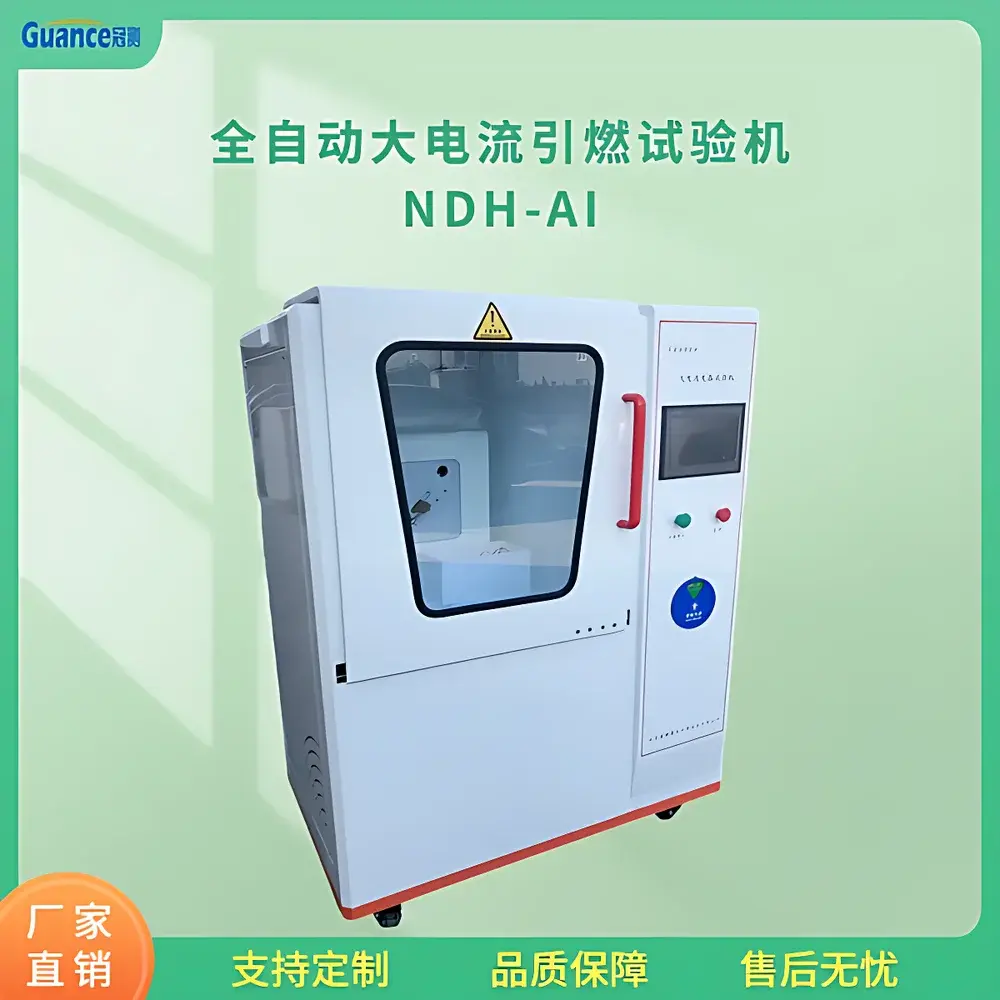
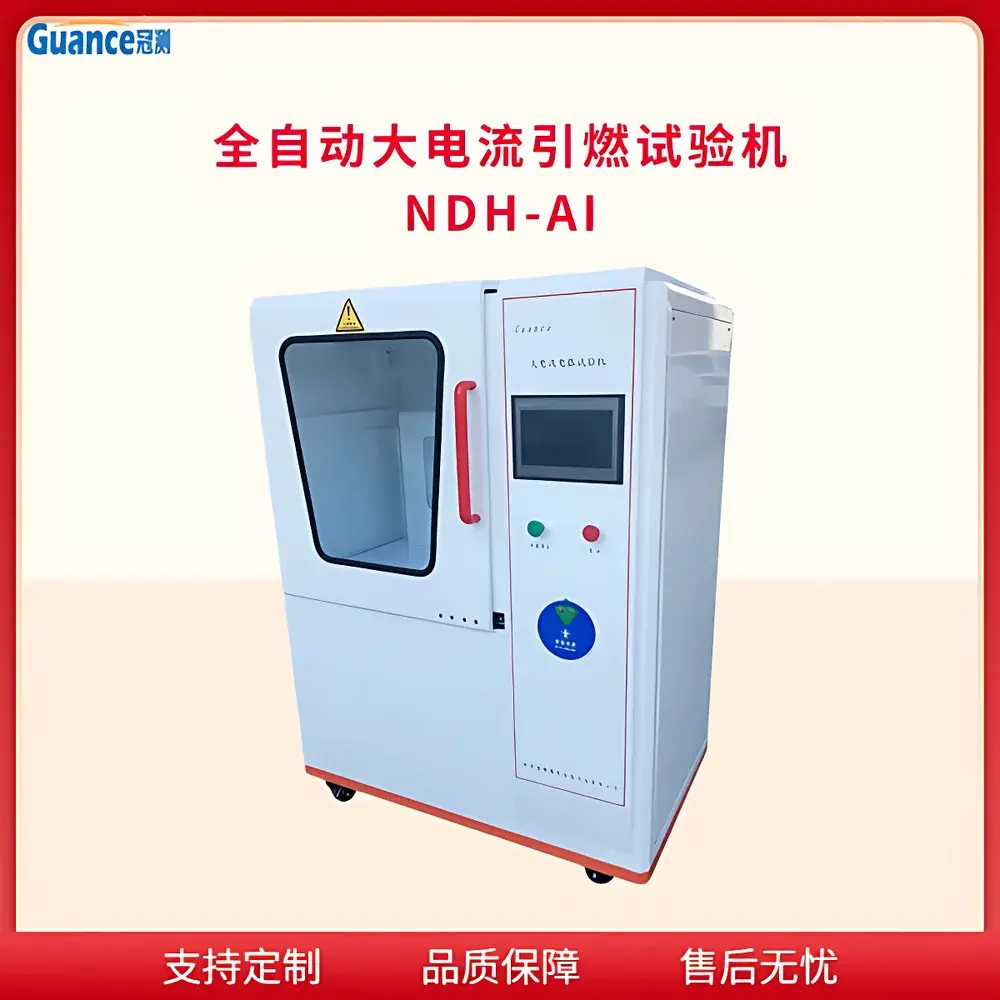
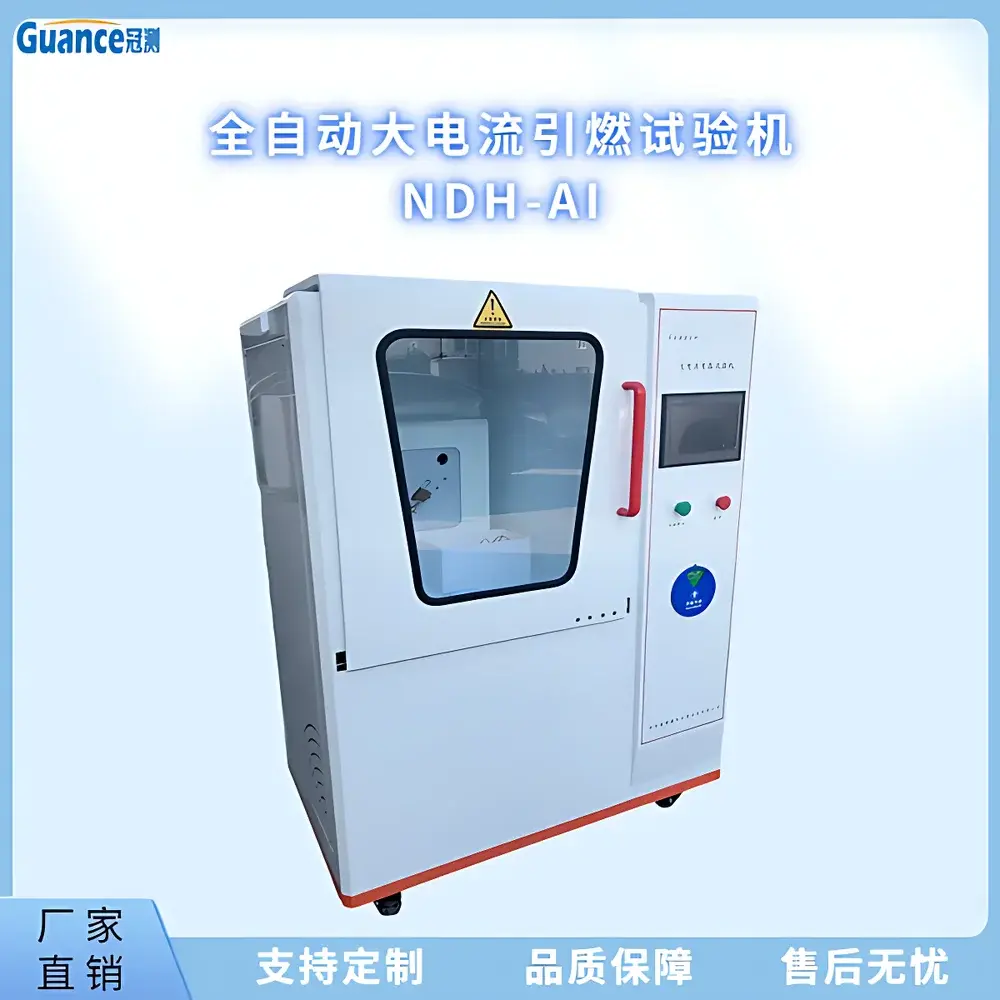
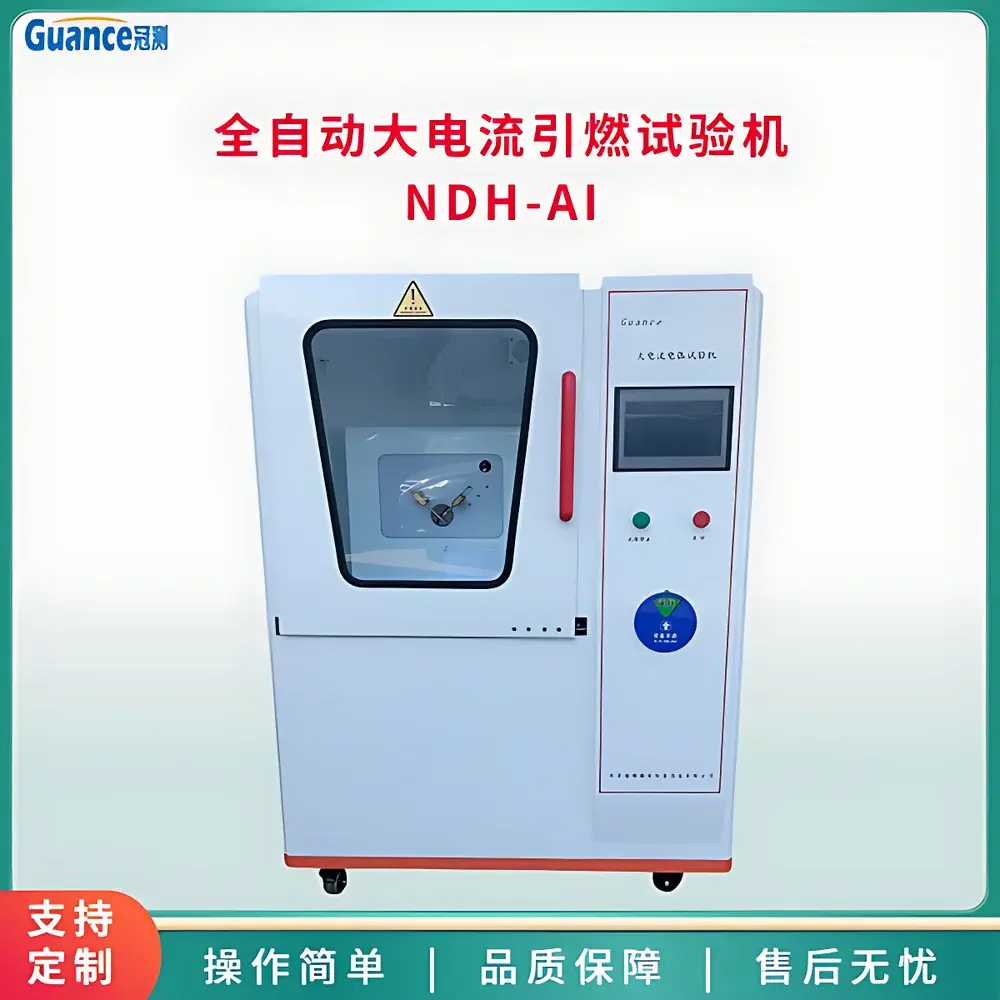
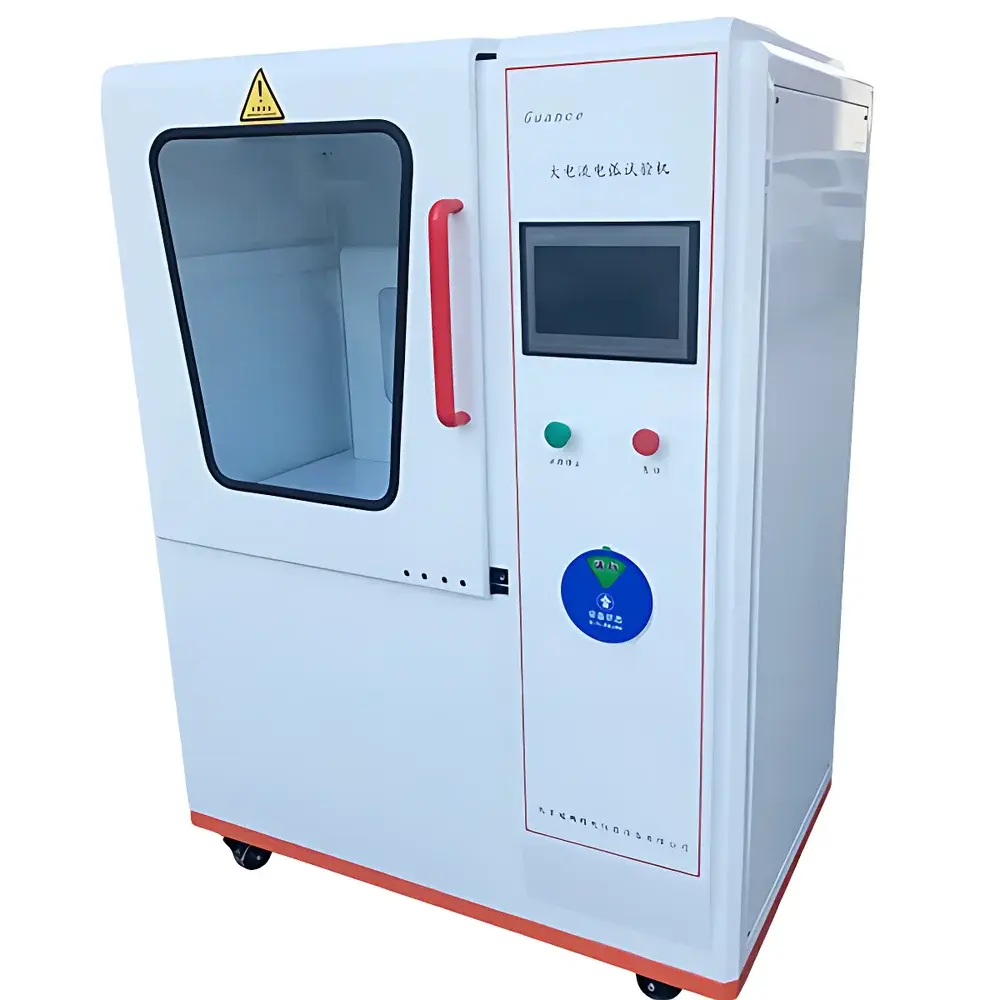
GuanCe Instruments NDH-AI3 Automatic High-Current Arc Ignition Universal Testing Machine
| Brand | GuanCe Instruments |
|---|---|
| Origin | Beijing, China |
| Manufacturer Type | Authorized Distributor |
| Regional Category | Domestic (China) |
| Model | NDH-AI3 |
| Quotation | USD 2,100 (FOB Beijing) |
| Instrument Type | Electromechanical Universal Testing Machine |
| Compliance Standards | IEC 60950-1:2001, BS EN 60950-1:2001, BS 7002:2000, GB 4943-2001, UL 746A, IEC 60947-1:1999, GB/T 14048.1-2000, IEC 730-1:1993, GB 14536.1-1998 |
| Control System | Siemens S7-1200 PLC |
| Human-Machine Interface | 10-inch resistive touchscreen with dynamic password login |
| Electrode Configuration | Static electrode — Cu, Ø3.2–3.5 mm, 30° chisel tip |
| Electrode Angle | 45° to horizontal plane |
| Test Voltage | 220 V AC / 50 Hz |
| Arc Current | 33 ± 5 A (adjustable) |
| Power Factor | cosφ = 0.5 ± 0.05 (adjustable) |
| Arcing Speed | 254 ± 25 mm/s |
| Arcing Frequency | 40 cycles/min (adjustable) |
| Arcing Cycles | Up to 200 (user-defined) |
| Specimen Dimensions | 130 mm × 13 mm × (2–12) mm |
| External Dimensions | 1250 mm (W) × 800 mm (D) × 1750 mm (H) |
| Rated Power | 10 kVA |
| Safety Features | Interlocked sliding door with limit switch, overload protection, audible alarm, tri-color tower lamp (green/amber/red), integrated exhaust fan with LED task lighting |
Overview
The GuanCe Instruments NDH-AI3 Automatic High-Current Arc Ignition Universal Testing Machine is a specialized electromechanical test system engineered for evaluating the arc ignition resistance of solid insulating materials and structural components used in low-voltage electrical and electronic equipment. It operates on the principle of controlled high-current arcing—repetitive, low-energy electric arcs generated between two precisely aligned electrodes under defined voltage, current, power factor, and mechanical motion parameters. This method simulates real-world fault conditions where conductive paths or degraded insulation may initiate thermal runaway due to sustained arcing, thereby assessing material performance under worst-case electrical stress per internationally recognized safety standards. The NDH-AI3 is not a general-purpose tensile/compression tester; rather, it is purpose-built for standardized arc-tracking and ignition endurance testing, with full compliance traceability to IEC, UL, GB, and EN regulatory frameworks governing fire hazard assessment in electrical product design and certification.
Key Features
- Siemens S7-1200 programmable logic controller (PLC) ensures deterministic real-time control of arc timing, current regulation, electrode motion sequencing, and interlock monitoring.
- 10-inch industrial-grade resistive touchscreen HMI with dynamic password authentication supports secure multi-user access and audit-ready operation logs.
- Dual-mode operation: manual mode for calibration and troubleshooting; automatic mode for fully unattended execution of pre-programmed test sequences.
- Configurable test profiles—including static (fixed-gap) and dynamic (reciprocating electrode) arcing modes—enable evaluation across diverse failure mechanisms.
- Electrode assembly features precision-machined copper static electrode (30° chisel tip) and stainless-steel movable electrode (60° conical tip), both geometrically compliant with IEC 60950-1 Annex Q requirements.
- Integrated safety architecture includes electromagnetic door interlock, current-sensing overload cutoff, acoustic alarm upon test completion, and tri-color tower lamp status indication (green = ready, amber = running, red = fault).
- Onboard exhaust system with adjustable-speed DC fan and LED task lighting ensures consistent visibility during post-test inspection and mitigates smoke accumulation in accordance with laboratory ventilation best practices.
Sample Compatibility & Compliance
The NDH-AI3 accommodates flat, rigid specimens measuring 130 mm × 13 mm × (2–12) mm—typical dimensions for insulating spacers, terminal blocks, housing inserts, and busbar supports found in lighting fixtures, motor controls, household appliances, and industrial control panels. Its test methodology directly implements Clause Q of IEC 60950-1:2001 (“Resistance to ignition by glowing/hot wires and electric arcs”) and aligns with parallel requirements in UL 746A (Polymeric Materials – Use in Electrical Equipment Evaluations), GB 4943.1-2022 (equivalent to IEC 62368-1), and GB/T 14048.1-2012 (Low-voltage switchgear and controlgear). All operational parameters—including arc current (33 ± 5 A), power factor (0.5 ± 0.05), frequency (40 cpm), and total cycles (200)—are independently adjustable within defined tolerances to support method validation, comparative benchmarking, and internal QC protocols. The system does not require external calibration certificates for routine use but supports periodic verification using certified shunt resistors and calibrated multimeters per ISO/IEC 17025 guidelines.
Software & Data Management
The embedded PLC firmware provides non-volatile storage of up to 100 test configurations and 500 completed test records, each timestamped and tagged with operator ID, specimen ID, and parameter set version. While no external PC software is bundled, raw data export is supported via USB flash drive in CSV format for integration into LIMS or QA documentation systems. All test events—including start/stop commands, interlock triggers, current deviation alerts, and door-open incidents—are logged with millisecond resolution. The system supports GLP-aligned record integrity through immutable session logging and password-protected configuration editing. Although native 21 CFR Part 11 compliance is not implemented (no digital signature or electronic audit trail), the architecture permits third-party validation packages for regulated environments requiring FDA-compliant data governance.
Applications
The NDH-AI3 serves laboratories engaged in fire safety qualification of polymeric insulators, thermoset housings, PCB substrates, and molded connectors across multiple sectors: OEM engineering labs validating new material formulations; third-party certification bodies conducting CB Scheme or CCC testing; quality assurance departments performing incoming inspection of supplier components; and R&D groups developing flame-retardant composites for automotive electronics or renewable energy inverters. Typical use cases include comparative arc tracking index (CTI) screening, validation of halogen-free flame retardants, verification of creepage distance adequacy under high-humidity aging, and root-cause analysis of field failures attributed to arc-induced carbonization. It is routinely deployed alongside glow-wire testers (e.g., GWFI/GWIT) and needle-flame apparatuses to establish comprehensive fire risk profiles per IEC 60695 series.
FAQ
What safety standards does the NDH-AI3 directly support?
It fulfills the arc ignition test requirements specified in IEC 60950-1:2001 Annex Q, UL 746A Section 22, GB 4943.1-2022 Clause 5.5.3, and equivalent clauses in BS EN 60947-1 and GB/T 14048.1.
Can the arcing frequency be adjusted beyond 40 cycles/minute?
No—the mechanical actuator and PLC timing logic are validated only for 40 ± 2 cpm per standard-defined test duration; deviations would invalidate compliance with referenced methods.
Is remote monitoring or Ethernet connectivity available?
The base configuration lacks network interfaces; however, optional RS-485 Modbus RTU output enables integration with SCADA or building management systems for status polling.
What maintenance is required for electrode longevity?
Electrodes must be cleaned with isopropyl alcohol after every 20 test cycles and visually inspected for pitting or deformation; replacement is recommended after 500 total arcing events or visible wear exceeding 0.1 mm tip erosion.
Does the system include calibration documentation?
A factory calibration report covering voltage, current, and timing accuracy is supplied with each unit; users are responsible for periodic verification using traceable instruments per their internal QA procedures.



