
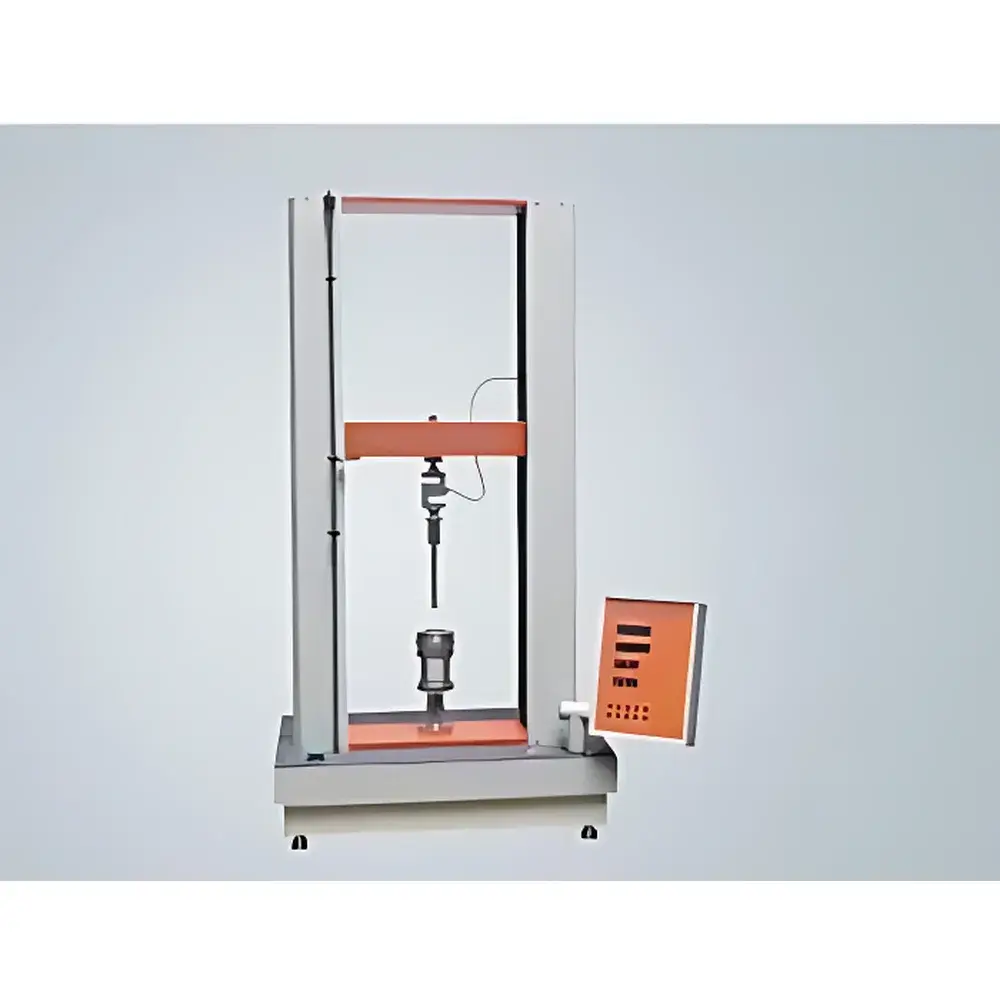
Electronic Burst Strength Tester GY031D by Fangyuan Instruments
| Key | Load Capacity: 2500 N |
|---|---|
| Load Resolution | 1/30000 F.S. |
| Load Accuracy | ≤ ±0.5% F.S. (2–120% of sensor range) |
| Sampling Rate | ≥200 Hz |
| Maximum Burst Stroke | 200 mm |
| Ring Clamp Inner Diameter | 25 mm |
| Indenter Ball Diameter | 20 mm |
| Indenter Descending/Retracting Speed | 10–500 mm/min (digitally adjustable) |
| Elongation Resolution | 0.1 mm |
| Data Storage Capacity | ≥4000 test records (non-volatile memory) |
| Power Supply | 220 V, 50 Hz, 1000 W |
| Dimensions (L×W×H) | 600 × 400 × 1700 mm |
| Weight | ~125 kg |
| Display | 5.7″ Sharp blue-backlit LCD with Chinese GUI |
| Control System | Mitsubishi 16-bit industrial microcontroller + 16-bit A/D converter |
| Interface Options | RS-232 printer port, USB/RS-232 PC interface (optional), optional software for force–displacement curve generation and GLP-compliant reporting |
Overview
The Fangyuan Instruments GY031D Electronic Burst Strength Tester is a precision electromechanical testing system engineered for the quantitative evaluation of burst resistance and expansion behavior in flexible textile substrates—including knitted fabrics, elastic woven fabrics, nonwovens, and seam assemblies. It operates on the principle of controlled spherical indenter displacement (ball burst method), where a standardized 20 mm diameter steel ball is driven at programmable speed against a specimen clamped within a rigid 25 mm inner-diameter annular holder. The instrument continuously measures applied force and corresponding vertical displacement at a minimum sampling rate of 200 Hz, capturing full load–elongation response curves to determine peak burst strength, burst expansion (extension at rupture), and post-peak deformation characteristics. Designed in accordance with GB/T 1030–1993 (Method A: Ball Burst Test for Knitted and Elastic Woven Fabrics) and FZ/T 60019–1994 (Burst Strength Testing of Nonwovens), the GY031D delivers traceable, repeatable mechanical performance data essential for R&D validation, QC release, and regulatory conformance in global textile supply chains.
Key Features
- High-fidelity force measurement system with ±0.5% full-scale accuracy across 2–120% of transducer range, verified per ISO 7500-1 Class 1 requirements;
- Real-time data acquisition at ≥200 Hz ensures no loss of critical peak events during rapid failure transitions;
- Digitally adjustable indenter speed (10–500 mm/min) enables precise replication of standard test velocities or custom ramp profiles;
- Modular ring clamp design with interchangeable fixtures supports consistent specimen alignment and minimizes edge-effect variability;
- Non-volatile internal memory stores ≥4000 complete test records—including timestamp, load–displacement arrays, and pass/fail flags—with automatic clock synchronization;
- Industrial-grade Mitsubishi 16-bit microcontroller and dedicated 16-bit A/D converter provide electromagnetic noise immunity in shared lab environments;
- 5.7-inch Sharp blue-backlit LCD with intuitive Chinese-language menu navigation reduces operator training time and mitigates misconfiguration risk;
- Standard RS-232 printer interface and optional PC connectivity support audit-ready documentation per GLP/GMP frameworks.
Sample Compatibility & Compliance
The GY031D accommodates flat, isotropic, and moderately anisotropic textile specimens up to 200 mm in effective clamping diameter—enabling testing of single-layer fabrics, laminated composites, seam-joined panels, and technical nonwovens used in medical gowns, filtration media, and geotextiles. Its mechanical architecture satisfies the geometric and kinematic constraints defined in GB/T 1030–1993, FZ/T 60019–1994, and ASTM D3787 (Standard Test Method for Bursting Strength of Textiles—Ball Burst Test). While not certified to ISO/IEC 17025, the system’s calibration traceability path aligns with national metrological standards applicable to textile mechanical testers in China (JJG 1025–2017). Optional firmware updates may extend compliance to EN ISO 13938-1 and ISO 13938-2 upon customer request and verification.
Software & Data Management
When paired with optional PC interface hardware and Fangyuan’s proprietary Windows-based analysis suite, the GY031D generates exportable CSV and PDF reports containing raw force–displacement datasets, statistical summaries (mean, SD, CV%), graphical overlays, and user-defined pass/fail thresholds. The software supports multi-sample batch processing, comparative trend analysis across material lots, and automated report generation compliant with 21 CFR Part 11 requirements—including electronic signatures, audit trails, and user access control levels (administrator/operator). All stored test data retain embedded metadata: date/time stamp, operator ID, calibration status, environmental notes, and instrument configuration parameters—ensuring full data integrity for internal audits or third-party certification reviews.
Applications
- Quality assurance of elastic sportswear and intimate apparel fabrics for burst resistance under dynamic stretching;
- Evaluation of surgical drape and gown nonwovens for barrier integrity under simulated mechanical stress;
- Validation of seam strength in protective workwear subjected to repetitive flexion and impact;
- R&D benchmarking of biodegradable textile substrates during accelerated degradation studies;
- Supplier qualification testing per brand-specific technical specifications (e.g., Nike ACG, Adidas Parley, H&M Conscious Collection).
FAQ
Does the GY031D comply with ASTM D3787?
Yes—the mechanical configuration, indenter geometry, and clamping dimensions meet all physical requirements of ASTM D3787–18. Calibration and reporting protocols require optional software configuration to fully satisfy its documentation clauses.
Can the instrument be calibrated using external deadweight standards?
Yes—load cell calibration is performed via digital point calibration using certified reference loads traceable to national standards; external deadweight kits are supported upon request.
Is firmware upgrade available for future international standards?
Fangyuan Instruments provides documented firmware revision history and offers targeted upgrades for EN ISO 13938 series and ISO 13938–2 implementation, subject to hardware compatibility verification.
What is the recommended maintenance interval?
Biannual mechanical inspection (guide rail lubrication, clamp torque verification, indenter sphericity check) and annual force sensor recalibration are advised per JJG 1025–2017 guidelines.
Can test data be exported to LIMS systems?
Yes—CSV exports include structured headers compatible with major LIMS platforms; API integration is available under enterprise licensing agreements.






