
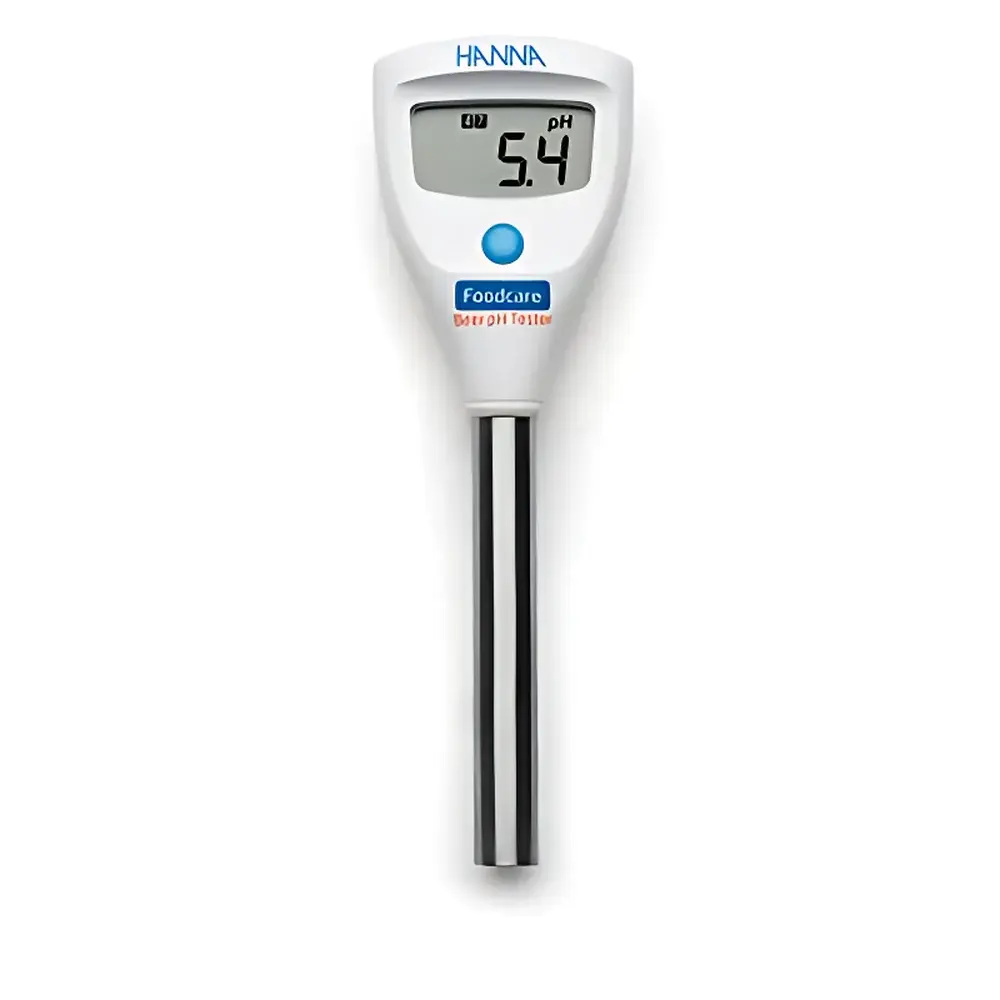
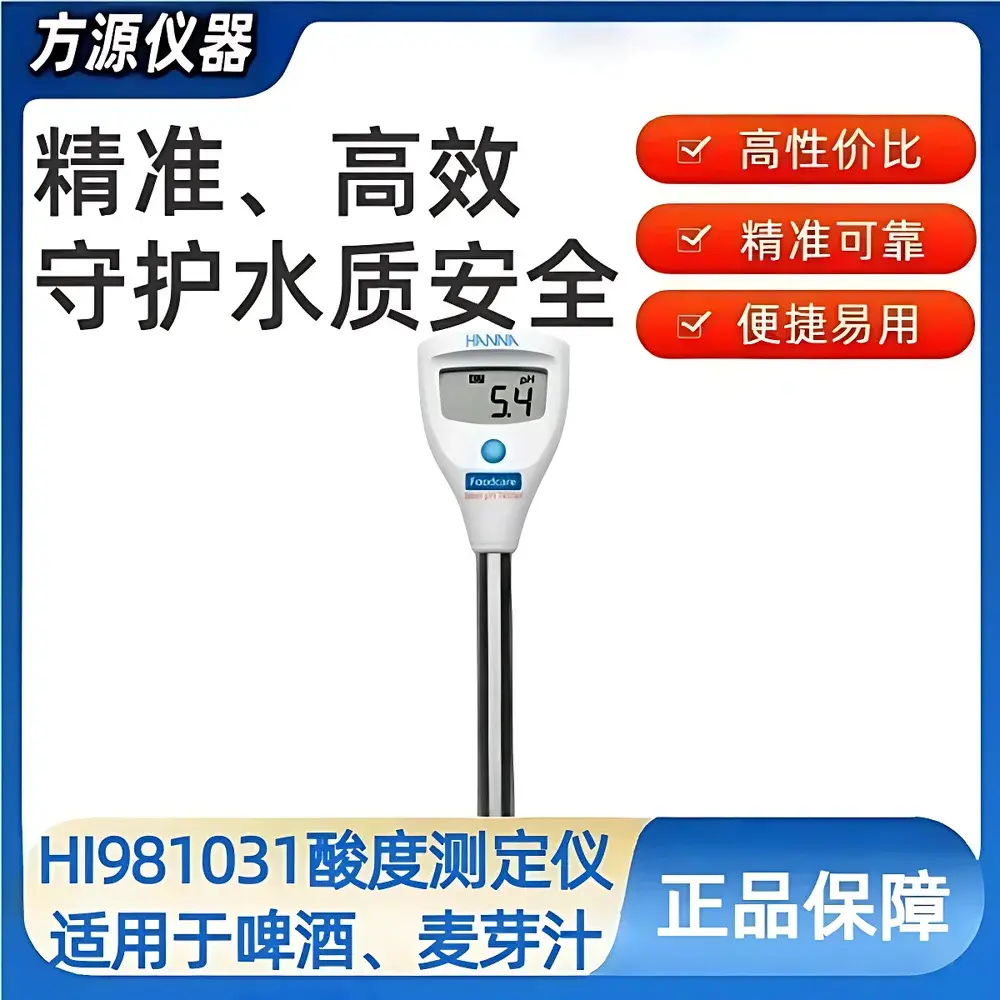
Hanna HI981031 Portable pH Meter for Brewing Applications (Beer & Wort)
| Brand | Hanna Instruments |
|---|---|
| Origin | Italy |
| Model | HI981031 |
| Instrument Type | Portable pH Meter |
| Parameter Type | Single-Parameter (pH) |
| Measurement Range | 0.00 to 12.00 pH |
| Resolution | 0.01 pH |
| Accuracy | ±0.05 pH @ 25°C |
| Calibration | Automatic 1–2 point with built-in buffer recognition (pH 4.01 and 7.01) |
| Temperature Compensation | Automatic (0 to 50°C) |
| Auto-Off Options | 8 min, 60 min, or disabled |
| Power Source | CR2032 lithium coin cell |
| Operating Environment | 0 to 50°C, ≤95% RH |
| Dimensions | 51 × 151 × 21 mm |
| Weight | 44 g |
Overview
The Hanna HI981031 is a purpose-engineered portable pH meter designed specifically for real-time acidimetric monitoring in brewing environments—particularly during mashing, lautering, fermentation, and wort conditioning. It operates on the fundamental principle of potentiometric measurement: the voltage difference between a glass pH-sensing electrode and a stable reference electrode is converted into a pH value using the Nernst equation. Unlike general-purpose pH meters, the HI981031 integrates structural and electrochemical optimizations for high-viscosity, particulate-laden, and organic-rich matrices such as wort, mash, and beer—where conventional spherical or conical electrodes are prone to clogging, drift, and calibration instability. Its flat-tip glass sensor geometry, combined with a replaceable dialysis membrane and titanium alloy probe housing, ensures mechanical durability, rapid response, and long-term reproducibility under routine brewery operational stress.
Key Features
- Flat-tip glass pH sensor: Engineered to minimize sample entrapment and facilitate cleaning after contact with viscous or suspended-solid-containing wort and mash.
- Replaceable dialysis membrane: A proprietary hydrophilic membrane allows controlled electrolyte diffusion while enabling manual renewal—simply pull ~3 mm to expose fresh membrane surface, restoring junction integrity without electrode replacement.
- Titanium alloy probe body: Corrosion-resistant and impact-durable, offering superior longevity in humid, acidic, and mechanically demanding brewery settings.
- Automatic temperature compensation (ATC): Integrated thermistor enables real-time correction across 0–50°C, critical for accurate pH interpretation during thermal transitions in mashing and boiling stages.
- Intuitive single-button operation: Simplified interface with LCD stability indicator, battery status icon, and final-value hold function—designed for glove-compatible use in production areas.
- Factory-calibrated buffers included: Pre-packaged, traceable single-use sachets (HI70004P pH 4.01 and HI70007P pH 7.01) ensure metrological consistency; compliant with ISO 3696 Grade 3 water specifications for buffer preparation.
Sample Compatibility & Compliance
The HI981031 is validated for direct immersion measurements in non-aqueous, semi-solid, and turbid media typical of brewing workflows—including unfiltered wort, grain mash slurries, yeast suspensions, and finished beer. Its flat-surface electrode geometry prevents air bubble adhesion and reduces fouling from proteins, polysaccharides, and hop resins. While not certified for GLP/GMP-regulated release testing, the instrument supports audit-ready documentation when used in conjunction with Hanna’s traceable calibration standards and optional logging accessories. All bundled reagents meet EU REACH and RoHS directives; the CR2032 battery complies with IEC 60086-2. The device conforms to EN 61010-1 (Safety Requirements for Electrical Equipment for Measurement, Control, and Laboratory Use) and EMC Directive 2014/30/EU.
Software & Data Management
As a standalone handheld instrument, the HI981031 does not feature onboard data logging or Bluetooth connectivity. However, its design facilitates seamless integration into laboratory quality systems: measurement values can be manually transcribed into LIMS or Excel-based QC logs. For traceability, users are advised to record batch numbers of calibration buffers (e.g., HI70004P Lot #), ambient temperature, and electrode maintenance events (e.g., membrane renewal date). When paired with Hanna’s HI981031-specific cleaning solution (HI70659), the system satisfies routine maintenance requirements outlined in ASBC Methods of Analysis (Section 6: “pH of Wort and Beer”) and supports consistent adherence to internal SOPs aligned with ISO/IEC 17025 clause 7.7 (Sampling and Handling of Test Items).
Applications
- Monitoring mash pH (target: 5.2–5.6) to optimize enzymatic activity (α-amylase, β-glucanase) and extract efficiency.
- Verifying kettle wort pH pre-boil (typically 5.0–5.3) to influence hop isomerization kinetics and polyphenol solubility.
- Tracking fermentation pH trends in real time—correlating with yeast health, attenuation, and organic acid accumulation (e.g., lactic, acetic).
- Quality control of post-fermentation beer stabilization, particularly for sour beer production where pH serves as a primary safety indicator.
- Field validation of inline pH sensors during CIP cycle verification or tank-to-tank transfer checks.
FAQ
What makes the HI981031 different from standard portable pH meters?
Its flat-tip glass sensor, titanium probe housing, and user-renewable dialysis membrane are engineered exclusively for high-particulate brewing samples—reducing maintenance frequency and improving measurement repeatability in wort and mash.
Can this meter be used for wine or dairy applications?
No—the HI981031 is optimized for brewing-specific matrix challenges; Hanna offers dedicated variants (e.g., HI981033 for wine, HI981032 for cheese) with tailored junction designs and calibration profiles.
Is ATC mandatory for accurate readings in brewing?
Yes—pH is temperature-dependent; without ATC, a 10°C deviation introduces ~0.03–0.05 pH error. The HI981031’s integrated thermistor ensures compliance with ASBC Method Beer-6 and ISO 2954:2015.
How often should the dialysis membrane be renewed?
Renewal frequency depends on usage intensity and sample cleanliness; typically every 2–4 weeks in continuous brewhouse operation. Visual inspection for discoloration or sluggish response is the primary indicator.
Does the meter support FDA 21 CFR Part 11 compliance?
Not natively—this is a manual-read instrument without electronic signature, audit trail, or secure data export. For regulated environments, it serves best as a secondary verification tool alongside validated automated systems.
Related Products




