
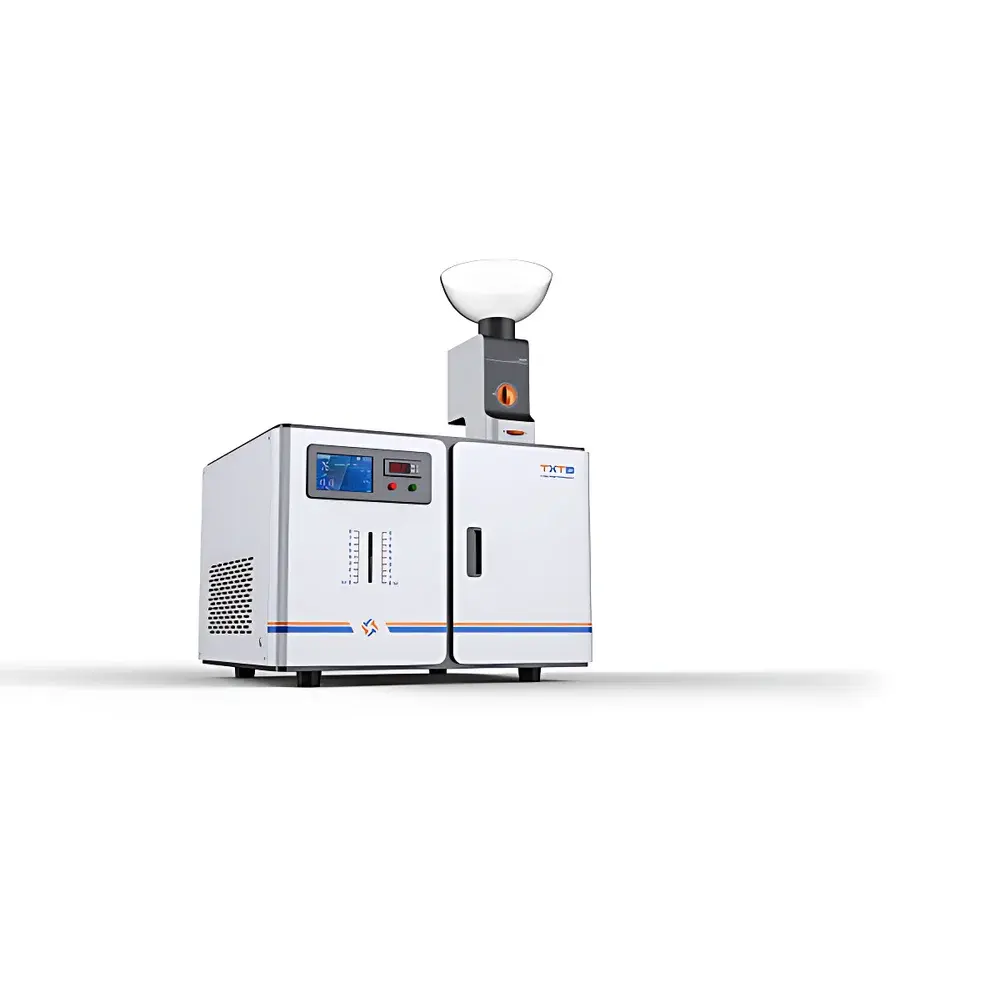
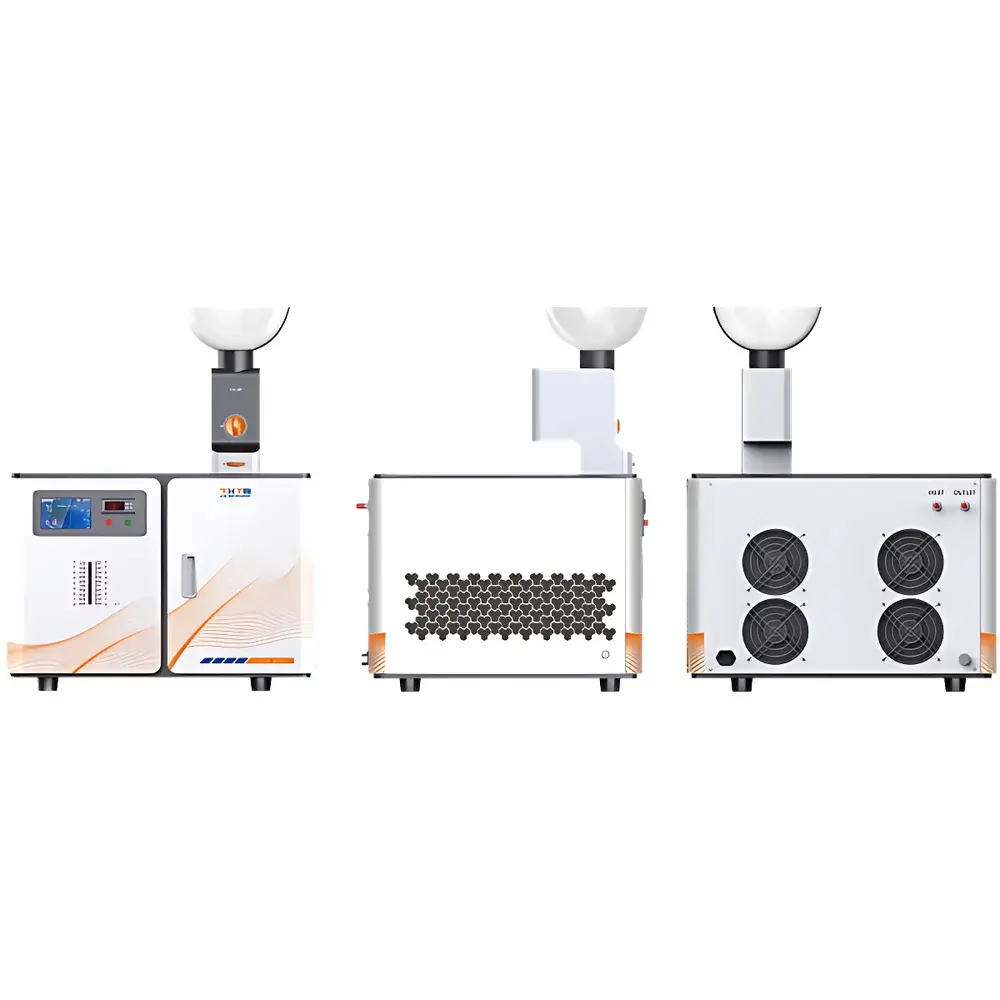
Tongxintianbo TDW-4000 Large-Capacity Cryogenic Continuous Hammer-and-Rotor Cyclone Mill
| Brand | Tongxintianbo |
|---|---|
| Origin | Beijing, China |
| Model | TDW-4000 |
| Sample Type | Hard materials (cereals, oilseeds) |
| Output Particle Size | < 0.01 mm |
| Batch Processing Capacity | 20 g – 3 kg |
| Cooling System | Integrated cryogenic circulation unit |
| Power | 2.2 kW (mill), 0.52 kW (chiller) |
| Dimensions (mill) | 690 × 620 × 620 mm |
| Construction | Monolithic stainless-steel housing |
| Compliance | Designed for ISO/IEC 17025-compliant grain testing laboratories |
Overview
The Tongxintianbo TDW-4000 is a purpose-engineered cryogenic continuous hammer-and-rotor cyclone mill designed specifically for high-throughput, temperature-sensitive sample preparation in cereal and oilseed quality analysis. Unlike conventional disc or blade mills, the TDW-4000 employs a high-speed rotor-driven hammer impact mechanism combined with tangential air cyclone classification to achieve rapid, uniform comminution while maintaining strict thermal control. Its integrated closed-loop chiller system continuously extracts heat from the grinding chamber and feed pathway—ensuring sample temperatures remain below 15 °C throughout extended operation. This thermal stability is critical for preserving analyte integrity in assays sensitive to enzymatic activity or lipid oxidation, including fatty acid value (FAV), falling number, gluten index, RVA viscosity, and NIR calibration model performance. The mill operates under ambient atmospheric conditions but delivers reproducible sub-10 µm particle size distributions without manual intervention, making it suitable for GLP-aligned routine testing in national grain inspection centers, food safety laboratories, and agricultural research institutes.
Key Features
- Cryogenic thermal management: Built-in refrigerated circulation system maintains grinding zone temperature ≤15 °C during continuous operation up to 3 kg per batch—eliminating thermal degradation of labile compounds.
- Continuous feed architecture: Automated volumetric hopper with adjustable flow control enables uninterrupted processing; no stoppage required for cooling or chamber clearing.
- Cyclonic particle classification: Integrated air-classifier separates fines in real time, ensuring consistent output below 10 µm (D90) with minimal overgrinding or agglomeration.
- Tooling durability: Hardened alloy hammers and wear-resistant stainless-steel grinding chamber withstand abrasive cereals (e.g., husked rice, maize kernels, soybeans) over >5,000 operational hours.
- Safety-integrated control logic: Interlocked access doors, overload current protection, and auto-shutdown on chiller failure comply with IEC 61000-6-2 EMC and EN 60204-1 machinery safety standards.
- Hygienic sample handling: Reusable breathable polyester collection bags capture ground material directly—minimizing cross-contamination and simplifying aliquot division for parallel analysis.
Sample Compatibility & Compliance
The TDW-4000 is validated for use with intact or dehulled grains including paddy rice, wheat, maize (corn), barley, oats, rye, sorghum, and soybeans—materials with Mohs hardness up to 6.5 and moisture content ranging from 8% to 14% (w.b.). It meets functional requirements outlined in AOAC Official Method 991.25 (cereal grinding), ISO 712:2022 (cereal and cereal products — determination of moisture content), and GB/T 5491–2017 (Chinese national standard for grain sampling and preparation). All wetted surfaces are electropolished 316L stainless steel, facilitating cleaning validation per FDA Food Code §3-302.11 and supporting audit readiness for ISO/IEC 17025 accreditation. Documentation includes factory calibration reports for rotational speed (±0.5% full scale), chiller setpoint accuracy (±0.3 °C), and particle size verification using laser diffraction traceable to NIST SRM 1980.
Software & Data Management
While the TDW-4000 operates via embedded PLC-based controls (no PC dependency), its operational parameters—including runtime, total batches processed, average feed rate, chiller delta-T, and motor load history—are logged internally with timestamped records retained for ≥12 months. Optional RS-485 Modbus RTU interface enables integration into LIMS environments (e.g., LabWare, STARLIMS) for automated metadata capture. Audit trails comply with FDA 21 CFR Part 11 requirements when paired with validated third-party middleware, supporting electronic signature workflows and change-controlled parameter locking. Firmware updates are performed via secure USB authentication to prevent unauthorized configuration changes.
Applications
- Fatty acid value (FAV) determination per ISO 660 and GB/T 15684—where elevated temperature during milling artificially inflates free fatty acid concentrations.
- Falling number testing (ISO 3093, AACCI 56-80B) requiring uniform particle morphology and minimal starch damage.
- Gluten index measurement (ISO 21415-1) dependent on consistent flour hydration kinetics post-milling.
- NIR calibration model development and transfer across multi-site laboratories, where spectral repeatability demands identical particle size and thermal history.
- RVA (Rapid Visco Analyzer) pasting profile generation (AACCI 76-21), sensitive to damaged starch content induced by frictional heating.
- Heavy metal extraction (EPA 3050B, GB 5009.12) requiring homogenized sub-10 µm matrix for representative subsampling.
FAQ
What is the maximum recommended continuous operating time per batch?
The TDW-4000 supports unattended operation for up to 45 minutes at full 3 kg capacity without exceeding 15 °C chamber temperature, assuming ambient room temperature ≤25 °C and chiller setpoint at 5 °C.
Can the mill process pre-dried or frozen samples?
Yes—samples with moisture content as low as 5% w.b. or stored at –20 °C may be introduced directly; however, condensation on feed throat must be avoided via controlled equilibration prior to loading.
Is routine maintenance documented and traceable?
Yes—maintenance logs (hammer replacement, bearing lubrication, chiller coolant exchange) are recorded in the onboard memory with user ID and date stamp, exportable via USB for QA review.
Does the system meet international electrical safety standards?
The TDW-4000 conforms to CE marking requirements under the Machinery Directive 2006/42/EC and Low Voltage Directive 2014/35/EU, with full test reports available upon request.
How is particle size distribution verified during qualification?
Each unit undergoes factory verification using Malvern Mastersizer 3000 with wet dispersion in isopropanol; D10/D50/D90 values and span index are reported in the Certificate of Conformance.



