

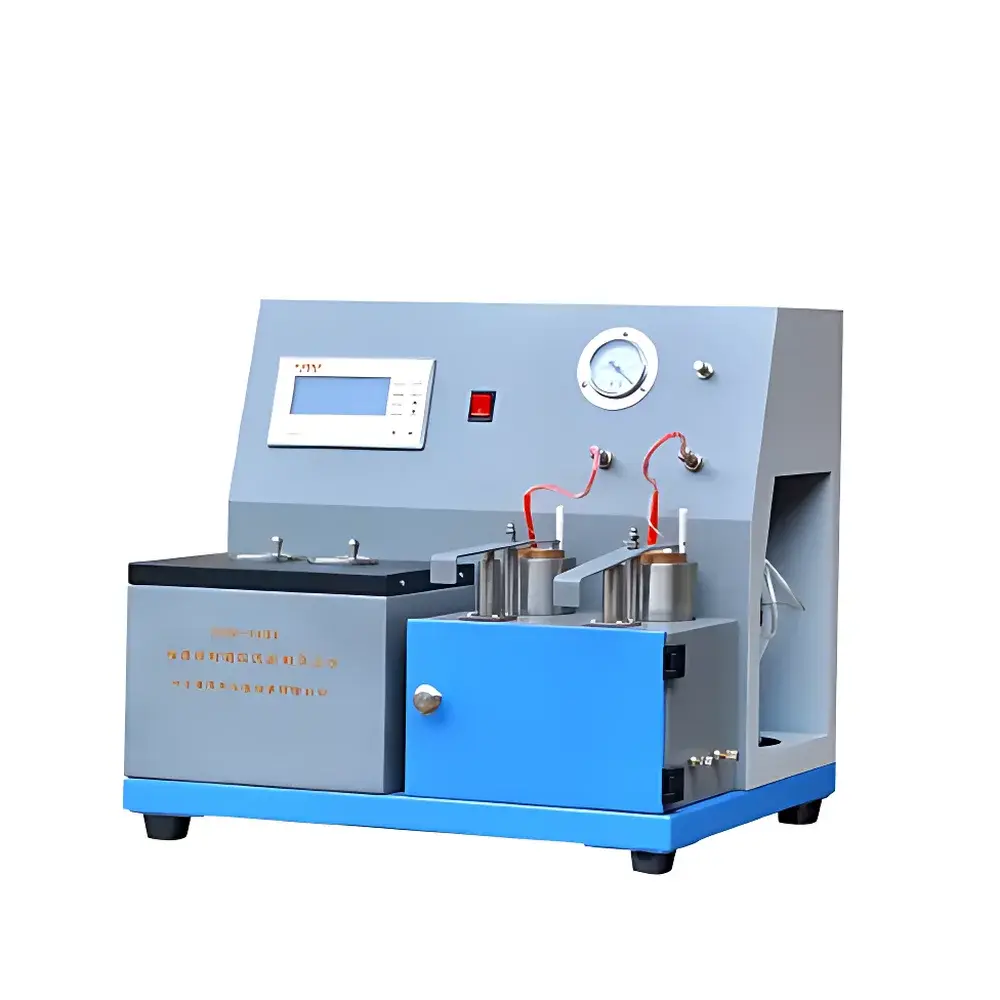
Flanland FDR-1431 Total Sediment Analyzer for Residual Fuel Oil
| Brand | Flanland / csfriend |
|---|---|
| Origin | Hunan, China |
| Model | FDR-1431 |
| Standards Compliance | SH/T 0701, SH/T 0702 |
| Temperature Control Range | Ambient to 100 °C |
| Temperature Accuracy | ±0.5 °C |
| Vacuum Pressure | 40 kPa ± 2 kPa (displayed via precision pressure gauge) |
| Timing Resolution | 0.01 s, max duration 99 h 99 m 99 s |
| Sample Capacity | Dual independent test units |
| Power Supply | AC 220 V ±10%, 50 Hz |
| Rated Power | 2000 W |
| Operating Environment | 0–45 °C, ≤80% RH |
| Display | LCD with bilingual (Chinese/English) interface |
Overview
The Flanland FDR-1431 Total Sediment Analyzer is a dedicated benchtop instrument engineered for the quantitative determination of total sediment in residual fuel oils and residual-blended distillate fuels, in strict accordance with two principal Chinese petroleum industry standards: SH/T 0701 (“Determination of Total Sediment in Residual Fuel Oil — Aging Method”) and SH/T 0702 (“Determination of Total Sediment in Residual Fuel Oil — Hot Filtration Method”). The analyzer implements gravimetric methodology based on controlled thermal aging followed by vacuum-assisted hot filtration and solvent rinsing, enabling precise isolation and mass measurement of insoluble particulate matter formed under accelerated oxidative conditions. Designed for routine quality control in refinery laboratories, marine fuel testing facilities, and third-party inspection agencies, the FDR-1431 delivers reproducible sediment quantification for fuels with kinematic viscosity below 55 mm²/s at 100 °C — a critical parameter influencing combustion efficiency, injector fouling risk, and compliance with ISO 8217:2017 Annex A specifications for residual marine fuels.
Key Features
- Dual-standard compliance: Simultaneously supports both SH/T 0701 (aging-based sediment formation) and SH/T 0702 (hot filtration without aging), eliminating need for separate instrumentation.
- Dual independent test units: Enables parallel analysis of two samples under identical thermal and vacuum conditions, improving throughput and statistical robustness for duplicate or control/blank runs.
- Integrated metal heating bath: Replaces traditional steam generators with a precisely machined aluminum alloy bath block, ensuring uniform temperature distribution, rapid thermal response, zero condensate handling, and enhanced operator safety.
- High-resolution timing system: LCD-based timer with 0.01-second resolution and full 99-hour capacity, programmable per test phase (e.g., aging duration, filtration time), supporting method-defined sequence adherence.
- Regulated vacuum subsystem: Equipped with a calibrated analog pressure gauge and fine-adjustment needle valve for stable vacuum maintenance at 40 kPa ±2 kPa during hot filtration — critical for consistent flow rate and filter cake integrity.
- Bilingual human-machine interface: Intuitive LCD display with context-sensitive prompts in both English and Chinese, reducing operator training burden in multinational or bilingual laboratory environments.
Sample Compatibility & Compliance
The FDR-1431 is validated for residual fuel oils (e.g., RMG, RMK grades per ISO 8217) and residual-blended distillates containing up to 30% residual fraction. It accommodates standard ASTM D4740-compatible filtration assemblies (e.g., 47-mm glass fiber filters, pre-weighed crucibles). Instrument design adheres to general electrical safety requirements per IEC 61010-1 and incorporates thermal cut-off protection. While SH/T standards are nationally recognized in China, data generated using the FDR-1431 may be referenced in broader quality documentation frameworks including ISO/IEC 17025-accredited testing reports, provided method validation (precision, recovery, LOD/LOQ) is performed per laboratory SOPs. The unit does not incorporate electronic audit trails or user authentication; therefore, it is intended for use in non-GxP environments unless supplemented by procedural controls.
Software & Data Management
The FDR-1431 operates as a standalone hardware platform with no embedded software stack or digital connectivity (no USB, Ethernet, or Wi-Fi interfaces). All operational parameters — including setpoint temperature, aging duration, and vacuum activation timing — are configured manually via membrane keypad. Measurement results (mass of dried sediment, calculated % w/w) are recorded externally by the analyst. For laboratories requiring traceability, integration with Laboratory Information Management Systems (LIMS) is achieved through manual data entry or optional barcode-scanned sample ID logging into external spreadsheets or validated electronic lab notebooks. No firmware updates or driver installation is required.
Applications
- Refinery QC labs assessing sediment stability of newly blended residual fuels prior to shipment.
- Port state control (PSC) and bunker fuel inspection laboratories verifying compliance with ISO 8217 sediment limits (e.g., ≤0.1% m/m for RMG 380).
- Engine testing facilities correlating sediment content with injector coking tendency and exhaust valve deposits.
- R&D departments evaluating antioxidant additive efficacy under accelerated aging protocols.
- Contract testing laboratories performing interlaboratory comparison studies under CNAS or CMA accreditation scopes.
FAQ
Does the FDR-1431 comply with ASTM D4740 or ISO 10307?
No. The instrument is designed exclusively for SH/T 0701 and SH/T 0702. ASTM D4740 employs a different aging protocol and filtration temperature; ISO 10307-1 specifies cold filtration and uses alternative solvent systems.
Can the unit be used for diesel or marine distillate fuels (DMA, DMZ)?
Only if they contain a specified residual component per SH/T 0701/0702 scope — pure distillates fall outside the method applicability and require ASTM D2709 or ISO 10307-2 instead.
Is calibration certificate included with delivery?
A factory-verified temperature calibration report (traceable to national metrology institutes) is supplied. Users must perform periodic verification using certified reference thermometers per internal QA procedures.
What consumables are required for routine operation?
Glass fiber filters (47 mm, ashless), pre-ashed and pre-weighed porcelain crucibles, n-heptane or toluene (analytical grade), and vacuum pump oil compatible with hydrocarbon vapors.
Does the instrument support automatic data export to Excel or LIMS?
No. Data output is manual. Integration requires external documentation workflows or custom scripting via optional RS-232 interface (available upon request, not standard).






