
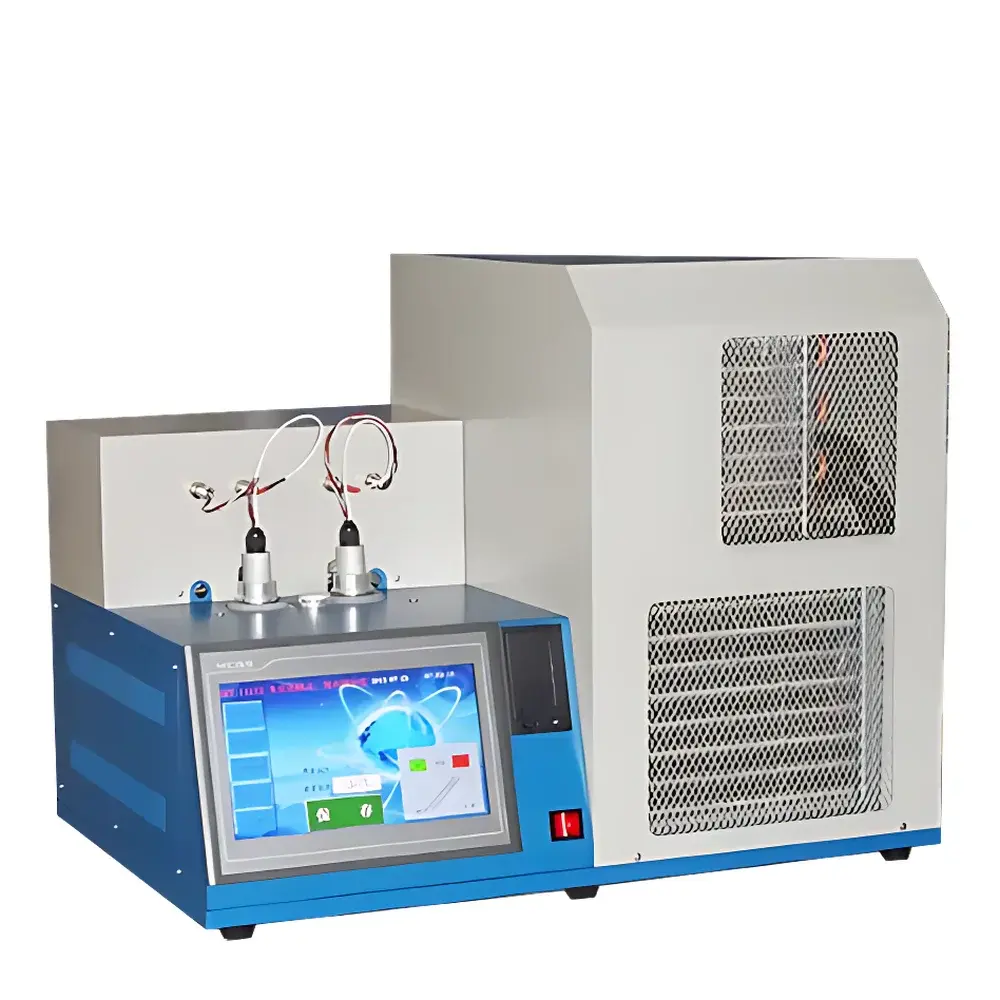
Fland FDT-0319 Fully Automated Petroleum Pour Point Tester
| Brand | Fland (csfriend) |
|---|---|
| Origin | Hunan, China |
| Model | FDT-0319 |
| Temperature Range | Ambient to –45 °C ±0.5 °C |
| Temperature Control Accuracy | ±0.1 °C |
| Detection Method | Fiber-optic Mesh Sensing System |
| Refrigeration System | Imported Cascade Compressor |
| Display | 10-inch Industrial Touchscreen (Chinese UI) |
| Printer | Integrated Thermal Mini-Printer |
| Power Supply | AC 220 V, 50 Hz, Max 2 kW |
| Operating Environment | 0–60 °C, ≤80% RH |
Overview
The Fland FDT-0319 Fully Automated Petroleum Pour Point Tester is an engineered solution for precise, repeatable determination of the pour point of petroleum products—including lubricating oils, diesel fuels, crude oils, and transformer oils—according to standardized test methods such as ASTM D97, ISO 3016, and GB/T 3535. The instrument operates on the principle of controlled cooling combined with real-time optical detection: samples are cooled at a defined rate while a fiber-optic mesh sensor continuously monitors fluid mobility across the cross-section of the test tube. A change in light transmission pattern—indicative of structural rigidity onset and cessation of flow under gravity—is interpreted as the pour point. Unlike manual tilt-based or visual inspection methods, this automated optical approach eliminates operator subjectivity and ensures high inter-laboratory reproducibility.
Key Features
- Dual independent testing channels: Enables simultaneous analysis of two samples under identical thermal conditions, supporting parallel testing, method validation, or quality control duplication without time lag.
- Fiber-optic mesh sensing technology: A proprietary optical array embedded around the sample tube detects minute changes in light scattering and transmission, offering superior sensitivity to early-stage wax crystallization and gel network formation compared to single-point thermocouple or mechanical tilt sensors.
- Cascade compressor refrigeration system: Sourced from a U.S.-based OEM supplier, this two-stage compression architecture achieves stable operation down to –45 °C with rapid cooldown rates (<15 min from 25 °C to –40 °C) and minimal temperature overshoot, ensuring compliance with strict ramp-rate requirements in ASTM D97 Annex A1.
- High-precision temperature control: PID-regulated bath temperature stability of ±0.1 °C over the full operating range (ambient to –45 °C), verified by traceable NIST-calibrated platinum resistance thermometers (PRTs) mounted directly in thermal contact with the test block.
- Industrial-grade 10-inch capacitive touchscreen interface: Featuring intuitive Chinese-language navigation, context-sensitive prompts, and embedded test method wizards—designed for routine operation by QC technicians with minimal training. All system logs, calibration events, and user actions are timestamped and stored locally.
- Integrated thermal printer: Automatically generates hard-copy reports containing sample ID, test date/time, final pour point result, cooling curve metadata, and operator signature field—supporting paper-based audit trails where required.
Sample Compatibility & Compliance
The FDT-0319 accommodates standard ASTM D97 sample tubes (19 mm OD × 150 mm L) and supports viscous and paraffinic feedstocks without pre-dilution. It complies with the mechanical and procedural requirements of ASTM D97 (2023 edition), ISO 3016:2015, and China’s national standard GB/T 3535–2019. While not certified to IEC 61000-4 electromagnetic immunity standards, its industrial enclosure meets IP20 ingress protection and CE-marked safety requirements for laboratory use. The system supports GLP-aligned workflows: user access levels (operator, supervisor, administrator), password-protected method editing, and non-erasable event logs including calibration history and abnormal shutdown records.
Software & Data Management
The embedded firmware includes built-in data storage for up to 1,000 test records with searchable metadata (sample ID, date, operator, result). Export is supported via USB flash drive in CSV format for integration into LIMS or Excel-based QA databases. Though no remote PC software or cloud connectivity is provided, all exported files include full traceability fields compatible with FDA 21 CFR Part 11–aligned documentation practices when paired with institutional electronic record policies. Audit trail entries capture user login/logout, parameter modification, and result confirmation events with immutable timestamps.
Applications
- Refinery quality assurance of distillate fuels and base oils prior to blending or shipment
- Monitoring cold-flow performance degradation during long-term storage of biodiesel blends
- Research evaluation of pour point depressant (PPD) efficacy in paraffinic crude assays
- Contract laboratory testing per API RP 1172 and ISO 8217 marine fuel specifications
- Regulatory submission support for ASTM-compliant product datasheets in APAC markets
FAQ
Does the FDT-0319 comply with ASTM D97 Annex A1 for automated instrumentation?
Yes—the dual-channel design, fiber-optic detection logic, and programmable cooling profile meet all functional requirements specified in Annex A1, including maximum allowable ramp rate deviation (±0.5 °C/min) and detection response latency (<2 s).
Can the instrument be used for testing highly viscous bitumen or heavy fuel oil?
No—FDT-0319 is validated only for materials that remain pumpable or pourable above –45 °C. Bitumen and residual fuel oils typically require alternative methods (e.g., ASTM D5853 for asphaltene gelling).
Is external calibration verification supported?
Yes—NIST-traceable PRT probes can be inserted into dedicated calibration ports adjacent to each test well; calibration certificates are accepted per ISO/IEC 17025 internal verification protocols.




