
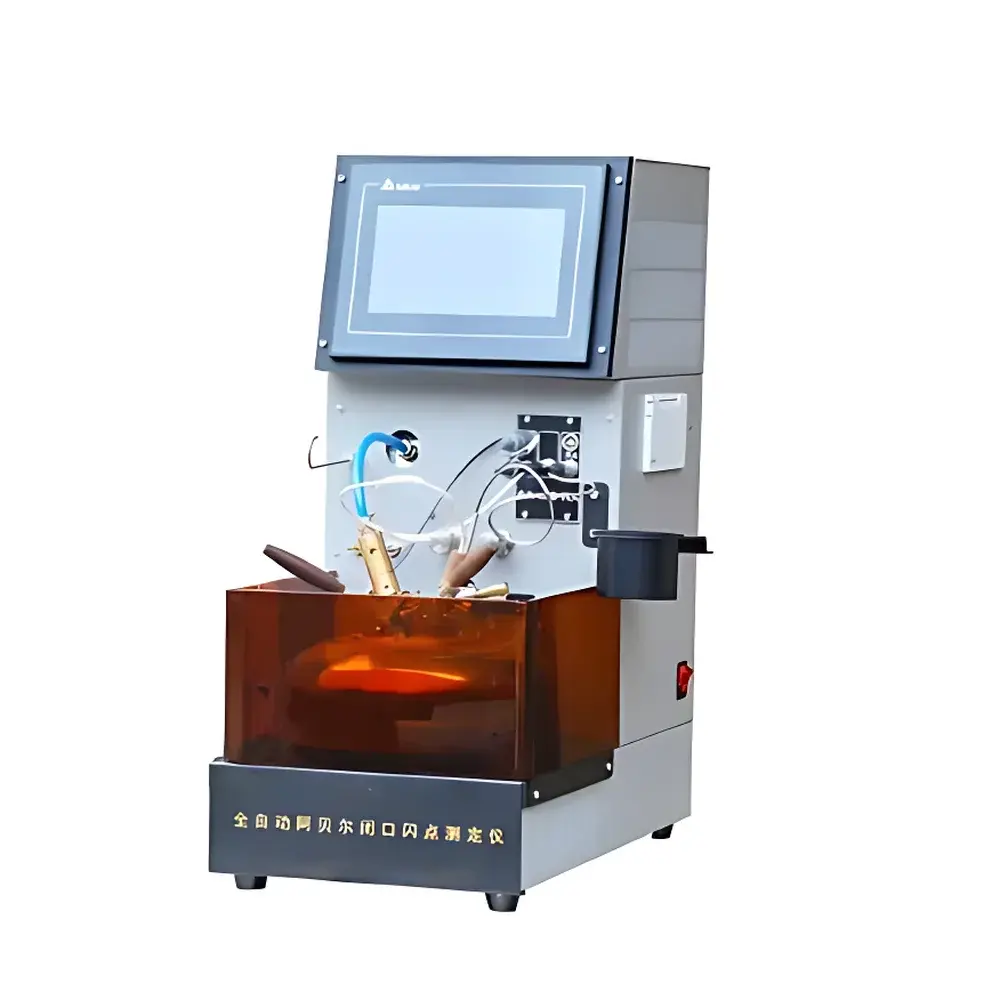
FDT-0292 Automated Closed-Cup Flash Point Tester by CSFriend
| Brand | CSFriend |
|---|---|
| Origin | Hunan, China |
| Model | FDT-0292 |
| Test Method | Closed-Cup (Pensky-Martens) |
| Operation Mode | Fully Automatic |
| Compliant Standards | GB/T 261, ASTM D93, ISO 2719 |
| Repeatability | ±1 °C |
| Ignition Methods | Electric Spark & Gas Flame |
| Temperature Range | 10–45 °C (ambient operating) |
| Measurement Range | Room Temperature to 300 °C |
| Resolution | 0.1 °C |
| Heating Rate | 5–6 °C/min (Method A), 1–1.5 °C/min (Method B) |
| Stirring Speed | 90–120 r/min (Method A), 250±10 r/min (Method B) |
| Power Supply | AC 220 V ±10%, 50 Hz |
| Max. Power Consumption | 500 W |
| Relative Humidity Limit | <85% RH |
| Safety Features | Over-Temperature Protection, Self-Diagnostic System, Pressure-Limited Platinum Wire Heating Control |
Overview
The FDT-0292 Automated Closed-Cup Flash Point Tester is an engineered solution for precise and repeatable flash point determination of petroleum products, lubricants, solvents, and other flammable liquids in accordance with internationally recognized closed-cup test protocols. Based on the Pensky-Martens principle, the instrument applies controlled heating, regulated stirring, and timed ignition to identify the lowest temperature at which vapors above a sample ignite momentarily under specified atmospheric conditions. Designed for laboratory environments requiring regulatory compliance and operational consistency, the FDT-0292 delivers traceable results aligned with GB/T 261 (China), ASTM D93 (USA), and ISO 2719 (International) — all within a single platform. Its closed-cup configuration minimizes vapor loss and ensures reproducibility critical for quality control, safety assessment, and regulatory submission workflows.
Key Features
- Two standardized test modes (Method A and Method B) programmable per GB/T 261 and ASTM D93, supporting both rapid screening and high-precision verification applications.
- Annular uniform-heating architecture ensures consistent thermal distribution across the test cup, eliminating localized hot spots and improving temperature ramp accuracy.
- Integrated air-cooling thermal management maintains stable ambient furnace conditions throughout extended testing cycles, reducing thermal drift and inter-test variability.
- Real-time curve visualization via capacitive touchscreen displays temperature vs. time progression, enabling immediate verification of heating rate compliance and endpoint detection.
- Dual ignition system — electric spark and pilot gas flame — provides redundancy and method flexibility; gas ignition supports legacy validation requirements, while electronic ignition enhances repeatability and eliminates consumables.
- Proprietary pressure-regulated platinum wire heating control ensures constant power delivery to the ignition source, minimizing energy fluctuation and enhancing measurement fidelity across repeated tests.
- Self-diagnostic firmware continuously monitors sensor integrity, heater performance, stirrer function, and ignition sequence, issuing contextual alerts for preventive maintenance or recalibration.
- User-configurable over-temperature cutoff thresholds allow lab-specific safety envelopes to be defined and enforced without hardware modification.
Sample Compatibility & Compliance
The FDT-0292 is validated for use with refined petroleum fractions, diesel fuels, jet fuels, base oils, biodiesel blends, and industrial solvents. It accommodates standard 50 mL Pensky-Martens test cups and conforms structurally and operationally to the dimensional, mechanical, and procedural specifications outlined in ASTM D93 Annex A1 (Manual) and Annex A2 (Automated). All calibration and verification procedures support traceability to NIST-traceable reference standards. The instrument meets general electrical safety requirements per IEC 61010-1 and is suitable for deployment in GLP-compliant laboratories. While not inherently 21 CFR Part 11 compliant, audit-ready data logging (with user authentication, timestamping, and immutable event records) can be enabled through optional software modules configured for GMP-aligned documentation practices.
Software & Data Management
Embedded firmware enables full method storage, result archiving, and export via USB interface in CSV format. Each test record includes operator ID, sample ID, method selection, ambient conditions (temperature/humidity), raw temperature/time data points, detected flash point, pass/fail status relative to specification limits, and diagnostic flags. Optional PC-based software extends functionality with statistical process control (SPC) charts, batch trending, report generation (PDF/Excel), and integration into LIMS via ODBC or HL7-compatible drivers. All data entries are time-stamped and non-editable post-acquisition, supporting ALCOA+ principles (Attributable, Legible, Contemporaneous, Original, Accurate, Complete, Consistent, Enduring, Available) for audit readiness.
Applications
- Quality assurance testing of finished fuels prior to shipment or blending operations.
- Regulatory compliance verification for customs clearance and hazardous material classification (UN TDG, GHS, CLP).
- Research and development of low-flash formulations, including bio-derived solvents and synthetic lubricants.
- Refinery process monitoring — detecting contamination or degradation in distillate streams.
- Third-party certification laboratories performing accredited flash point testing under ISO/IEC 17025 scope.
- Educational institutions conducting standardized physical property experiments in chemical engineering and petroleum technology curricula.
FAQ
What standards does the FDT-0292 fully support?
The instrument is designed and verified to meet the procedural, geometric, and performance criteria of GB/T 261, ASTM D93 (Methods A and B), and ISO 2719.
Can the instrument operate unattended for sequential sample analysis?
Yes — once loaded and initiated, the FDT-0292 executes complete Method A or B cycles autonomously, including cup cleaning (manual pre-load required), heating, stirring, ignition, and result logging.
Is external gas supply mandatory for operation?
No — electric spark ignition is the default and fully functional mode; gas ignition is provided as an optional alternative for labs maintaining dual-method validation protocols.
How is temperature calibration verified?
Calibration is performed using certified reference materials (e.g., n-decane, n-dodecane) traceable to national metrology institutes; built-in calibration verification routines confirm sensor linearity and heater response prior to each test series.
What maintenance intervals are recommended?
Stirrer assembly inspection every 200 tests; platinum wire cleaning after 500 ignitions; annual full-system verification including thermocouple calibration and gas flow calibration (if gas mode used).




