
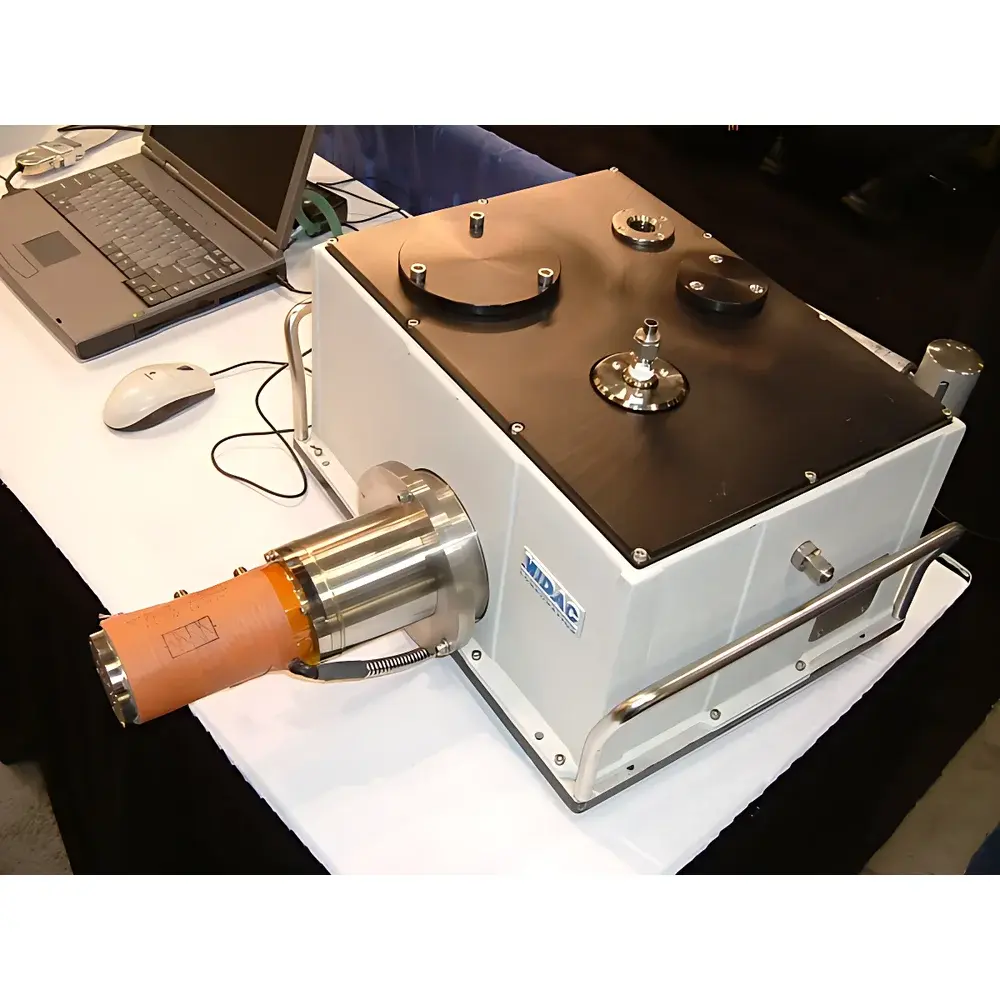
MIDAC I-Series Fourier Transform Infrared (FTIR) Gas Analyzer
| Brand | GAOMAI |
|---|---|
| Origin | USA |
| Distributor Type | Authorized Distributor |
| Import Status | Imported |
| Model | I-Series |
| Instrument Type | Online FTIR Spectrometer |
| Wavenumber Range | 4000–7500 cm⁻¹ |
| Spectral Resolution | 0.5 cm⁻¹ |
| Scan Speed | 8 s per spectrum |
| Signal-to-Noise Ratio | <1% (RMS, 100 scans) |
| Wavenumber Accuracy | ±0.05 cm⁻¹ across 4000–7500 cm⁻¹ |
Overview
The MIDAC I-Series Fourier Transform Infrared (FTIR) Gas Analyzer is an engineered online analytical platform designed for real-time, quantitative multi-component gas analysis in demanding industrial and environmental applications. Based on Michelson interferometry and rapid-scan FTIR spectroscopy, the system delivers high-fidelity absorption spectra by measuring the interferogram of infrared radiation after transmission through a heated, temperature-controlled gas cell. Its optical architecture incorporates thermally stabilized beam paths, high-efficiency KBr or ZnSe optics (application-dependent), and a liquid-nitrogen-cooled MCT detector optimized for the mid-IR region (4000–7500 cm⁻¹). Unlike dispersive or filter-based systems, the I-Series leverages Fellgett’s (multiplex) and Jacquinot’s (throughput) advantages to achieve simultaneous detection of all spectral channels—enabling robust quantification of trace and major constituents without sequential wavelength scanning.
Key Features
- Multi-component quantification from sub-ppb to percent-level concentrations, supported by chemometric calibration models validated per ASTM D6348 and ISO 12039 protocols
- Temperature-controlled gas cell with precise isothermal heating up to 250 °C, minimizing condensation and wall adsorption effects for reactive or high-boiling-point analytes
- Real-time concentration visualization via time-series plots and dynamic spectral overlays in AutoQuant Pro software
- 12-channel analog input interface for synchronized acquisition of auxiliary process parameters—including mass flow controllers (MFCs), O₂ sensors, H₂ partial pressure transducers, and pressure/temperature transmitters
- Integrated environmental compensation algorithms that auto-correct for pressure-induced line broadening and thermal drift using embedded PT100 and piezoresistive sensors
- Modular sampling architecture compatible with automated multi-point manifolds, Nafion dryers, catalytic scrubbers, and heated sample lines compliant with EPA Method 320 and ASTM D5504
- Low-maintenance design featuring solid-state laser referencing, sealed optical bench, and field-replaceable consumables (e.g., desiccant cartridges, inlet filters)
Sample Compatibility & Compliance
The I-Series accommodates gaseous samples across diverse matrices—including corrosive semiconductor process gases (e.g., NF₃, WF₆, SiH₄), ambient air, stack emissions, biogas, and syngas—without requiring pre-concentration or derivatization. Sample introduction is compatible with both positive-pressure and vacuum-suction configurations, with inlet conditioning options meeting SEMI F57 purity requirements. The analyzer complies with electromagnetic compatibility standards (IEC 61326-1), safety directives (IEC 61010-1), and supports audit-ready operation under FDA 21 CFR Part 11 when paired with AutoQuant Pro’s electronic signature and change-control modules. Calibration traceability follows NIST SRM guidelines, and routine performance verification aligns with USP and EP 2.2.42 recommendations for spectroscopic gas analyzers.
Software & Data Management
AutoQuant Pro is a validated Windows-based application providing full instrument control, spectral acquisition, multivariate calibration (PLS, PCR, CLS), and real-time quantitative reporting. It includes a curated spectral library of >1,200 pure-component IR reference spectra (NIST, HITRAN, and proprietary gas-phase libraries), with tools for peak fitting, baseline correction, and residual analysis. Data export supports CSV, ASCII, and ASTM E1382-compliant .spc formats. Audit trails record all user actions, method changes, calibration events, and result modifications with timestamps and operator IDs. Optional OPC UA and Modbus TCP interfaces enable seamless integration into DCS, SCADA, and MES platforms for automated alarm routing and SPC charting.
Applications
- Continuous monitoring of etchant and dopant gases in semiconductor front-end fabs, supporting ISO 14644 cleanroom compliance
- Real-time emission profiling of NOₓ, SO₂, CO, CH₄, NH₃, and VOCs in municipal waste incinerators and cement kilns per EN 15267 and EPA PS-15
- In-line quality assurance of high-purity specialty gases (e.g., Ar, He, Ne blends) certified to SEMI C37 and CGA G-13 specifications
- Mobile laboratory deployment for fugitive emission surveys, landfill gas characterization, and emergency response screening
- Process analytical technology (PAT) implementation in pharmaceutical lyophilization and fermentation control per ICH Q8(R2) and FDA PAT guidance
FAQ
What is the typical calibration interval for the I-Series under continuous operation?
Calibration verification is recommended every 72 hours for critical applications; full multi-point calibration every 30 days or after maintenance—supported by built-in zero/span checks and NIST-traceable gas standards.
Can the system operate unattended for extended periods?
Yes—the I-Series supports fully autonomous 24/7 operation with watchdog timers, automatic fault logging, remote diagnostics via secure TLS-enabled web interface, and configurable email/SNMP alerts for out-of-spec conditions.
Is the optical bench purge required? What gas is used?
A continuous dry-air or nitrogen purge (≥5 L/min) is mandatory to prevent atmospheric CO₂/H₂O interference; integrated flow sensors and pressure switches monitor purge integrity in real time.
How does the system handle water vapor interference in humid samples?
Through a combination of heated sample path (up to 250 °C), inline Nafion membrane dryers (optional), and multivariate spectral deconvolution algorithms that explicitly model H₂O rotational-vibrational bands.
Does AutoQuant Pro support IQ/OQ/PQ documentation packages?
Yes—preformatted templates aligned with GAMP 5 and ASTM E2500-07 are included for installation qualification (IQ), operational qualification (OQ), and performance qualification (PQ) execution and archiving.




