
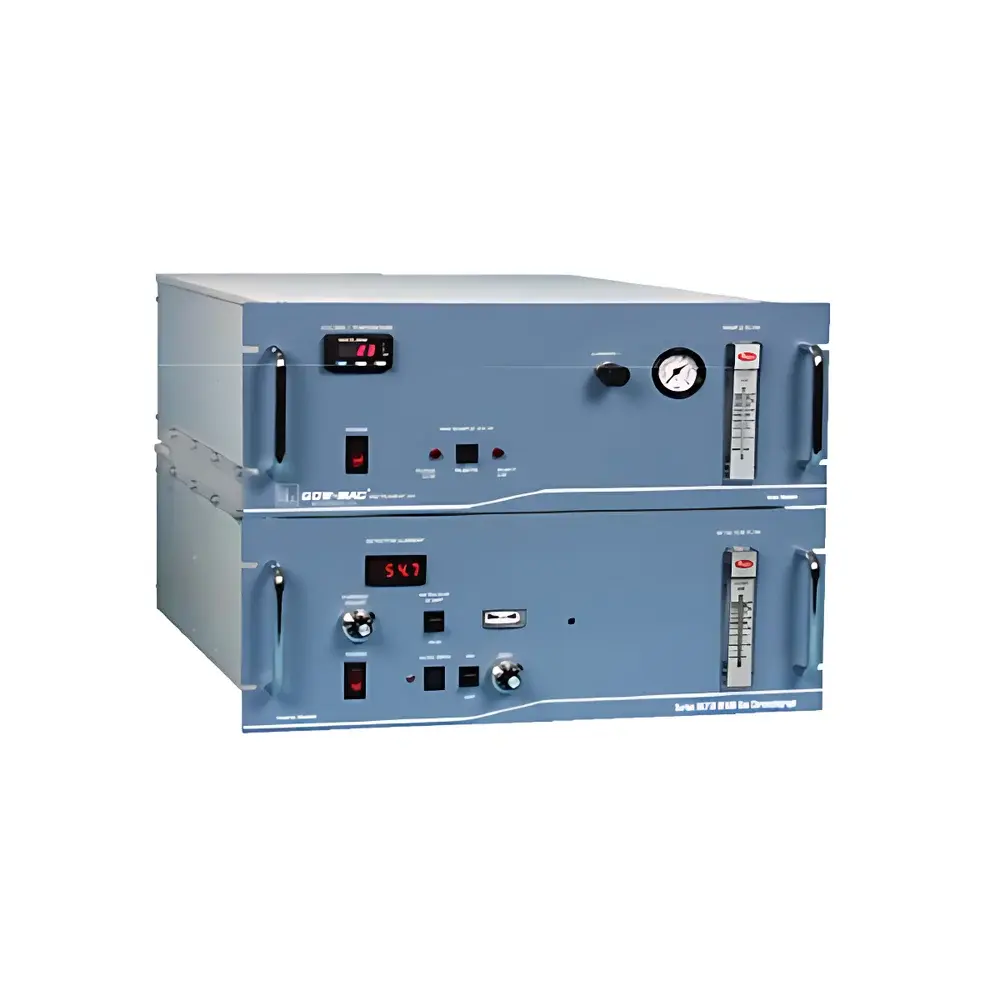
GOW-MAC Ar 722 Dedicated Gas Chromatograph for Trace Impurity Analysis in High-Purity Argon
| Brand | GOW-MAC |
|---|---|
| Origin | USA |
| Model | Ar 722 |
| Instrument Type | Laboratory Gas Chromatograph |
| Application | Universal (Specialized for Ultra-High-Purity Argon Impurity Profiling) |
| Temperature Control Range | 0–450 °C |
| Ramp Rate | 0.1–40 °C/min |
| Cool-down Time | ~5 min (450 °C → 10 °C) |
| Carrier Gas Flow Range & Control | 0–30 mL/min |
| Carrier Gas Pressure Range & Control | 0–100 kPa |
| Injector Maximum Operating Temperature | 450 °C |
| Injector Pressure Setpoint Range | 0–100 kPa |
| Injector Total Flow Setpoint Range | 0–30 mL/min |
| Detection Principle | Glow Discharge Photoemission Detection (GD-PED) with Argon as Carrier and Excitation Medium |
| Sensitivity (Typical LODs) | H₂ < 15 ppb |
| Accuracy | ±1% of reading (calibrated against NIST-traceable standards) |
Overview
The GOW-MAC Ar 722 Dedicated Gas Chromatograph is a purpose-built analytical system engineered exclusively for the quantitative determination of trace-level impurities in ultra-high-purity argon (≥99.9999% Ar). Unlike conventional GC platforms, the Ar 722 integrates a proprietary glow discharge photoemission detection (GD-PED) module, where high-purity argon serves both as the carrier gas and the excitation medium. Under high-frequency voltage, argon undergoes continuous, stable glow discharge, generating characteristic photon emission. When trace impurities—including H₂, O₂, N₂, CH₄, CO, and CO₂—enter the discharge zone, they perturb the electron energy distribution and quench or modulate the emitted light intensity in a concentration-dependent manner. This optical signal is captured via a calibrated photodiode array and converted into quantitative concentration data through factory-established calibration curves. The instrument’s architecture eliminates reliance on traditional flame ionization (FID) or thermal conductivity (TCD) detectors, thereby avoiding baseline drift, carrier gas interference, and cross-sensitivity common in multi-gas environments. Designed from the ground up for inert gas purity assurance, the Ar 722 delivers metrologically robust performance under ISO/IEC 17025-aligned laboratory conditions.
Key Features
- Integrated GD-PED detection optimized for argon matrix: No external reagents, zero consumables beyond carrier gas, and immunity to argon purity fluctuations.
- Low-flow pneumatic architecture (0–30 mL/min) minimizing argon consumption while maintaining chromatographic resolution and detector response stability.
- Full-temperature programmability: Oven range 0–450 °C with ramp control from 0.1 to 40 °C/min and rapid cool-down (~5 min from 450 °C to 10 °C), enabling method flexibility across volatile and semi-volatile impurities.
- VCR®-fitted fluidic path throughout: All stainless-steel tubing, valves, and column connections utilize metal gasket VCR fittings certified to ASTM F2516, ensuring helium-leak-tight integrity (<1×10⁻⁹ atm·mL/s).
- Pre-installed, pre-conditioned analytical column: Factory-validated for separation of permanent gases and light hydrocarbons in argon; shipped with documented retention time reproducibility (RSD < 0.3% over 100 injections).
- Argon-purged enclosure with integrated leak-sensing valves: Internal cabinet atmosphere maintained at positive argon pressure; automatic shut-off on pressure deviation exceeding ±5 kPa.
- Factory-loaded acquisition and reporting software: Pre-configured methods, auto-integration templates, and audit-trail-enabled data export compliant with FDA 21 CFR Part 11 requirements.
Sample Compatibility & Compliance
The Ar 722 accepts gaseous samples delivered via standardized CGA-679 or ISO 8573-1 Class 1 sampling interfaces. It is validated for use with cylinder-grade, pipeline-delivered, or on-line process-stream argon across pressure ranges from 100 to 2,000 psig (with appropriate pressure regulation). All hardware components meet ASME B31.3 process piping standards and are compatible with SEMI F57-0301 specifications for electronic specialty gases. Method validation documentation supports compliance with ASTM D7607 (Standard Test Method for Determination of Trace Impurities in High-Purity Argon by Gas Chromatography), ISO 8573-5 (Purity Classes for Compressed Air — Part 5: Oil Vapor and Organic Solvent Content), and IEC 61508 for functional safety in continuous monitoring configurations. Full GLP/GMP traceability is enabled via embedded electronic logbooks, user access controls, and immutable raw data storage.
Software & Data Management
The Ar 722 operates with GOW-MAC ChromaLink™ v4.2, a Windows-based acquisition and reporting platform built on .NET Framework with SQLite backend. Software functions include real-time chromatogram overlay, automated peak identification using retention index libraries (NIST 2021), multi-point calibration curve generation with quadratic weighting, and configurable pass/fail criteria per impurity. All data files (.gcx) embed metadata such as operator ID, instrument serial number, environmental temperature/humidity, and calibration certificate expiry. Audit trails record every parameter change, integration edit, and report export event with timestamp, user signature, and IP address (where networked). Export formats include CSV, PDF/A-2b, and XML conforming to ASTM E1702-19 for laboratory information management system (LIMS) integration.
Applications
- Quality control of bulk argon during production at air separation units (ASUs) and cryogenic plants.
- In-process verification of electronic-grade argon in semiconductor front-end fabrication lines (e.g., CVD, PVD, etch tool purge validation).
- Final product release testing for cylinder-filling facilities supplying to photovoltaics, LED manufacturing, and nuclear coolant applications.
- Reference material certification laboratories performing inter-laboratory comparison studies under CCQM frameworks.
- Research into argon matrix effects on discharge physics, supporting development of next-generation plasma diagnostics.
FAQ
What detection principle does the Ar 722 employ, and why is it superior for argon impurity analysis?
It uses glow discharge photoemission detection (GD-PED), leveraging argon itself as both carrier and excitation medium—eliminating background noise from foreign carrier gases and enabling sub-ppb sensitivity without catalytic converters or hydrogen supply.
Can the Ar 722 be integrated into an automated process monitoring loop?
Yes. It supports Modbus TCP and OPC UA protocols for seamless integration with DCS/SCADA systems; optional 19″ rack-mount configuration includes redundant power and Ethernet failover.
Is method transfer possible between different Ar 722 units?
Yes. All instruments ship with serialized column lot data, GD-PED gain calibration coefficients, and firmware-matched response factors—ensuring <±0.5% inter-unit RSD for identical test mixtures.
Does the system require routine detector maintenance or filament replacement?
No. The GD-PED module has no consumable electrodes or filaments; only annual verification of optical alignment and photodiode linearity is recommended per ISO/IEC 17025 Clause 6.4.3.
How is data integrity ensured for regulated environments?
ChromaLink™ implements role-based access control, electronic signatures per 21 CFR Part 11 Subpart B, and SHA-256 hashing of all raw acquisitions—retained for ≥30 years in tamper-evident archives.






