
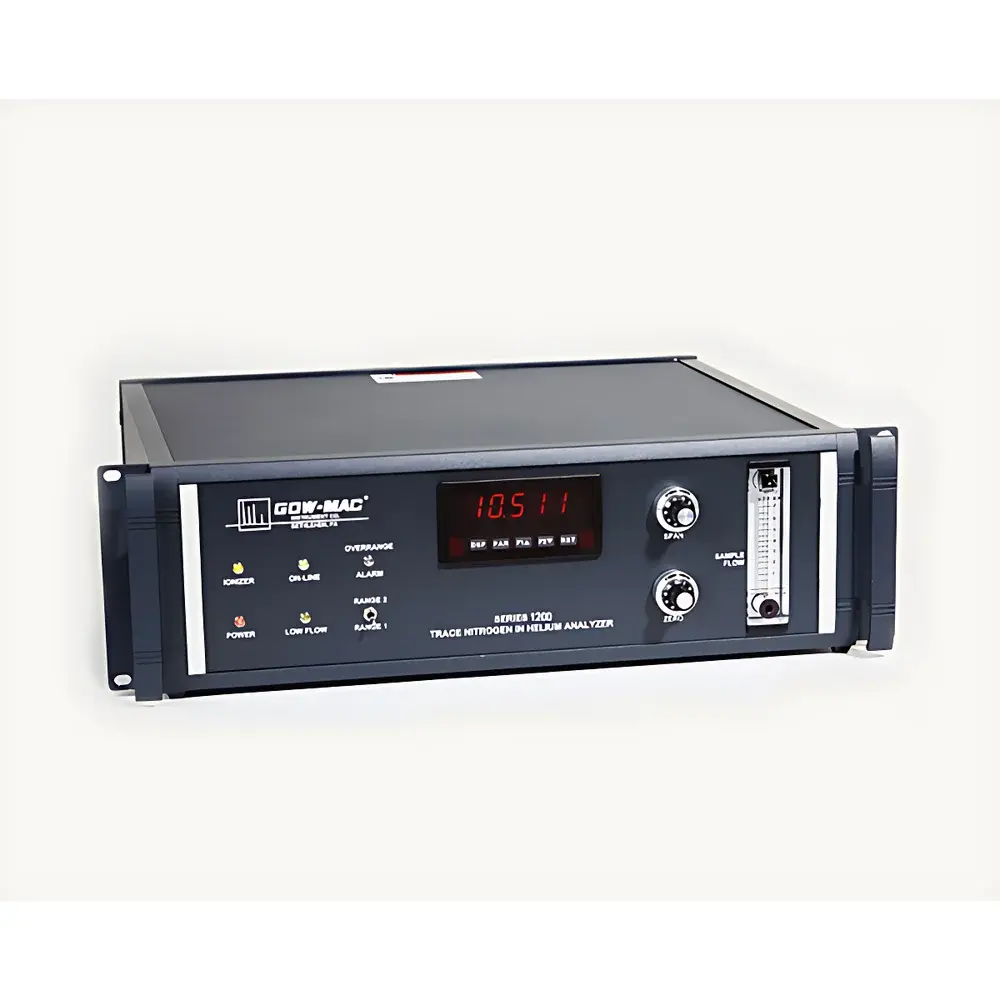
GOW-MAC 1200 Trace Nitrogen Analyzer for Argon
| Brand | GOW-MAC |
|---|---|
| Origin | USA |
| Model | GOW-MAC 1200 |
| Detection Principle | Plasma Emission Spectroscopy |
| Measurement Range | 0–2 ppm, 0–10 ppm, 0–20 ppm, 0–100 ppm, 0–200 ppm N₂ in Ar |
| Accuracy | ±0.02 ppm (0–2 ppm range), ±0.25 ppm (0–10/0–20 ppm ranges), ±2.50 ppm (0–100/0–200 ppm ranges) |
| Sensitivity | ±0.01 ppm (Model 1200-A/1202-A), ±0.10 ppm (1200-B/1202-B), ±1.00 ppm (1200-C/1202-C) |
| Sample Flow Rate | 2 scfh (0.88 slpm) |
| Inlet/Outlet Fittings | 1/4" VCR inlet, 1/4" Swagelok outlet |
| Operating Temperature | 16–35 °C (60–95 °F) |
| Max Inlet Pressure | 10 psig |
| Measurement Cell Pressure | 6 psig |
| Normal Inlet Pressure | 2–7 psig |
| Output Signals | 4–20 mA analog, dry contact alarms |
| Power | 100 W, 115/230 VAC, 50/60 Hz |
| Dimensions | 13.34 × 42.23 × 37.15 cm |
| Weight | 11.3 kg |
Overview
The GOW-MAC 1200 Trace Nitrogen Analyzer is a high-stability, laboratory- and process-grade instrument engineered for the precise quantification of nitrogen impurities in ultra-high-purity argon streams. Utilizing microwave-induced plasma emission spectroscopy (MIP-OES), the analyzer detects atomic nitrogen line emission at 149.26 nm — a highly selective and interference-resistant spectral signature. This principle enables direct, real-time measurement without chemical conversion or catalytic reactors, eliminating drift associated with thermal decomposition methods. Designed for applications demanding sub-part-per-trillion detection capability in inert gas matrices, the GOW-MAC 1200 delivers trace-level sensitivity with robust repeatability across multiple calibrated ranges (0–2 ppm to 0–200 ppm). Its architecture reflects over eight decades of GOW-MAC’s heritage in gas purity analytics, beginning with foundational work in carrier gas purification and trace impurity metrology since 1935.
Key Features
- Plasma emission detection optimized for N atoms in Ar matrix — no NOₓ formation or reduction chemistry required
- Multi-range calibration capability: five user-selectable spans (0–2, 0–10, 0–20, 0–100, 0–200 ppm N₂ in Ar) with independent accuracy specifications per range
- Integrated high-efficiency argon purifier (GM 75-800-2-AR) compatible with zero-gas preparation for all calibration levels
- Stable optical path design with temperature-controlled plasma chamber and sealed quartz flow cell to minimize thermal drift
- Dual-pressure regulation: independent control of sample inlet pressure (2–7 psig typical) and measurement cell pressure (6 psig fixed)
- LED-based digital display with real-time concentration readout, status indicators, and range selection feedback
- Industrial I/O interface: isolated 4–20 mA output with configurable scaling, plus dry-contact relays for out-of-range alarm and span-change confirmation
Sample Compatibility & Compliance
The GOW-MAC 1200 is validated for use with argon streams meeting ASTM D7607 Class I purity specifications (≥99.999% Ar) and is routinely deployed in semiconductor fab gas delivery systems, specialty gas production QC labs, and cryogenic distillation monitoring. It complies with ISO 8573-1:2010 Class 1 requirements for instrumental trace gas analysis when operated within specified environmental conditions (16–35 °C ambient, non-condensing). The system supports GLP-compliant operation through documented calibration procedures using NIST-traceable standard gases (e.g., 1.6–2 ppm, 8–10 ppm, 16–20 ppm, 80–100 ppm, and 160–200 ppm N₂ in Ar). While not inherently 21 CFR Part 11 compliant, audit-ready data logging can be implemented via external SCADA or LIMS integration using its analog output and discrete status signals.
Software & Data Management
The GOW-MAC 1200 operates as a stand-alone analyzer with embedded firmware controlling plasma ignition sequence, signal integration time, background subtraction, and linearization algorithms. No proprietary PC software is required for basic operation; however, optional analog-to-digital acquisition modules enable time-series logging into third-party platforms (e.g., LabVIEW, Ignition SCADA, or DeltaV DCS). All calibration events — including zero-gas verification, span adjustment, and sensitivity validation — are recorded via front-panel timestamps and relay-triggered external loggers. For regulated environments, users may implement electronic record retention policies aligned with FDA guidance on legacy instrumentation, leveraging the device’s deterministic response and mechanical interlocks (e.g., plasma enable/disable sequencing tied to pressure interlock).
Applications
- Final quality verification of electronic-grade argon prior to cylinder filling or bulk delivery
- In-line monitoring of argon purge streams in ALD and CVD tool cabinets
- Validation of purifier breakthrough in multi-stage gas purification skids
- Reference method for verifying performance of electrochemical or TCD-based nitrogen sensors
- Research applications requiring stable baseline measurements for nitrogen solubility studies in liquid argon systems
- Supporting ISO/IEC 17025 accredited testing laboratories performing gas purity certification per ISO 8573-5
FAQ
What detection technology does the GOW-MAC 1200 employ?
It uses microwave-induced plasma emission spectroscopy (MIP-OES) to detect atomic nitrogen emission at 149.26 nm.
Is the instrument suitable for continuous unattended operation?
Yes — designed for 24/7 operation with automatic plasma re-ignition after power interruption and stable thermal management.
Can it measure nitrogen in gases other than argon?
No — the optical and pressure calibration is specifically optimized for argon matrix; helium or neon require separate validation and are not supported out-of-the-box.
What maintenance intervals are recommended?
Plasma torch cleaning every 6 months under continuous use; quartz flow cell inspection annually; GM 75-800-2-AR purifier cartridge replacement per manufacturer’s gas throughput schedule.
Does the analyzer require external cooling or compressed air?
No — air-cooled only; no external utilities beyond line power and sample gas supply are needed.
Related Products





