
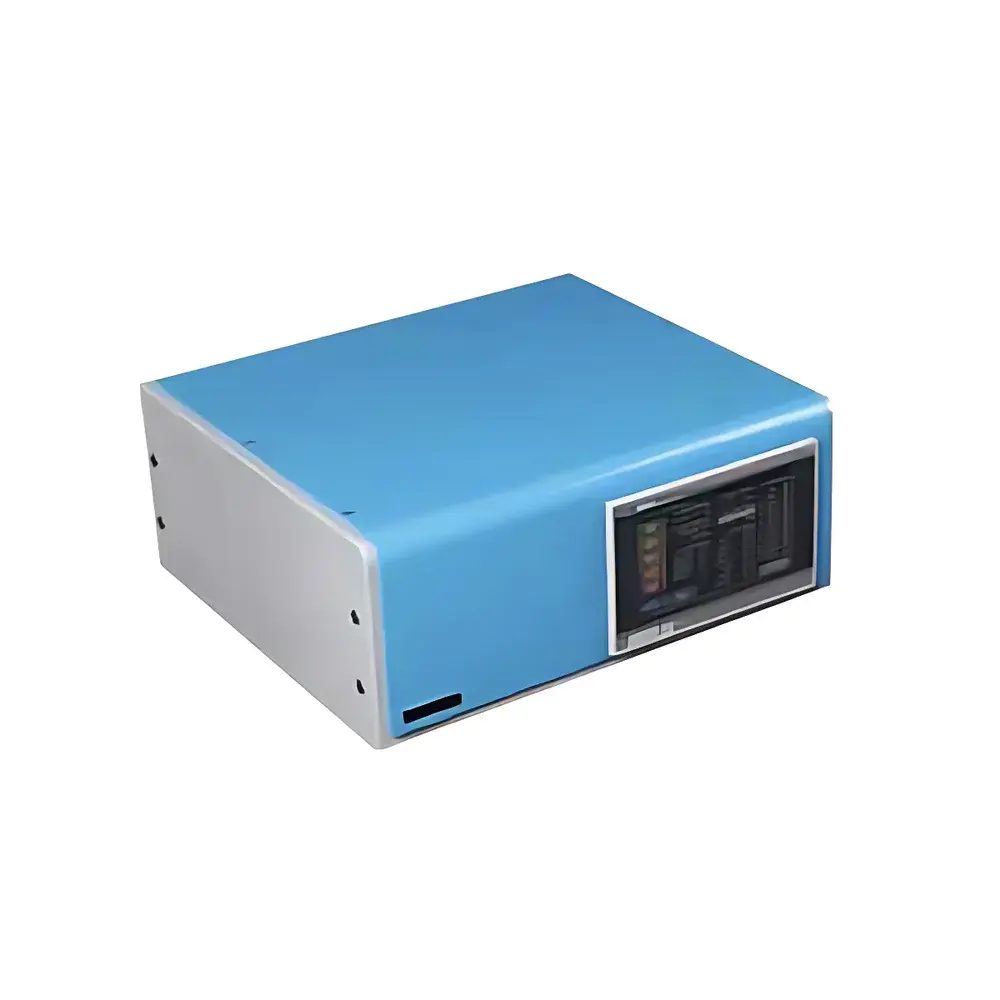
MIDAC Dynamic Calibration System
| Brand | GAOMAI |
|---|---|
| Origin | USA |
| Manufacturer Type | Authorized Distributor |
| Product Category | Imported Instrument |
| Model | MIDAC Dynamic Calibration System |
| Price Range | USD 42,000 – 70,000 (FOB) |
| Instrument Type | Laboratory Gas Chromatography Calibration Standard Generator |
| Application Scope | Universal Calibration for GC & FTIR |
| Gas Dilution Stages | Triple-stage |
| Mass Flow Controllers (MFCs) | Multi-channel digital MFC support |
| Corrosive Gas Compatibility | Yes (acidic, alkaline, organic) |
| Dilution Ratio Programmability | Yes, time-scheduled auto-run |
| Real-time Flow Monitoring | Yes |
| Repeatability | ≤ ±0.8% RSD (N₂ baseline, 10–1000 sccm) |
| Control Interface | PLC-based with 7″ TFT touchscreen (800×600) |
| PLC Cycle Time | Standard mode 160 µs |
| Onboard Memory | Display buffer 26 MB |
| Touchscreen Lifetime | ≥ 5 years (MTBF) |
Overview
The MIDAC Dynamic Calibration System is a precision-engineered gas standard generator designed to deliver traceable, programmable, and repeatable multi-component gas mixtures for analytical instrument calibration—specifically optimized for gas chromatography (GC) and Fourier-transform infrared (FTIR) spectrometry. Unlike static cylinder-based calibration methods, the MIDAC system employs dynamic dilution principles based on digitally controlled mass flow control (MFC) technology, enabling real-time generation of certified reference gas concentrations across wide dynamic ranges. Its triple-stage dilution architecture allows sequential reduction of primary standard gases—from high-concentration stock cylinders down to sub-ppb levels—with minimized adsorption, diffusion, and memory effects. The system operates under ISO/IEC 17025-aligned calibration traceability protocols and supports audit-ready documentation required for GLP and GMP environments.
Key Features
- Triple-stage dynamic dilution architecture for extended concentration range (ppm to sub-ppb) with <0.8% RSD repeatability
- Multi-channel digital mass flow controllers (MFCs), individually calibrated per ISO 6145-7 and traceable to NIST standards
- Corrosion-resistant fluidic path constructed from electropolished 316L stainless steel, PFA-lined tubing, and Hastelloy C-276 valves—validated for HCl, NH₃, H₂S, SO₂, and volatile organic compounds (VOCs)
- Programmable dilution ratio and timing sequence via embedded PLC controller, supporting unattended batch calibration runs
- Real-time digital display of all active gas flows, pressure differentials, and dilution status on a 7″ industrial-grade TFT touchscreen (800×600 resolution)
- Independent channel isolation for acidic, alkaline, and organic gas streams—preventing cross-contamination and chemical degradation
- Integrated Ethernet communication (Modbus TCP/IP) for remote monitoring, SCADA integration, and data logging compliance with FDA 21 CFR Part 11 requirements
Sample Compatibility & Compliance
The MIDAC system accommodates standard gas cylinders (CGA-600, CGA-330, CGA-590) containing certified reference materials (CRMs) compliant with ISO 6141 and ISO 6142. It supports single- or multi-component gas standards—including hydrocarbons (C₁–C₁₀), sulfur compounds, halogenated organics, and inorganic toxicants. All wetted materials meet USP Class VI biocompatibility criteria and ASTM F2220 for elastomer compatibility. System validation documentation includes IQ/OQ/PQ protocols aligned with ISO/IEC 17025:2017, EU GMP Annex 15, and EPA Method TO-15/TO-17 auxiliary calibration requirements.
Software & Data Management
The onboard PLC firmware provides deterministic control with cycle times as low as 160 µs (standard I/O) and 270 µs (Ethernet-enabled operations), ensuring synchronization with high-speed GC injectors and FTIR data acquisition systems. The HMI interface stores up to 26 MB of operational logs—including timestamped flow profiles, dilution events, alarm history, and user authentication records. Backup memory (512 KB) retains critical configuration parameters during power loss. Exportable CSV reports include full audit trails meeting FDA 21 CFR Part 11 requirements: electronic signatures, operator ID, change timestamps, and immutable event logs.
Applications
- Primary calibration of GC-FID, GC-TCD, GC-ECD, and GC-MS systems for environmental air monitoring (EPA Method 18, TO-14A, TO-15)
- Dynamic span calibration and linearity verification of continuous emission monitoring systems (CEMS)
- Method validation and instrument qualification per USP , ICH Q2(R2), and ISO 11352
- Trace gas generation for photochemical reactor studies and atmospheric simulation chambers
- Reference material preparation for proficiency testing programs accredited to ISO/IEC 17043
FAQ
What gas standards can the MIDAC system generate?
It generates certified gas mixtures from primary standards (e.g., 1000 ppm CH₄ in N₂) down to sub-ppb levels across three dilution stages, supporting hydrocarbons, sulfur species, nitrogen oxides, halocarbons, and corrosive analytes.
Is the system compatible with third-party GC data systems?
Yes—via Modbus TCP/IP or RS-485, it integrates with Agilent OpenLab, Thermo Fisher Chromeleon, Shimadzu LabSolutions, and custom LIMS platforms.
How is traceability maintained for calibration outputs?
Each MFC is factory-calibrated against NIST-traceable flow standards; dilution ratios are mathematically derived from certified input concentrations and verified using gravimetric or dynamic volumetric reference methods.
Can the system be validated for regulated pharmaceutical use?
Yes—the included IQ/OQ/PQ documentation package supports GMP-compliant installation and operation, including 21 CFR Part 11 electronic record controls and ALCOA+ data integrity principles.
What maintenance is required for long-term stability?
Annual MFC recalibration and quarterly leak-checks per ASTM E2654 are recommended; no consumables beyond standard cylinder connections and filter elements are required.






