
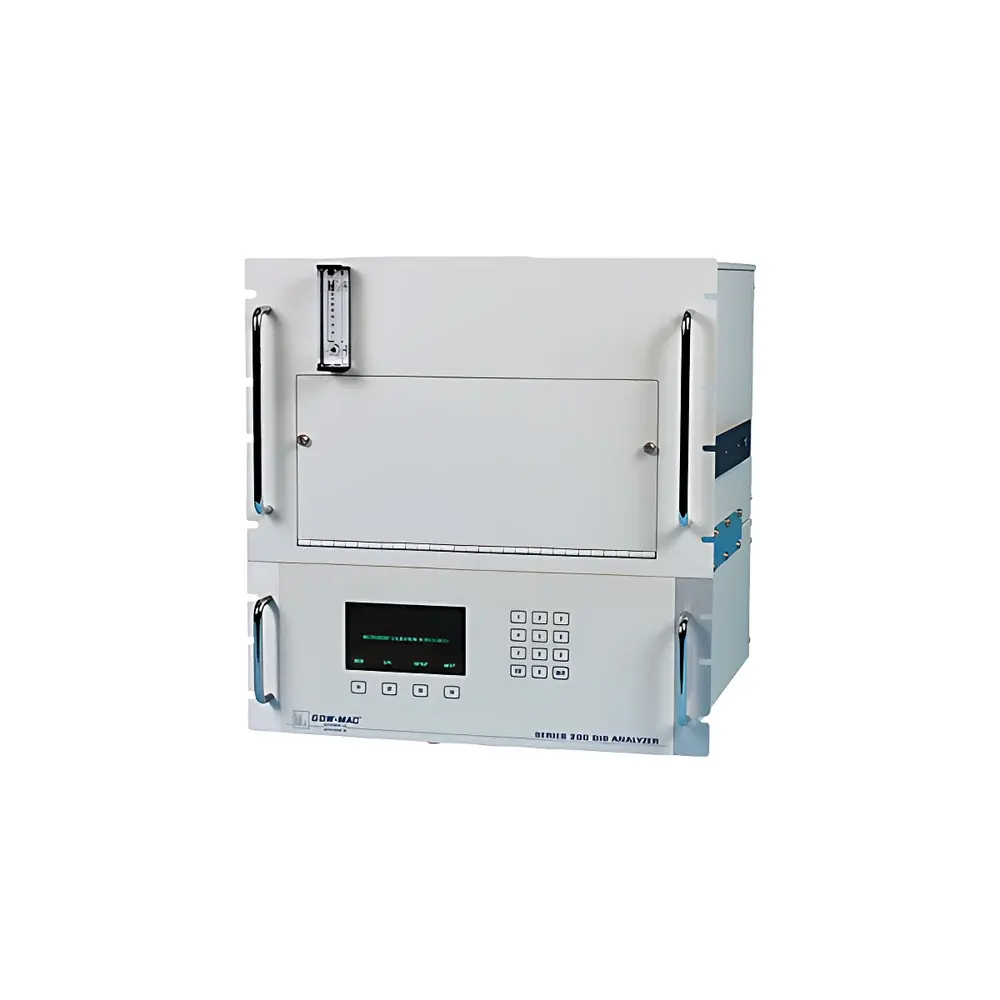
GOW-MAC 200 Series Online Gas Chromatograph
| Brand | GOW-MAC |
|---|---|
| Origin | USA |
| Model | GOW-MAC 200 |
| Instrument Type | Online Gas Chromatograph |
| Detector Options | TCD, DID, FID, PID, NPD, FPD |
| Column Compatibility | Packed & Micro-packed Columns |
| Sample Introduction | Gas Sampling Valve & Liquid Sampling Valve |
| Valve Configuration | Up to 3 Pneumatically Actuated Valves |
| Oven Temperature Range | +10 °C to 150 °C |
| Software | Clarity PC Chromatography Data System (CDS) |
| Construction | Stainless Steel Flow Path |
| Compliance | Designed for GLP/GMP environments |
Overview
The GOW-MAC 200 Series Online Gas Chromatograph is a rugged, rack-mountable analytical platform engineered for continuous, unattended operation in industrial process monitoring, environmental emissions tracking, and high-reliability laboratory applications. Built upon GOW-MAC’s legacy of precision gas analysis since 1935, this system employs classical gas chromatographic separation principles—differential partitioning of analytes between a mobile gas phase (carrier gas) and a stationary phase coated inside a packed or micro-packed column—to achieve selective, reproducible compound identification and quantification. Unlike benchtop GCs optimized for discrete sample injection, the 200 Series integrates directly into process streams via dedicated sampling interfaces, enabling real-time compositional feedback with minimal operator intervention. Its modular architecture supports flexible detector selection and configurable valve routing, making it suitable for both routine compliance testing and complex multi-component gas matrix analysis.
Key Features
- Rack-mountable, industrial-grade chassis designed for permanent installation in control rooms, analyzer shelters, or production line enclosures
- Temperature-stabilized column oven with ±0.1 °C thermal uniformity across the +10 °C to 150 °C operating range, ensuring retention time repeatability critical for long-term calibration stability
- Multi-detector compatibility: Select from Thermal Conductivity Detector (TCD), Helium Discharge Ionization Detector (DID), Flame Ionization Detector (FID), Photoionization Detector (PID), Nitrogen-Phosphorus Detector (NPD), or Flame Photometric Detector (FPD) based on target analyte classes and sensitivity requirements
- High-integrity flow path constructed from electropolished stainless steel; optional wetted materials include silicon steel and nickel alloys for aggressive gas matrices (e.g., HCl, HF, Cl₂, NH₃)
- Configurable pneumatic valve manifold supporting up to three independently actuated valves—enabling backflush, column switching, heart-cutting, and parallel/series column configurations
- Gas and liquid sample introduction via dedicated sampling valves with pressure-balanced design to minimize carryover and ensure quantitative transfer
Sample Compatibility & Compliance
The GOW-MAC 200 Series accommodates gaseous samples introduced directly from pressurized lines or ambient air via calibrated sampling valves, as well as volatile liquid samples introduced through heated vaporization chambers. It meets the mechanical and operational prerequisites for ISO/IEC 17025-accredited laboratories and supports regulatory workflows aligned with EPA Method 18, ASTM D1945, ASTM D1946, and USP . The system’s hardware architecture and Clarity CDS software are engineered to satisfy data integrity requirements under FDA 21 CFR Part 11—including electronic signatures, user access controls, audit trail logging, and secure method/version management—making it deployable in pharmaceutical, petrochemical, and semiconductor manufacturing settings governed by GLP or GMP protocols.
Software & Data Management
Data acquisition, processing, and reporting are managed through Clarity PC Chromatography Data System—a validated, Windows-based CDS widely adopted in regulated industries. Clarity enables full method development (including gradient timing, valve event sequencing, and detector parameter optimization), automated calibration curve generation with polynomial or linear regression, customizable report templates compliant with internal SOPs or external submission formats (e.g., PDF, CSV, XML), and batch sequence scheduling for unattended overnight or weekend operation. Raw data files are stored in vendor-neutral formats with embedded metadata, facilitating third-party reprocessing and long-term archival in accordance with ALCOA+ principles (Attributable, Legible, Contemporaneous, Original, Accurate, Complete, Consistent, Enduring, Available).
Applications
- Continuous monitoring of refinery off-gas composition for sulfur compounds, hydrocarbons, and hydrogen sulfide
- In-line purity verification of bulk specialty gases (e.g., N₂, Ar, He, O₂) used in semiconductor fabrication
- Trace-level VOC analysis in ambient air or stack emissions per EPA TO-14/TO-15 protocols
- Residual solvent testing in pharmaceutical intermediates using headspace-GC/FID
- Hydrogen and light hydrocarbon quantification in syngas and biogas streams
- Quality control of industrial solvents and monomers in chemical production facilities
FAQ
Is the GOW-MAC 200 Series suitable for hazardous area installation?
Yes—when equipped with appropriate explosion-proof enclosures (e.g., Class I, Division 1 or ATEX-certified variants), the system can be deployed in classified locations per NEC Article 500 or IEC 60079 standards.
Can the instrument operate without continuous PC connectivity?
Yes—the onboard controller maintains method execution and data buffering during temporary network outages; acquired chromatograms sync to Clarity upon reconnection.
What maintenance intervals are recommended for the TCD and DID detectors?
TCD filament replacement is typically required every 12–24 months under normal use; DID discharge cell cleaning and electrode inspection are advised quarterly in high-moisture or particulate-laden gas streams.
Does the system support remote diagnostics and firmware updates?
Yes—via secure SSH or TLS-enabled web interface, authorized service engineers can perform health checks, log review, and controlled firmware upgrades without onsite presence.
How is calibration traceability established for regulatory submissions?
Certified reference standards (NIST-traceable or equivalent) are used during initial qualification and periodic revalidation; Clarity automatically logs standard preparation details, injection sequences, and curve statistics to support audit readiness.







