
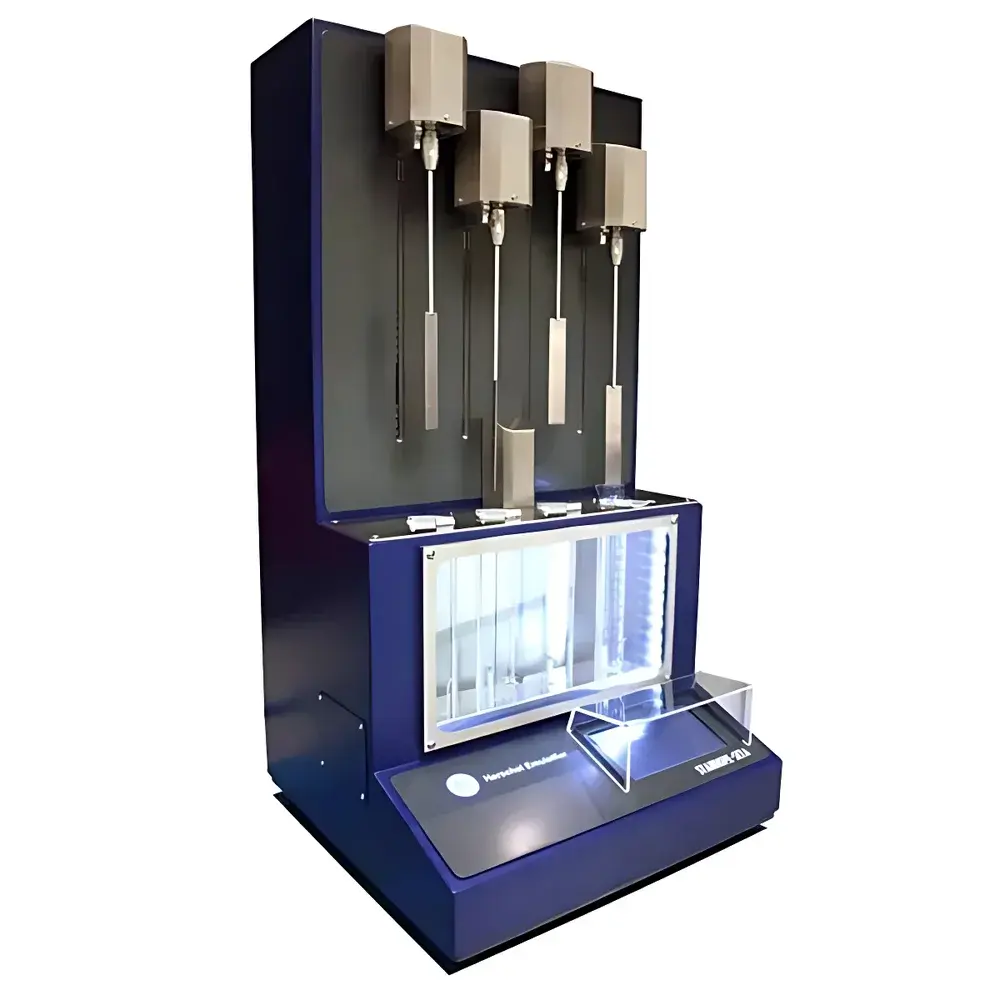
SETA 96700-2 Petroleum Demulsibility Tester
| Brand | SETA |
|---|---|
| Origin | United Kingdom |
| Model | 96700-2 |
| Standards Compliance | ASTM D1401, ISO 6614, GB/T 7305 |
| Test Positions | 4 independent stations |
| Stirring Mechanism | 4 individually controlled stirrers |
| Stirring Speed | Adjustable (0–1200 rpm typical range) |
| Illumination | Integrated backlight for visual phase separation assessment |
| Control Interface | Touchscreen HMI with embedded test protocol manager |
| Communication | RS232 serial interface |
| Power Supply | 100–240 V AC, 50/60 Hz |
| Dimensions (W×D×H) | 480 × 420 × 320 mm |
| Weight | Approx. 28 kg |
Overview
The SETA 96700-2 Petroleum Demulsibility Tester is a precision-engineered laboratory instrument designed to quantitatively evaluate the ability of lubricating oils and other petroleum-based fluids to separate from water under controlled thermal and mechanical agitation conditions. It operates in strict accordance with internationally recognized standard test methods—including ASTM D1401 (Standard Test Method for Determining the Demulsibility Characteristics of Turbine Oils), ISO 6614 (Petroleum Products — Determination of Demulsibility), and GB/T 7305 (Chinese national standard for demulsibility testing of lubricating oils). The instrument employs a gravimetric and visual phase-separation assessment principle: oil–water emulsions are subjected to defined temperature (typically 54 °C or 82 °C per method), standardized stirring duration and speed, followed by a quiescent settling period during which the volume of separated water, emulsion layer, and bulk oil is recorded at specified time intervals (e.g., 10, 30, 60 minutes). This provides objective, repeatable data essential for quality control, formulation development, and oxidative stability monitoring in turbine, hydraulic, and circulating lubricant systems.
Key Features
- Four independent test stations—each equipped with dedicated heating bath, temperature sensor, stirrer motor, and optical viewing window—enabling concurrent evaluation of multiple samples or replicate testing under identical conditions.
- Individually programmable stirring parameters per station: speed (adjustable in 1-rpm increments within the 0–1200 rpm range), duration (1–60 min), and agitation profile (continuous or intermittent).
- Integrated LED backlit viewing panels with calibrated scale markings facilitate accurate visual determination of water/oil/emulsion layer volumes without external lighting interference.
- Quick-release magnetic coupling design allows tool-free removal and reinstallation of stainless-steel stirrer paddles—minimizing cross-contamination and enabling rapid cleaning between tests.
- Embedded touchscreen human-machine interface (HMI) with preloaded ASTM/ISO/GB test templates; supports user-defined protocols, real-time status monitoring, and on-device result logging.
- RS232 serial port enables direct connection to LIMS or PC-based data acquisition software for automated report generation and audit trail compliance.
Sample Compatibility & Compliance
The SETA 96700-2 accommodates standard 40-mL graduated glass demulsibility test tubes (ASTM D1401-compliant dimensions: 125 mm height × 25 mm OD) and accepts a broad range of petroleum-based fluids including mineral and synthetic turbine oils, hydraulic fluids, gear oils, and rust-inhibited lubricants. Its thermal control system maintains bath temperature within ±0.5 °C of setpoint across all four stations, satisfying repeatability requirements of ASTM D1401 Annex A1 and ISO 6614 Clause 6. All wetted components are constructed from borosilicate glass, stainless steel (316), and PTFE—ensuring chemical resistance to hydrocarbons, additives, and trace water-soluble contaminants. The unit is CE-marked and conforms to IEC 61010-1:2010 safety standards for electrical equipment used in laboratory environments.
Software & Data Management
The onboard firmware includes a GLP-compliant data management module that records timestamped test metadata—including operator ID, sample ID, method selection, temperature setpoint, stirring parameters, and observed phase volumes—at each measurement interval. Audit trails are retained locally for ≥1000 test cycles and exportable via RS232 as CSV or XML files. Optional integration with third-party laboratory informatics platforms supports 21 CFR Part 11-compliant electronic signatures, role-based access control, and long-term archival aligned with ISO/IEC 17025 documentation requirements.
Applications
- Quality assurance of new lubricant batches prior to release—verifying demulsibility performance against OEM specifications.
- Monitoring in-service oil degradation: increased emulsion stability often correlates with oxidation by-products, additive depletion, or surfactant contamination.
- Formulation screening of demulsifier additives during R&D of high-performance turbine oils.
- Root-cause analysis in power generation facilities experiencing bearing corrosion or moisture-related failures.
- Regulatory submission support for API, OEM, or military specification compliance (e.g., MIL-PRF-2104G, GEK 32568).
FAQ
What standards does the SETA 96700-2 fully support?
It is validated for ASTM D1401, ISO 6614, and GB/T 7305, with hardware and software logic aligned to clause-specific requirements including temperature ramp rates, stirrer geometry, and observation timing windows.
Can test results be exported to Excel or LIMS?
Yes—via RS232 serial output using ASCII-delimited formats compatible with Microsoft Excel, LabWare LIMS, and Thermo Fisher SampleManager.
Is calibration traceable to NIST or UKAS?
Temperature sensors are supplied with individual calibration certificates traceable to UKAS-accredited laboratories; periodic verification kits and SOPs are available upon request.
What maintenance is required for long-term reliability?
Routine tasks include weekly cleaning of glassware and stirrer assemblies, biannual verification of bath temperature uniformity, and annual firmware updates distributed by SETA Technical Support.
Does the instrument meet GLP or GMP documentation requirements?
Yes—the embedded audit trail, user authentication, and electronic record retention meet core GLP principles and serve as foundational evidence for GMP-aligned lubricant manufacturing QA systems.



