
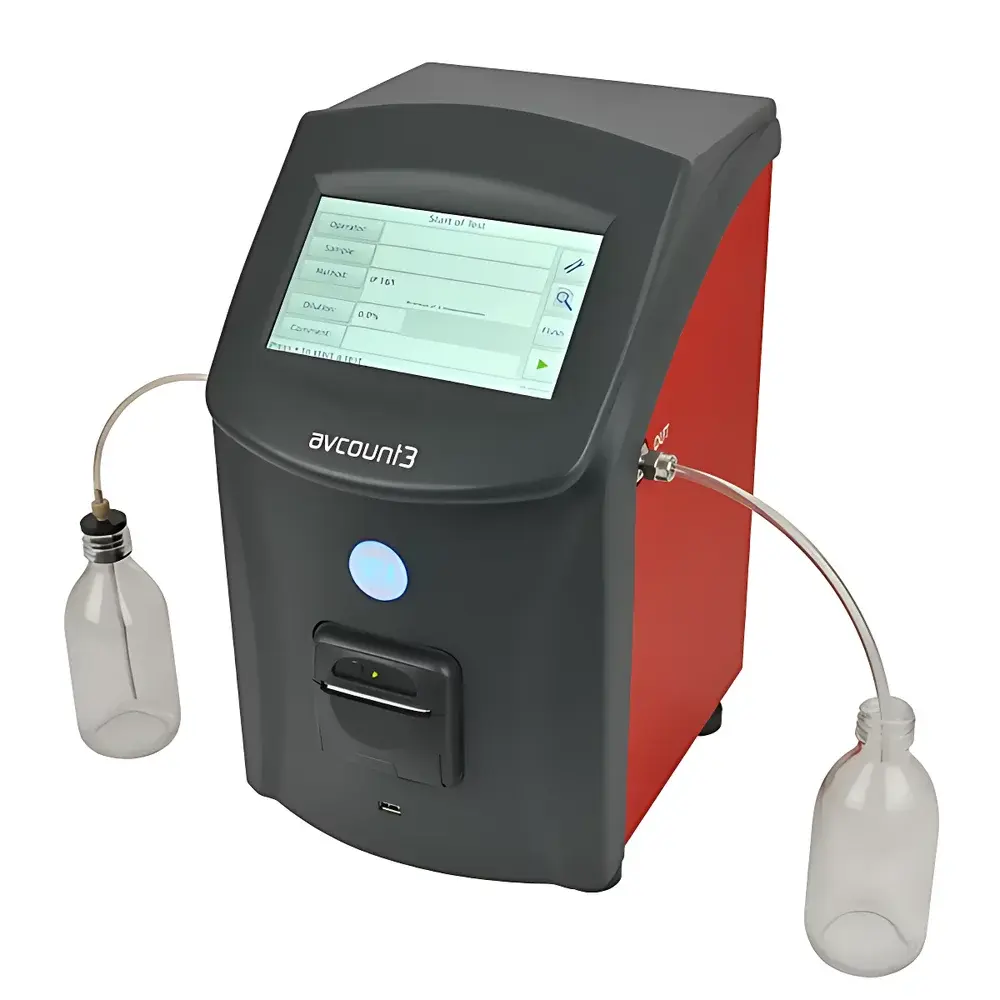
SETA AvCount3 Third-Generation Automatic Particle Counter
| Brand | SETA |
|---|---|
| Origin | United Kingdom |
| Model | SA1100-0 |
| Instrument Type | Optical Particle Counter |
| Particle Size Range (ISO 11171) | 4 µm to >70 µm |
| Particle Size Range (ISO 4402) | 2 µm to >100 µm |
| Number of Sizing Channels | 16 |
| Maximum Particle Count per Test | 60,000 particles/mL |
| Sample Viscosity Range | up to 68 mm²/s (direct from bottle), up to 500 mm²/s at 10 bar |
| Sample Temperature Range | 0–70 °C |
| Flow Rate | 30 mL/min |
| Total Sample Volume per Test | 80 mL (including rinse) for IP 565 |
| Maximum Inlet Pressure | 10 bar (310 bar optional) |
| Output Units | particles/mL or particles/10 mL |
| Cleanliness Codes | Cumulative & Differential per ISO 4406, NAS 1638, SAE AS4059, JIS B 9932:2012, JIS B 9933:2021, JIS B 9934:2012, GOST 17216, Defence Standards 91-091 & 91-86, ASTM D975, D6299, D7619, D7647, IP 565, IP 630 |
| Calibration Standard | ISO 11171 |
| Data Interfaces | Ethernet, USB |
| Display | Integrated touchscreen interface |
| Onboard SQC Software | Compliant with ASTM D6299 statistical quality control requirements |
| User Authentication | Password-protected access levels |
| Embedded Test Methods | 14 preconfigured methods |
Overview
The SETA AvCount3 Third-Generation Automatic Particle Counter (Model SA1100-0) is a precision-engineered optical particle counter designed for rapid, repeatable, and standards-compliant analysis of particulate contamination in low- to medium-viscosity fluids. Operating on the principle of light extinction (also known as optical obscuration), the instrument detects individual particles suspended in a laminar fluid stream as they pass through a focused laser beam. Each particle generates a pulse proportional to its cross-sectional area, enabling accurate sizing and counting across 16 calibrated channels. The system is optimized for critical applications in aviation fuel quality assurance, hydraulic system monitoring, biofuel certification, and lubricant condition assessment—where adherence to international cleanliness specifications directly impacts operational safety and equipment longevity.
Key Features
- Optical detection platform calibrated per ISO 11171 reference standards, ensuring metrological traceability and inter-laboratory comparability.
- Integrated sample dispersion module engineered to minimize bubble generation and ensure homogeneous particle suspension—critical for reproducible results in volatile fuels and low-surface-tension liquids.
- Touchscreen HMI with intuitive workflow navigation; no specialized operator training required—reducing ramp-up time and minimizing human error.
- Real-time test visualization including live particle count rate, channel-by-channel histogram updates, and dynamic cleanliness code calculation.
- Dual viscosity handling: direct sampling from standard bottles (≤68 mm²/s) and high-pressure dilution mode (up to 500 mm²/s at 10 bar), extending applicability to heavier distillates and aged lubricants.
- Onboard Statistical Quality Control (SQC) software compliant with ASTM D6299, supporting trend analysis, control charting, and automated outlier detection per laboratory QA/QC protocols.
- Multi-level password protection with configurable user roles—supporting audit-ready access control in GLP- and GMP-regulated environments.
Sample Compatibility & Compliance
The AvCount3 accommodates a broad range of petroleum-based and synthetic fluids, including Jet A-1, JP-8, kerosene, biodiesel (B5–B20), hydraulic oils (ISO VG 10–68), and turbine oils. Its temperature-controlled flow path (0–70 °C) enables testing under field-relevant conditions while maintaining measurement stability. The instrument supports full compliance with over 15 global cleanliness standards—including ISO 4406:2021, NAS 1638 Class Code, SAE AS4059F, JIS B 9932:2012/B 9933:2021/B 9934:2012, GOST 17216-2014, and military specifications DEF STAN 91-091 and 91-86. All embedded test methods are pre-validated against ASTM D7619 (for aviation turbine fuels), ASTM D7647 (for diesel), IP 565 (for hydrocarbon fuels), and ASTM D975 (for diesel fuel oils).
Software & Data Management
Data acquisition, reporting, and archival are managed via the integrated firmware with dual export pathways: direct USB flash drive transfer (CSV, PDF, XML) and networked Ethernet connectivity for integration into LIMS or centralized QC databases. Reports include raw channel counts, cumulative/differential histograms, ISO 4406 and NAS 1638 cleanliness codes, pass/fail status against method-defined thresholds, and full metadata (operator ID, sample ID, timestamp, instrument calibration status). Audit trails record all user actions—including method modifications, result overrides, and calibration events—in accordance with FDA 21 CFR Part 11 requirements when deployed in regulated pharmaceutical or aerospace maintenance settings.
Applications
- Aviation fuel certification per DEF STAN 91-091 and ASTM D7619 at refinery terminals, fuel farms, and airfield hydrant systems.
- Hydraulic fluid cleanliness verification in aerospace MRO facilities and wind turbine gearbox maintenance programs.
- Biodiesel blending quality control to detect catalyst residue, glycerin droplets, or storage-induced particulates per ASTM D6751 and EN 14214.
- Condition monitoring of turbine and compressor oils in power generation and marine propulsion systems.
- Research-grade particle morphology studies in low-viscosity synthetic esters and polyalphaolefins (PAOs), leveraging the instrument’s high-resolution 2–100 µm sizing capability.
FAQ
Does the AvCount3 require external calibration standards for routine operation?
No—each unit ships with an ISO 11171-traceable calibration certificate and built-in verification protocol using NIST-traceable latex sphere suspensions. Daily system suitability checks are performed automatically during startup.
Can the instrument analyze samples above 68 mm²/s without dilution?
Yes—via the optional high-pressure dilution module (rated to 310 bar), enabling direct analysis of oils up to ISO VG 100 without manual pre-dilution.
Is remote diagnostics supported?
Yes—Ethernet connectivity allows secure remote firmware updates, configuration backup, and real-time technical support via encrypted VNC session.
How does the system handle water droplets in fuel matrices?
The optical detection algorithm discriminates between solid particulates and free water droplets based on refractive index contrast and pulse shape analysis—enabling independent reporting per ASTM D7647 Annex A1.
What sample volume is consumed during a full IP 565-compliant test?
80 mL total, including 20 mL for system rinse and 60 mL for primary analysis—fully aligned with IP 565 Section 7.3 requirements.



