
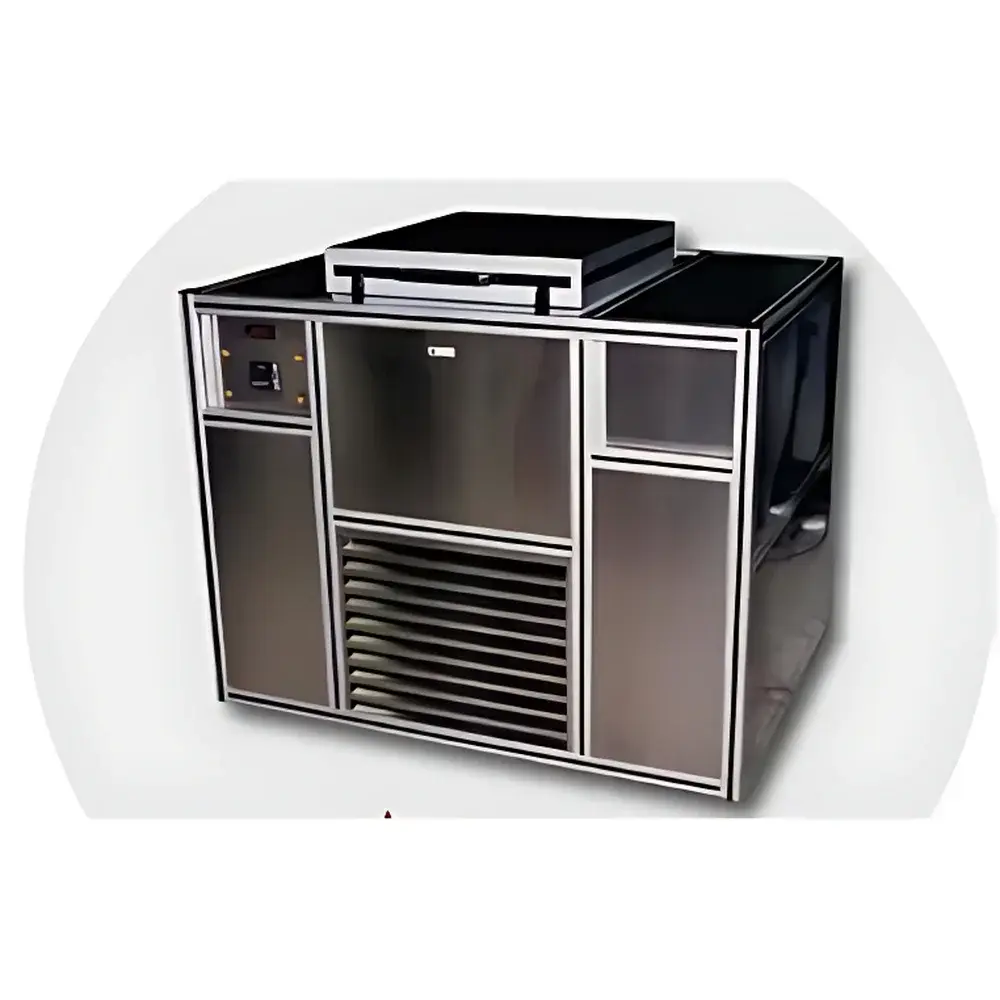
Lawler 64-22 Low-Temperature Grease Torque Testing System
| Brand | Lawler |
|---|---|
| Origin | USA |
| Model | 64-22 |
| Compliance | ASTM D1478, ASTM D4693 |
| Operating Temperature Range | –73 °C to ambient |
| Temperature Stability | ±0.3 °C |
| Temperature Display Resolution | 0.1 °C |
| Drive Speed | 1 rpm (fixed) |
| Test Stations | 1 or 2 independent |
| Torque Sensing | Strain-gauge-based, digital readout |
| Cooling System | Dual hermetic mechanical compressors |
| Air Bath Seal Integrity | High-efficiency insulated lid with positive closure |
| Optional Feature | Torque-limit safety cutoff (with Option V) |
Overview
The Lawler 64-22 Low-Temperature Grease Torque Testing System is a precision-engineered instrument designed for quantitative evaluation of the low-temperature starting and running torque characteristics of lubricating greases under standardized conditions. It operates on the principle of direct mechanical torque measurement during slow-speed rotation (1 rpm) of standardized test bearings immersed in grease, while subjected to controlled cryogenic air-bath environments. This system implements the physical test protocols defined in two foundational ASTM standards: D1478 (“Standard Test Method for Low-Temperature Torque of Ball Bearing Grease”) and D4693 (“Standard Test Method for Low-Temperature Torque of Wheel-Bearing Grease”). Its architecture integrates thermodynamic stability, mechanical repeatability, and metrological traceability—enabling laboratories to generate data suitable for specification conformance, formulation development, and regulatory documentation in accordance with petroleum product quality assurance frameworks.
Key Features
- Double-compressor refrigeration system delivering stable operation down to –73 °C without liquid nitrogen or external coolant loops
- Digital temperature controller maintaining air-bath thermal stability within ±0.3 °C across the full operating range; primary display resolution of 0.1 °C
- Dual independent test stations (configurable as single- or dual-position), each with dedicated drive motor, sealed air bath, and isolated thermal envelope
- Hermetically sealed top-access lid ensuring minimal thermal leakage and consistent boundary conditions per ASTM requirements
- Strain-gauge transducer mounted directly in the torque transmission path, providing high-fidelity analog-to-digital conversion with real-time digital display
- Thermally insulated drive shafts minimizing conductive heat ingress into test bearings during measurement
- Optional torque-limit safety interlock (Option V): automatically de-energizes the drive motor if measured torque exceeds user-defined threshold—protecting both test hardware and bearing integrity
Sample Compatibility & Compliance
The Lawler 64-22 accommodates standard ASTM-specified test bearings—including deep-groove ball bearings (e.g., 6204-2RS) and tapered roller wheel-bearing assemblies—as outlined in D1478 and D4693. Sample preparation follows prescribed grease packing procedures, including controlled shear history and dwell time prior to insertion. The system’s mechanical design, thermal management, and sensor calibration are validated against the dimensional, environmental, and procedural constraints of both methods. As an ASTM-compliant platform, it supports generation of data used in product certification, technical datasheet validation, and internal QC release testing. While not certified to ISO/IEC 17025 by default, the system is fully compatible with laboratory accreditation workflows when integrated with documented calibration schedules, uncertainty budgets, and operator training records.
Software & Data Management
The Lawler 64-22 operates via embedded digital instrumentation with local front-panel control and real-time numeric readouts for temperature and torque. It does not include onboard data logging or PC connectivity as standard; however, analog voltage outputs (0–5 V or 4–20 mA) are available for torque and temperature signals—enabling integration with third-party DAQ systems, SCADA platforms, or LIMS interfaces. When deployed in regulated environments (e.g., API-certified refineries or OEM lubricant qualification labs), users commonly pair the system with validated data acquisition software supporting 21 CFR Part 11 audit trails, electronic signatures, and secure storage. Calibration certificates for torque transducers and temperature sensors are issued per NIST-traceable protocols, and routine verification checks align with ASTM E74 and ISO 9001 maintenance guidelines.
Applications
- Formulation screening of thickener type (lithium, calcium sulfonate, polyurea), base oil viscosity grade, and additive package effects on cold-start performance
- Quality control release testing of finished grease batches against OEM specifications (e.g., GM 6277M, Ford WSS-M2C949-A)
- Failure analysis of field-returned greases exhibiting excessive cold cranking resistance or bearing seizure
- Supporting ASTM D6693 (low-temperature pumpability) correlation studies through comparative torque profiling
- Research into nanomaterial-enhanced greases, bio-based thickeners, and synthetic ester formulations requiring reproducible sub-zero rheomechanical characterization
FAQ
Does the Lawler 64-22 require liquid nitrogen or external chillers?
No. It uses two sealed, maintenance-free mechanical compressors to achieve –73 °C without cryogenic consumables.
Can the system be calibrated in-house?
Torque transducers and temperature sensors must be calibrated by an accredited laboratory using NIST-traceable standards; field verification checks may be performed per ASTM D1478 Annex A2.
Is dual-station operation truly independent?
Yes—each station has its own drive motor, air bath enclosure, temperature controller, and torque readout channel, enabling simultaneous but non-interacting tests.
What bearing types are supported out-of-the-box?
Standard configurations include 6204-2RS ball bearings (per D1478) and 1.5″ tapered roller assemblies (per D4693); custom fixtures are available upon request.
How is temperature uniformity verified across the air bath?
Per ASTM D1478 Section 7.2, users perform spatial mapping using calibrated PT100 probes at defined grid points during initial qualification and annually thereafter.





