
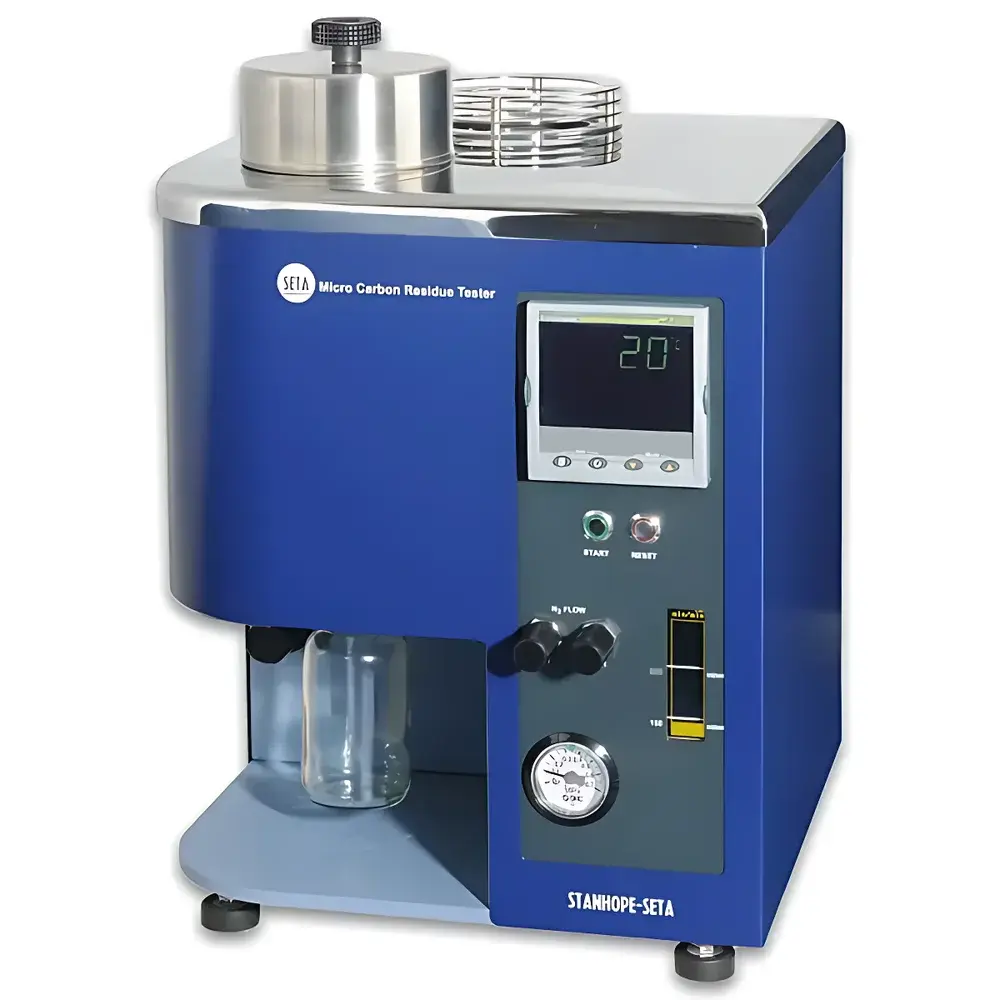
SETA 97400-3 Automatic Micro Carbon Residue Tester
| Brand | SETA |
|---|---|
| Origin | United Kingdom |
| Model | 97400-3 |
| Standard Compliance | ASTM D4530, IP 398, ISO 10370, GB/T 17144 |
| Carbon Residue Range | 0.1–30.0% (m/m) |
| Sample Capacity | 12 positions |
| Nitrogen Pressure Range | 0–200 kPa |
| Nitrogen Flow Rate | 150–600 mL/min |
| Safety Features | Low-pressure cutoff, over-temperature shutdown, forced-air cooling |
| Exhaust Management | Integrated condensate trap and external exhaust port |
Overview
The SETA 97400-3 Automatic Micro Carbon Residue Tester is an engineered solution for precise, reproducible determination of carbon residue in petroleum products via the micro-method principle defined in ASTM D4530, IP 398, ISO 10370, and GB/T 17144. Unlike traditional Conradson or Ramsbottom techniques, this instrument employs controlled pyrolysis under inert nitrogen atmosphere in sealed crucibles, minimizing oxidation artifacts and enabling quantification of thermally stable carbonaceous deposits formed during high-temperature decomposition. The system operates on a gravimetric basis: sample mass loss and residual char mass are measured before and after programmed thermal ramping, yielding carbon residue as a mass percentage (m/m). Designed for routine QC laboratories in refineries, lubricant manufacturers, and third-party testing facilities, the 97400-3 delivers high inter-laboratory reproducibility while reducing operator dependency through full automation of temperature profiling, gas flow regulation, and endpoint detection.
Key Features
- Automated thermal program execution with programmable heating ramps, soak periods, and cooling cycles per ASTM D4530 Annex A1 requirements.
- Integrated dual-stage nitrogen pressure regulator enabling fine-tuned control across 0–200 kPa, ensuring consistent purge gas delivery throughout the pyrolysis sequence.
- Precise mass-flow controlled nitrogen supply (150–600 mL/min), independently monitored and adjustable via front-panel interface to meet method-specified flow tolerances.
- 12-position sample carousel with individual crucible holders, supporting unattended batch processing without manual intervention between runs.
- Dedicated condensate collection chamber and standardized exhaust port (1/2″ NPT) for safe remote venting—enabling operation outside fume hoods when connected to facility exhaust ductwork.
- Real-time digital display of furnace temperature, nitrogen pressure, and flow rate; audible end-of-test alert for immediate operator awareness.
- Redundant safety architecture including low-pressure cutoff (halts heating if N₂ pressure falls below threshold) and over-temperature shutdown (activates at preset limit, independent of main controller).
- Forced-air cooling system accelerates post-run cooldown, reducing turnaround time between consecutive analyses by up to 40% compared to passive cooling units.
Sample Compatibility & Compliance
The 97400-3 accommodates standard micro-carbon residue crucibles (typically 2–4 mL capacity) and is validated for use with distillate fuels (e.g., diesel, jet fuel), residual oils, lubricating base stocks, and cracked feedstocks. Its measurement range of 0.1–30.0% (m/m) covers both low-residue aviation turbine fuels and high-residue heavy fuel oils. All operational parameters—including ramp rates (e.g., 10–15 °C/min to 500 °C), final hold temperature (500 ± 2 °C), and nitrogen flow stability—are aligned with the repeatability and reproducibility criteria specified in ASTM D4530 and ISO 10370. The instrument’s mechanical design and software logic support GLP-compliant data integrity: audit trails record all parameter changes, run logs include timestamped temperature/flow profiles, and calibration events are stored with user ID and date stamp.
Software & Data Management
While the 97400-3 operates via intuitive front-panel controls without mandatory PC linkage, optional RS-232 or USB interface enables integration with LIMS or centralized QA databases. Exportable CSV reports include sample ID, start/end timestamps, peak temperature, actual flow and pressure values at key stages, final residue mass, and calculated %CR. All electronic records comply with FDA 21 CFR Part 11 requirements when deployed with validated configuration—including electronic signatures, role-based access control, and immutable audit logs. Firmware updates are delivered via secure authenticated channels and require administrative credentials to install.
Applications
- Quality assurance of middle distillates to verify compliance with ASTM D975 (diesel) or D1655 (jet fuel) carbon residue limits.
- Monitoring coker feed quality in refinery operations to predict coke drum fouling propensity.
- Evaluating thermal stability of lubricant formulations during R&D screening.
- Supporting API RP 990 validation studies for used oil analysis programs.
- Providing traceable carbon residue data for ISO 8217 marine fuel certification.
FAQ
Does the 97400-3 require connection to a central exhaust system?
No—it includes a built-in condensate trap and threaded exhaust port; connection to facility ductwork is optional but recommended for continuous operation in non-ventilated spaces.
Can the instrument be calibrated in-house?
Yes—temperature calibration uses NIST-traceable thermocouple verification at three points (200 °C, 400 °C, 500 °C); flow calibration requires certified mass flow meter verification at 300 mL/min and 500 mL/min.
Is the 12-sample capacity fully automated without manual crucible handling?
The carousel rotates automatically; however, loading/unloading crucibles remains a manual step prior to initiation—no robotic arm is included.
What maintenance intervals are recommended?
Daily visual inspection of crucibles and condensate trap; quarterly cleaning of furnace chamber and nitrogen inlet filters; annual verification of pressure regulator linearity and thermocouple drift.
Does the system support multi-language UI?
The firmware supports English only; no localization options are available in current release versions.




