
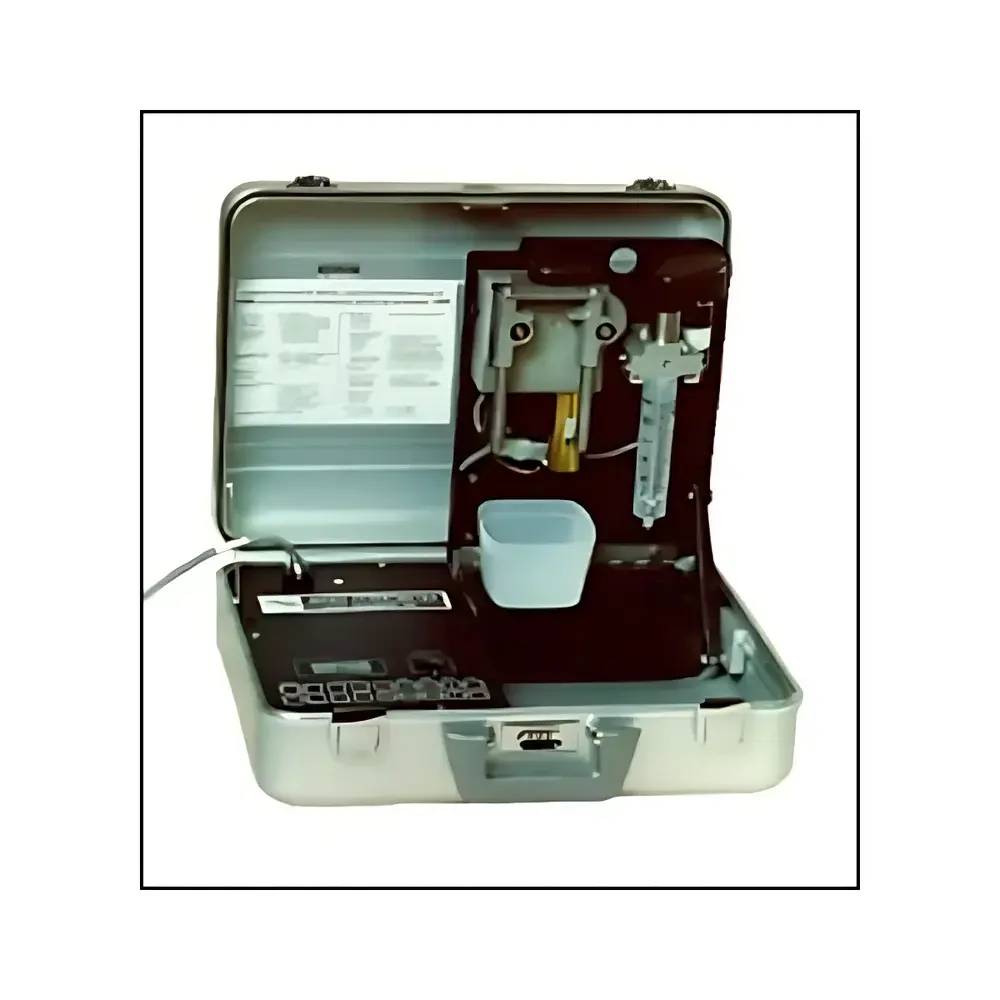
EMCEE Model 1140 Water Separation Index Tester
| Brand | EMCEE |
|---|---|
| Origin | USA |
| Model | 1140 |
| Compliance | ASTM D3948, D4860, D7224, D7261, SH/T 0616 |
| Sample Volume | 150 mL |
| Test Duration | 5 minutes per run |
| Display | Digital LCD |
| Design | Portable benchtop unit with integrated timer and full accessory set |
| Repeatability | High (±0.5 units typical under controlled conditions) |
Overview
The EMCEE Model 1140 Water Separation Index Tester is a precision-engineered benchtop instrument designed to quantify the water separation performance of aviation turbine fuels (Jet A, Jet A-1, JP-8) and diesel fuels in accordance with internationally recognized standard test methods—including ASTM D3948 (for turbine fuels), ASTM D4860 (for diesel), ASTM D7224 (filter membrane compatibility), ASTM D7261 (high-shear water separation), and Chinese standard SH/T 0616. The instrument operates on the principle of gravity-driven coalescence and phase separation: a defined volume of fuel—containing a standardized emulsified water challenge—is passed through a certified hydrophobic coalescer filter assembly under controlled flow conditions. The time required for the fuel to pass through the filter and the volume of free water collected downstream are measured to calculate the Water Separation Index (WSI), a dimensionless metric that correlates directly with the presence and concentration of surface-active contaminants (e.g., surfactants, detergents, oxidation byproducts) that impair interfacial tension and hinder natural water droplet coalescence.
Key Features
- Full compliance with ASTM D3948, D4860, D7224, D7261, and SH/T 0616—enabling direct traceability for quality control laboratories operating under ISO/IEC 17025 or API Q1 frameworks
- Digital LCD display with real-time elapsed time tracking and automatic stop-on-completion functionality
- Integrated electromechanical timer calibrated to ±0.2 s accuracy, eliminating manual stopwatch dependency and reducing operator-induced variability
- Pre-configured, NIST-traceable coalescer filter holder assembly compatible with standard 47 mm diameter hydrophobic membranes (e.g., PTFE or polypropylene)
- Fixed-flow gravity feed system ensuring consistent pressure head (±1.5 cm H2O) across test runs—critical for method reproducibility
- Compact, portable design (32 × 24 × 28 cm; 8.2 kg) with molded carrying case, enabling deployment in field labs, refinery QC trailers, or aircraft refueling facilities
- No external power supply required beyond standard 120 VAC/60 Hz—no pumps, compressors, or vacuum sources needed
Sample Compatibility & Compliance
The Model 1140 is validated for use with low-viscosity hydrocarbon liquids meeting ASTM D975 (diesel) and ASTM D1655 (aviation turbine fuel) specifications. It accommodates samples containing up to 500 ppm dissolved water and emulsified water challenges prepared per ASTM D3948 Annex A1 (using 0.2% v/v synthetic seawater). All wetted components are constructed from chemically resistant materials—borosilicate glass, PTFE, and anodized aluminum—to prevent leaching or catalytic degradation during repeated exposure to aggressive fuel matrices. The system supports GLP-compliant documentation when paired with laboratory notebooks referencing ASTM-defined acceptance criteria (e.g., WSI ≥ 70 for jet fuel per D3948; WSI ≥ 65 for ultra-low-sulfur diesel per D4860). Instrument qualification includes as-received verification of filter integrity, flow rate consistency, and volumetric collection accuracy per manufacturer’s PQ protocol.
Software & Data Management
The Model 1140 operates as a standalone hardware platform with no embedded firmware or proprietary software. All measurement data—including start/stop timestamps, total effluent volume, and calculated WSI—are recorded manually or transcribed into LIMS-compatible spreadsheets. This architecture ensures full auditability, avoids FDA 21 CFR Part 11 electronic signature complications, and aligns with GMP Annex 11 and ISO 17025 Clause 7.7 requirements for non-automated instrumentation. Users may integrate results into validated ELN systems via structured CSV import templates. Calibration records, preventive maintenance logs, and filter lot traceability documentation are maintained externally per laboratory SOPs.
Applications
- Monitoring surfactant contamination in aviation fuel supply chains—from refinery blending tanks to hydrant systems at major airports
- Diagnosing premature filter plugging or water carryover in diesel distribution networks following detergent additive over-treatment
- Verifying conformance of batch-certified fuels prior to aircraft acceptance (per ATA Spec 103 or IATA Guidance Material)
- Supporting root-cause analysis during fuel system corrosion investigations where interfacial instability is suspected
- Training and proficiency testing for fuel lab technicians under API RP 473 or EI JIG-3 guidelines
FAQ
What standards does the EMCEE Model 1140 explicitly support?
ASTM D3948 (turbine fuels), ASTM D4860 (diesel), ASTM D7224 (membrane compatibility), ASTM D7261 (high-shear separation), and SH/T 0616 (Chinese national standard).
Is the instrument suitable for use with biodiesel blends (e.g., B5, B20)?
Yes—provided the blend meets ASTM D7467 (diesel) or D1655 Annex A2 (jet fuel) specifications and exhibits kinematic viscosity ≤ 5.0 mm²/s at 40 °C. Validation per ASTM D7467 Appendix X1 is recommended for high-blend applications.
Does the system require periodic calibration?
Yes—volumetric collection vessels must be verified annually against NIST-traceable Class A glassware; timer accuracy must be confirmed quarterly using a certified frequency standard.
Can test results be exported digitally?
No—the device has no USB, Bluetooth, or network interface. Data entry is manual, supporting full traceability and avoiding electronic record validation burdens.
What consumables are required for routine operation?
Certified 47 mm hydrophobic coalescer membranes (e.g., Pall Acrodisc PF, Sartorius Sartobran P), calibrated 100 mL graduated cylinders, and ASTM-grade synthetic seawater (D1141) for emulsion preparation.







