
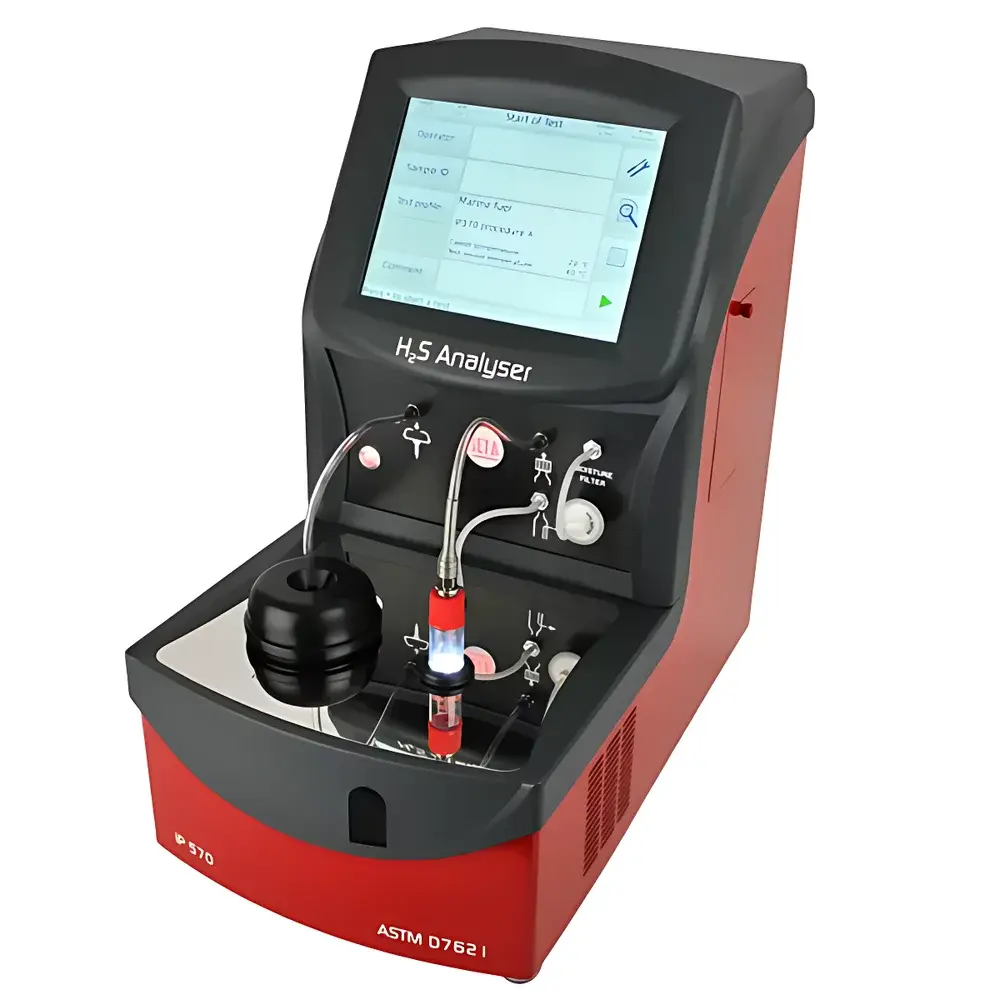
SETA SA4000-4 Hydrogen Sulfide Analyzer for Liquid Petroleum Fuels
| Brand | SetaAnalytics |
|---|---|
| Origin | United Kingdom |
| Model | SA4000-4 |
| Compliance | ASTM D7621, IP 570 |
| Measurement Range | 0–250 mg/kg H₂S (ppm) |
| Analysis Time | 15 min |
| Operating Temperature | 5–40 °C |
| Sample Volume | 1 mL / 2 mL / 5 mL |
| Viscosity Limit | ≤3000 mm²/s at 40 °C |
| Interface | RS232 |
| Power | 60 W |
| Dimensions | 21 × 30 × 41 cm |
| Weight | 8 kg |
Overview
The SETA SA4000-4 Hydrogen Sulfide Analyzer is a dedicated, benchtop analytical instrument engineered for the rapid and precise quantification of dissolved hydrogen sulfide (H₂S) in liquid petroleum fuels—including marine distillate and residual fuel oils, diesel, kerosene, and other hydrocarbon-based distillates. Unlike gas-phase H₂S monitors, the SA4000-4 employs a controlled thermal extraction principle coupled with electrochemical detection to determine the total releasable H₂S potential from the liquid phase—a critical parameter for operational safety, materials integrity, and regulatory conformance. The analyzer operates in full compliance with two internationally recognized standard test methods: ASTM D7621 – Standard Test Method for Determination of Hydrogen Sulfide in Distillate Fuels by Rapid Extraction and Electrochemical Detection, and IP 570 – Determination of Hydrogen Sulphide in Fuel Oils. These standards define the procedural framework for sample conditioning, headspace generation, H₂S transfer kinetics, and signal calibration—ensuring traceable, inter-laboratory reproducible results required for ISO 8217:2017-compliant marine fuel certification.
Key Features
- Method-Validated Performance: Fully aligned with ASTM D7621 and IP 570 protocols—including specified temperature ramp profiles, agitation parameters, and extraction durations—to eliminate method deviation risk during audits or third-party verification.
- Automated Thermal Extraction Workflow: Integrated heating block, programmable stirrer, and sealed reaction chamber enable unattended sample preparation, headspace equilibration, and gas-phase transfer—minimizing operator intervention and human error.
- Electrochemical Sensor Architecture: Uses a temperature-compensated, diffusion-controlled amperometric H₂S sensor with built-in zero-point stability monitoring and automatic baseline correction, delivering high specificity without chemical reagents or consumable cartridges.
- Short Turnaround Time: Delivers a complete quantitative result within 15 minutes per sample—enabling real-time batch release decisions in refinery off-gas handling, bunker fuel inspection, and marine fuel quality assurance workflows.
- Flexible Sample Handling: Accommodates discrete volumes of 1 mL, 2 mL, or 5 mL—optimized for low-volume field sampling or high-throughput lab screening—and supports viscosity up to 3000 mm²/s at 40 °C, covering both distillate and intermediate fuel grades.
- Benchtop Efficiency: Compact footprint (21 × 30 × 41 cm), lightweight design (8 kg), and low power draw (60 W) allow deployment in mobile labs, shipboard testing facilities, or QC environments with limited utility infrastructure.
Sample Compatibility & Compliance
The SA4000-4 is validated for use with a broad spectrum of liquid hydrocarbon matrices, including ISO 8217-compliant marine gas oil (MGO), marine diesel oil (MDO), residual fuel oil (RFO), aviation turbine fuel (Jet A-1), and industrial heating oils. It excludes samples containing significant water content (>0.5% v/v), suspended solids, or strong oxidizers that may interfere with sensor response or compromise thermal stability. All measurement outputs are traceable to NIST-traceable H₂S calibration gases and certified reference materials (CRMs) per ISO/IEC 17025 requirements. The instrument’s operation satisfies data integrity expectations under GLP and GMP frameworks, with audit-ready event logs capturing sample ID, timestamp, ambient temperature, extraction duration, and raw sensor output—all exportable via RS232 interface for integration into LIMS or electronic lab notebooks.
Software & Data Management
The SA4000-4 operates with embedded firmware supporting configurable test protocols, user-defined sample naming conventions, and internal memory storage for up to 500 test records. Data export is performed via RS232 serial connection to Windows-based PCs running optional Setalab™ Data Manager software (v3.2+), which provides CSV/Excel-compatible reporting, statistical trend analysis (e.g., X-bar/R charts), and automated PDF certificate generation compliant with ISO 17025 clause 7.8.2. No proprietary drivers or cloud dependencies are required; all communication adheres to ASCII-based SCPI-like command syntax, enabling seamless integration with custom QA/QC automation scripts or MES platforms. Audit trail functionality records operator login, method version, calibration status, and any manual overrides—meeting FDA 21 CFR Part 11 electronic record requirements when deployed in regulated environments.
Applications
- Pre-bunkering verification of marine fuel H₂S content prior to vessel delivery (per ISO 8217 Annex B)
- In-process monitoring of hydrotreated distillates in refinery product streams
- Root-cause investigation of souring events in stored fuel tanks or pipelines
- Corrosion risk assessment for carbon steel infrastructure exposed to heated fuel vapors
- Contractual compliance testing for fuel procurement specifications (e.g., EN 590, ASTM D975)
- Research-grade quantification of H₂S evolution kinetics under simulated service conditions
FAQ
Does the SA4000-4 require daily calibration or frequent sensor replacement?
No. The electrochemical sensor is factory-calibrated and maintains stable sensitivity for ≥6 months under normal usage. A single-point verification using a certified 10 mg/kg H₂S standard is recommended before each analytical session.
Can the instrument measure H₂S in biodiesel blends (e.g., B5, B20)?
Yes—provided the blend exhibits kinematic viscosity ≤3000 mm²/s at 40 °C and contains no free glycerin or methanol above trace levels (<0.1% w/w), which may suppress H₂S volatility or poison the sensor.
Is the SA4000-4 suitable for field use aboard vessels or offshore platforms?
Yes. Its shock-resistant housing, wide operating temperature range (5–40 °C), and battery-compatible 12 V DC input option (via optional adapter) support deployment in non-climate-controlled maritime environments.
How does the SA4000-4 handle samples with high sulfur content but low H₂S potential?
The method specifically targets free, volatile H₂S—not total sulfur or mercaptans. High total sulfur does not interfere, as the thermal extraction selectively liberates only molecular H₂S present in equilibrium with the liquid phase.
What documentation accompanies the instrument for regulatory submissions?
Each unit ships with a Factory Calibration Certificate (traceable to UKAS-accredited standards), ASTM/IP Method Conformance Statement, CE Declaration of Conformity, and full IEC 61000-4 EMC test report—sufficient for ISO 17025 accreditation applications.






