
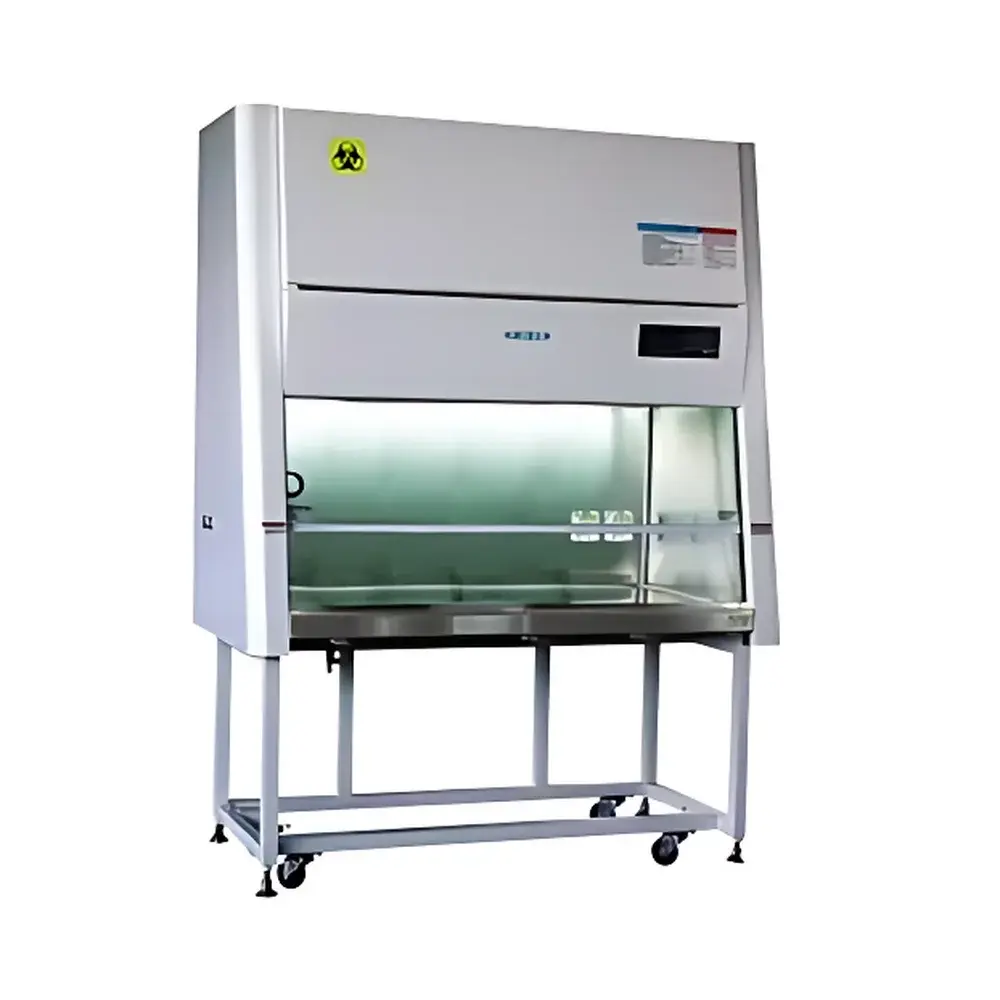
SuJin AnTai BSC-1000IIA2 Class II Type A2 Biological Safety Cabinet
| Brand | Suzhou Antai |
|---|---|
| Origin | Jiangsu, China |
| Manufacturer Type | Authorized Distributor |
| Product Category | Domestic |
| Model | BSC-1000IIA2 |
| Instrument Type | Class II Type A2 Biological Safety Cabinet |
| External Dimensions (L×W×H) | 1200 × 790 × 2050 mm |
| Internal Dimensions (L×W×H) | 1000 × 600 × 620 mm |
| Filter Efficiency | ULPA ≥99.999% @ 0.12 µm |
Overview
The SuJin AnTai BSC-1000IIA2 is a Class II, Type A2 biological safety cabinet engineered for containment of low-to-moderate risk biological agents (BSL-2 and select BSL-3 applications under defined protocols). It operates on the principle of inward airflow (personnel protection), downward laminar airflow (product protection), and recirculated/externally exhausted air (environmental protection), conforming strictly to NSF/ANSI 49-2002 performance criteria. The cabinet integrates a dual-airflow architecture: ~70% of total airflow is recirculated through a ULPA filter after passing through the work area, while ~30% is exhausted via a dedicated ducted or thimble-connected system. This configuration ensures simultaneous personnel, product, and environmental protection without compromising operational efficiency or energy consumption. Designed for continuous 24-hour operation under ambient conditions of 0–40°C and ≤85% RH, the BSC-1000IIA2 supports critical workflows in clinical diagnostics, virology research, cell culture, and public health laboratories—including national HIV screening programs and provincial CDC infrastructure projects.
Key Features
- ULPA filtration system with American-sourced HV-grade low-resistance ultra-low penetration air filters, delivering ≥99.999% particle capture efficiency at 0.12 µm—exceeding ISO 14644-1 Class 4 (Fed Std 209E Class 10) cleanroom requirements.
- Japanese AIR TECH intelligent fan system with real-time airflow compensation: maintains constant inflow velocity (≥0.55 ± 0.015 m/s) and downflow velocity (0.33 ± 0.015 m/s) even with >50% filter loading; airflow deviation remains within ±10% across full filter life.
- Patented zero-leakage filter housing (Patent No. ZL200520140347.2): enables quantitative integrity testing of both supply and exhaust ULPA filters—ensuring verifiable containment integrity per ISO 14644-3 Annex B and EN 12469.
- Motorized, maintenance-free Japanese suspension lift mechanism for the 5 mm tempered anti-explosion sash; allows infinitely variable positioning and full closure for decontamination cycles.
- Full stainless steel (SUS304) work chamber with R10 radius corners and seamless one-piece forming—enhancing cleanability, corrosion resistance, and compliance with GLP cleaning validation protocols.
- Integrated microprocessor-based control panel with LCD interface: monitors and displays real-time inflow/downflow velocities, cumulative operating hours, filter pressure drop, sash height status, and fault diagnostics—including audible/visual alarms for sash over-height, motor failure, or filter saturation.
- Dual independent power outlets with surge protection and circuit isolation; UV lamp interlock system (30 W, 254 nm) with automatic 30-minute timer and sash-activated cutoff—meeting IEC 61000-4-2 ESD immunity and FDA 21 CFR Part 11 audit-trail readiness when paired with optional data logging firmware.
Sample Compatibility & Compliance
The BSC-1000IIA2 accommodates standard biosafety workflows involving microbial cultures (e.g., Bacillus subtilis spore challenge tests), tissue dissociation, transfection reagents, and low-concentration viral vectors. It has been validated for personnel protection (≤10 CFU/sample via impactor; ≤5 CFU/sample via slit sampler), product protection (≤5 CFU/sample), and cross-contamination control (≤2 CFU/sample) using aerosolized B. subtilis at 5–8 × 10⁸ CFU/mL—per NSF/ANSI 49 Annex D. Structural leak integrity is verified at 500 Pa ±10% static pressure differential (EN 12469 Clause 6.3). All materials comply with USP cytotoxicity and ISO 10993-5 biocompatibility standards. Electrical safety conforms to IEC 61010-1:2010 Ed.3. The unit is CE-marked and registered with China NMPA as a Class II medical device (Registration No. valid per latest database).
Software & Data Management
The embedded controller supports configurable alarm thresholds, event logging (last 100 events with timestamps), and USB export of operational history (velocity trends, filter delta-P, runtime). Optional firmware upgrade enables CSV-formatted audit logs compliant with FDA 21 CFR Part 11 requirements—including user authentication, electronic signatures, and immutable record retention. Data output interfaces with LIMS platforms via RS-485 Modbus RTU protocol. No cloud connectivity or remote access capabilities are implemented—preserving network security boundaries required in regulated laboratory environments.
Applications
- Clinical microbiology: HIV serological screening, TB culture processing, and antimicrobial susceptibility testing.
- Virology labs: Handling of lentiviral vectors, adenovirus preparations, and SARS-CoV-2 RNA extraction under BSL-2+ containment.
- Cell therapy manufacturing: Aseptic manipulation of primary human T-cells and mesenchymal stem cells prior to GMP-grade expansion.
- Public health surveillance: National disease monitoring programs requiring high-throughput sample processing with traceable operator safety metrics.
- Pharmaceutical QC: Sterility testing of parenteral drug components and environmental monitoring media preparation.
FAQ
Does the BSC-1000IIA2 meet NSF/ANSI 49-2002 certification requirements?
Yes—fully certified to NSF/ANSI 49-2002 for Class II, Type A2 cabinets, including third-party verification of airflow profiles, filter integrity, and containment performance.
Can this cabinet be installed without external ducting?
Yes, it supports recirculating (ducted) and thimble (non-ducted) configurations; however, thimble mode requires ≥75% room air exchange rate and activated carbon pre-filtering per NSF 49 Section 7.3.2.
What is the expected service life of the ULPA filter under typical lab use?
Under continuous operation at rated airflow and average particulate load, service life exceeds 3–5 years; real-time delta-P monitoring alerts users at 70% of rated pressure drop.
Is the UV lamp intensity validated and recalibratable?
UV irradiance is factory-validated at 40 µW/cm² at 15 cm distance; users may perform periodic verification using NIST-traceable radiometers—no field recalibration is required.
How is compliance with GLP/GMP documentation requirements supported?
The system provides timestamped event logs, configurable alarm records, and USB-exportable CSV files—sufficient for inclusion in equipment qualification (IQ/OQ/PQ) documentation and internal audit trails.
Related Products




