
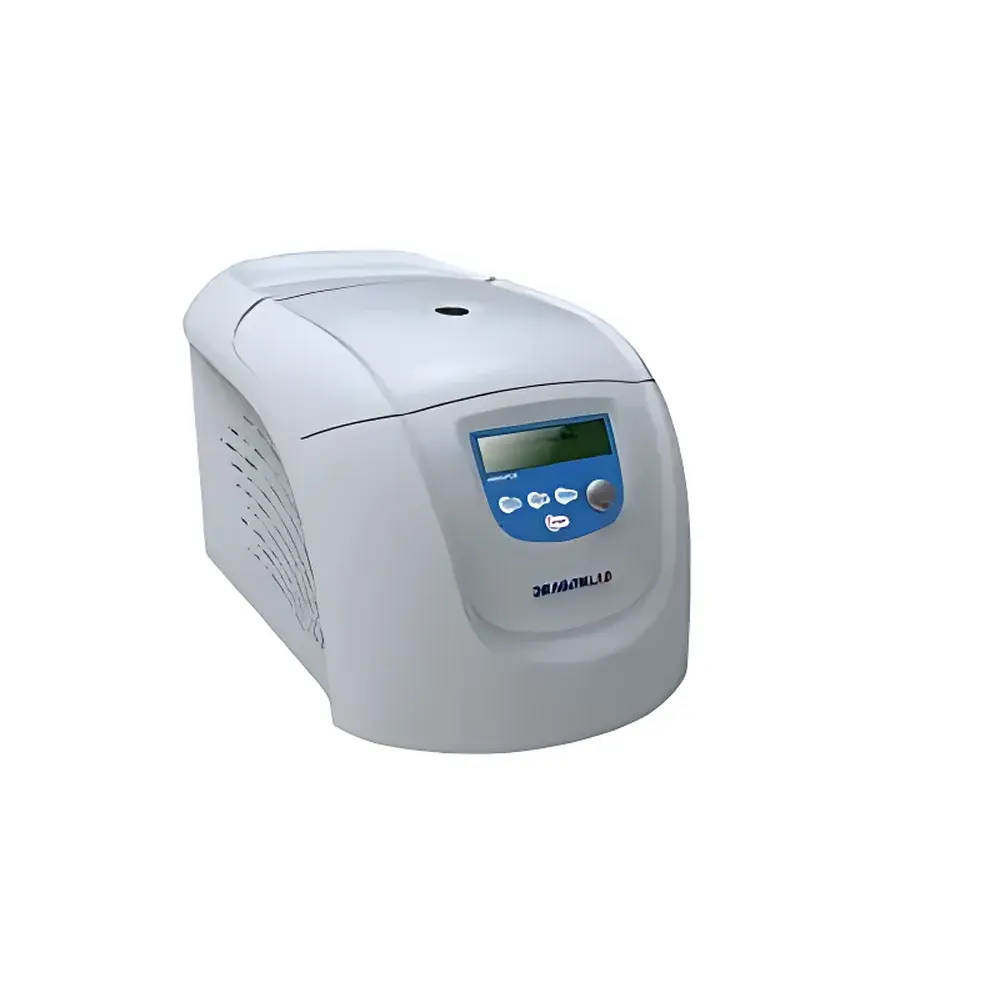
DLAB D3024 High-Speed Microcentrifuge
| Brand | DLAB |
|---|---|
| Origin | Beijing, China |
| Model | D3024 |
| Centrifuge Type | Benchtop High-Speed Centrifuge |
| Speed Range | 200–15,000 rpm (adjustable in 10 rpm increments) |
| Max RCF | 21,380 × g (adjustable in 10 × g increments) |
| Max Capacity | 2 mL × 24 |
| Rotor Type | Fixed-angle rotor |
| Rotor Material | High-strength anodized aluminum, autoclavable (121°C, 20 min, repeated cycles) |
| Cooling System | Dual independent air-cooling channels |
| Temperature Monitoring | Real-time chamber temperature display (non-refrigerated) |
| Timer | 30 sec – 99 min – HOLD mode |
| Drive Motor | Brushless DC motor |
| Safety Features | Dual mechanical door locks, overspeed protection, overtemperature monitoring, real-time system diagnostics |
| Power Supply | AC 220–240 V, 50/60 Hz, 5 A |
| Dimensions (L×D×H) | 280 × 364 × 266 mm |
| Net Weight | 12 kg |
| Compliance | Designed to meet IEC 61010-1 (Safety Requirements for Electrical Equipment for Measurement, Control, and Laboratory Use), EN 61326-1 (EMC for laboratory equipment) |
Overview
The DLAB D3024 High-Speed Microcentrifuge is a precision-engineered benchtop centrifuge optimized for rapid, reproducible separation of small-volume biological samples. Utilizing a brushless DC motor and fixed-angle rotor architecture, it operates on the principle of radial sedimentation under controlled centrifugal force—enabling efficient pelleting of nucleic acids, proteins, cellular organelles, and microorganisms from volumes as low as 0.2 mL. With a maximum speed of 15,000 rpm and corresponding RCF of 21,380 × g, the D3024 meets standard requirements for high-speed microcentrifugation protocols in molecular biology, clinical diagnostics, and pharmaceutical QC labs. Its non-refrigerated design prioritizes thermal stability through dual air-cooling channels and real-time chamber temperature monitoring—ensuring sample integrity without active refrigeration, thus minimizing condensation risks and simplifying maintenance.
Key Features
- Brushless DC motor: Delivers rapid acceleration (0–15,000 rpm in <15 s) and extended service life with zero carbon dust generation or routine brush replacement.
- Dual independent air-cooling system: Maintains consistent rotor and chamber temperatures during prolonged runs, preventing heat-induced sample degradation.
- Autoclavable aluminum rotor: Certified for repeated sterilization at 121°C for 20 minutes; compatible with ISO 17664-compliant cleaning validation procedures.
- Dual mechanical door interlock system: Ensures rotor containment at all times—meets IEC 61010-1 mechanical safety Class II requirements.
- Intuitive LCD interface: Displays real-time rpm, RCF, remaining time, chamber temperature, and operational status; supports direct rpm/RCF conversion and short-spin (pulse) mode.
- Programmable deceleration profile: Low-speed braking minimizes resuspension of delicate pellets, improving recovery yield in RNA and plasmid isolation workflows.
Sample Compatibility & Compliance
The D3024 accommodates standardized microcentrifuge tubes (0.2–5 mL), including PCR strip tubes (8 × 0.2 mL), 0.5 mL conical tubes, 2 mL round-bottom tubes, and 5 mL screw-cap tubes—supporting common formats used in ISO/IEC 17025-accredited testing laboratories. Its rotor geometry ensures balanced load distribution across all configurations, validated per ASTM E2916-22 (Standard Guide for Validation of Analytical Methods for Biotechnology). While not a refrigerated unit, its thermal management design aligns with CLSI EP17-A2 guidelines for ambient-temperature centrifugation where chilling is not mandated by protocol. Safety systems comply with IEC 61010-1:2010 + A1:2019 and electromagnetic compatibility per EN 61326-1:2013.
Software & Data Management
The D3024 operates via embedded firmware with no external software dependency. All user-defined parameters—including speed, time, acceleration/deceleration ramp profiles, and hold mode—are stored in non-volatile memory and recalled upon power-up. The instrument logs run history (last 10 cycles) with timestamps, final rpm, and fault codes—supporting GLP-aligned record-keeping when paired with lab notebook documentation. Though lacking network connectivity or FDA 21 CFR Part 11-compliant electronic signatures, its deterministic behavior, diagnostic self-tests, and hardware-based safety interlocks make it suitable for GMP environments where manual log entry and periodic calibration verification are standard practice.
Applications
- Plasmid DNA and genomic DNA purification from bacterial lysates
- RNA precipitation and cleanup following TRIzol® or column-based extraction
- Microbial pellet collection for downstream MALDI-TOF MS or culture expansion
- Clarification of cell lysates prior to SDS-PAGE or Western blotting
- Separation of exosomes and extracellular vesicles using differential ultracentrifugation prep steps
- High-throughput sample preparation in clinical microbiology and virology labs (e.g., viral RNA pellet concentration prior to RT-qPCR)
FAQ
Is the D3024 suitable for BSL-2 applications?
Yes—the sealed rotor cavity and autoclavable rotor enable safe handling of biosafety level 2 agents when used with appropriate tube caps and centrifuge-safe containment practices.
Can the D3024 be calibrated in-house?
Yes—speed accuracy can be verified using a certified handheld tachometer; RCF values are calculated per ISO 21501-4 using factory-validated rotor radius data. Calibration records should follow ISO/IEC 17025 clause 6.5.
Does it support rotor imbalance detection?
Yes—the integrated vibration sensor triggers automatic shutdown if imbalance exceeds 5% mass asymmetry, in accordance with IEC 61010-2-020 Annex BB.
What maintenance is required beyond rotor autoclaving?
Annual inspection of door latches, cooling fan operation, and motor bearing noise is recommended. No lubrication or internal servicing is required due to brushless motor architecture.
Is the timer resolution sufficient for precise spin protocols?
Yes—30-second minimum increment and 1-second display resolution meet USP <1058> requirements for analytical instrument timing control in regulated QC labs.



