
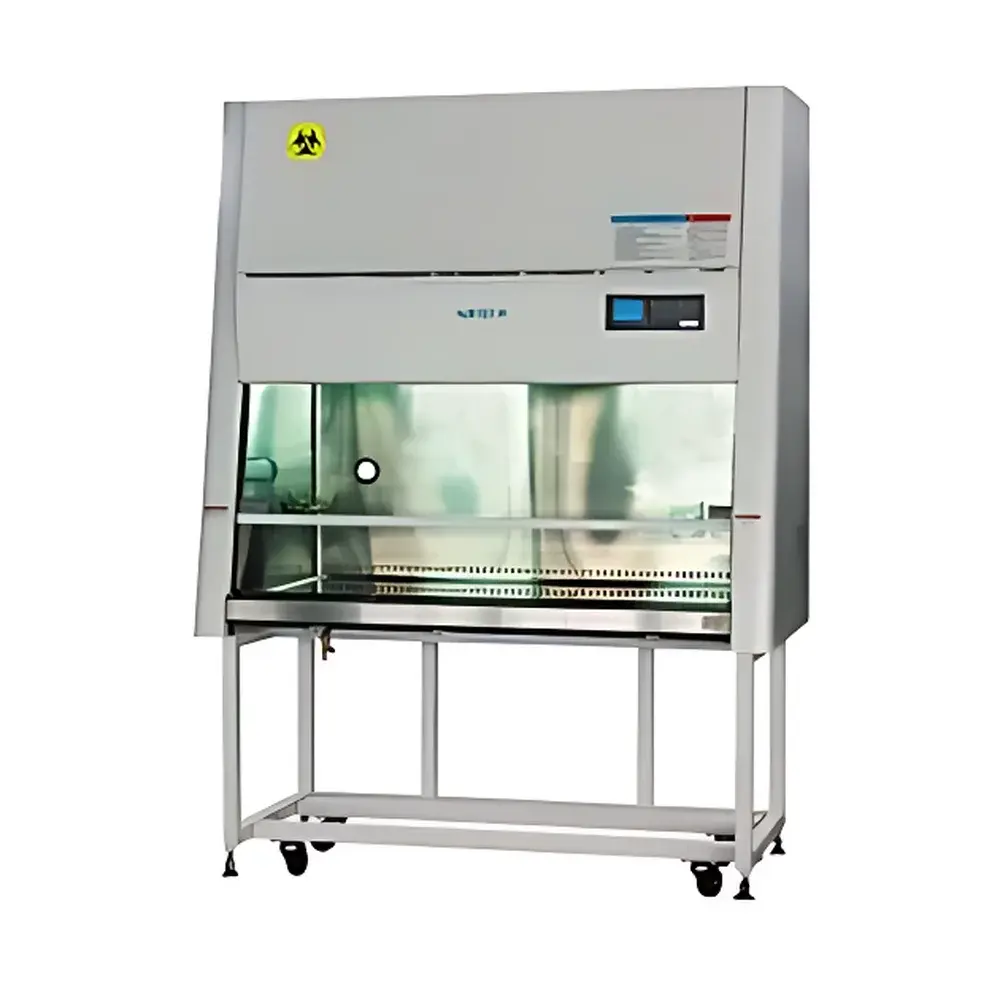
SuJin AnTai BSC-1300IIB2 Class II Type B2 Biological Safety Cabinet
| Brand | Suzhou Antai |
|---|---|
| Origin | Jiangsu, China |
| Manufacturer Type | Authorized Distributor |
| Origin Category | Domestic |
| Model | BSC-1300IIB2 |
| Instrument Type | Class II, Type B2 Biological Safety Cabinet |
| External Dimensions (L×W×H) | 1500 × 790 × 2330 mm |
| Internal Work Area Dimensions (L×W×H) | 1270 × 600 × 620 mm |
| Filter Efficiency | HEPA ≥ 99.995% @ 0.3 µm |
Overview
The SuJin AnTai BSC-1300IIB2 is a certified Class II, Type B2 biological safety cabinet engineered for total exhaust (100% external venting) applications requiring maximum personnel, product, and environmental protection. It operates on the principle of vertical laminar airflow under negative pressure, with all air drawn through a pre-filter, conditioned via dual HEPA or ULPA filtration stages, and fully exhausted to the outside environment—eliminating recirculation entirely. Designed and validated in strict compliance with both YY 0569–2011 (China SFDA) and NSF/ANSI 49–2022 (USA), the unit meets the most stringent international requirements for biosafety containment in molecular biology, virology, vaccine development, and clinical diagnostics laboratories. Its structural integrity is reinforced by a double-walled, negative-pressure-encapsulated chassis fabricated from electropolished SUS304 stainless steel, ensuring zero leakage under sustained 500 Pa internal negative pressure—a critical performance benchmark for B2-type cabinets.
Key Features
- Patented “zero-leakage” dual-filtration system: Independently certified HEPA (≥99.995% @ 0.3 µm) or ULPA (≥99.999% @ 0.12 µm) filters installed in both supply and exhaust paths, enabling ISO Class 5 (100) or ISO Class 4 (10) cleanroom-grade workspaces.
- Ergonomic 10° inclined sash interface with Japanese-sourced counterbalanced suspension mechanism: 5 mm tempered safety glass sash provides infinite positioning, maintains seal integrity during decontamination cycles, and requires no routine maintenance.
- Unobstructed front intake design (Patent ZL200520140353.8): Optimized airflow entry geometry minimizes turbulence and ensures uniform inflow velocity (0.55 m/s) across the full working width.
- Integrated intelligent airflow compensation: Imported EC centrifugal fans with BELIMO PDI-controlled dampers dynamically adjust static pressure loss—maintaining ±10% airflow stability even with 50% filter loading increase.
- Full-stainless-steel construction: Seamless, radius-formed inner chamber; removable arc-shaped forearm rest; 4 L capacity corrosion-resistant liquid collection trough; IP65-rated fluorescent (2 × 36 W) and UV (1 × 20 W) lighting systems with ≥800 lux work surface illumination.
- Comprehensive real-time monitoring: Embedded microprocessor displays downflow velocity (0.35 m/s), inflow velocity, filter service life estimation, fan status, fault diagnostics, and cumulative operational hours via intuitive Chinese-language LCD interface.
- Safety interlocks: Sash height–dependent audiovisual alarm linked to lighting control; UV–light and main power mutual lockout; integrated GFCI-protected dual AC outlets and utility valve ports (gas/vacuum) within the work area.
Sample Compatibility & Compliance
The BSC-1300IIB2 is validated for use with Risk Group 2 and select Risk Group 3 biological agents under appropriate institutional biosafety level (BSL-2/BSL-3) protocols. Its non-recirculating architecture makes it suitable for handling volatile toxic chemicals in conjunction with biological materials—common in hybrid pharmacology and toxicogenomics workflows. All structural welds, gasket interfaces, and filter housings undergo rigorous leak testing per IEST-RP-CC001.2: ≤0.01% scanable filter penetration and ≤0.005% non-scanable filter penetration are verified using photometer-based aerosol challenge methods. Cabinet integrity is confirmed at 500 Pa negative pressure for ≥15 minutes with no detectable leakage. The unit supports GLP-compliant documentation and is compatible with FDA 21 CFR Part 11–enabled data logging when interfaced with optional external audit trail modules.
Software & Data Management
While the onboard controller features a localized Chinese UI optimized for laboratory technicians in domestic settings, the cabinet’s analog sensor outputs (air velocity, motor current, temperature) are accessible via RS-485 Modbus RTU protocol for integration into centralized BMS or LIMS platforms. Optional firmware upgrades support timestamped event logging—including sash position changes, UV activation cycles, alarm triggers, and filter differential pressure thresholds—with exportable CSV reports for regulatory review. All firmware revisions adhere to IEC 62304 Class B medical device software lifecycle standards, and configuration parameters are protected by password-secured write access to prevent unauthorized modification.
Applications
- Cell culture operations involving primary human cells or genetically modified organisms (GMOs)
- Preparation of sterile pharmaceutical intermediates under aseptic conditions
- Handling of lentiviral or adenoviral vectors in gene therapy R&D
- Microbiological analysis of environmental or clinical specimens containing potential pathogens
- Hybrid workflows combining cytotoxic drug formulation and microbial assay validation
- Training environments requiring full-exhaust containment without ductless compromises
FAQ
Does the BSC-1300IIB2 require dedicated ductwork for installation?
Yes. As a hard-ducted Type B2 cabinet, it must be connected to an external exhaust system capable of sustaining ≥150 Pa static pressure loss. Site survey and duct design verification are mandatory prior to delivery.
Can ULPA filters be retrofitted into a HEPA-configured unit?
No. ULPA filtration requires upgraded fan capacity and reinforced filter housing seals. Units are factory-configured as either HEPA or ULPA; field conversion is not supported.
What is the recommended maintenance interval for filter integrity testing?
Per YY 0569 and NSF/ANSI 49, initial certification must be performed post-installation, followed by semiannual retesting. Additional testing is required after filter replacement, major component service, or relocation.
Is the cabinet compliant with electromagnetic compatibility (EMC) directives for EU deployment?
The base model meets GB 4824–2019 (equivalent to CISPR 11 Group 1, Class A). CE marking for EU markets requires additional EN 61326-1 and EN 61000-6-3/6-4 conformity assessments, available upon request for export-configured units.
How is operator exposure risk quantified during sash movement?
Inflow velocity is continuously monitored and maintained at 0.55 m/s ±0.05 m/s across the full sash opening range. Alarm thresholds trigger at <0.45 m/s, meeting NSF/ANSI 49 dynamic inflow stability criteria for personnel protection.
Related Products



