
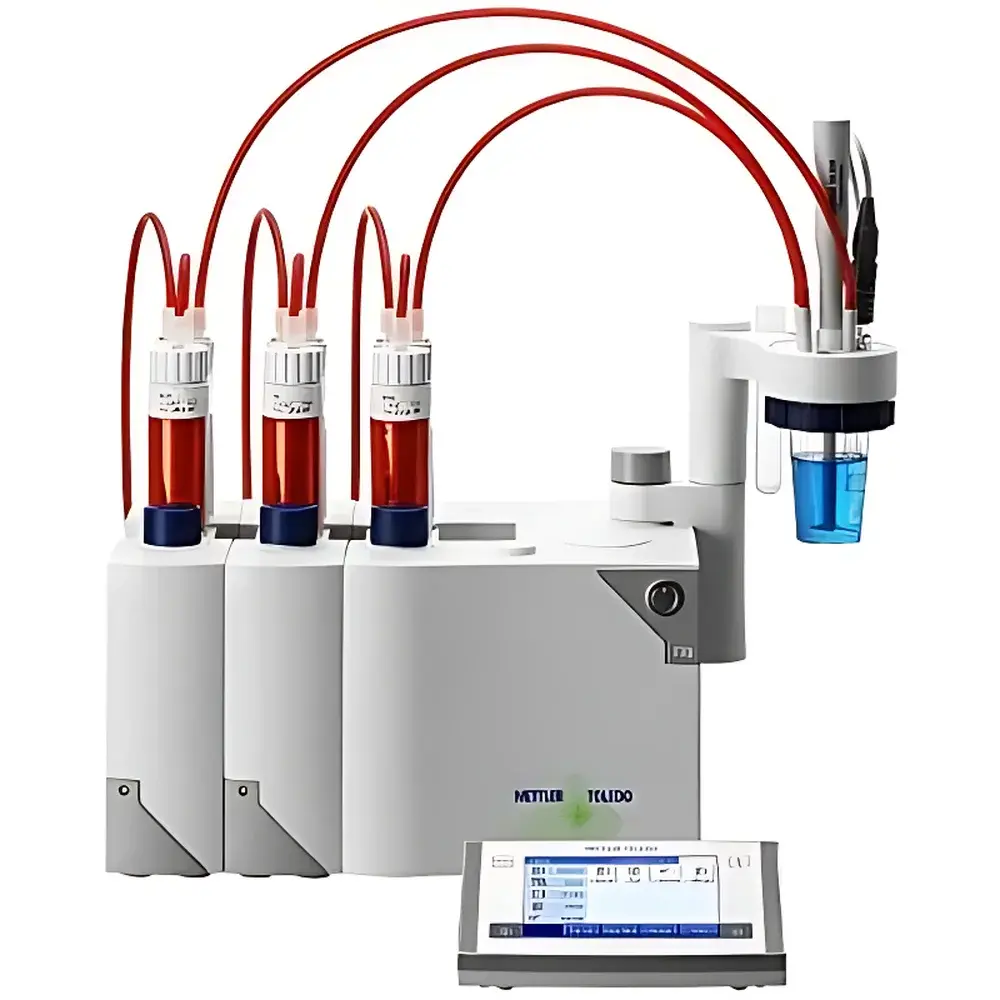
METTLER TOLEDO T7 Advanced Automatic Potentiometric Titrator
| Brand | METTLER TOLEDO |
|---|---|
| Origin | Switzerland |
| Model | T7 |
| Instrument Type | General-purpose Potentiometric Titrator |
| Measurement Range | −2000 to +2000 mV |
| Meter Accuracy | ±0.2 mV |
| Meter Resolution | 0.1 mV |
| Titration Precision | ±0.2 mV |
| Compliance | Designed for GLP/GMP environments with full audit trail support per FDA 21 CFR Part 11 requirements |
Overview
The METTLER TOLEDO T7 Advanced Automatic Potentiometric Titrator is a modular, CE-marked analytical platform engineered for precision potentiometric titration in regulated and research-intensive laboratories. Based on the proven principles of potentiometric endpoint detection—measuring potential difference (in mV) between a reference and indicator electrode as titrant is incrementally added—the T7 delivers high reproducibility across diverse electrochemical reaction systems. Its core architecture integrates a high-stability analog-to-digital converter with real-time potential monitoring at 10 Hz sampling frequency, enabling robust detection of inflection points in titration curves for acid-base, redox, complexometric, non-aqueous, and precipitation reactions. Designed and manufactured in Switzerland, the T7 complies with IEC 61010-1 safety standards and supports full traceability through time-stamped, user-authenticated data logging.
Key Features
- One Click® Titration workflow: Predefined, validated methods launch with single touchscreen interaction—reducing operator dependency and minimizing procedural variability.
- Modular hardware expansion: Supports up to four independent burettes (including optional 1 mL, 5 mL, 10 mL, or 25 mL glass or plastic syringe types) and simultaneous connection of multiple sensor types (e.g., pH, redox, ion-selective, photometric, thermometric).
- Plug-and-Play electrode interface: Auto-detection of METTLER TOLEDO SmartElectrodes via embedded RFID chips; automatic loading of calibration history, serial number, and recommended method parameters.
- Integrated Rondo 30 autosampler compatibility: Enables unattended analysis of up to 30 samples with programmable rinse cycles, temperature-controlled sample staging, and barcode-assisted sample identification.
- Intuitive 7-inch capacitive touchscreen UI: Customizable home screen layout, multi-level user permission management (admin, analyst, viewer), and role-based access control aligned with ISO/IEC 17025 and FDA 21 CFR Part 11 requirements.
- Real-time titration curve visualization: Live overlay of dE/dV and d²E/dV² derivatives during titration, with adjustable equivalence point algorithms (e.g., first derivative maxima, tangent intersection, Gran plot).
Sample Compatibility & Compliance
The T7 accommodates liquid, semi-solid, and suspended-phase samples across pH 0–14, ionic strength up to 4 mol/L, and temperatures from 5 °C to 40 °C (with optional Peltier-controlled cell). It supports standardized methodologies per ASTM E2087 (acid number), ISO 8587 (redox titrations), USP (potentiometric assay), and AOAC 973.22 (water content by Karl Fischer coulometric mode when equipped with appropriate cell and reagents). All measurement data—including raw mV readings, calculated endpoints, metadata, and operator actions—are stored in encrypted .tdf format with immutable timestamps and digital signatures, satisfying audit readiness for GLP, GMP, and ISO/IEC 17025 accreditation.
Software & Data Management
Powered by METTLER TOLEDO titration software (version 3.3 or later), the T7 provides comprehensive data governance features: electronic signatures compliant with FDA 21 CFR Part 11, configurable audit trails with event-type filtering (e.g., method edit, result override, calibration), and automated backup to network drives or cloud repositories via TLS 1.2–secured connections. Raw datasets export natively to CSV, PDF, or XML formats; integration with LIMS is supported via ASTM E1384-compliant HL7 messaging or direct ODBC connectivity. Method templates can be version-controlled, locked against modification, and distributed centrally using secure firmware update protocols.
Applications
- Determination of total acidity in food oils (ASTM D664) and beverages using NaOH titration with pH electrode.
- Quantification of chloride in wastewater via argentometric titration with silver nitrate and Ag/AgCl electrode.
- Redox titration of iron(II) in pharmaceutical intermediates using cerimetric standardization (Ce⁴⁺/Ce³⁺).
- Karl Fischer coulometric water determination in hygroscopic APIs (e.g., antibiotics, peptides) using dual-platinum electrode cell.
- Complexometric titration of calcium/magnesium hardness in drinking water per ISO 6059 with EDTA and Ca-selective electrode.
- Non-aqueous titration of weak bases (e.g., amine hydrochlorides) in glacial acetic acid using perchloric acid titrant and glass electrode.
FAQ
Does the T7 support Karl Fischer titration?
Yes—when configured with a dedicated Coulometric KF cell, dual-platinum electrodes, and compatible reagents, the T7 performs water content analysis down to 1 µg H₂O with full compliance to ASTM E203 and USP .
Can legacy methods from older METTLER TOLEDO titrators be imported?
Yes—via backward-compatible .met file import; the system validates syntax and automatically maps deprecated parameters to current firmware equivalents.
Is remote monitoring or troubleshooting possible?
Yes—through optional METTLER TOLEDO LabX Remote Access module, enabling secure web-based status viewing, real-time curve streaming, and technician-assisted diagnostics without local network exposure.
What electrode types are certified for use with the T7?
All METTLER TOLEDO InLab® and DL series electrodes with SmartChip technology—including InLab® Micro, InLab® Redox, InLab® Solids Pro, and InLab® KF—carry full firmware-integrated calibration and lifetime tracking.
How is data integrity ensured during power failure?
The T7 features non-volatile flash memory and automatic checkpointing: all active titrations resume from last valid measurement point upon reboot, with no loss of raw mV data or metadata.




