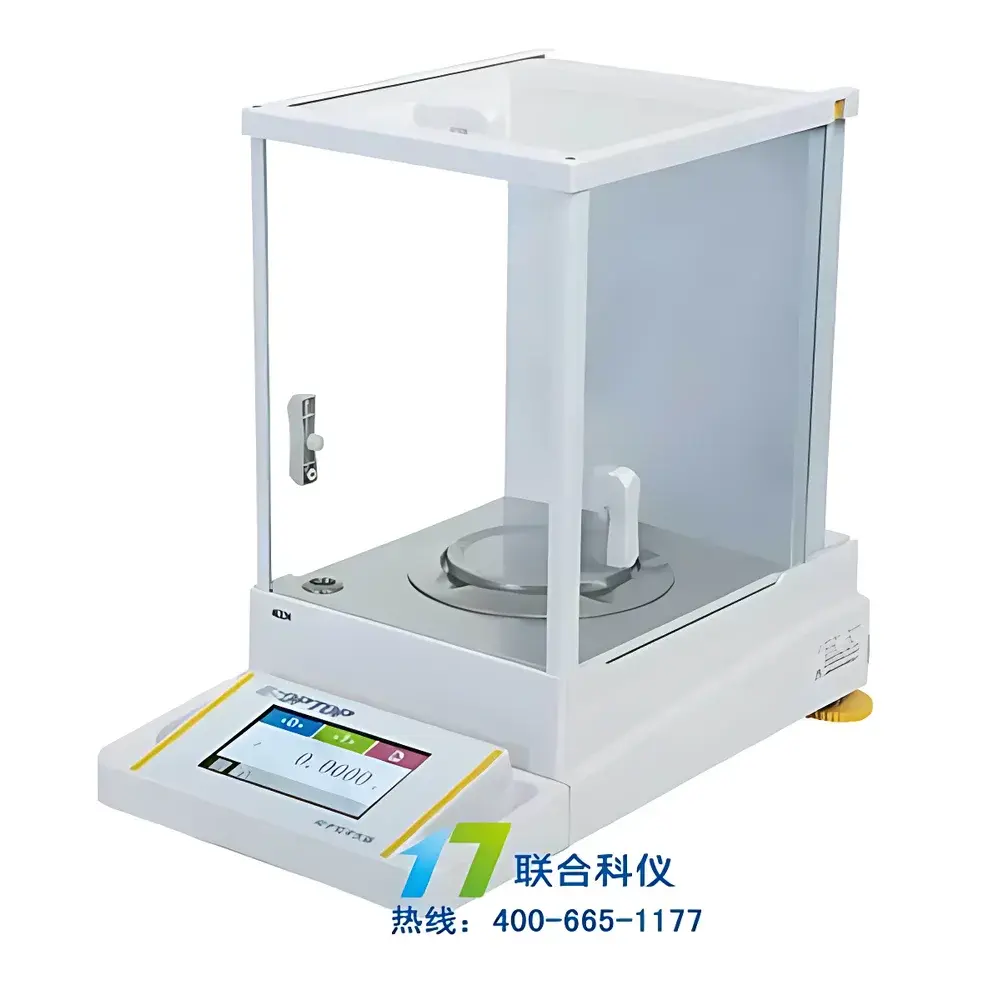
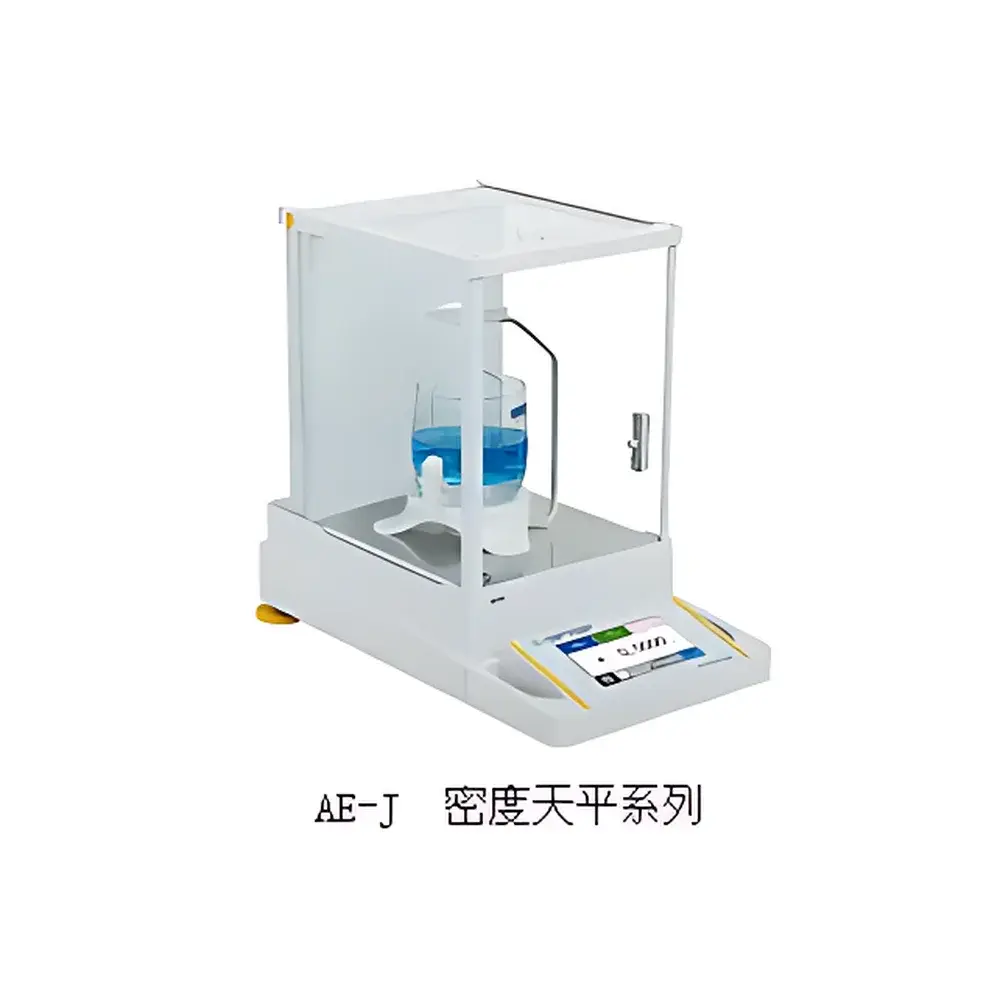
SOP TOP AE523J Laboratory Electronic Density Balance
| Brand | SOP TOP |
|---|---|
| Origin | Shanghai, China |
| Model | AE523J |
| Maximum Capacity | 520 g |
| Readability | 0.001 g |
| Repeatability (Standard Deviation) | 0.001 g |
| Calibration | External |
| Pan Diameter | Ø90 mm |
| Draft Shield Internal Volume | 160 × 165 × 200 mm |
| Dimensions (W×D×H) | 365 × 223 × 338 mm |
| Net Weight | 6 kg |
| Power Supply | AC 100–240 V, 50/60 Hz |
Overview
The SOP TOP AE523J Laboratory Electronic Density Balance is a precision mass-measurement instrument engineered for high-reproducibility density determination of solid and liquid samples in regulated laboratory environments. Based on the principle of Archimedean buoyancy—where sample mass is measured both in air and immersed in a reference fluid—the AE523J integrates a high-stability electromagnetic force compensation transducer with a dedicated density calculation module. Its 0.001 g readability and ≤0.001 g repeatability meet the performance requirements for routine QC testing per ISO 1183-1 (plastics), ASTM D792 (density and specific gravity of plastics), and USP (density of liquids). Designed for integration into GLP-compliant workflows, the balance features an internal calibration memory that logs date/time stamps and operator IDs when external calibration is performed—supporting audit readiness under FDA 21 CFR Part 11 where electronic records are maintained.
Key Features
- True-color 4.3-inch TFT LCD touchscreen display with full-screen gesture support—optimized for operation with nitrile or latex gloves without loss of responsiveness.
- Ergonomic front-mounted level indicator and dual-height adjustable leveling feet—enabling rapid horizontal alignment verification prior to measurement.
- Integrated draft shield with transparent tempered glass doors and transport lock mechanism—minimizing mechanical shock during relocation while preserving sensor integrity.
- Overload-protected weighing pan (Ø90 mm stainless steel) featuring reinforced suspension geometry—designed to absorb impact loads up to 150% of maximum capacity without sensor damage.
- Metro-inspired UI color scheme compliant with ISO 9241-303 (visual ergonomics), reducing visual fatigue during extended analytical sessions.
- Built-in density application suite supporting solid (single-sink or dual-sink mode), liquid, and powder density protocols—including automatic temperature compensation input fields for fluid density correction.
Sample Compatibility & Compliance
The AE523J accommodates standard density measurement configurations: solid samples suspended via stainless-steel hook or density basket (not included), and liquid samples placed in calibrated pycnometers or beakers. Its draft shield interior volume (160 × 165 × 200 mm) permits use with common 50 mL and 100 mL volumetric glassware. The balance complies with OIML R76-1 (non-automatic weighing instruments), meets EMC directive 2014/30/EU, and conforms to safety standard IEC 61010-1 for laboratory electrical equipment. All firmware operations—including unit conversion (g, oz, ct, dwt, grain, momme), tare, and preset density calculation—are traceable via internal event log, enabling retrospective review during internal audits or regulatory inspections.
Software & Data Management
Data output is supported via RS232 interface (standard) and optional USB-to-serial adapter for connection to LIMS or ELN systems. The balance stores up to 200 measurement records locally—including raw mass values (air/mass-in-fluid), calculated density, temperature input, and operator ID—each timestamped with millisecond resolution. Export format is ASCII-delimited text compatible with Excel, MATLAB, and statistical process control (SPC) platforms. Firmware supports user-defined report templates and configurable auto-print triggers. When integrated with validated third-party data capture software, the system satisfies ALCOA+ principles (Attributable, Legible, Contemporaneous, Original, Accurate) required for GMP documentation.
Applications
- Density verification of polymer granules and injection-molded parts per ISO 1183 series.
- Specific gravity analysis of pharmaceutical excipients and active ingredients in formulation development.
- Quality control of metal alloys, ceramics, and composite materials in materials science labs.
- Density profiling of battery electrode slurries and electrolyte solutions in energy storage R&D.
- Teaching laboratories requiring robust, intuitive instrumentation for undergraduate physics and chemistry curricula.
FAQ
What calibration standards are recommended for routine verification?
A Class M2 or better external weight certified to ISO/IEC 17025, traceable to NIST or equivalent national metrology institute, is required for external calibration at 200 g—the nominal calibration point specified for the AE523J.
Does the balance support automatic temperature compensation for fluid density calculations?
Yes—the user may manually enter ambient or fluid temperature (°C) into the density application; the system applies standard water density tables (IAPWS-95) or allows custom fluid density input.
Is the internal event log exportable and tamper-evident?
Event logs are exportable via RS232 as plain-text files; however, the device does not implement cryptographic hashing or digital signatures—tamper evidence requires integration with validated external data acquisition software compliant with 21 CFR Part 11.
Can the AE523J be used for differential density measurements (e.g., void fraction analysis)?
While not preconfigured for void fraction, the dual-mass input capability (mass in air / mass in fluid) enables manual derivation of apparent density, true density, and porosity when paired with geometric volume data from complementary instruments such as micro-CT or mercury intrusion porosimetry.